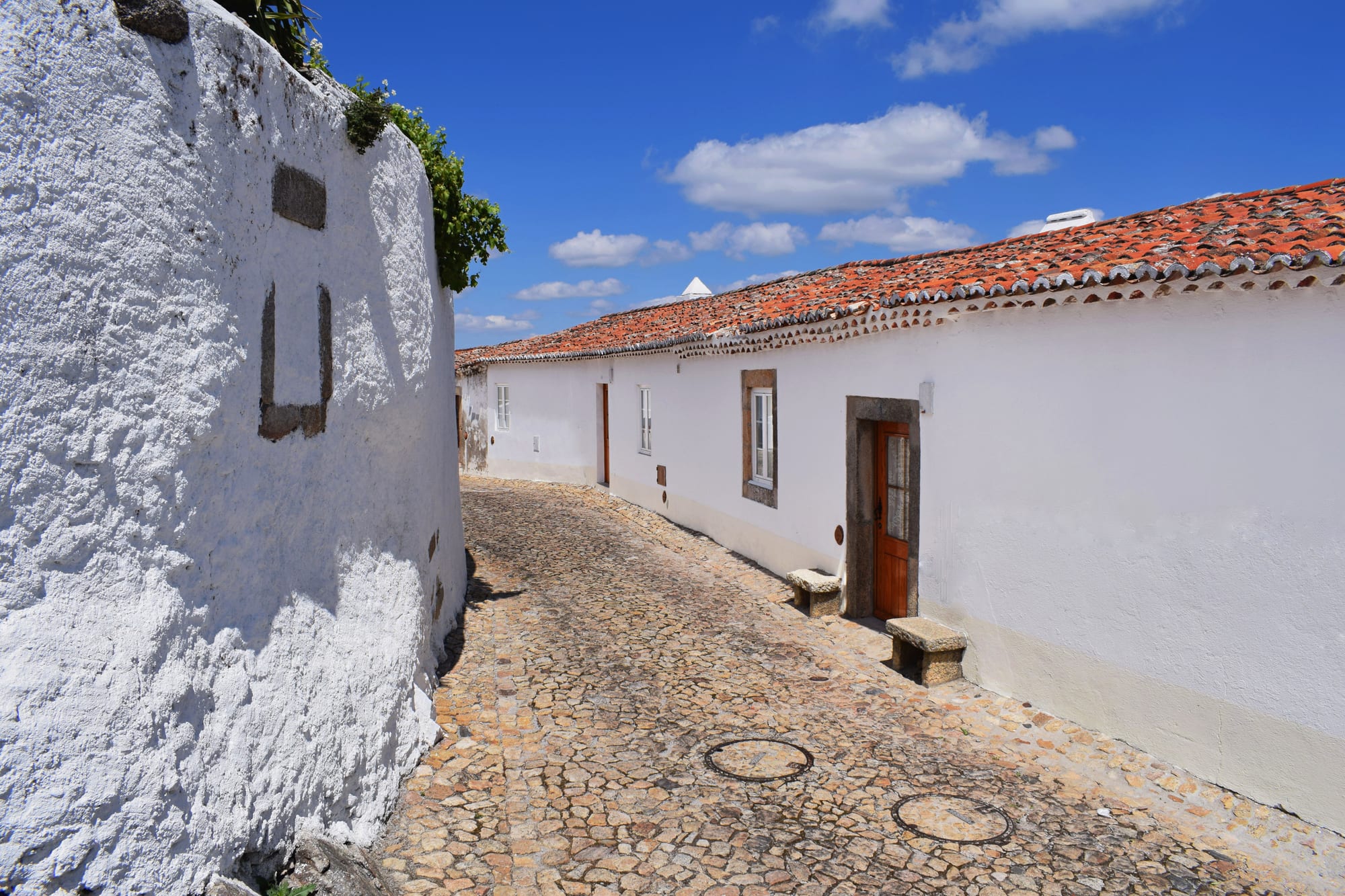
A curving cobbled lane between whitewashed walls and low white houses with red tiled roofs under a blue sky

Alentejo, Portugal

Marvão

A cobbled lane between whitewashed houses inside the walls of Marvão. (Jocelyn Erskine-Kellie from London, UK / Wikimedia Commons · CC BY 2.0)

A walled village on a quartzite crag of the Serra de São Mamede, at about 860 metres on the border with Spain in the north of the Alentejo. Named after the 9th-century rebel Ibn Marwan, fortified by Portuguese kings and the Knights Hospitaller and besieged in later wars with Spain, it is now a small, ageing village of white houses below a castle with views far into both countries.

Neighbourhoods

  • The walled village
    • First-time visitors
    • Historic district
    • Viewpoints

    A short ridge of whitewashed lanes inside a complete circuit of walls, running from the castle past the church that houses the municipal museum. Hospitaller crosses mark some doorways, and the views open on every side.

    Open in Maps
  • São Salvador da Aramenha and the Sever valley
    • Roman ruins
    • Countryside
    • Quiet and residential

    The parish in the valley below the crag, along the River Sever, where the Roman town of Ammaia once stood. Farms, chestnut groves and small villages spread across the slopes of the natural park.

    Open in Maps

Things to do

In the village

  • Castle of Marvãolandmark

    A well-preserved castle built mostly after 1299, with a tall keep at 867 metres, lower turrets, arrow slits and a huge vaulted cistern that stored rainwater for sieges.

    Open in Maps
  • Municipal Museummuseum

    A museum in a church in the walled village, whose collection includes the head of a pig-like berrão sculpture of the pre-Roman Vettones.

    Open in Maps

Around the village

  • Roman ruins of Ammaialandmark

    The excavated remains of a Roman town of the 1st century in the valley below, with a forum, baths, a gate and a site museum at Quinta do Deão.

    Open in Maps
  • Serra de São Mamede Natural Parkpark

    The protected mountain range around Marvão, cooler and wetter than the surrounding region, with sweet chestnut on its higher slopes.

    Open in Maps

Short trips from the village

  • Castelo de Videattraction

    A neighbouring hill town with its own castle, and dolmens such as the Coureleiros group in its countryside.

    Open in Maps
  • Menhir of Meadalandmark

    Believed to be the largest entirely human-carved menhir in Iberia, about 7 metres tall, north of Castelo de Vide.

    Open in Maps
  • Portalegreattraction

    The district capital to the south, a cathedral city known for its tapestry workshop.

    Open in Maps

Seasonal events

  • Marvão International Music FestivalJuly

    A classical music festival launched in 2014 under the artistic direction of the German conductor Christoph Poppen.

  • PeriferiasAugust

    An international film festival held in the village each summer.

  • Al-Mossassaearly October

    A celebration of Marvão's Moorish past, held jointly with Badajoz in Spain, the city also founded by Ibn Marwan.

  • Chestnut Festivalearly November

    A major autumn festival built around the chestnuts grown on the mountain.

Eat and drink

Long-standing places and food districts in Marvão. Hours, ratings and directions come from your maps app, always current.

Marvão classics

  • Restaurants in the walled villageneighborhood

    A few restaurants and snack bars inside the walls, serving Alentejo cooking with local pork and, in autumn, chestnuts.

    Open in Maps
  • Castelo de Vide and the valley villagesneighborhood

    More places to eat in the villages of the valley and in neighbouring Castelo de Vide.

    Open in Maps

Experience Marvão

History

The crag of Marvão has stood on a frontier since prehistory. Around it lies one of the densest clusters of megalithic sites in Europe — more than 200 Neolithic, Bronze and Iron Age monuments within 25 km — and before the Romans it sat where the lands of the Celtici, Lusitani and Vettones met. In the 1st century the Romans built the town of Ammaia in the valley below, with a forum, baths and a bridge over the Sever; it may have held 5,000–6,000 people, more than live in the municipality now, and fell into ruin after the invasions of the 5th century.

Islamic rule began in the 8th century. The village takes its name from Ibn Marwan, a Muwallad rebel and reputed founder of Badajoz who from 884 led a statelet that defied the emirs of Córdoba; he is believed to have built the castle on the crag, probably on the site of a Roman watchtower. Afonso I took Marvão in the 1160s, Sancho II gave it one of the earliest charters on the eastern border in 1226, and the Knights Hospitaller extended the castle and village between the 13th and 15th centuries. King Denis strengthened the border castles after 1297, and most of the castle seen today dates from after 1299.

Spain attacked repeatedly: in 1641 and 1648 during the Restoration War, in 1704–05, when Spanish forces held the fortress for a time, and in 1772. It was freed from French and Spanish occupation in 1808, and Liberal forces took it on 12 December 1833. Restoration of the walls began in 1938. Since then tourism has grown, and the population has fallen steadily.

Culture & Customs

Marvão's culture is bound up with its views and its border. Writers have long been moved by the place: José Saramago wrote of the whole land being visible from it, and the village is included in a best-selling book of a thousand places to see. Its Islamic past is celebrated each October at Al-Mossassa, held jointly with Badajoz, the Spanish city that shares Ibn Marwan as its founder.

For a village this small, the cultural calendar is busy. An international classical music festival, directed by the German conductor Christoph Poppen, has been held each July since 2014, the Periferias film festival comes in August, and the Chestnut Festival in early November celebrates a crop that may have been grown on the mountain since Roman times. The municipal holiday is 8 September.

Rural traditions survive in the hills. Round barns with broom-thatched roofs, called choças, and corbelled dry-stone shelters called chafurdões stand in the fields; Portuguese mastiffs guard livestock; and Hospitaller crosses can still be seen on houses in the walled village.

Daily Life

The municipality of Marvão had about 3,000 people in 2023, spread across four parishes and some 155 square kilometres, and fewer than 400 live in the walled village itself. The population is ageing, the birth rate is low and young people leave for the cities, so numbers have been falling for decades. Most of the municipality's people live outside the walls, in the other parishes and hamlets.

Farming still shapes the land: porco preto, the black Iberian pig, remains dominant in local agriculture, with chestnuts, olives and livestock on the terraced slopes, many of them first built in Roman and Islamic times. The village has generated significant tourist interest, and guesthouses, restaurants and the festivals bring visitors to it.

Daily life is quiet and close to the land. Residents depend on Portalegre and Castelo de Vide for many services, local buses are infrequent, and the village fills with day visitors in fine weather and on festival days before emptying again in the evening.

Food

Marvão eats the food of the Alto Alentejo, and pork is at its heart. Porco preto, the black Iberian pig raised in the oak woodland of the region, remains dominant in local farming and cooking, and its acorn-fed ham is prized. Chestnuts are the autumn crop, gathered on the terraced slopes of the mountain and celebrated at the November festival.

The region's bread-based dishes appear on local menus as well: açorda, a soup of stale bread with garlic, coriander and poached eggs, and migas, made in the Alentejo from leftover bread with pork drippings and coriander. Olives and olive oil, grown on the slopes since Roman times, are found on every table, as are the region's sheep's cheeses, including those of Nisa to the north-west, which have protected designation.

Desserts follow the Alentejo's convent tradition of egg and sugar, and wine comes from the wider Alentejo region, whose wines are among the best-loved in Portugal.

Planning tools

Budget

Marvão has only a few places to stay inside the walls, including small guesthouses and a converted pair of village houses, with more rural guesthouses on the slopes below. Prices are moderate, as across the Alentejo, but rooms in the village are few and fill up during the festivals.

Daily Budget Midrange
USD 100–200 (village guesthouse, restaurant dinners, castle and museum tickets, a hire car)
Daily Budget Shoestring
USD 50–85 (guesthouse room, set lunches, snack bars)

Book early for the July music festival and the November chestnut festival, and stay the night to see the village at its quietest.

Best Time to Visit

Spring and autumn are the best seasons for walking in the Serra de São Mamede. July and August bring the music and film festivals, and early November the chestnut harvest and its festival. The mountain is cooler and greener than the Alentejo plains, but exposed to wind and cloud in winter.

Suggested Number of Days

The walled village and castle need a day or less. Allow two or three days to add the Roman ruins below, the megaliths and neighbouring hill towns, or longer for walking in the natural park.

First Visit
1 day
With Surroundings
2–3 days

Transportation

The village is small enough to cross on foot. Beyond it, a car is the practical way to reach Ammaia, the megaliths and the towns nearby: local buses run to Portalegre and other villages but infrequently.

Allow time for the slow mountain roads, and fill up with fuel before long stretches between towns.

Airport & Station Connections

Rede Expressos runs a daily direct coach from Lisbon to Marvão, stopping at Portalegre and Castelo de Vide on the way. There are no trains from Lisbon to Marvão. Most visitors drive.

Walkability

The walled village is compact and entirely walkable, but its lanes are steep and cobbled, and the castle has stairs and high walls. Old mountain paths, many dating from medieval shepherding routes and Roman roads, lead down the slopes for longer walks.

Safety

Portugal is one of the safest countries in Europe, with low violent crime. Marvão is a quiet village, and the risks are the drops from the castle walls and crag, slippery cobbles and summer heat and wildfires in the hills.

Keep to marked paths on the walls and crag, wear good shoes, and avoid hill walks on high-fire-risk days. Check current official travel advice before travelling.

Climate

A Mediterranean climate with hot, dry summers and mild winters, as in nearby Portalegre, but tempered by the height of the crag. The Serra de São Mamede is cooler and greener than the plains around it.

Summer
hot and dry — in nearby Portalegre summer highs can reach 38–39°C, and the 1971–2000 record was 40.4°C
Winter
cool and damper — in nearby Portalegre winter temperatures can drop below 0°C, with a 1971–2000 record low of −4.5°C

Local Customs

Marvão is a small, ageing community, and the walled village is a place where people live as well as a monument. Tipping is not generally expected; a euro or two after a full meal is appreciated. Churches remain places of worship.

Wear appropriate clothes and keep quiet in churches, and ask before photographing residents.

Common Payment Methods

The currency is the euro. Cards are taken by most restaurants and guesthouses; carry some cash for snack bars, the castle and small shops.