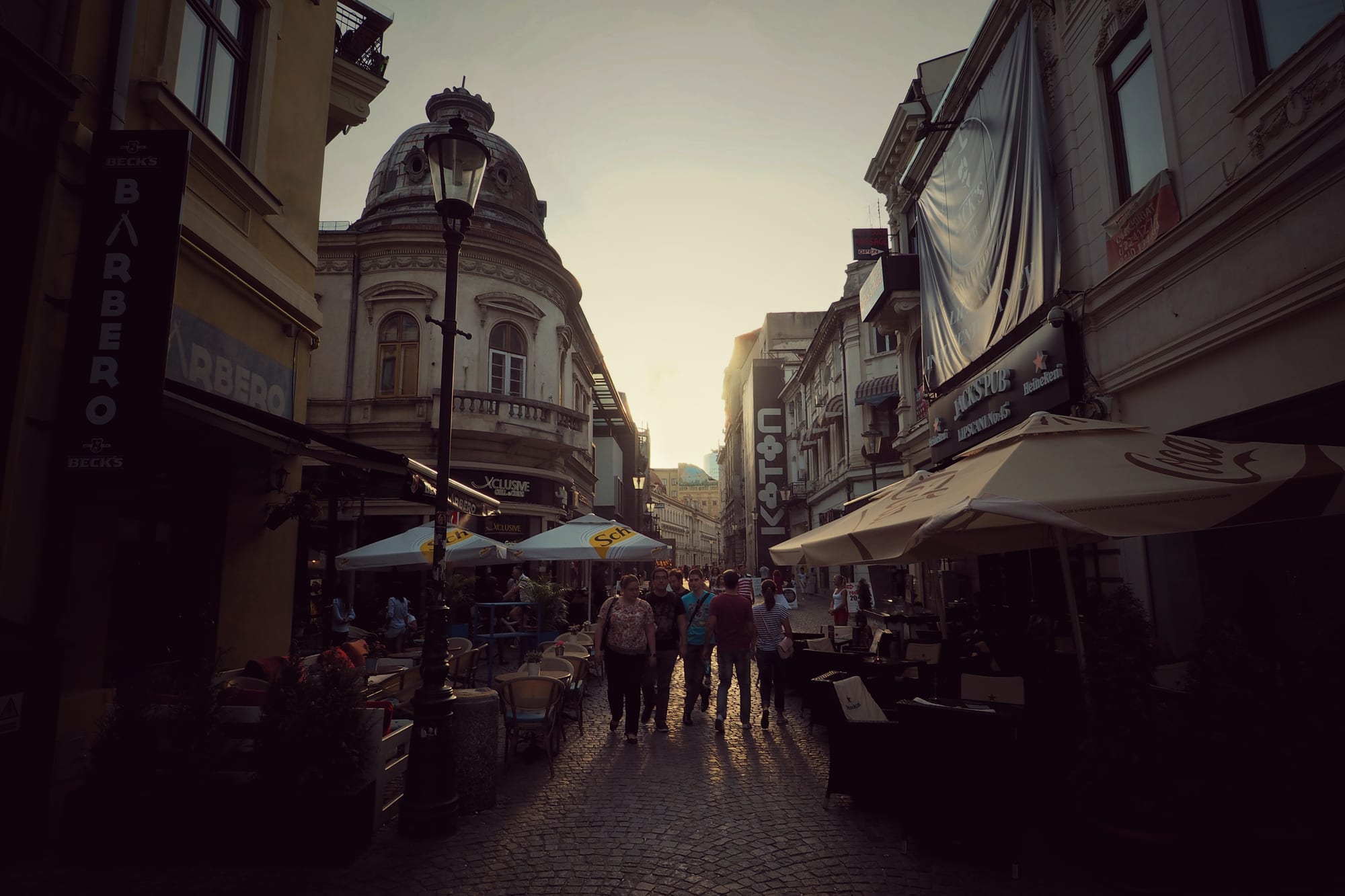
A cobbled pedestrian street at sunset lined with café terraces and parasols, with a domed corner building at the end

Bucharest & Muntenia, Romania

Bucharest

Strada Lipscani in Bucharest's Old Town at sunset. (Ștefan Jurcă from Munich, Germany / Wikimedia Commons · CC BY 2.0)

Romania's capital and largest city, on the Dâmbovița River in the middle of the Wallachian plain. A princely seat first recorded in 1459, it grew into the 'Paris of the East' before war and Ceaușescu's demolitions remade it; today it mixes Belle Époque avenues, the vast Palace of the Parliament, communist-era housing blocks and a booming office and technology economy.

Neighbourhoods

  • Old Town (Lipscani)
    • First-time visitors
    • Nightlife
    • Historic district

    The medieval merchants' quarter around Strada Lipscani, whose cobbled streets still carry the names of old guilds. Much restored in the early 21st century, it holds the ruins of the princely court, Stavropoleos church and Caru' cu Bere among a dense cluster of bars, terraces and clubs.

    Open in Maps
  • Calea Victoriei and Revolution Square
    • Architecture
    • Museums
    • Concerts

    The city's historic main avenue, 2.7 km from the river to Piața Victoriei. Along it stand the National Museum of Art in the former royal palace, the Romanian Athenaeum, the National History Museum and a run of 19th-century and interwar palaces, banks and churches.

    Open in Maps
  • Civic Centre and Unirii
    • Communist-era landmarks
    • Close to public transport

    The district Ceaușescu built in the 1980s over a levelled part of the historic city, with wide boulevards leading to the Palace of the Parliament. The huge new National Cathedral now rises beside the palace, and Piața Unirii is a major metro interchange.

    Open in Maps
  • Cotroceni
    • Quiet and residential
    • Historic villas

    A leafy neighbourhood on Cotroceni hill west of the centre, around the presidential palace and the Botanical Garden, with streets of houses first built near the palace for royal servants and army officers.

    Open in Maps
  • Dorobanți and Floreasca
    • Cafés and restaurants
    • Upmarket

    Prosperous northern districts of embassies, red-brick and glass buildings and low apartment blocks, with cafés favoured by the city's wealthy. Floreasca, built on a former landfill, stretches towards its lake and has many green spaces.

    Open in Maps
  • King Michael I Park and the north
    • Parks and lakes
    • Museums
    • Families

    The big lakeside park formerly called Herăstrău, home to the open-air Village Museum, with the Arcul de Triumf nearby on Kiseleff Road and the newer office towers of the north beyond.

    Open in Maps

Things to do

Famous landmarks

  • Palace of the Parliamentlandmark

    Ceaușescu's People's House, built from 1984 to 1997 on Dealul Spirii — the heaviest building in the world and the largest civilian administrative building, housing both chambers of parliament and visited on guided tours.

    Open in Maps
  • National Cathedrallandmark

    The People's Salvation Cathedral facing the Palace of the Parliament, at 127 metres the tallest and largest Eastern Orthodox church in the world, consecrated in 2018 and opened permanently in October 2025 when its mosaics were consecrated.

    Open in Maps
  • Romanian Athenaeumlandmark

    The domed, circular concert hall opened in 1888, the city's most prestigious, home of the George Enescu Philharmonic and the Enescu Festival.

    Open in Maps
  • Revolution Squarelandmark

    The square on Calea Victoriei where Ceaușescu's speech of 21 December 1989 erupted into revolt, and from whose Central Committee building he fled by helicopter the next day; the Memorial of Rebirth and a statue of Carol I stand here.

    Open in Maps
  • Arcul de Triumflandmark

    A triumphal arch on Kiseleff Road commemorating victory in the First World War and the coronation of King Ferdinand and Queen Marie, built in 1921–22 and renovated in 1935–36.

    Open in Maps

Old Town and churches

  • Stavropoleos Monasterylandmark

    A small 18th-century church in the Brâncovenesc style in the Old Town, now a convent known for its choir of Byzantine music.

    Open in Maps
  • Curtea Vechelandmark

    The ruins of the Old Princely Court, a residence dating from Vlad III's time, excavated from 1953 and run as a museum site beside the 16th-century court church.

    Open in Maps
  • Romanian Patriarchal Cathedrallandmark

    The 17th-century Metropolitan Church on its hill above Piața Unirii, the working seat of the Orthodox Patriarch and the site of many religious holidays and observances.

    Open in Maps
  • Choral Templelandmark

    A Moorish Revival synagogue completed in 1866, one of the active synagogues of the city's Jewish community.

    Open in Maps
  • Cărturești Caruselattraction

    A bookshop on Strada Lipscani in an early 20th-century building put up by the Chrissoveloni banking family as their bank's headquarters.

    Open in Maps

Museums

  • National Museum of Art of Romaniamuseum

    Medieval and modern Romanian art, including works by Brâncuși, and the international collection gathered by the royal family, in the former Royal Palace on Revolution Square.

    Open in Maps
  • Village Museummuseum

    An open-air museum opened in 1936 in King Michael I Park, with peasant houses, farmsteads and a wooden church brought from around Romania.

    Open in Maps
  • National Museum of the Romanian Peasantmuseum

    Costumes, textiles, icons and ceramics of Romanian village life, one of Europe's leading museums of popular arts; it was European Museum of the Year in 1996.

    Open in Maps
  • National History Museum of Romaniamuseum

    Romanian historical artefacts from prehistory to modern times, at the southern end of Calea Victoriei.

    Open in Maps
  • Grigore Antipa Museum of Natural Historymuseum

    A natural history museum founded in 1834, in a 1908 building near Piața Victoriei, with a collection of over two million specimens.

    Open in Maps

Parks and lakes

  • Cișmigiu Gardenspark

    The oldest and largest park in the city centre, laid out around an artificial lake from the 1840s, with a circle of busts of Romanian writers.

    Open in Maps
  • King Michael I Parkpark

    A large park around Lake Herăstrău in the north of the city, with lakeside paths, boat rental and the Village Museum.

    Open in Maps
  • Carol Parkpark

    A French-style park partly on Filaret Hill, designed in 1900, opened in 1906 and long used for exhibitions, with the Tomb of the Unknown Soldier and a large communist-era mausoleum.

    Open in Maps
  • Văcărești Nature Parkpark

    A wetland that grew inside an abandoned communist reservoir basin in the south of the city, protected since 2014 and home to dozens of bird species.

    Open in Maps

Short trips from the city

  • Mogoșoaia Palacelandmark

    Constantin Brâncoveanu's palace of 1698–1702, about 10 km from the city, a showpiece of the Brâncovenesc style with arcaded loggias facing a lake.

    Open in Maps
  • Snagov Monasterylandmark

    A medieval monastery on an island in Lake Snagov, north of the city, first recorded in 1408 and linked by legend with the burial of Vlad the Impaler.

    Open in Maps

Seasonal events

  • Mărțișor1 March

    Small tokens on red-and-white strings are sold all over the city and given and worn at the start of spring, a custom on UNESCO's intangible heritage list.

  • George Enescu FestivalSeptember, in odd-numbered years

    Romania's largest classical music festival and competition, held since 1958 at the Athenaeum and other halls across the city.

  • Feast of St Dimitrie Basarabov27 October

    Pilgrims gather on the Patriarchal hill on 27 October to venerate the relics of the city's patron saint.

Eat and drink

Long-standing places and food districts in Bucharest. Hours, ratings and directions come from your maps app, always current.

Bucharest classics

  • Caru' cu Bererestaurant

    A beer hall and restaurant opened in 1899 by a family of Transylvanian brewers, in a Gothic Revival building with a celebrated Art Nouveau interior, serving Romanian dishes.

    Open in Maps
  • Covrigi bakeriescafe

    Hatch-front bakeries selling covrigi — salted bread rings topped with poppy seeds, sesame or coarse salt — a common street snack.

    Open in Maps

Food districts and markets

  • Old Town restaurantsneighborhood

    The streets around Lipscani, Covaci and Franceză are packed with restaurants, beer gardens and cocktail bars, busiest on summer evenings.

    Open in Maps
  • Piața Obormarket

    The market at Obor, successor to the old Târgul Moșilor fair, with produce stalls and a district of small shops around it.

    Open in Maps

Cafés and bars

  • Green Hourscafe

    A long-standing jazz club and bar on Calea Victoriei, one of the venues behind the city's jazz revival since the early 2000s.

    Open in Maps

Experience Bucharest

History

Bucharest is first recorded in 1459, as a citadel of Vlad III, the Impaler, prince of Wallachia. The Old Princely Court, whose ruins survive in the Old Town, was built up by Mircea Ciobanul in the mid-16th century, and the town competed with Târgoviște to be the capital until the court settled here for good from 1698 under Constantin Brâncoveanu. Under the Phanariot princes of the 18th century it traded through its guild streets, suffered Caragea's plague in 1813–14 and, in 1847, lost a third of its buildings in a single fire.

It became the capital of the united principalities in 1862 and of the Kingdom of Romania in 1881. Grand boulevards, eclectic architecture and a francophile high society earned it the name "Paris of the East", with Calea Victoriei as its Champs-Élysées. German troops occupied it from 1916 to 1918; between the wars it grew by about 30,000 people a year. In January 1941 the Legionnaires' rebellion brought a pogrom against its Jews, Allied bombing caused heavy damage, and on 23 August 1944 the royal coup here took Romania out of the Axis.

Communism ringed the city with tower blocks. The earthquake of 4 March 1977 killed about 1,500 people, and in the 1980s Ceaușescu levelled some eight square kilometres of the historic centre, churches and synagogues included, for his Civic Centre and the People's House. In December 1989 a rally Ceaușescu addressed on Revolution Square erupted into the revolt that overthrew his regime. In the early 21st century much of the Old Town was restored and made a pedestrian zone; the Colectiv nightclub fire of 2015 killed 64 people, and mass protests in 2017–19 opposed changes to the judicial system.

Culture & Customs

Bucharest is the centre of Romanian cultural life. The Romanian Athenaeum and the National Radio Orchestra anchor a strong classical scene, crowned in odd-numbered years by the George Enescu Festival, and the city has the National Opera, the I. L. Caragiale National Theatre and the State Jewish Theatre among many smaller stages. Two of its museums, the open-air Village Museum and the Museum of the Romanian Peasant, hold some of the richest collections of folk culture in the country.

Popular music is just as rooted here. Most of Romania's big record labels and many of its musicians are based in the city; 1970s and 1980s rock bands such as Iris and Holograf still draw crowds, and Bucharest hip hop acts such as B.U.G. Mafia are known across the country. Manele, a Roma- and Oriental-influenced pop, plays in neighbourhood discos of the working-class districts, while the jazz scene has grown since 2002 around clubs such as Green Hours. Nightlife has no single strip, but clusters in Lipscani and Regie.

The city is the seat of the Romanian Orthodox Patriarch, and its patron saint, Dimitrie Basarabov, draws pilgrims each October. Catholic, Protestant, Muslim and Jewish communities have their own places of worship, including the Choral Temple and the Great Synagogue. Football is the most followed sport, with rival clubs Steaua, FCSB, Dinamo and Rapid, and the 55,600-seat Arena Națională, with its retractable roof, hosts national team matches and major concerts.

Daily Life

The 2021 census counted about 1.72 million people in the city proper, a fall from 2011 partly as people moved out to fast-growing satellite towns in Ilfov County such as Voluntari, Popești-Leordeni and Otopeni; the wider metropolitan area has an estimated 2.33 million. Bucharest is densely built, at over 8,000 people per square kilometre, because most residents live in communist-era apartment blocks, the blocuri, in districts such as Drumul Taberei, Berceni, Titan, Militari and Pantelimon. Villas and smaller blocks fill wealthier northern and central areas such as Dorobanți, Floreasca and Cotroceni.

The city accounts for around a quarter of Romania's economic output with less than a tenth of its people. Nearly all large Romanian companies have their headquarters here, alongside the Bucharest Stock Exchange, government and banks; it is the country's largest centre for information technology, with offices of firms such as Amazon, Microsoft, Oracle and Ubisoft, and a building boom has filled the north with office towers, flats and more than 20 shopping malls.

Daily life runs on long commutes by metro and car through heavy traffic, while potholes on busy roads are a standing complaint. Evenings and weekends fill the terraces of the Old Town and the big parks — Cișmigiu, King Michael I, Tineretului and Titan — and summer weekends send many residents out of the city.

Food

Bucharest eats the full Romanian repertoire. Ciorbă, sour soup, starts many meals, and ciorbă de burtă, tripe soup, is a city favourite: thickened with sour cream and egg yolks, seasoned with vinegar and served with mujdei, a garlic sauce of crushed garlic and oil. Sarmale, minced meat and rice rolled in cabbage leaves, and mămăligă, firm cornmeal polenta, appear on traditional menus, and mici — grilled minced-meat sausages of mixed beef, lamb and pork seasoned with garlic, black pepper and thyme — come with mustard from grills across the city.

Street food is simple and everywhere. Covrigi, salted bread rings sprinkled with poppy seeds, sesame or coarse salt, are sold from small bakeries across the city, and papanași, fresh-cheese doughnuts topped with sour cream and fruit preserve, are a favourite dessert. Joffre cake, a chocolate layer cake, was created at a historic Bucharest restaurant in honour of a visit by Marshal Joseph Joffre after the First World War.

Beer halls are a city institution. Caru' cu Bere has served beer and Romanian dishes under its painted vaults since 1899, and Berăria H, in the park area of the north, is one of the largest beer halls in Europe. Wine comes from the Dealu Mare hills to the north, and țuică, plum brandy, is offered in homes before a meal. Piața Obor, successor to the old Târgul Moșilor fair, was the city's largest public market until 2007.

Planning tools

Budget

Bucharest is the most expensive place in Romania but still moderate by Western European standards. Rooms and restaurants in the Old Town and the northern districts cost the most; workday set lunches, bakeries and public transport are cheap. Big concerts, the Enescu Festival and football internationals push up hotel prices.

Daily Budget Midrange
USD 110–200 (central hotel, restaurant meals, museum and palace tours, app taxis)
Daily Budget Shoestring
USD 45–70 (hostel bed, covrigi and canteen lunches, metro and buses)

Many of the best things — Calea Victoriei, the Old Town streets, the churches and the big parks — cost nothing to see.

Best Time to Visit

April to June and September to October, when days are mild — spring and autumn daytime temperatures are usually around 17–22°C. Midsummer can be very hot in the centre, and many residents leave for the mountains and the coast at weekends. Winter is cold, sometimes snowy and windy, but concerts, theatre and museums carry on, and odd-numbered Septembers bring the Enescu Festival.

Suggested Number of Days

Two or three days cover the centre, its museums and parks at an easy pace. Four or five allow time for the palaces and monasteries on the city's edge or a trip up the Prahova Valley. Traffic makes journeys across the city slow, so it pays to group sights by area.

First Visit
2–3 days
With Surroundings
4–5 days

Transportation

The metro, run by Metrorex, has five lines and 64 stations and is the quickest way across the city; buses, trams and trolleybuses run by STB cover the rest of a very large surface network. Roads are badly congested at rush hours. Ride-hailing apps are widely used, and taxis ordered by app or from the official kiosks at the airport are safer than cars hailed on the street.

Contactless bank cards can be used to pay fares at metro stations and on most buses; the metro's newest line, M5, opened in 2020 and a sixth line is under construction.

Airport & Station Connections

Henri Coandă International Airport, Romania's busiest, is at Otopeni, 16.5 km north of the centre; the express bus takes 50–90 minutes depending on traffic, and taxis and app cars are quicker outside rush hour. The smaller Băneasa Aurel Vlaicu airport, within the city, has been a business airport since 2012. Gara de Nord is the country's largest railway station, with trains to all major Romanian cities and international routes, and motorways run to Pitești, Ploiești and the Black Sea at Constanța.

Walkability

The historic core is walkable: the Old Town, Calea Victoriei, Revolution Square and Cișmigiu Gardens lie within a short walk of one another, and Calea Victoriei itself is 2.7 km long. Beyond the centre the city is very spread out, crossed by wide, busy boulevards, and the metro is the practical way to reach the northern parks or the Palace of the Parliament from the north. Pavements are often uneven and crowded with parked cars.

Safety

Romania is a safe country with low violent crime. Bucharest has a low crime rate for a European capital; petty theft, above all pickpocketing on crowded public transport, is the common problem. Crime is higher in some southern districts such as Ferentari, and independent taxis waiting outside Gara de Nord are best avoided.

Keep valuables secure on buses, trams and the metro, use app or kiosk taxis rather than unlicensed drivers, and check bills carefully in Old Town clubs. Check current official travel advice before travelling.

Climate

A humid continental climate with hot, humid summers and cold, snowy winters. Summer storms can be heavy, and winds sweeping across the open plain make winter days feel colder.

Summer
hot — the average high in July and August is about 30°C, and midsummer days in the centre frequently reach 35–40°C
Winter
cold — temperatures often fall below 0°C and sometimes to −10°C, with spells of snow and wind

Local Customs

Most people are Orthodox, churches are working places of worship, and photography is not allowed inside the Patriarchal Cathedral. People working in tourism usually speak English. Romanians are proud of their Latin language and do not take kindly to being addressed in Russian.

Carry a passport for the Palace of the Parliament tour and some synagogue visits, where security checks are made.

Common Payment Methods

The currency is the Romanian leu (RON), not the euro. Cards and contactless payment are accepted almost everywhere in the city, and ATMs are common; exchange desks at the airport and Gara de Nord give poor rates. Some street stalls and small bakeries prefer cash.