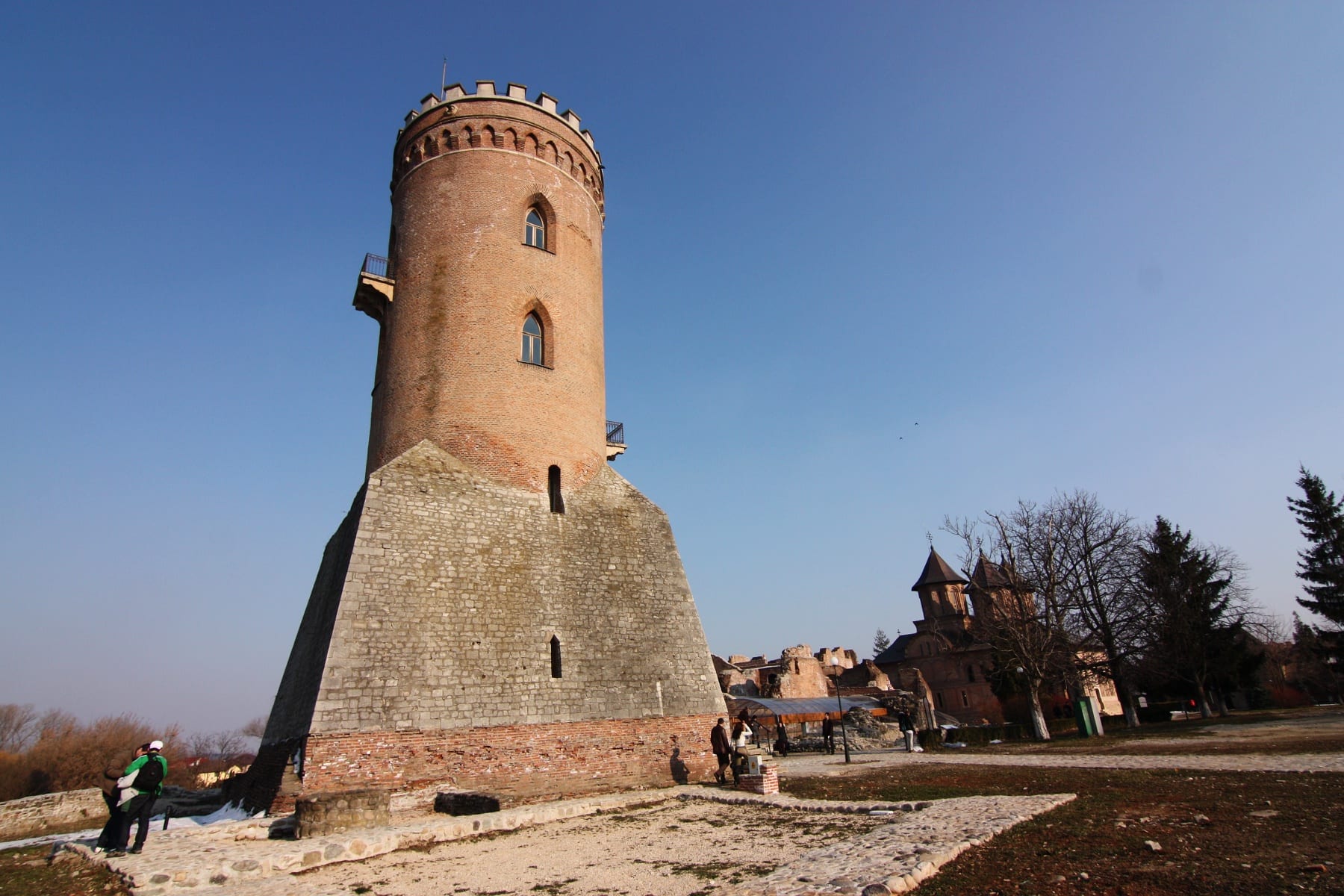
A tall round brick tower with battlements on a stone base, beside the ruins and a church of the old princely court under a clear sky

Bucharest & Muntenia, Romania

Târgoviște

The Chindia Tower and the ruins of the princely court of Târgoviște. (Nicubunu / Wikimedia Commons · CC BY-SA 3.0)

A county town on the Ialomița River, where the Wallachian plain meets the hills, 80 km north-west of Bucharest. For more than two centuries it was the capital of Wallachia, and its walled princely court and the Chindia Tower recall Vlad the Impaler; in 1989 it was the scene of Ceaușescu's trial and execution. Today it is an industrial and university city.

Neighbourhoods

  • The princely court
    • First-time visitors
    • Historic district
    • Museums

    The walled compound of the Wallachian princes, with the ruins of the palace rebuilt by Brâncoveanu, the Great Princely Church and the Chindia Tower, at the edge of a park. Most of the city's museums are a short walk away.

    Open in Maps
  • The old town and its churches
    • Historic churches
    • Walking

    The streets of the old market town, where the oldest settlement grew up around today's Stelea and St Nicholas churches and Saxon colonists built the Catholic church of St Mary. The Metropolitan cathedral complex and a cluster of 16th- and 17th-century churches stand among later houses.

    Open in Maps
  • The modern city
    • Local life
    • Close to public transport

    The apartment districts and industrial zones that grew under communism around the old core, with the campus of Valahia University, founded in 1992, served by buses and maxi-taxis and by several railway stations and halts.

    Open in Maps

Things to do

The princely court

  • Târgoviște Princely Courtlandmark

    The fortified residence of the princes of Wallachia, extended from Mircea the Elder's time onwards; its centrepiece is the palace rebuilt under Constantin Brâncoveanu in 1695, now in ruins inside the walls.

    Open in Maps
  • Chindia Towermuseum

    The tower begun in Vlad the Impaler's second reign and given its final form in the 19th century — the symbol of the city, with an exhibition of documents, weapons and objects belonging to Vlad.

    Open in Maps
  • Great Princely Churchlandmark

    The court church inside the princely compound, founded by Petru Cercel in 1585.

    Open in Maps
  • Church of St Georgelandmark

    A church of 1699 at the princely court, a fine example of the Brâncovenesc style of Constantin Brâncoveanu's reign.

    Open in Maps

Churches and monasteries

  • Stelea Monasterylandmark

    A monastery complex in the old centre, listed among the city's historic monuments.

    Open in Maps
  • Metropolitan cathedral complexlandmark

    The seat of the Orthodox metropolitans who moved here from Curtea de Argeș in 1517, a complex of the 16th century rebuilt in the 19th and 20th.

    Open in Maps
  • Dealu Monasterylandmark

    A 15th-century monastery on the hill 6 km north of the city, whose narthex is one of the largest princely burial places in the country.

    Open in Maps

Museums

  • Museum of Military Traditionmuseum

    The barracks where Nicolae and Elena Ceaușescu were tried and executed on 25 December 1989, opened to the public as a museum in 2025.

    Open in Maps
  • Museum of Printing and Old Romanian Booksmuseum

    One of the city's museums, devoted to printing and old books.

    Open in Maps
  • Art Museummuseum

    The city's art museum, one of several run alongside the history museum and the memorial houses of the painters Gheorghe Petrașcu and Vasile Blendea.

    Open in Maps

Short trips from the city

  • Sinaiaattraction

    The royal mountain resort of Peleș Castle in the Prahova Valley, reached over the hills by the DN71.

    Open in Maps

Eat and drink

Long-standing places and food districts in Târgoviște. Hours, ratings and directions come from your maps app, always current.

Eating in town

  • Restaurants in the centreneighborhood

    Restaurants and terraces around the old centre and the princely court serve Romanian standards — ciorbă, sarmale and grilled mici.

    Open in Maps
  • Covrigi and bakeriescafe

    Bakeries sell covrigi, salted bread rings topped with poppy seeds, sesame or coarse salt, and plăcintă pastries for a quick breakfast.

    Open in Maps

Experience Târgoviște

History

The oldest part of Târgoviște grew up where the Stelea and St Nicholas churches now stand, and Saxon colonists from Transylvania founded a second quarter around the Catholic church of St Mary, which local tradition dates to 1300. Its name comes from the Slavonic word for a marketplace. Under Mircea the Elder it became a princely seat, and in 1431 Alexandru Aldea moved the court here for good from Curtea de Argeș; it remained the capital, with interruptions, until the court moved to Bucharest under Constantin Brâncoveanu.

As capital it traded with Poland, Brașov and Sibiu and suffered repeated attacks: Bayezid I burned it in 1395, and in 1462 Vlad III held off the Ottoman army with his night attack outside the city. Vlad also punished the town's elite for the murder of his brother, killing many and sending the young to build his fortress at Poenari, and he added the Chindia Tower to the court. Stephen Báthory took the city in 1476, and in 1597 Michael the Brave's forces won a decisive battle here against the Ottomans. Matei Basarab strengthened the walls with ten bastions, and Brâncoveanu rebuilt the palace in 1695.

Once the capital had gone, the town declined. In 1821 Tudor Vladimirescu was tortured and executed here during the Wallachian uprising. A railway arrived in 1884, industry followed in the 20th century, and on 25 December 1989 Nicolae and Elena Ceaușescu were tried and shot in a military barracks in the city; in 2025 the unit opened to the public as the Museum of Military Tradition.

Culture & Customs

Târgoviște's sense of itself is bound up with its centuries as a capital. The Chindia Tower is the symbol of the city, the princely court is run as a national museum, and the city has a cluster of museums for a place its size: history, art, the police, printing and old books, local writers, and the houses of the painters Gheorghe Petrașcu and Vasile Blendea.

Vlad the Impaler is the dominant historical figure. The city's churches span five centuries, from the Little Princely Church of St Vineri to the Brâncovenesc St George of 1699, and the Dealu Monastery outside the city is the burial place of several princes, including Vlad II Dracul and Radu the Great. The city's Saxon and Greek merchants have long since gone, but the Catholic church of St Mary and the monasteries where Greek monks once settled recall them.

Sport and youth culture have a local edge. The football club FC Chindia Târgoviște shares its name with the tower, the city has a professional basketball team, and a skateboarding, blading and graffiti scene gathers on Tricolorului Square, known locally as "Sindicate", where its crew organises the Târgoviște Underground Manifest festival.

Daily Life

The 2021 census counted about 67,000 people, making Târgoviște the 27th-largest city in Romania and the seat of Dâmbovița County; the city also administers the village of Priseaca. The city sits at 260–300 metres between the Dâmbovița and Ialomița rivers, at the edge of the Subcarpathian hills that rise towards the Bucegi.

Industry is the backbone of the economy: large operators such as the steelmakers Mechel and Oțelinox have plants served by the city's own railway halts, and the five stations and halts around the town also carry passengers. Valahia University of Târgoviște brings students to the city, and Bucharest is 80 km away by road and rail. According to the 2002 census, about 97 per cent of the inhabitants were Romanians and about 3 per cent Roma.

Daily life is quiet and provincial. Buses and maxi-taxis link the apartment districts with the centre, after a public-private partnership modernised the network in 2005, and the old court, the churches and the shops of the centre remain the focus of town life.

Food

Târgoviște eats the Muntenian staples. Ciorbă, sour soup, begins many meals; sarmale are minced meat and rice rolled in cabbage leaves; mămăligă, firm cornmeal polenta, comes with cheese, sour cream or a fried egg; and mici, grilled sausages of mixed minced beef, lamb and pork seasoned with garlic and thyme, are served with mustard. Ciorbă de burtă, tripe soup thickened with sour cream and egg yolks and sharpened with vinegar and garlic, is a Romanian classic.

Bakeries sell covrigi, salted bread rings sprinkled with poppy seeds, sesame or coarse salt, and plăcintă pastries filled with cheese or apple. For dessert, papanași are fresh-cheese doughnuts topped with sour cream and fruit preserve, and cozonac, a rich sweet bread rolled with walnuts or poppy seeds, is traditionally baked for Easter.

Țuică, a brandy made from plums, is usually drunk in a small glass before a meal. Wine comes from the Dealu Mare area of neighbouring Prahova and Buzău counties.

Planning tools

Budget

Târgoviște is much cheaper than Bucharest, with modest hotels, guesthouses and restaurants, and few foreign visitors. Museum entries at the princely court and the Chindia Tower are low; the main extra cost is transport to the monasteries outside the city.

Daily Budget Midrange
USD 80–150 (comfortable hotel, restaurant meals, museum entries, a taxi or hire car)
Daily Budget Shoestring
USD 35–55 (guesthouse, local restaurants, buses)

Buses from Bucharest are frequent, so a day trip is easy; staying over leaves time for the monasteries.

Best Time to Visit

May to June and September to October are the most comfortable months. July is warm and the city can be very hot in summer heatwaves, while winters are cold, with snow some years; the court and museums are open all year.

Suggested Number of Days

One day is enough for the princely court and the main churches; two allow time for the monasteries outside the city and the smaller museums. Most visitors come as a day trip from Bucharest.

First Visit
1 day
With Surroundings
2 days

Transportation

The centre is easily walked. City buses and maxi-taxis cover the rest of town; the trolleybuses that ran from 1995 to 2005 are gone. Taxis or a car are the practical way to reach Dealu Monastery and the countryside.

Buses from Bucharest leave as often as every 15 minutes at rush hour, usually from near Gara de Nord.

Airport & Station Connections

Târgoviște is about 80 km north-west of Bucharest. Buses leave frequently from an area near Bucharest's Gara de Nord, and trains take about an hour and a half on the faster services, two hours on the slower ones. Henri Coandă International Airport, north of Bucharest, is the nearest major airport.

Walkability

The historic core is compact and flat, and the princely court, the main churches and the museums lie within walking distance of each other. The railway station and the outer housing districts are a bus or taxi ride away.

Safety

Romania is a safe country with low violent crime. Târgoviște is a quiet provincial city; usual city precautions against pickpockets and unlicensed taxis are enough.

Use metered or app taxis and keep valuables secure on crowded buses. Check current official travel advice before travelling.

Climate

A temperate continental climate at 260–300 metres, where the plain meets the Subcarpathian hills. Summers are warm and most of the year's rain falls in the warm season; winters are cold, with north-westerly winds the most frequent.

Summer
warm — July averages 20.8°C, and the highest temperature recorded is 40.4°C
Winter
cold — the lowest temperature recorded is −28°C, and the north-westerly wind is the most frequent

Local Customs

The city is mostly Orthodox, and its many old churches and monasteries are working places of worship; visitors keep quiet during services.

Ask before photographing services or monks and nuns at the monasteries.

Common Payment Methods

The currency is the Romanian leu (RON). Cards are widely accepted in shops and restaurants, and ATMs are easy to find in the centre; carry some cash for church donations, small museums and markets.