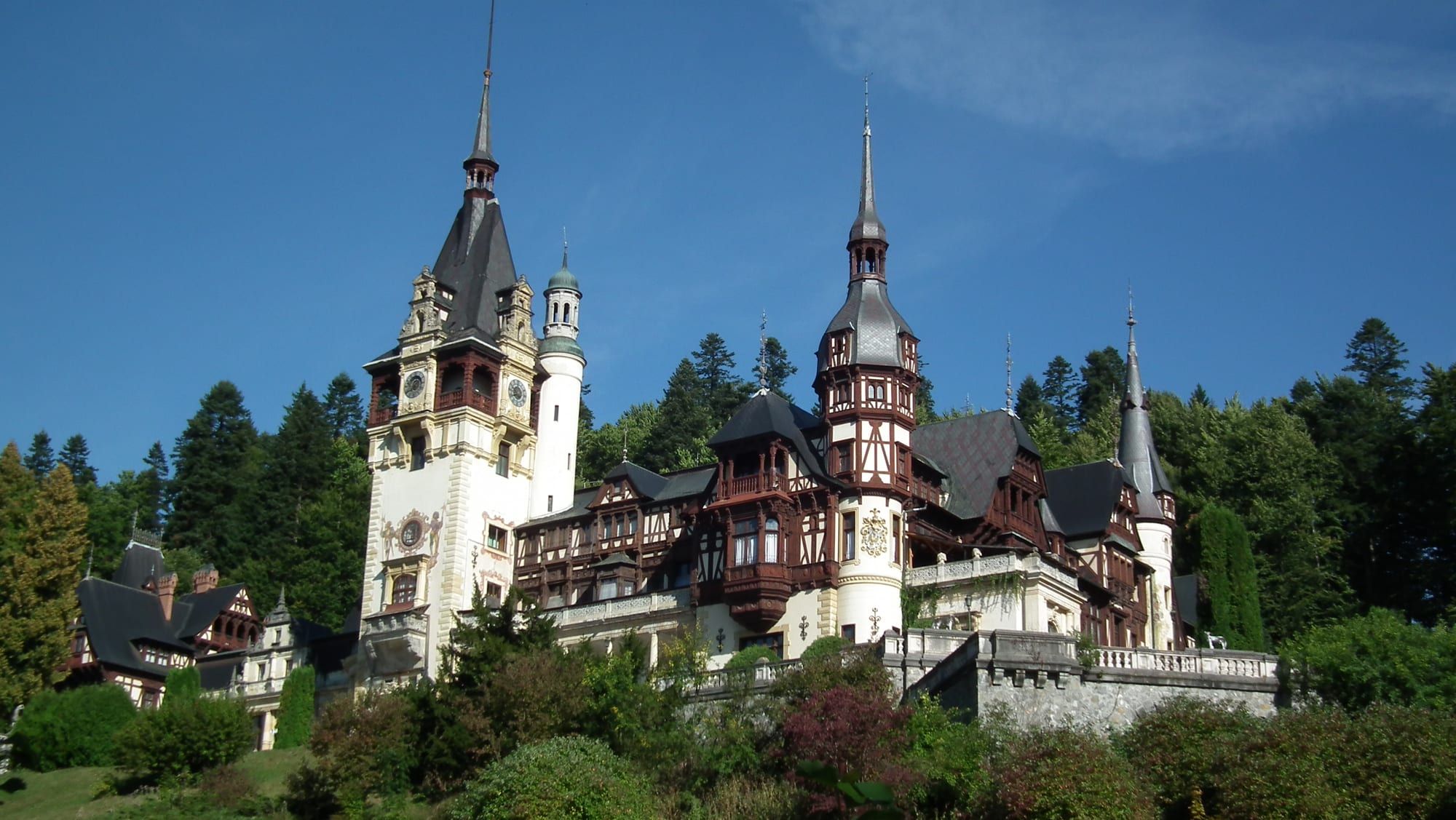
A turreted white and timber-framed castle with dark spires rising above gardens and fir forest under a blue sky

Bucharest & Muntenia, Romania

Sinaia

Peleș Castle, the royal summer palace above Sinaia, built for King Carol I. (BogdanClaw / Wikimedia Commons · CC BY-SA 3.0 ro)

A mountain resort in the Prahova Valley, at the foot of the Bucegi Mountains, that grew around a monastery of 1695. King Carol I chose it for his summer palace of Peleș, and by 1900 it was Romania's unofficial summer capital; today it is a small town of royal villas, a former casino and ski slopes, busy with hikers and skiers.

Neighbourhoods

  • Town centre and Bulevardul Carol I
    • First-time visitors
    • Cafés and restaurants
    • Close to the station

    The main street, Bulevardul Carol I, runs along the valley past shops, restaurants and old villas to Dimitrie Ghica Park, where the casino stands among older hotels. The lower cable car station and the town museum in the Știrbey villa are close by.

    Open in Maps
  • Peleș and the monastery slope
    • Historic sights
    • Forest walks

    Above the centre, a footpath lined with stalls climbs through the woods to Sinaia Monastery and on to the Peleș estate, with Pelișor nearby. It is the busiest part of town by day and very quiet at night.

    Open in Maps
  • Cumpătu
    • Quiet and residential
    • Music history

    The town's only suburb, home to George Enescu's Luminiș villa, a protected alder grove and a University of Bucharest research station with a small museum of Bucegi wildlife.

    Open in Maps
  • Cota 1400 and the ski area
    • Skiing
    • Hiking
    • Mountain views

    The cable cars climb from town to the mid-station at about 1,400 metres and on to Cota 2000 on the Bucegi slopes, where the ski runs, chalets and summer trailheads are.

    Open in Maps

Things to do

Royal Sinaia

  • Peleș Castlemuseum

    Carol I's Neo-Renaissance summer palace, built from 1873 to 1914 and inaugurated in 1883 — the world's first castle fully powered by locally produced electricity, visited on guided tours of its armouries and state rooms.

    Open in Maps
  • Pelișor Castlemuseum

    The smaller castle of 1899–1902 on the same estate, built as the home of the future King Ferdinand and Queen Marie.

    Open in Maps
  • Sinaia Monasterylandmark

    Founded in 1695 by Mihail Cantacuzino after a pilgrimage to Mount Sinai, with an old church of 1695 and a Great Church of 1846, the first church in Romania lit by electricity.

    Open in Maps
  • Sinaia Casinolandmark

    Built in 1912–13 on Carol I's initiative and opened with a recital by George Enescu; gambling ended under communism and it is now a conference centre in Dimitrie Ghica Park.

    Open in Maps
  • Luminiș, George Enescu Memorial Housemuseum

    The villa in Cumpătu where Romania's great composer spent his summers, built in the 1920s and now a memorial museum.

    Open in Maps
  • Sinaia railway stationlandmark

    A station of 1913 first reserved for the royal family and its guests at Peleș, still on the main line from Bucharest to Brașov.

    Open in Maps

Mountains and viewpoints

  • Bucegi Natural Parkpark

    The protected mountain area of the Bucegi above the town, covering about 327 square kilometres; gathering protected alpine plants such as edelweiss is severely punished.

    Open in Maps
  • Franz Joseph Cliffsviewpoint

    Rock outcrops near the Royal Meadow, named by Carol I after the Austrian emperor and fitted with steps and railings, with a clear view down the Prahova Valley.

    Open in Maps

Short trips from the town

  • Bușteniattraction

    The neighbouring resort at the foot of the Bucegi, overlooked by the Heroes' Cross on Caraiman Peak.

    Open in Maps
  • Babeleviewpoint

    Mushroom-shaped rocks carved by erosion on the Bucegi plateau, beside the Sphinx formation, reached by cable car from Bușteni or on foot.

    Open in Maps
  • Heroes' Cross on Caraiman Peaklandmark

    A 39-metre steel cross built in 1926–28 at 2,291 metres to honour Romania's dead of the First World War, lit at night above Bușteni.

    Open in Maps
  • Bran Castlemuseum

    The Saxon castle of 1377 across the old Transylvanian border, marketed abroad as Dracula's castle and now a museum of Queen Marie's collections.

    Open in Maps

Seasonal events

  • Sinaia Foreverearly September

    The town's three-day autumn festival, recreating the atmosphere of the 1940s with an opening parade, concerts by well-known Romanian artists and amusement rides.

  • Ski seasonDecember to April

    The slopes of the Bucegi above the town fill with skiers and snowboarders when the snow is down.

Eat and drink

Long-standing places and food districts in Sinaia. Hours, ratings and directions come from your maps app, always current.

Food in town

  • Bulevardul Carol Ineighborhood

    The main street has most of the town's restaurants, cafés and bars, plus craftsmen selling handmade goods and local food; places in the centre cost more than elsewhere in town.

    Open in Maps
  • Cafés around Dimitrie Ghica Parkneighborhood

    Terraces near the central park and the casino.

    Open in Maps
  • Mountain chaletsrestaurant

    Chalets on the Bucegi slopes, reached by cable car or on foot, serve hot food to skiers and hikers.

    Open in Maps

Experience Sinaia

History

The upper Prahova Valley was uninhabited forest in the 17th century. Its first settlers were the monks of Sinaia Monastery, founded in 1695 by the boyar Mihail Cantacuzino after a pilgrimage to St Catherine's Monastery on Mount Sinai, and designed to serve both as a monastery and as a fortified stronghold on the road from Brașov to Bucharest. A village grew around it, and the town took the monastery's name.

Everything changed after 5 August 1866, when the newly arrived Prince Carol I visited the monastery and fell for the mountain scenery. He had Peleș built from 1873, inaugurating it with a royal ball in 1883, and the royal family made Sinaia its summer residence; Carol II was born at the castle in 1893. Sinaia became a town in 1880, a railway arrived, and by the end of the 19th century the Romanian upper class had built villas, hotels and restaurants that turned it into the country's unofficial summer capital. A casino followed in 1912–13, opened with a piano recital by George Enescu, who later built his own villa in Cumpătu.

After King Michael I was forced to abdicate in 1947, the communist state seized the royal estate, and gambling at the casino ceased; the casino became a conference centre. Peleș was declared a museum in 1953, but Ceaușescu closed the whole estate from 1975 to 1990; reopened, it now receives between a quarter and almost half a million visitors a year, and Sinaia is a busy ski and weekend resort for Bucharest.

Culture & Customs

Sinaia's identity is royal and musical. Peleș, called by Carol I the "cradle of the dynasty, cradle of the nation", and Pelișor, the home of Queen Marie, keep the memory of the monarchy alive, and the town still trades on its belle-époque villas, more than sixty of them listed as local monuments alongside eleven national ones. George Enescu spent his summers at Luminiș, now a memorial house, and the casino's opening recital is part of local lore.

The monastery remains a living Orthodox community, holding a library with the earliest Romanian translation of the Bible, from 1668, and Cantacuzino family treasures. Its Great Church was the first church in Romania to be lit by electricity, thanks to Carol I — an echo of the castle above, the first in the world fully powered by its own electricity.

The mountains shape local life as much as the palaces. Sinaia has a long tradition in winter sport: its sports club has sections for bobsleigh, luge, skeleton, alpine skiing, snowboard, cross-country skiing and biathlon. On the first weekend of September the Sinaia Forever festival brings three days of parades, concerts and 1940s nostalgia.

Daily Life

The 2021 census counted about 9,100 people in Sinaia, down from about 10,400 in 2011 — a small town that fills with visitors at weekends. Tourism is the economy: castle visitors by day, hikers in summer, skiers in winter, and a steady flow of conferences, weddings and Bucharest families renting rooms.

The town lies between 767 and 860 metres along the Prahova river, at the foot of the Bucegi, with the DN1 and the main railway running through it. Bulevardul Carol I is the spine of daily life, with supermarkets, a small mall and cafés, while the quieter Zamora neighbourhood lies across the tracks and Cumpătu is the town's only suburb.

Living inside a natural park brings rules: trees may not be felled, alpine flowers may not be picked, and camping is allowed only at designated sites. Brown bears, wolves and red deer live in the surrounding Bucegi. Trains on the main line between Bucharest and Brașov stop at the station in the centre, and local buses run along the main street.

Food

Sinaia eats like the rest of Muntenia: ciorbă sour soups, sarmale of minced meat and rice rolled in cabbage leaves, mămăligă cornmeal porridge with cheese and sour cream, and mici, small grilled sausages of minced beef, lamb and pork served with mustard. Mountain chalets serve the same hearty dishes to skiers and hikers.

The main street has most of the restaurants and cafés; craftsmen on Bulevardul Carol I sell handmade goods and local foods, and souvenir stalls line the walk up to Peleș. Prices in the centre are higher than elsewhere in town, and supermarkets on the main street serve visitors who prefer to cook for themselves.

The Dealu Mare wine area lies in Prahova and Buzău counties, on the southern slopes of the Istrița hills, and țuică, plum brandy, is traditionally offered before a meal. Papanași, fresh-cheese doughnuts topped with sour cream and fruit preserve, are a favourite Romanian dessert.

Planning tools

Budget

Sinaia costs more than most Romanian towns because Bucharest crowds drive up at weekends and in the ski season, when guesthouse prices rise. Restaurants in the centre are dearer than those further out. Midweek outside the holidays is the cheapest time, and walking in the mountains costs nothing beyond the cable car.

Daily Budget Midrange
USD 100–180 (comfortable guesthouse, restaurant meals, castle tours, cable cars or ski pass)
Daily Budget Shoestring
USD 40–65 (simple guesthouse, local restaurants, regional trains)

Stay midweek to avoid weekend prices, and check which lifts a ski pass covers, as not all of them run every day.

Best Time to Visit

Summer, from June to September, is the hiking season, when the cable cars carry walkers to the Bucegi plateau; early summer is often very rainy. Snow usually settles in November and lasts into March or April, giving a ski season from about December to April. September brings the Sinaia Forever festival and autumn colour in the forests.

Suggested Number of Days

One day covers the castles and the monastery, and a second allows a trip up the cable cars. Three or four days suit hikers and skiers, or anyone adding the neighbouring resorts of the valley.

First Visit
1–2 days
With Surroundings
3–4 days

Transportation

The centre is walkable, and local buses run along the main street and up towards Peleș, the monastery and the lower cable car station; tickets are bought at kiosks or through the town's transport app before boarding. The cable cars climb in two stages to Cota 1400 and Cota 2000. Trains and the DN1 road link Sinaia with Bușteni, Predeal and Brașov to the north and Ploiești and Bucharest to the south.

Bus tickets must be bought before boarding, at a kiosk or through the Sinaia Transport app, and the QR code validated on getting on.

Airport & Station Connections

Most visitors arrive by train on the main line between Bucharest and Brașov, which stops at Sinaia station in the town centre, or by car on the DN1. The nearest airports are Brașov-Ghimbav, open to commercial flights since 2023, and Henri Coandă in Bucharest. Brașov is 48 km to the north and Ploiești about 65 km to the south-east.

Walkability

The town is small and walkable, but steep: the centre lies at about 770 metres and the streets climb towards 860 metres, and the walk from the main street up to Sinaia Monastery and Peleș is a steady uphill through the woods. Above town, marked trails lead into the Bucegi; easy routes follow the white-red-white markers.

Safety

Romania is a safe country with low violent crime. In Sinaia the main concerns are pickpockets in crowded places, aggressive stray dogs in the Zamora neighbourhood across the railway, brown bears in the surrounding mountains, and mountain weather on the Bucegi, which changes fast.

Never feed bears, keep to marked trails, check the forecast before going high, and camp only at designated sites. Check current official travel advice before travelling.

Climate

A cool mountain climate with four seasons. Summers are fresh and very rainy at the start; winters are moderately cold with heavy snow, which usually settles in November and melts between March and May, lying anywhere from 20 centimetres to 3 metres deep on the higher slopes.

Summer
fresh and often wet — in Brașov, 48 km to the north, temperatures from May to September hover around 23°C
Winter
moderately cold with heavy snow from November into spring; at Brașov, 48 km to the north, the lowest temperature on record is −33.3°C

Local Customs

Sinaia Monastery is a working Orthodox community of monks, and visitors are expected to behave quietly in its churches. A separate fee for cameras is charged at Peleș. Cutting trees and picking protected alpine flowers such as edelweiss and yellow gentian are forbidden and heavily punished.

Respect the monastery's services and ask before photographing monks or worshippers.

Common Payment Methods

The currency is the Romanian leu (RON). Cards are accepted in most restaurants, shops and supermarkets on the main street, and there are ATMs in the centre; carry some cash for mountain chalets, market stalls and the monastery's donation box.