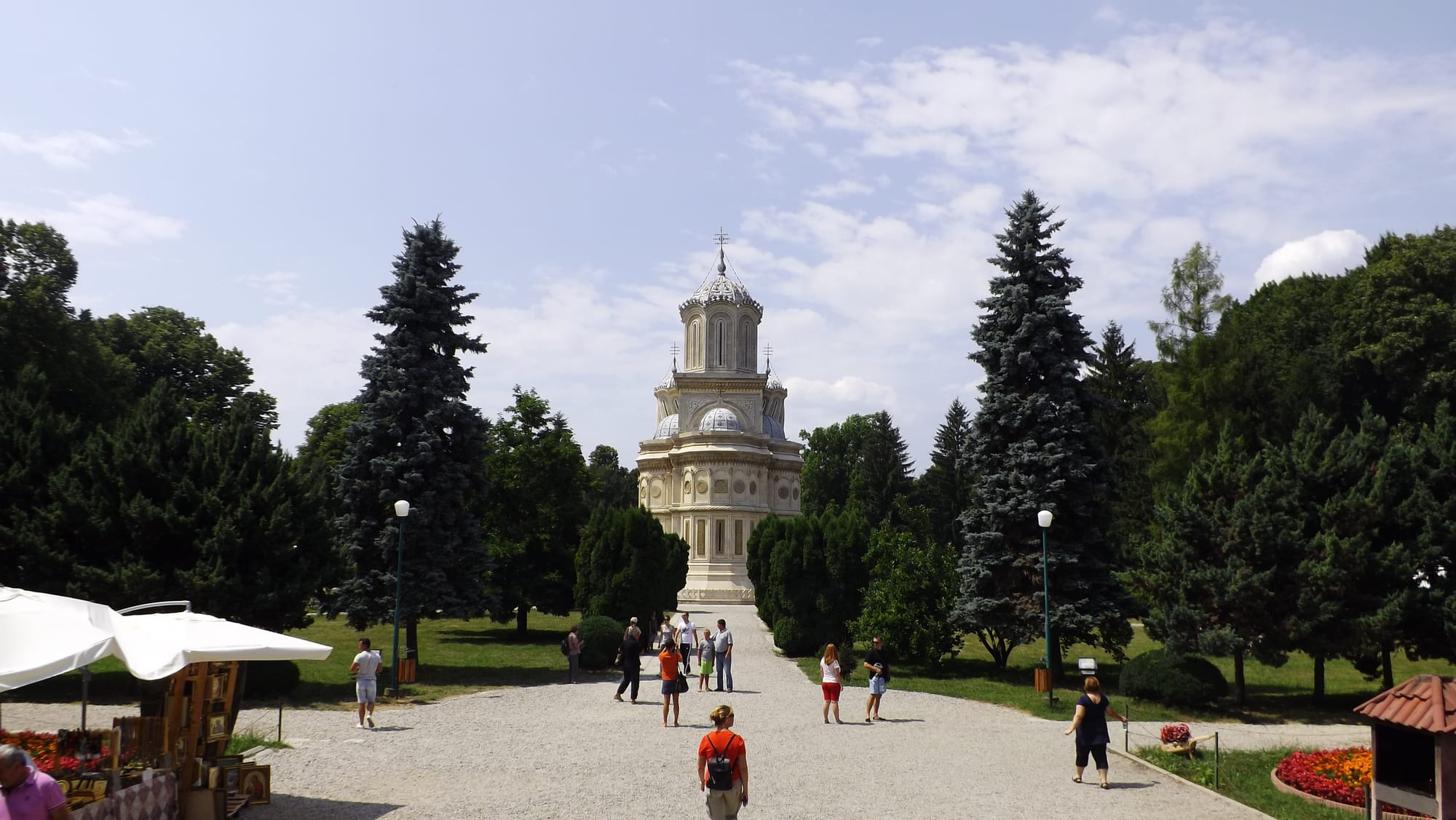
A gravel avenue between tall fir trees leading to the pale, carved stone monastery church with its twisted towers

Bucharest & Muntenia, Romania

Curtea de Argeș

The avenue through the park to the church of the Curtea de Argeș Monastery on a summer day. (Maria Radu / Wikimedia Commons · CC BY-SA 4.0)

A small town on the Argeș river where the foothills meet the Făgăraș Mountains — an early capital of Wallachia, whose name means 'the court on the Argeș'. It keeps the 14th-century Princely Church of its first rulers and the richly carved 16th-century monastery church where Romania's kings are buried, and it is the southern gateway to the Transfăgărășan road.

Neighbourhoods

  • The princely court and old centre
    • Historic district
    • Museums
    • First-time visitors

    The heart of the medieval town, where the Princely Church of St Nicholas stands within the bounds of the old princely court, across the street from the town museum. Old churches such as Olari are a short walk away.

    Open in Maps
  • The monastery quarter
    • Historic sights
    • Parks

    North of the centre, a French-style park surrounds the Curtea de Argeș Monastery church and fronts the Episcopal Palace. It is the town's showpiece, quiet in the evenings and busy with visitors and pilgrims by day.

    Open in Maps
  • The station area
    • Close to public transport

    The south of town, about 2 km below the monastery, where the ornate 1898 railway station built for Carol I's branch line stands next to the bus station.

    Open in Maps

Things to do

Churches and the princely court

  • Curtea de Argeș Monasterylandmark

    Neagoe Basarab's church of 1512–1517, faced in finely carved pale limestone and painted inside — the royal necropolis since 1886, with the tombs of Carol I, Ferdinand and Marie, and Michael I and Anne.

    Open in Maps
  • Princely Church of St Nicholaslandmark

    The church founded by Basarab I and completed in 1352 within the old princely court, the oldest princely foundation in Wallachia, with murals painted in 1364–1369.

    Open in Maps
  • Manole's Welllandmark

    The spring that, by legend, rose where Master Manole fell from the monastery roof after the prince left the builders stranded there.

    Open in Maps
  • Olari Churchlandmark

    A small church dated to before 1687, about ten minutes' walk from the Princely Church.

    Open in Maps

Museums

  • Curtea de Argeș Municipal Museummuseum

    The town museum of history and ethnography beside the Princely Church; its folk art section is in the Norocea House, built in the early 1920s by a restorer of the church's frescoes.

    Open in Maps

Short trips from the town

  • Poenari Castlelandmark

    The ruined mountaintop fortress of Vlad the Impaler on the road north into the mountains, reached by climbing 1,480 steps.

    Open in Maps
  • Vidraru Damlandmark

    A 166-metre arch dam completed in 1966, holding back Lake Vidraru between steep forested mountains on the road north.

    Open in Maps
  • Transfăgărășanviewpoint

    The high road built in the early 1970s across the Făgăraș Mountains, climbing past Poenari and Vidraru to the ridge; it is usually closed by snow from late autumn to early summer.

    Open in Maps
  • Piteștiattraction

    The Argeș county capital down the valley, a trading town since the Middle Ages and the place to join the motorway to Bucharest.

    Open in Maps

Eat and drink

Long-standing places and food districts in Curtea de Argeș. Hours, ratings and directions come from your maps app, always current.

Eating in town

  • Restaurants in the centreneighborhood

    Family restaurants and terraces in the town centre and near the monastery park serve Romanian standards such as ciorbă, sarmale and grilled mici.

    Open in Maps
  • Roadside food on the Transfăgărășanneighborhood

    Food stands and small restaurants along the DN7C north of town, including beside the foot of the Poenari steps.

    Open in Maps

Experience Curtea de Argeș

History

Curtea de Argeș is an old seat of Wallachia's rulers, and archaeology shows a ruler's seat here from the 13th century. Wallachian chronicles say the town was founded in 1290 by Radu Negru, who crossed the Carpathians from Transylvania; Hungarian documents record that in 1330 King Charles I attacked "the unfaithful" Basarab I and destroyed the Argeș stronghold. After 1340 a new court with a palace and church was built, the Metropolitan Church of Wallachia was founded here in 1359, and the town traded across the mountains with Sibiu. A Catholic bishopric served German settlers from 1381.

The court remained the princes' residence up to and including Mircea the Elder, then shared that role with Târgoviște, and in the 16th century the capital moved away for good. The Orthodox metropolitan left in 1517, trade with Sibiu and Brașov fell, and the monastery founded by Neagoe Basarab gained rights over the town, holding trials in the marketplace and running its customs house and mills.

Revival came with the kingdom. Carol I restored the monastery and made it the royal necropolis in 1886, and built a railway from Bucharest with a station of 1898 by André Lecomte du Noüy. Between the wars the Ștefănescu-Goangă brothers gave the town paved roads, a post office, a central market and a summer school that became the Vlaicu Vodă National College. Communist industrialisation brought factories for porcelain, textiles and agricultural proteins; most closed in the 1990s, though textile and fashion manufacturing continues.

Culture & Customs

The town's identity rests on two churches. The Princely Church of St Nicholas is one of the most representative monuments of medieval Romanian architecture and is on Romania's tentative list for UNESCO; its murals date from 1364–1369. The monastery church of Neagoe Basarab, faced with pale limestone that was carved while soft and hardened in the air, is the burial place of the Romanian royal family, including Carol I, Ferdinand I and Queen Marie, and Michael I and Queen Anne.

The monastery also gave Romania one of its best-known legends. In the folk ballad of Meșterul Manole, the master builder cannot finish the church until he walls up his own pregnant wife inside it; when the prince strands the builders on the roof so they can never build anything finer, Manole falls to his death, and a spring rises where he lands. The literary critic George Călinescu counted it among the four fundamental myths of Romanian folk literature.

Curtea de Argeș has been an Orthodox bishopric again since the late 18th century and is now the seat of the Archdiocese of Argeș and Muscel. The avant-garde writer Urmuz and the sociologist Mattei Dogan were born here.

Daily Life

The 2021 census counted about 26,000 people, down from about 27,400 in 2011; most residents who gave a religion are Orthodox. The town lies at about 450 metres in a basin of the upper Argeș, surrounded by hills, and covers some 75 square kilometres, including the village of Noapteș.

Most of the communist-era factories closed during the 1990s, but textile and high-end fashion manufacturing remain important employers, alongside the church, the schools — the Vlaicu Vodă National College is one of the best-regarded high schools in Romania — and tourism to the monastery and the mountains.

Life is slow and local, built around the centre's shops, the market and the churches, and the Episcopal Palace and the monastery set the rhythm of the religious year. Pitești, the county capital, is the nearest city for hospitals, universities and larger shops. In summer the town fills with visitors heading north on the DN7C towards Poenari, Vidraru and the Transfăgărășan, and the chapel of the Episcopal Palace keeps the relics of St Philofteia.

Food

Curtea de Argeș eats the Muntenian staples: ciorbă, the sour soups that start many meals; sarmale, minced meat and rice rolled in cabbage leaves; mămăligă, firm cornmeal polenta, with cheese and sour cream; and mici, grilled sausages of mixed minced beef, lamb and pork served with mustard. Ciorbă de burtă, tripe soup, is thickened with sour cream and egg yolks and sharpened with vinegar and mujdei, a garlic sauce of crushed garlic and oil.

The Argeș valley has a long wine tradition: the Ștefănești winery, across the river from Pitești, is one of the best known in Romania. Țuică, a brandy made from plums, is usually drunk in a small glass before a meal.

Papanași, fresh-cheese doughnuts topped with sour cream and fruit preserve, are a favourite dessert, and roadside stands on the DN7C, one by the foot of the Poenari steps, sell snacks to travellers heading into the mountains.

Planning tools

Budget

Curtea de Argeș is inexpensive, with guesthouses and plain restaurants at much lower prices than Bucharest or Sinaia. Costs rise mainly with a hire car, which is close to essential for Poenari, Vidraru and the Transfăgărășan.

Daily Budget Midrange
USD 80–150 (comfortable guesthouse or hotel, restaurant meals, a hire car for the Argeș valley)
Daily Budget Shoestring
USD 35–55 (guesthouse, local restaurants, buses)

The town's own sights are mainly churches and a museum, so the car is the main cost.

Best Time to Visit

May to October. The Transfăgărășan usually opens to traffic over the mountains only from late June to late October, and the high road may close at short notice in bad weather; Vidraru and Poenari can be reached from the south for longer. The town itself can be visited all year, with cold, quiet winters.

Suggested Number of Days

The town's churches and museum fill a day at an easy pace. Two or three days allow time for the mountain valley to the north and a crossing of the Făgăraș range in summer. Without a car, more time is needed, as buses up the valley are few.

First Visit
1 day
With Surroundings
2–3 days

Transportation

The centre and the monastery quarter can be covered on foot. Buses link the town with Pitești, Bucharest, Brașov, Câmpulung and Râmnicu Vâlcea, though times can be erratic. The DN7C runs south to Pitești and north up the Argeș valley into the mountains, and the DN73C crosses east to Câmpulung and west to Râmnicu Vâlcea.

Poenari, Vidraru and the Transfăgărășan are far easier with a car; check the signs in town for whether the high road is open.

Airport & Station Connections

Curtea de Argeș is the end of a branch railway from Pitești, with only a few trains a day, so most visitors come by car or bus; Pitești is 38 km to the south on the DN7C, and from there the A1 motorway runs to Bucharest. The nearest airports are Bucharest Henri Coandă, Sibiu and Craiova.

Walkability

A compact town at about 450 metres above sea level, easy to walk: the Princely Church and the museum face each other across the street, Olari Church is about ten minutes' walk away, and the monastery quarter is a short walk north. The station is about 2 km south of the monastery.

Safety

Romania is a safe country with low violent crime. Curtea de Argeș itself is quiet; the risks lie in the mountains to the north, where bears live around Poenari and along the Transfăgărășan, and on the winding, busy mountain road.

Never feed bears or leave food at roadside stops, take care on the hairpins of the DN7C, and check road conditions before driving into the mountains. Check current official travel advice before travelling.

Climate

A temperate continental climate, sheltered in a basin among the hills below the Făgăraș Mountains. Summer storms can be extreme: on 7 July 1947 the town recorded 205.7 mm of rain in 20 minutes, a world record. The mountains to the north are much colder and snowbound for much of the year.

Summer
warm — in Pitești, 38 km to the south, the average July temperature is 20.8°C
Winter
cold — in Pitești, 38 km to the south, the average January temperature is −2.4°C

Local Customs

The monastery church is the seat of the Archdiocese of Argeș and Muscel and a working cathedral as well as a royal burial place, and the chapel of the Episcopal Palace holds the relics of St Philofteia; visitors are expected to keep quiet during services.

Ask before photographing worshippers or services inside the churches.

Common Payment Methods

The currency is the Romanian leu (RON). Cards are accepted in supermarkets and many restaurants, and there are ATMs in the centre; carry cash for church entry, donations, roadside stalls and mountain guesthouses.