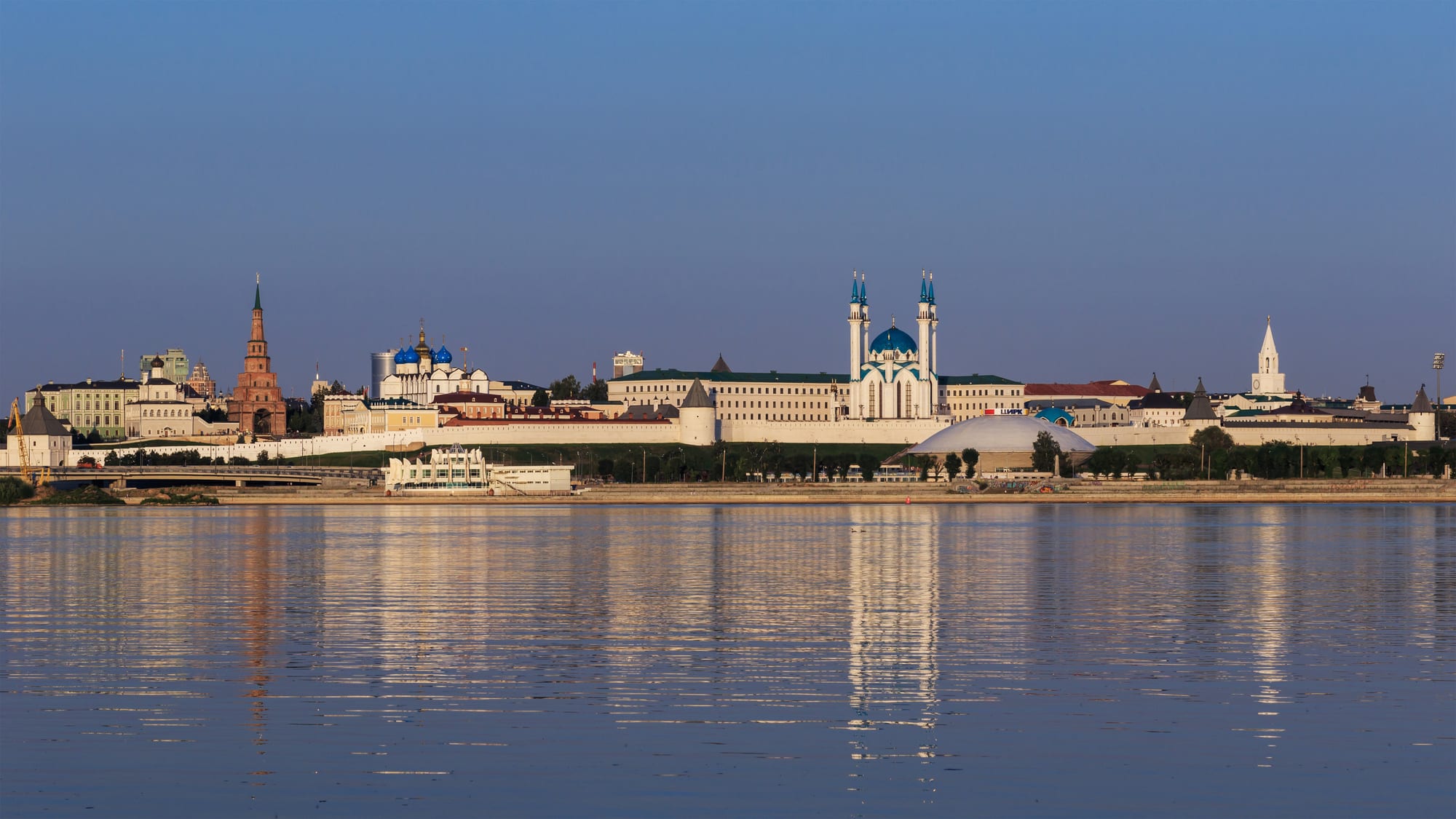
The white walls of a riverside kremlin with a blue-domed mosque, a red brick tower and blue cathedral domes reflected in calm water

The Volga, Russia

Kazan

The Kazan Kremlin, with the Kul Sharif Mosque. (A.Savin / Wikimedia Commons · FAL)

The capital of Tatarstan, where the Kazanka meets the Volga — once the seat of the Kazan Khanate, taken by Ivan the Terrible in 1552, and now Russia's fifth-largest city. Tatars and Russians live in roughly equal numbers, and a white-walled kremlin holds both a cathedral and a great mosque. This page is written to explain the city, not to encourage travel.

Neighbourhoods

  • The Kremlin and Bauman Street
    • First-time visitors
    • Historic district
    • Shops and cafés

    The historic upper town, once the Russian part of Kazan. Bauman Street, a pedestrian street paved with coloured brick and lined with lindens, runs from the foot of the Kremlin to Tukay Square, past the Epiphany bell tower, souvenir shops and cafés.

    Open in Maps
  • Old Tatar Quarter
    • History
    • Best for food
    • Mosques

    The district between the Bolaq channel and Lake Nizhny Kaban where Tatars settled after 1552. Its 18th- and 19th-century mosques and merchants' mansions along Tukay and Qayum Nasiri streets make it the heart of Tatar Kazan.

    Open in Maps
  • The Kaban Lakes
    • Walks
    • Quiet and residential

    A chain of three lakes south of the centre, Tatarstan's largest lake system, linked to the Kazanka by the Bolaq channel, with embankments along the shore of Nizhny Kaban.

    Open in Maps
  • Aviastroitelny
    • Local life
    • Industrial heritage

    The northern district built around the Kazan aircraft factory and an aircraft-engine plant, with the workers' housing that grew up beside them — a working side of the city far from the tourist centre.

    Open in Maps

Things to do

The Kremlin

  • Kazan Kremlinlandmark

    The white-walled citadel built on the ruins of the khans' castle after 1552, a UNESCO World Heritage Site since 2000, holding a cathedral, a mosque, towers and museums.

    Open in Maps
  • Kul Sharif Mosquelandmark

    The blue-domed mosque inside the Kremlin, dedicated during the city's millennium celebrations in 2005 and named after Kul Sharif, a religious scholar who died defending Kazan in 1552.

    Open in Maps
  • Söyembikä Towerlandmark

    The tiered red-brick tower that is the city's best-known symbol, once leaning by nearly two metres before it was straightened, and linked in legend with Söyembikä, the last queen of Kazan.

    Open in Maps
  • Annunciation Cathedrallandmark

    The five-domed cathedral on six piers inside the Kremlin, built in 1554–62 and its oldest building.

    Open in Maps

Churches, mosques and old streets

  • Bauman Streetneighborhood

    Kazan's main pedestrian street, from the Kremlin to Tukay Square, where fairs and festive events are held.

    Open in Maps
  • Epiphany Cathedrallandmark

    An Orthodox church on Bauman Street whose tall bell tower is one of the landmarks of the centre.

    Open in Maps
  • Saints Peter and Paul Cathedrallandmark

    A richly decorated church of 1722, one of the best-known works of Naryshkin Baroque.

    Open in Maps
  • Märcani Mosquelandmark

    Built in 1766–70 with Catherine the Great's permission, the first mosque allowed in Kazan after the conquest, in the Old Tatar Quarter.

    Open in Maps
  • Temple of All Religionsattraction

    A complex on the edge of the city, begun in 1992 by the artist Ildar Khanov, combining an Orthodox church, a mosque and other religious forms — not a working place of worship but, in its builder's words, a temple of culture.

    Open in Maps

Theatre and the university

  • Kazan Federal Universitylandmark

    Founded in 1804, the second-oldest continuously existing university in Russia, where Lobachevsky was rector and Lenin a student.

    Open in Maps
  • Galiaskar Kamal Tatar Academic Theatreattraction

    The Tatar-language theatre founded in 1906, with translation devices for those who do not understand Tatar.

    Open in Maps

Rivers, bridges and sport

  • Millennium Bridgeviewpoint

    An 835-metre cable-stayed bridge over the Kazanka, opened in 2005–07, whose 45-metre pylon is shaped like an M for the city's thousandth anniversary.

    Open in Maps
  • Ak Bars Arenaattraction

    The football stadium completed in 2013, home of Rubin Kazan and a venue of the 2018 World Cup.

    Open in Maps
  • TatNeft Arenaattraction

    The indoor arena opened in 2005, home of the ice hockey club Ak Bars Kazan.

    Open in Maps

Short trips from the city

  • Sviyazhskattraction

    The island-town fortress built in four weeks in 1551 for the siege of Kazan, whose Assumption Cathedral and Monastery are a UNESCO World Heritage Site; reached by causeway or by summer boat from Kazan.

    Open in Maps
  • Bolgharattraction

    The site of the medieval capital of Volga Bulgaria on the Volga, with monuments on the UNESCO list.

    Open in Maps

Seasonal events

  • Sabantuysecond half of June

    The Tatar summer festival, with köräş belt-wrestling on towels, horse races, sack races and pole climbing; Kazan holds the last Sabantuy of the season, usually on a Sunday.

Eat and drink

Long-standing places and food districts in Kazan. Hours, ratings and directions come from your maps app, always current.

Tatar classics

  • Echpochmakrestaurant

    The triangular Tatar pie, originally filled with fatty meat and onion, with potato added later.

    Open in Maps
  • Chak-chakcafe

    A mound of honey-drenched sweet pastry balls, common among all Turkic peoples.

    Open in Maps
  • Gubadiacafe

    A tall, round festive pie of urban Kazan Tatars with layers of rice, dried fruit and qort, a dried salty cheese.

    Open in Maps

Food districts and markets

  • Old Tatar Quarterneighborhood

    Cafés and restaurants serving Tatar food in the historic quarter around Qayum Nasiri Street.

    Open in Maps
  • Bauman Streetneighborhood

    The pedestrian street's cafés and bars.

    Open in Maps
  • Central Marketmarket

    The city's market, at the northern edge of the Old Tatar Quarter, a short walk from the main railway station.

    Open in Maps

Experience Kazan

History

Kazan's official founding date is 1005, settled by a city commission on the strength of a 10th-century Czech coin and other finds from the Kremlin hill; the town began as a border post between Volga Bulgaria and the Finno-Ugric Mari and Udmurts. After Novgorodian river pirates burned the first Kazan in 1391, the ousted Golden Horde khan Ulugh Muhammad took the town in 1438 and made it the capital of the Khanate of Kazan, known for its bazaar and its leather and gold work.

Ivan the Terrible besieged and took Kazan in 1552. Most of its Tatars were forcibly Christianised or driven out, mosques and palaces were destroyed, and Tatars were later allowed to settle only beyond the walls, in what became the Old Tatar Quarter. In 1774 Pugachev's rebels largely destroyed the city; Catherine the Great had it rebuilt in stone and allowed mosques again, beginning with the Märcani Mosque. The university was founded in 1804 and after 1905 Kazan became a centre of Tatar theatre and publishing.

In 1918 Kazan was briefly the capital of the Idel-Ural State and was occupied by the Czechoslovak Legion, and in 1920 it became capital of the Tatar ASSR. Factories evacuated during the Second World War made it a centre of tank and aircraft production, and its population passed one million in 1979. After 1991 it became the centre of a Tatar cultural revival. A sweeping renovation for the millennium in 2005 rebuilt the Kremlin and the centre but demolished many historic districts. It hosted the 2013 Universiade, World Cup matches in 2018 and the BRICS summit in 2024; in 2021 a school shooting killed nine people, and in December 2024 a Ukrainian drone attack struck the city.

Culture & Customs

Kazan presents itself as a city of two faiths and two peoples. At the 2021 census 48.8 per cent of its residents were Tatars and 46.9 per cent Russians, and the Kremlin's Annunciation Cathedral and Kul Sharif Mosque stand a short walk apart. Most Muslims follow the Hanafi school of Sunni Islam; Orthodox Christianity is the other main faith, with Catholic, Protestant and Jewish communities as well. Russian is the most spoken language and Tatar the second, and Russian, Tatar and English are used across public transport and large stores. The city's emblem is the Zilant, a winged dragon from local legend, official since 1730.

The city is the capital of Tatar culture. The Galiaskar Kamal Theatre, founded in 1906, leads a strong theatre scene alongside opera and ballet. Craft traditions survive in soft safyan leather goods and the embroidered tubeteika cap, the classic souvenir. In 2009 Kazan was granted the right to call itself the "Third Capital of Russia", a title it took from the competing Nizhny Novgorod.

Sport is a large part of the city's image: Kazan was named Russia's "sports capital" in 2009, Rubin Kazan play football at the Ak Bars Arena and Ak Bars Kazan, five-time Russian champions, play ice hockey at the TatNeft Arena. Sabantuy, the Tatar summer festival of köräş wrestling, horse racing and games, ends its season each year in Kazan.

Daily Life

About 1.31 million people lived in Kazan at the 2021 census, and about 1.8 million in the wider metropolitan area, making it the largest city on the Volga. It is divided into seven districts, from the historic Vakhitovsky in the centre to industrial Aviastroitelny in the north.

Kazan is one of Russia's largest industrial and financial centres. Its main industries are engineering, chemicals and petrochemicals, and light and food industries; the Kazan aircraft plant has built Tupolev airliners and bombers, and the city's banking capital is the third-largest in Russia. It also has the largest IT park in Russia, and Kazan Federal University alone has more than 52,000 students, about 11,500 of them from abroad. The Alabuga special economic zone elsewhere in Tatarstan produces Shahed drones for Russia's military, and its drone factory was struck by a Ukrainian drone in April 2024.

Tourism has grown fast: some four million visitors came in 2023, and the Kremlin recorded more than 4.5 million visits. Daily life runs on a modern transport network of metro, trams, trolleybuses and some 60 bus routes. Summer evenings fill Bauman Street and the lake embankments, and winters are long, cold and snowy.

Food

Tatar cooking is the city's pride. Among its pies is echpochmak, a triangular pastry originally filled with fatty meat and onions, with pieces of potato added later. Peremech is a round minced-meat pie, fried and served hot with melted butter; bälesh is a pie of fatty meat mixed with grains or potatoes; and qystybyi has been made with mashed potato since the end of the 19th century.

Gubadia, a tall round pie layered with rice, dried fruit and qort, a dried salty cheese, is a special festive dish of the urban Kazan Tatars. Horse meat is made into qazylyk sausage, cured goose and duck are delicacies, and boiled potatoes with grated horseradish are a favourite side dish. Noodle soup with homemade noodles and pieces of boiled meat or chicken is particularly popular.

Sweet baking is served with tea. Chak-chak, a mound of honey-drenched pastry balls common to all Turkic peoples, is served alongside deep-fried pancakes, qatlama rolls and the fried dough pieces called "bird's tongue". Tea is the essential hospitality drink, hot and strong, usually with milk, drunk from small cups and traditionally poured from a samovar, and tea with baked sweets sometimes replaces breakfast altogether.

Planning tools

Budget

Prices in Kazan are generally below Moscow's. The practical problem is payment: foreign cards do not work, so every rouble must come from cash brought into the country and exchanged.

Daily Budget Midrange
USD 85–170 (mid-range hotel, restaurants, museums and theatre, taxis)
Daily Budget Shoestring
USD 30–60 (hostel, canteens and Tatar bakeries, metro and buses)

Carry enough foreign cash for the whole trip; there is no way to top up with a foreign card once inside Russia.

Best Time to Visit

Late May to September, when summers are warm and sunny and the river boats run to Sviyazhsk; Sabantuy falls in the second half of June. Winters are long and colder than Moscow's.

Suggested Number of Days

Two or three days cover the centre and its old quarters. Allow four or five to add day trips along the Volga by road or boat.

First Visit
2–3 days
With Surroundings
4–5 days

Transportation

Kazan has a single metro line, opened in 2005 with eleven stations and a second line under construction, plus buses, trolleybuses and trams; announcements are made in Russian, Tatar and English. River boats leave from the port for towns along the Volga in summer.

Carry passport, visa and migration card on every train and flight.

Airport & Station Connections

Ğabdulla Tuqay Kazan International Airport lies south-east of the city, some way from the centre, and is linked to it by Aeroexpress train and bus. The main station, Kazan-Passazhirskaya, is in the centre, with overnight trains to Moscow, and federal highways connect the city with Moscow and Ufa.

Walkability

The centre is very walkable: the Kremlin, Bauman Street, the university and the Old Tatar Quarter are close together, and the Kaban lakes and the Kazanka embankments make good walks. Beyond the centre the city is spread out, and the metro or a taxi is needed. Pavements are icy in winter.

Safety

Beyond the ordinary crime of a large European city, the decisive risks are political and legal: near-total loss of consular support, a real risk of arbitrary arrest and lengthy detention of foreigners on politically motivated charges (and their use in prisoner swaps), sweeping wartime censorship laws, and the possibility that men of certain ages, including dual nationals, face conscription or exit bans. Kazan is far from the front line yet not out of the war: Ukrainian drones struck the city in December 2024 and have hit targets elsewhere in Tatarstan, and its aircraft and defence plants are sensitive sites.

Most governments advise against all travel to Russia and against any travel near the Ukrainian border. Do not photograph factories, airfields, bridges, refineries or military sites, and keep political opinions offline. Check current official travel advice before travelling.

Climate

Humid continental, with long winters colder than Moscow's and warm, sunny summers. Heatwaves can be severe: temperatures reached 39°C in 2010.

Summer
warm — July has a daily mean of about 20°C
Winter
cold and snowy — January has a daily mean of about −10°C

Local Customs

Kazan prides itself on the peaceful coexistence of its Tatar Muslim and Russian Orthodox communities; Russian is the most spoken language and Tatar the second. Tea is the Tatar hospitality drink, served hot and strong, usually with milk, from small cups so that it stays hot, with baked sweets on the side.

Dress modestly in mosques and churches, and ask before photographing people at prayer.

Common Payment Methods

The currency is the rouble (RUB). Visa and Mastercard cards issued abroad do not work, ATMs will not accept foreign cards, and most transfers are blocked, so cash brought in and exchanged at banks is the only reliable means of payment.