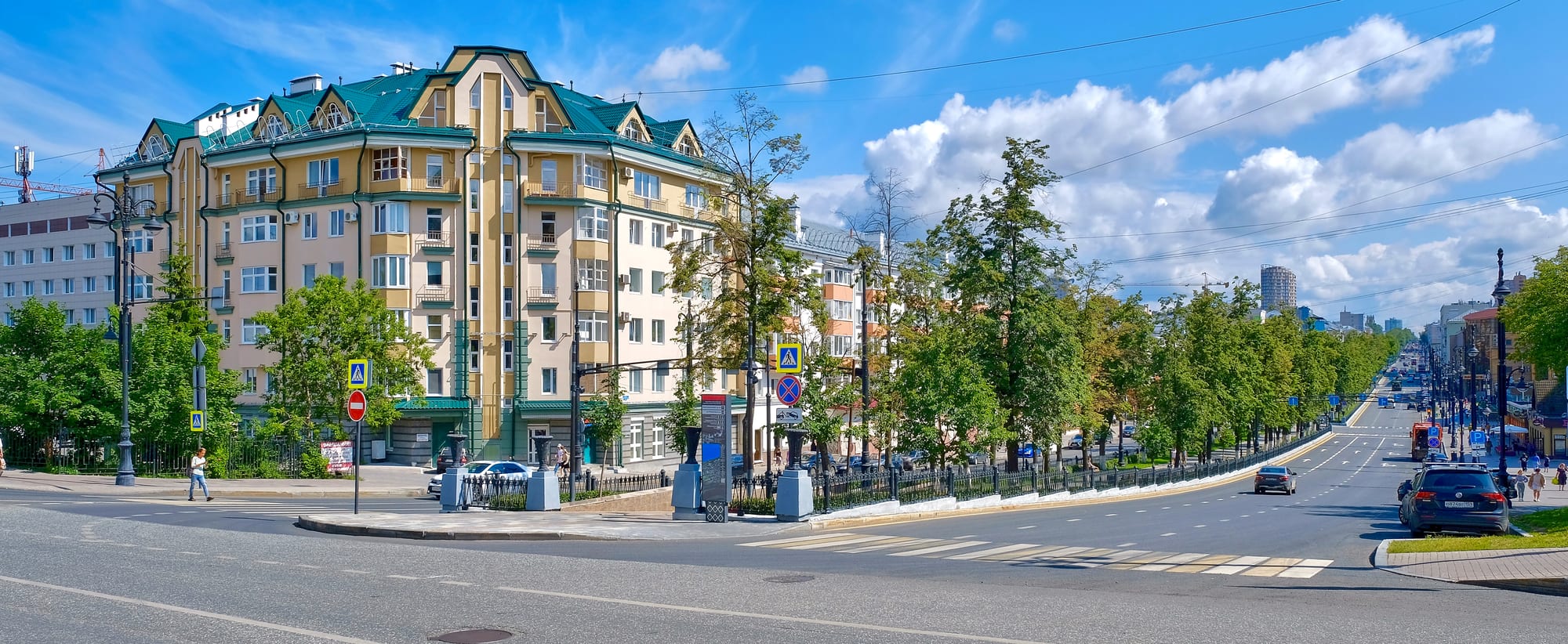
A wide tree-lined avenue in summer sun, with a cream and green apartment building with steep roofs on the corner and a tower block in the distance

The Volga, Russia

Perm

Komsomolsky Prospekt, Perm's main avenue, seen from Cathedral Square. (Vyacheslav Bukharov / Wikimedia Commons · CC BY-SA 4.0)

A city of about a million people stretched along the Kama River at the western foot of the Urals — founded around a copper works in 1723, called Molotov from 1940 to 1957 and closed to foreigners in the Cold War. It is known for its opera and ballet house, its collection of wooden sculpture and the Gulag camp nearby. This page is written to explain the city, not to encourage travel.

Neighbourhoods

  • The centre and Komsomolsky Prospekt
    • First-time visitors
    • Museums
    • Close to public transport

    The grid of streets running parallel to the Kama, with Komsomolsky Prospekt as the main avenue. The art gallery, the regional museum, the opera house, the Salty Ears sculpture and most cafés and shops are within walking distance.

    Open in Maps
  • The Kama embankment
    • Walks
    • Views

    The promenade along the Kama in the centre, looking across the wide river towards the Kommunalny Bridge and the right bank, with the main museums a few streets behind.

    Open in Maps
  • Motovilikha
    • Industrial history
    • Local life

    A former factory town east of the centre, merged into Perm in 1938 and home to the Motovilikha plants, which made a quarter of the Red Army's artillery in the Second World War. An open-air museum of the plants' weapons and a museum of the December 1905 uprising tell its story.

    Open in Maps
  • The right bank
    • Quiet and residential

    The districts across the Kama, joined to the centre by bridges, along small rivers such as the Gayva.

    Open in Maps

Things to do

Art and museums

  • Perm State Art Gallerymuseum

    The city's art museum, housed in an early 19th-century former Orthodox cathedral on Komsomolsky Prospekt, with paintings from the 15th to 18th centuries and wooden sculptures from the region.

    Open in Maps
  • Perm Museum of Contemporary Art (PERMM)museum

    A contemporary art museum opened in 2009, now in a former tram depot on Gagarina Boulevard, with changing exhibitions, talks and performances.

    Open in Maps
  • Perm Regional Museummuseum

    Founded in 1890, the oldest and largest museum in the city, covering the history and nature of the Perm lands.

    Open in Maps
  • Motovilikha open-air museummuseum

    An outdoor collection of military equipment made at the Motovilikha factories.

    Open in Maps

Landmarks and the stage

  • Perm Opera and Ballet Theatrelandmark

    The Tchaikovsky Opera and Ballet Theatre, opened in 1870 and one of the oldest theatres in Russia, whose repertoire includes all of Tchaikovsky's stage works and whose ballet troupe is among the most popular in the country.

    Open in Maps
  • Permyak Salty Earsattraction

    A 2006 street sculpture on Komsomolsky Prospekt of a photographer and a frame with huge ears, through which passers-by pose for pictures; a magazine judged it Russia's ‘strangest’ monument in 2009.

    Open in Maps
  • Immaculate Conception Churchlandmark

    The Catholic church built in 1873–75, after Poles exiled to the Urals following the 19th-century uprisings had swelled the local Catholic community.

    Open in Maps

The river

  • Kama River embankmenttrail

    The promenade above the Kama, the Volga's main tributary, here a broad river crossed by the Kommunalny Bridge of 1967.

    Open in Maps
  • Gorky Parkpark

    The Gorky amusement park, where the international snow and ice sculpture festival has been held every year since 1995.

    Open in Maps

Short trips from the city

  • Khokhlovkamuseum

    An open-air museum of wooden architecture on the right bank of the Kama, opened in 1980, with 23 buildings from the 17th to early 20th centuries moved from across Perm Krai.

    Open in Maps
  • Kungur Ice Caveattraction

    A karst cave on the Sylva River near the town of Kungur, known for its ice formations and visited by about 100,000 people a year.

    Open in Maps
  • Perm-36museum

    A former Soviet labour camp for political prisoners near the village of Kuchino, preserved by the Memorial society and opened in 1995 as a museum of political repression; the founding organisation was forced out in 2014.

    Open in Maps

Seasonal events

  • Ice, Snow and Fire festivalwinter

    An international ice and snow sculpture competition held in Gorky Park every year since 1995.

  • Diaghilev Seasons festivalevery two years

    The 'Diaghilev Seasons: Perm–Petersburg–Paris' festival, named after the ballet impresario Sergei Diaghilev and held every two years since 2003 at the opera and ballet theatre.

  • Victory Day9 May

    The biggest state occasion of the year, with parades and families marching with portraits of relatives who fought in the Second World War.

Eat and drink

Long-standing places and food districts in Perm. Hours, ratings and directions come from your maps app, always current.

Food districts and markets

  • Central Marketmarket

    The large, always crowded bazaar opposite the central bus station at the start of Kosmonavtov Avenue, with market halls and countless stalls.

    Open in Maps
  • Komsomolsky Prospekt cafésneighborhood

    The main avenue and the streets around it hold many of the city's cafés and restaurants, with Georgian, Azerbaijani and Uzbek food and blini cafés.

    Open in Maps

Experience Perm

History

Perm's name is of Uralic origin, compared with the Finnish and Vepsian perämaa, "far-away land", and it passed in turn to the Permian period of geology. A village called Yagoshikha was recorded on the Kama in 1647, but the city really began in 1723, when Vasily Tatishchev, Peter the Great's manager of the Ural works, founded a copper-smelting plant there, in the same years as Yekaterinburg. It received city status and the name Perm in 1781.

Its place on the navigable Kama and on the Siberian Route made it a trading and manufacturing town, and also a stage on the road to exile: in 1813 almost the whole population was said to be exiles, and Polish insurgents of the November Uprising, exiled here in the 1830s, were allowed to settle in the city. After a great fire in 1842 the city was rebuilt; an opera house opened in 1870 and a university in 1916. In the Civil War the Whites took it in December 1918 and the Reds retook it in July 1919.

Soviet industrialisation added aircraft, ship and chemical plants, and in 1940 the city was renamed Molotov, after Stalin's foreign minister. In the Second World War it was a leading centre of artillery production, and in the Cold War it became a closed city. The old name returned in 1957. Its recent history includes the Lame Horse nightclub fire of 2009, which killed 156 people, and a shooting at the university in 2021.

Culture & Customs

Perm's cultural pride is its stage. The Tchaikovsky Opera and Ballet Theatre, often called "Tchaikovsky's House" because the composer was born in the region, keeps all his operas and ballets in its repertoire, and its ballet company is among the most popular in Russia. The Diaghilev Seasons festival, named after the impresario Sergei Diaghilev, has been held every two years since 2003, and Perm also has drama and puppet theatres.

The art gallery, in a former cathedral on Komsomolsky Prospekt, is known for its wooden sculptures from the region. In the late 2000s the city tried to remake itself through contemporary art: the PERMM museum opened in 2009 and was praised abroad, until its founding director was dismissed in 2013 after an exhibition satirising the Sochi Olympics. Street sculptures such as the bronze "Legend of the Perm Bear" and the Salty Ears, through whose frame passers-by pose, are favourite photo spots.

Boris Pasternak lived here for a time, and the city appears as "Yuriatin" in Doctor Zhivago. Perm has produced figure-skating champions and a women's world chess champion, and once had a national champion basketball team, Ural Great.

Daily Life

About 1.03 million people lived in Perm in 2025. The city stretches some 70 km along the Kama, which divides it into the central left bank and the right bank, and its districts spread over hilly ground crossed by many small rivers.

Perm has the largest industrial output of any city in the Urals. It refines oil piped from West Siberia, makes aircraft engines at Perm Motors and Aviadvigatel, rocket engines at Proton-PM and artillery at Motovilikha, and has a large chemical industry; oil production, about 3% of Russia's output, and timber processing are also among its leading industries. Since 2022 refineries and factories across the Volga region have become targets for Ukrainian drones. Several universities, led by Perm State University, make it a student city.

Daily life follows the long, snowy winter and summer weekends on the river and at the dacha. Hydrofoils returned to the Kama routes in 2025, and a new city zoo opened the same year.

Food

Perm eats in the Russian way: borsch and shchi, blini, kasha and pirozhki, pickled cucumbers and mushrooms, and sour cream and dill on almost everything. Pelmeni — dumplings with a filling wrapped in thin, unleavened dough — have particular local weight: they became a Russian staple during the expansion into the Urals and Siberia, and their name was borrowed from the Komi and Udmurt languages.

Zakuski — pickled cucumbers and mushrooms, herring and black bread — open a proper meal, with toasts, and blini are eaten in vast quantities at Maslenitsa before Lent. Georgian, Azerbaijani and Uzbek restaurants are common, and blini cafés serve the thin pancakes. The Central Market opposite the bus station is the place to see the city's produce, in its market halls and countless stalls. Strong tea with jam and kvass are the everyday drinks, and in winter the warm canteens and cafés of the centre fill up with people escaping the cold.

Planning tools

Budget

Perm is cheaper than Moscow and similar in cost to the other large Volga and Ural cities. As everywhere in Russia, the difficulty is payment rather than price: most foreign cards no longer work, so the money for the stay has to be brought in as cash.

Daily Budget Midrange
USD 85–170 (mid-range hotel, restaurants, museums and a night at the opera)
Daily Budget Shoestring
USD 30–60 (hostel, canteens and the market, trams and buses)

Carry enough foreign cash for the whole stay; a trip out to Khokhlovka or Kungur adds transport costs.

Best Time to Visit

June to early September for the river, the embankment and the open-air museums. Winters are long, snowy and cold, though the ice sculpture festival is held in winter. Timing matters less than the national picture: most governments advise against all travel to Russia.

Suggested Number of Days

Two days are enough for the museums, the embankment and an evening at the theatre. Allow three or four to add the open-air museum of wooden architecture and the ice cave, which are each a separate trip out of the city.

First Visit
2 days
With Surroundings
3–4 days

Transportation

Perm has trams, buses and a city railway; the trolleybuses stopped running in 2019, and plans for a metro were never built. The city stretches for tens of kilometres along the Kama, so crossing it can take several changes. Taxis are ordered by app.

Carry passport, visa and migration card at all times, and use app-ordered taxis rather than street cabs.

Airport & Station Connections

Perm International Airport at Bolshoye Savino is about 16 km south-west of the city, with buses into town. Perm lies on the Trans-Siberian Railway; the main station is Perm II, and trains from Moscow take about 20 hours. Buses run to Yekaterinburg, Izhevsk and Chelyabinsk, and recreational cruises use the Kama river port.

Walkability

The centre is a walkable grid parallel to the river, with the main museums, the opera house and the embankment close together. Beyond it the city is long and spread out along both banks of the Kama, and those distances need trams or buses. Pavements are icy and snowy in winter.

Safety

Beyond the ordinary crime of a large European city, the decisive risks are political and legal: near-total loss of consular support, a real risk of arbitrary arrest and lengthy detention of foreigners on politically motivated charges (and their use in prisoner swaps), sweeping wartime censorship laws, and the possibility that men of certain ages, including dual nationals, face conscription or exit bans. The Volga region is far from the front line yet not out of the war: Ukrainian long-range drones have struck refineries, airfields and factories in the region, and Perm's refinery and arms and engine plants are sensitive sites. Pickpocketing occurs on crowded transport and in the markets.

Most governments advise against all travel to Russia and against any travel near the Ukrainian border. Do not photograph factories, airfields, bridges, refineries or military sites, and keep political opinions offline. Check current official travel advice before travelling.

Climate

Warm-summer continental, with long, snowy, quite cold winters. September, October and November are colder than May, April and March respectively. Snow can lie up to 60 cm deep in winter.

Summer
warm, with most of the year's rain from June to August; the record high is 37.5°C, set in July 2023
Winter
long, snowy and quite cold; the record low is −47.1°C

Local Customs

Perm is mostly Orthodox, with Muslim Tatar and other minorities and a Catholic church with roots in the Polish exiles of the 19th century. In Orthodox churches women usually cover their heads and men remove hats. Hospitality around the table, with zakuski and toasts, matters, and Victory Day is treated with great seriousness.

Do not photograph factories, military sites or police, and avoid political conversations with strangers; wartime laws punish public criticism of the army.

Common Payment Methods

The currency is the rouble (RUB). Western credit and debit cards such as Visa and Mastercard do not work in Russia, and most foreign bank cards cannot be used at Russian ATMs, so all the money needed has to be brought in as cash.