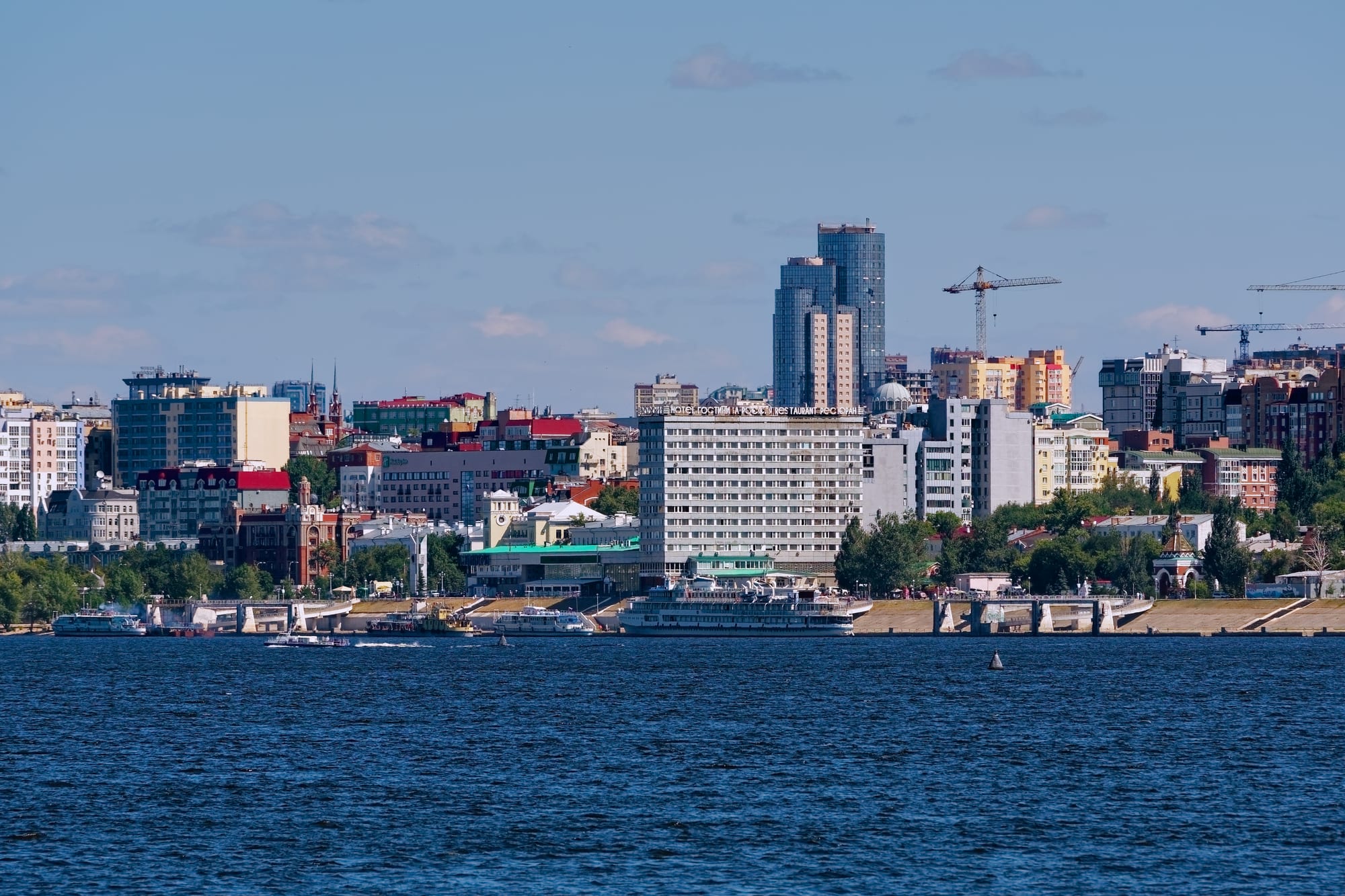
Samara's riverside seen across the blue Volga, with river boats at the quay, a white hotel block and two tall glass towers behind

The Volga, Russia

Samara

Samara's Volga embankment seen from the river. (Alexxx1979 / Wikimedia Commons · CC BY-SA 4.0)

A city of about 1.15 million on the left bank of the Volga where the Samara River joins it — founded as a frontier fortress in 1586, renamed Kuybyshev in 1935 and made the Soviet Union's reserve capital in 1941. Long a closed city of rocket factories, it is known for its Volga embankment, merchant mansions and Stalin's bunker. This page is written to explain the city, not to encourage travel.

Neighbourhoods

  • Old Samara
    • First-time visitors
    • Historic district
    • Architecture

    The merchant city laid out on a grid between the Volga and the Samara River, with Kuybyshev Square, the drama theatre, Art Nouveau mansions, wooden houses and the shopping street Leningradskaya. Many old ensembles were lost to office and apartment blocks after the 1990s, but whole streets of 19th- and early 20th-century houses remain.

    Open in Maps
  • The Volga embankment
    • Walks
    • Beaches
    • Summer evenings

    A pedestrian promenade about 5 km long on the Volga bank, built in stages from 1940, with a city beach, summer cafés and views across the river. The old Zhigulevskoye brewery and, opposite it, the Iveron convent stand on Volzhsky Prospekt by the river.

    Open in Maps
  • Oktyabrsky district
    • Views
    • Parks
    • Quiet and residential

    The higher ground upriver from the old centre, around the Square of Glory with its Monument of Glory and eternal flame, the Victory Garden and the Elephant House of Golovkin's dacha. The square looks down on the embankment and the Volga.

    Open in Maps
  • Bezymyanka and the industrial east
    • Soviet history
    • Local life

    The factory district built up under the post-war city plan as a second centre, linked to the old town by rail and bus. Today the metro line runs out here, past the large red-brick mosque near Gagarin Park.

    Open in Maps
  • Krasnoglinsky district
    • Views
    • Outdoors

    The northern outskirts, with the Helipad viewpoint and the Krasnaya Glinka ski complex, a good place for beginner skiers and snowboarders.

    Open in Maps

Things to do

Landmarks of the wartime capital

  • Stalin's bunkerlandmark

    An air-raid shelter dug in 1942 some 37 metres below the regional party building as a reserve headquarters for Stalin, who never used it. Declassified in 1990, it is now a civil defence museum.

    Open in Maps
  • Kuybyshev Squarelandmark

    The second-largest public square in Europe, on the site of a cathedral demolished in the 1930s, with the opera and ballet theatre and seven hectares of gardens. A military parade was held here in November 1941.

    Open in Maps
  • Soyuz rocket monumentlandmark

    A real Soyuz launch vehicle standing upright on Lenin Avenue since 2001 in honour of the city's rocket builders, with the Cosmic Samara space museum in its base.

    Open in Maps

Churches, mosques and mansions

  • Sacred Heart Churchlandmark

    A red-brick neo-Gothic Catholic church consecrated in 1906, whose two 47-metre towers long made it the tallest building in the city; it was closed in Soviet times and returned to worshippers in 1991.

    Open in Maps
  • Iveron Conventlandmark

    An Orthodox convent on the Volga founded as a women's community in 1850, closed in 1925 and revived from 1992 in its surviving churches and buildings.

    Open in Maps
  • Golovkin's dachalandmark

    The Elephant House, a mansion built in 1908–09 by the merchant and self-taught artist Konstantin Golovkin, with Vienna Secession influences and elephant sculptures visible from the Volga.

    Open in Maps
  • Samara Mosquelandmark

    One of the largest mosques in Russia, built of red brick in the late 1990s, with a 13.5-metre main dome and a minaret of 67 metres.

    Open in Maps

Museums

  • Kurlina Mansion — Art Nouveau museummuseum

    The Art Nouveau mansion of the merchant's wife and philanthropist Alexandra Kurlina, now a house-museum.

    Open in Maps
  • Ulyanov family house-museummuseum

    The merchant's house where the Ulyanov family rented a flat in the early 1890s, while the young Vladimir Ulyanov — later Lenin — worked at the Samara court.

    Open in Maps
  • Samara Art Museummuseum

    The city's art museum on Kuybysheva Street, one of the largest museums of the Volga region, with an oriental collection on the third floor.

    Open in Maps

The Volga and the parks

  • Samara embankmenttrail

    The 5 km pedestrian promenade along the Volga, lined with granite, sculptures and summer cafés, with a city beach that has drawn swimmers since 1939.

    Open in Maps
  • Strukovsky Gardenpark

    The oldest park in the city, opened in 1849 in the centre and named after Grigory Strukov, who once owned the land.

    Open in Maps

Sport and the stage

  • Solidarnost Samara Arenaattraction

    The flying-saucer-shaped football stadium of about 45,000 seats built for the 2018 World Cup, now the home of Krylia Sovetov Samara of the Russian Premier League.

    Open in Maps

Short trips from the city

  • Samarskaya Luka National Parkpark

    The national park covering most of the peninsula inside the Volga's 180-degree bend around the Zhiguli Mountains, popular for hiking, with six museums on its grounds.

    Open in Maps
  • Zhiguli Mountainstrail

    Wooded limestone hills on the right bank of the Volga inside the Samara Bend, rising to about 381 metres and popular for walks and regional tourism.

    Open in Maps
  • Tolyattiattraction

    The car-making city upriver, known before 1964 as Stavropol and home of Russia's largest carmaker, AvtoVAZ, maker of the Lada.

    Open in Maps

Seasonal events

  • Victory Day9 May

    The biggest state occasion of the year, with parades and families marching with portraits of relatives who fought in the Second World War.

  • Grushinsky Festivallate June or early July

    A festival of guitar-poetry 'bard' songs held since 1968 on the Mastryukovo lakes near Samara, with a stage on a guitar-shaped raft; since 2007 a rival festival of the same name is also held near Tolyatti.

  • Parade of 7 November7 November

    A military parade on Kuybyshev Square, held each year since 2011 to recall the parade of November 1941, when the city served as the wartime capital.

Eat and drink

Long-standing places and food districts in Samara. Hours, ratings and directions come from your maps app, always current.

Samara classics

  • Zhigulevskoye at the old breweryrestaurant

    The brewery founded in 1881 by the Austrian Alfred von Vacano gave the Soviet Union its best-known beer, Zhigulevskoye; a bar and a restaurant near the brewery on Volzhsky Prospekt serve it fresh.

    Open in Maps

Food districts and cafés

  • Embankment cafésneighborhood

    In summer the Volga promenade fills with open-air cafés looking over the water and the beach.

    Open in Maps
  • Leningradskaya Streetneighborhood

    The pedestrian shopping street of the old town, with cafés and restaurants on the streets around it, including Georgian food on Kuybysheva Street.

    Open in Maps

Experience Samara

History

Long before the city, the Arab envoy Ahmad ibn Fadlan passed through the area around 921 on his way to the Volga Bulgars, and a Volga port called Samara appears on Italian maps of the 14th century. The Samara Bend was a nest of river pirates until 1586, when a wooden fortress with eleven towers was built at the meeting of the Volga and the Samara River. A customs office followed in 1600. It opened its gates to the rebel armies of Stepan Razin and Yemelyan Pugachev, welcoming them with bread and salt.

In 1851 Samara became the capital of its own governorate, with about 20,000 people, and the railway to Orenburg, built through the city in 1875–77, strengthened its role as a major trading centre. It was renamed Kuybyshev in 1935 after the Bolshevik Valerian Kuybyshev. In October 1941, with Moscow threatened, government offices, foreign embassies and leading theatres were evacuated here and the city served as the Soviet Union's reserve capital until the summer of 1943. Stalin's bunker was dug beneath the regional party building in 1942 but never used, and Shostakovich finished his Seventh Symphony in the city.

After the war the defence industry grew rapidly and Kuybyshev became a closed city. The Vostok launcher that carried Yuri Gagarin into orbit in 1961 was built at the Progress plant, and Gagarin rested here after his flight. The city took back the name Samara in January 1991, opened up, and hosted World Cup matches in 2018.

Culture & Customs

Samara has an opera and ballet theatre on Kuybyshev Square, a philharmonic hall and five drama theatres. Its architecture is a large part of its identity: more than 2,000 heritage buildings, from carved wooden houses to the Art Nouveau mansions of merchant families, though many ensembles were lost to a "concrete tsunami" of new blocks after the 1990s. The writers Aleksey Tolstoy and Maxim Gorky and the painters Ilya Repin and Vasily Surikov all lived in the city.

The wartime years remain central to local pride. The city carries the titles "City of Labour and Combat Glory" and "City of Labour Valour", and a parade on Kuybyshev Square each November recalls the parade of 1941. The space age is the other civic theme, celebrated by the Soyuz rocket on Lenin Avenue and an aerospace museum at the university.

Music has its own tradition in the Grushinsky Festival, held near the city since 1968, which grew from a gathering of bard singer-songwriters into an open-air event that drew 140,000 spectators in 1997. Football means Krylia Sovetov, and Samara is also a centre of ice speedway. The city is multi-confessional, with an Orthodox majority and Catholic, Armenian, Muslim and Jewish communities.

Daily Life

About 1.15 million people lived in Samara in 2025, and up to 1.22 million in the wider urban area. The city stretches along the Volga, and for most of the 20th century it had two centres: the old merchant town by the river and Bezymyanka, the factory district to the east built up after the war, with Soviet housing estates between them.

Industry still dominates. Samara builds launch vehicles and satellites at the Progress rocket centre and engines at the Kuznetsov design bureau, makes aircraft, cable and rolled aluminium, and refines oil, and it is one of the main university cities of the Volga, led by its aerospace university. Since 2025 Ukrainian drones have struck the oil refinery at nearby Novokuybyshevsk.

Summer life moves to the river: the embankment, the city beach, boats across to the Zhiguli hills and weekends at the dacha. Winter means snow-covered streets. Most people get around by tram, bus or the single metro line, and an eleventh metro station has been under construction for several years.

Food

Samara eats the food of the middle Volga: Russian soups such as borsch and shchi, pelmeni dumplings, blini, kasha and pirozhki, cold okroshka in summer, and fish from the river, including ukha, a clear Russian fish soup. Zakuski of pickled cucumbers and mushrooms, herring and black bread open a proper meal, with toasts. Echpochmak, the triangular Tatar and Bashkir turnover of chopped meat, onion and potatoes, spread to public canteens across the Soviet Union from the late 1960s.

The city's own contribution is beer. The Austrian Alfred von Vacano founded a brewery here in 1881 that made "Viennese Beer"; in the 1930s, legend has it, it was renamed Zhigulevskoye, and in Soviet times it was at times almost the only beer brand found anywhere in the country. The old brewery still stands on Volzhsky Prospekt by the embankment, with a bar and a restaurant nearby.

Kvass, the mildly fermented rye drink, and strong tea with jam are the everyday drinks. Georgian food is served in the old town, and in summer cafés line the Volga promenade.

Planning tools

Budget

Samara is cheaper than Moscow and in line with the other large Volga cities. As everywhere in Russia, the difficulty is payment rather than price: most foreign cards no longer work, so the money for the stay has to be brought in as cash.

Daily Budget Midrange
USD 85–170 (mid-range hotel, restaurants, museums and the bunker tour)
Daily Budget Shoestring
USD 30–60 (hostel, canteens and markets, trams, buses and the metro)

Carry enough foreign cash for the whole stay; many of the best things — the embankment, the beach, the squares and the old streets — cost nothing.

Best Time to Visit

Late May to September, when the embankment, the beach and the river boats are busy and the Zhiguli hills across the Volga are green; the Grushinsky song festival is traditionally held in early July. Winters are cold. Timing matters less than the national picture: most governments advise against all travel to Russia.

Suggested Number of Days

Two days cover the old town, the embankment and the main museums. Allow three or four to add the Samara Bend and the Zhiguli hills across the river.

First Visit
2 days
With Surroundings
3–4 days

Transportation

Trams are the backbone: the network opened in 1915 and has around 25 lines, alongside trolleybuses, buses and minibuses. The single metro line, opened in 1987, has ten stations and runs east–west from the centre towards the industrial districts. Taxis are ordered by app.

Carry passport, visa and migration card at all times, and use app-ordered taxis rather than street cabs.

Airport & Station Connections

Kurumoch International Airport, which also serves Tolyatti, is about 35 km north of the city, with flights across Russia and to Central Asia, China and the Middle East. Overnight trains from Moscow take about 13 to 20 hours, and Samara lies on the M5 highway between Moscow and the Urals. Local passenger boats leave from the river station.

Walkability

The old town is compact and laid out on a grid, and the Volga embankment runs along its edge, so the centre is easy to explore on foot. The city stretches a long way along the river and out to the industrial east, and those distances need the tram or metro. Pavements are icy in winter.

Safety

Beyond the ordinary crime of a large European city, the decisive risks are political and legal: near-total loss of consular support, a real risk of arbitrary arrest and lengthy detention of foreigners on politically motivated charges (and their use in prisoner swaps), sweeping wartime censorship laws, and the possibility that men of certain ages, including dual nationals, face conscription or exit bans. The Volga region is far from the front line yet not out of the war: Ukrainian long-range drones have struck refineries, airfields and factories in the region, and Samara's aerospace and defence plants are sensitive sites.

Most governments advise against all travel to Russia and against any travel near the Ukrainian border. Do not photograph factories, airfields, bridges, refineries or military sites, and keep political opinions offline. Check current official travel advice before travelling.

Climate

Humid continental, with hot summers and cold winters. The average annual temperature is about 6°C, and summer and winter monthly averages differ by as much as 31°C.

Summer
hot — the record high is 40.4°C, and in nearby Tolyatti July averages about 21°C
Winter
cold — in nearby Tolyatti, upriver, January averages about −10.6°C

Local Customs

Samara is mostly Orthodox Christian, with Armenian, Catholic, Protestant, Muslim and Jewish minorities. In Orthodox churches women usually cover their heads and men remove hats; shoulders and knees should be covered in churches and mosques alike. Hospitality around the table, with zakuski and toasts, matters, and Victory Day is treated with great seriousness.

Do not photograph factories, military sites or police, and avoid political conversations with strangers; wartime laws punish public criticism of the army.

Common Payment Methods

The currency is the rouble (RUB). Western credit and debit cards such as Visa and Mastercard do not work in Russia, and most foreign bank cards cannot be used at Russian ATMs, so all the money needed has to be brought in as cash.