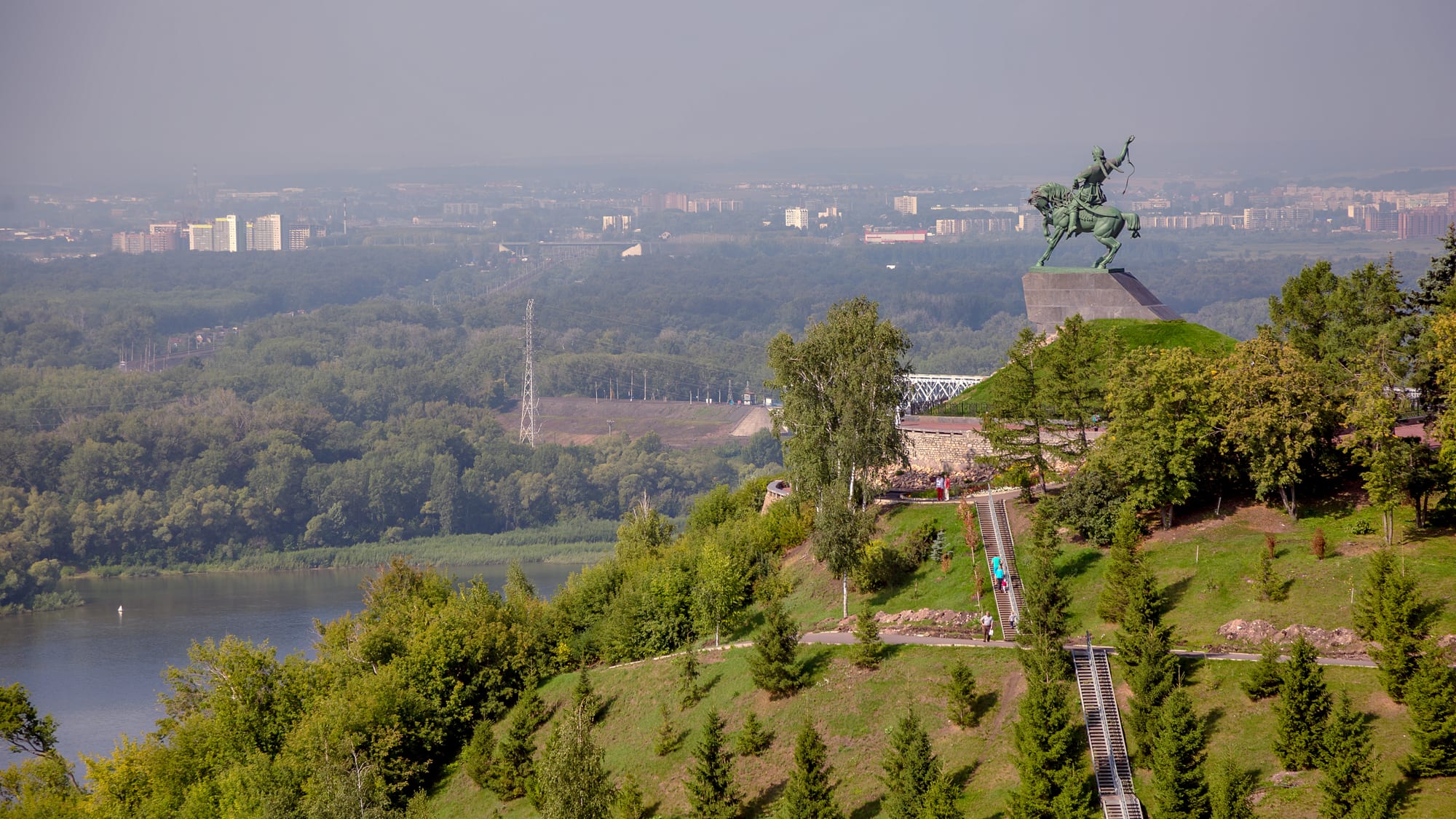
A bronze equestrian statue on a stone plinth on a green wooded bluff above a river, with a hazy city spread across the plain beyond

The Volga, Russia

Ufa

The monument to Salawat Yulayev on its bluff above the Belaya River in Ufa, photographed in 2014. (Gummy-beer / Wikimedia Commons · CC0)

The capital of Bashkortostan, a city of about 1.19 million on hills above the meeting of the Belaya and Ufa rivers, west of the southern Urals. Founded as a Russian fort in 1574 and long the seat of Russia's Muslim authorities, it is now an oil-refining city of Russians, Bashkirs and Tatars, with mosques and wooden houses. This page is written to explain the city, not to encourage travel.

Neighbourhoods

  • The Old City
    • First-time visitors
    • Historic district
    • Museums

    The historic centre on the southern end of the plateau, between Aksakov and Tsyurupa streets, around Gostiny Dvor, the old merchant trading hall, and Lenin Street. Pre-revolutionary houses, carved wooden cottages on streets such as Gogol Street, the national museum and the art museum are all here.

    Open in Maps
  • Trunilovskaya Sloboda and Tukayev Street
    • Mosques
    • Local life

    Old settlements on the steep slope above the Belaya, with colourful one-storey houses, the oldest surviving mosque in the city, Lenin Park and the modern Bashkir drama theatre.

    Open in Maps
  • Trinity Hill and the Belaya bluffs
    • Views
    • Monuments

    The high edge of the city over the river, with the Friendship Monument, the bluff of the Salawat Yulayev monument and lookout points across the Belaya to the plain beyond.

    Open in Maps
  • Chernikovka
    • Soviet architecture
    • Mosques

    A former separate city in the north, built around the refineries and engine works, with solid Stalin-era streets, Victory Park on the high riverbank and the Lala Tulpan mosque.

    Open in Maps

Things to do

Landmarks above the Belaya

  • Monument to Salawat Yulayevlandmark

    The 1967 equestrian statue of the Bashkir national hero, poet and rebel leader, which appears on the republic's coat of arms; it was taken down for restoration in 2025, with its return planned for 2027.

    Open in Maps
  • Russian-Bashkir Friendship Monumentlandmark

    A stele on a hill above the Belaya, opened in 1965, with bronze women representing Russia and Bashkortostan at its base.

    Open in Maps
  • Gostiny Dvorlandmark

    The old merchant trading hall on Verkhnetorgovaya Square, the older of the city's two market squares, once ringed by merchant mansions, some of which survive.

    Open in Maps

Mosques and theatres

  • Lala Tulpan Mosquelandmark

    One of Russia's largest mosques, built in 1990–98 in Chernikovka, whose twin 53-metre minarets are shaped like tulip buds about to open.

    Open in Maps
  • Tukayevskaya Mosquelandmark

    The oldest surviving mosque in the city, a classical building of 1830 that served as the main mosque of Russia's Muslim administration, surrounded by the tombs of Ufa's muftis.

    Open in Maps
  • Bashkir Academic Drama Theatrelandmark

    The Bashkir-language drama theatre named after the writer Mazhit Gafuri, in a building declared an architectural monument and counted among the best examples of modern Bashkir national architecture.

    Open in Maps

Museums

  • Bashkir Nesterov Art Museummuseum

    Founded in 1920 and named after the Ufa-born painter Mikhail Nesterov, with works by Repin, Vrubel, Aivazovsky, Serov, Levitan and Kustodiev among others.

    Open in Maps
  • Bashkortostan National Museummuseum

    The republic's main museum of history, archaeology, nature and ethnography, in the 1905 Art Nouveau building of the Peasant Land Bank, with a model of the painted Kapova Cave.

    Open in Maps

Parks and sport

  • Victory Parkpark

    A park laid out in 1947 on the high bank of the Belaya in Chernikovka, dedicated to the Second World War, with monuments, artillery guns and a tank.

    Open in Maps
  • Yakutov Parkpark

    A small city park founded in 1904, with a boating lake and a children's railway 1.8 km long.

    Open in Maps
  • Ufa Arenaattraction

    The 8,500-seat arena opened in 2007, home of Salavat Yulaev Ufa, the ice hockey club that won the KHL's Gagarin Cup in 2011.

    Open in Maps

Short trips from the city

  • Chishmyattraction

    A small settlement near Ufa with two medieval mausoleums, the oldest architectural monuments in Bashkortostan.

    Open in Maps

Seasonal events

  • Sabantuysummer

    The Bashkir and Tatar summer festival, once a farmers' feast and now a national holiday also celebrated in the cities, with horse races, wrestling and games.

  • Victory Day9 May

    The biggest state occasion of the year, with parades and families marching with portraits of relatives who fought in the Second World War.

Eat and drink

Long-standing places and food districts in Ufa. Hours, ratings and directions come from your maps app, always current.

Ufa classics

  • Bashkir tea and pastriescafe

    Bashkir cafés serve the 'tea party' — tea always taken with milk, alongside pies, honey, sour cream and boiled meat — and the pastries sold across the city.

    Open in Maps
  • Summer shashlikneighborhood

    In summer, grilled shashlik is sold in squares and outside shopping centres all over the city.

    Open in Maps

Food districts

  • Lenin Street and Gostiny Dvorneighborhood

    The old centre's main street and its market square hold the densest cluster of cafés, canteens and restaurants.

    Open in Maps

Experience Ufa

History

People have lived around Ufa since the Palaeolithic, and a medieval town may have stood here: 14th-century maps, including the Catalan Atlas of 1375, mark a town called Pascherti, or Bashkort, near the Belaya, and the historian Ibn Khaldun counted Bashkort among the larger cities of the Golden Horde. The Russian city dates from 1574, when Ivan the Terrible ordered a fortress built on the hill of Tura-Tau after the Bashkirs accepted Moscow's rule; it became a town in 1586. For two centuries it was a frontier fort, periodically attacked by rebellious Bashkirs, and was caught up in Pugachev's rebellion of 1773–75, in which the Bashkir poet and commander Salawat Yulayev fought.

Catherine II made the city the seat of the Muslim Spiritual Assembly, the official body of Russia's Muslims, and Ufa became a centre of Islamic learning with madrasas that still stand. It became capital of its own governorate in 1865, and the Belaya steamship route (1870) and the Samara–Zlatoust railway (1890) linked it to European Russia. The singer Fyodor Chaliapin, at the start of his career, sang in an operetta chorus here in 1890.

Ufa went on to become the capital of the Bashkir ASSR, the first autonomous republic of Soviet Russia, and of today's Republic of Bashkortostan. Factories evacuated in 1941 and the oil boom after the war turned a modest town into a refining and engineering city, and it passed a million people in 1980. In 1989 a gas explosion beside the railway about 75 km away killed 575 train passengers. Ufa hosted the BRICS and Shanghai Cooperation Organisation summits in 2015.

Culture & Customs

Ufa is Bashkir, Tatar and Russian at once. Ethnic Russians are the majority, but Bashkirs and Tatars are numerous, and Sunni Islam and Orthodoxy are the main faiths; the Central Spiritual Administration of Muslims of Russia and the Russian Islamic University, opened in 1989, are based here. Almost all of the city's mosques have been rebuilt or newly built, the best known being Lala Tulpan, while the modest classical mosque of 1830 recalls the old Muslim administration.

Salawat Yulayev, the 18th-century rebel and poet, is the republic's hero: his statue on the bluff appears on the coat of arms, an opera about him was written in 1955, and the city's ice hockey club bears his name. Modern Bashkir architecture, with national motifs, can be seen in the drama theatre and the Dynamo stadium beside it. The art museum is named after the Ufa-born painter Mikhail Nesterov.

Sabantuy, the summer "plough's feast", is celebrated in the city as well as the villages. Ice hockey is the passion: Salavat Yulaev won the Gagarin Cup in 2011. Ufa's odder touches include its nickname, the City of Three Screws, from the look of its Bashkir name, ӨФӨ, and a 2020 monument to a tick.

Daily Life

About 1.19 million people lived in Ufa in 2025, with up to 1.4 million in the wider area. The city runs for more than 50 km along a narrow plateau between the rivers: the old centre in the south, Soviet districts in the middle, and the refineries and engine works of Chernikovka in the north.

Oil refining, petrochemicals and engineering dominate. The oil company Bashneft has its headquarters here and runs the city's refineries and petrochemical plant, and a large works builds gas-turbine engines. There are about 200 large and medium industrial enterprises and several universities, including Bashkir State University and the aviation and petroleum universities. In the post-war decades the population grew with the region's oil and chemical industries.

Air pollution is a recurring concern, with suspended dust above permitted levels recorded across the city's monitoring posts in 2017, and the city suffers from traffic congestion and a lack of parking. A long-promised metro has been frozen indefinitely; in 2024 a new eastern road exit with a bridge and tunnel opened instead. Evenings outside the centre are quiet, as public transport winds down after about 10 pm.

Food

Bashkir cooking grew from a semi-nomadic, cattle-raising way of life: boiled and dried horse meat and lamb, dairy products, dried berries and grains, and honey. Bishbarmak — finely chopped boiled meat with noodles and an onion sauce, its name meaning "five fingers" — is a fixture of the festive table. Qazı, horse-meat sausage, is eaten with thick slices of fat, and qurut is a dried fermented-milk product. Kumis, mildly alcoholic fermented mare's milk, is important to the Bashkirs as to other steppe peoples.

Honey is a matter of national pride, above all the honey of the Burzyan bee, and no tea is served without it. The "Bashkir tea party" is a meal in itself: tea always taken with milk, with pies, boiled meat, sausage, sour cream, jam and honey. Chak-chak, small balls of fried dough piled into a mound and drenched in hot honey, is popular in both Bashkortostan and Tatarstan.

Russian dishes — borsch, pelmeni, blini — are just as common, and in summer shashlik is grilled in squares and outside shopping centres across the city.

Planning tools

Budget

Ufa is markedly cheaper than Moscow, and among the less expensive of the Volga capitals. As everywhere in Russia, the difficulty is payment rather than price: most foreign cards no longer work, so the money for the stay has to be brought in as cash.

Daily Budget Midrange
USD 85–170 (mid-range hotel, restaurants, museums and theatre)
Daily Budget Shoestring
USD 30–60 (hostel, canteens and street food, buses and minibuses)

Carry enough foreign cash for the whole stay; Bashkir honey bought here makes a light, typical souvenir.

Best Time to Visit

June to August, when the parks and riverbanks are green and Sabantuy is celebrated. Summers can be long and hot; winters are harsh, with January averaging about −15°C. Timing matters less than the national picture: most governments advise against all travel to Russia.

Suggested Number of Days

Two days are enough for a first visit, and three allow a short trip out of the city as well. The great natural sights of Bashkortostan lie further away in the Urals and need a separate journey.

First Visit
2 days
With Surroundings
3 days

Transportation

Buses and minibuses (marshrutki) go everywhere and run often, with trams (since 1937) and trolleybuses (since 1962) on fewer routes. The long-planned metro was never built. Transit largely stops after about 10 pm. Taxis are quick to order by phone or app; hailing on the street is difficult.

Carry passport, visa and migration card at all times, and check minibus routes on a map app before setting out.

Airport & Station Connections

Ufa International Airport was the second busiest in the Volga Federal District in 2025, with domestic flights and some to Turkey, Central Asia and the Middle East; a taxi to the centre takes about half an hour. Ufa is on the historic Samara–Chelyabinsk branch of the Trans-Siberian, about 8 hours by train from Samara, and the M5 and M7 highways link it with Moscow.

Walkability

The Old City is compact and good for walking, with wooden houses and monuments in its side streets, but the city as a whole runs more than 50 km from north to south on a narrow plateau, so Chernikovka and the northern districts need transport. The station lies below the hill, a steep climb from the streets above. Side streets are poorly lit at night.

Safety

Beyond the ordinary crime of a large European city, the decisive risks are political and legal: near-total loss of consular support, a real risk of arbitrary arrest and lengthy detention of foreigners on politically motivated charges (and their use in prisoner swaps), sweeping wartime censorship laws, and the possibility that men of certain ages, including dual nationals, face conscription or exit bans. The Volga region is far from the front line yet not out of the war: Ukrainian long-range drones have struck refineries, airfields and factories in the region, and Ufa's refineries and engine works are sensitive sites. Day to day the city is calm.

Most governments advise against all travel to Russia and against any travel near the Ukrainian border. Do not photograph factories, refineries, airfields, bridges or military sites, and keep political opinions offline. Check current official travel advice before travelling.

Climate

Continental, with harsh winters and summers that can be long and hot. The average temperature over the year is about 4°C.

Summer
warm, with July averaging about 20°C and occasional heat — the record is 39.4°C, set in July 2023
Winter
harsh, with January averaging about −15°C; the record low is −48.5°C

Local Customs

Sunni Islam and Russian Orthodoxy are the main faiths, and Ufa is the seat of the Central Spiritual Administration of Muslims of Russia. Dress modestly in mosques and churches; women cover their hair in both. Bashkir hospitality centres on tea, always served with milk and plenty of food.

The ban on drinking alcohol in public places is enforced and can bring a fine. Do not photograph factories, military sites or police.

Common Payment Methods

The currency is the rouble (RUB). Western credit and debit cards such as Visa and Mastercard do not work in Russia, and most foreign bank cards cannot be used at Russian ATMs, so all the money needed has to be brought in as cash.