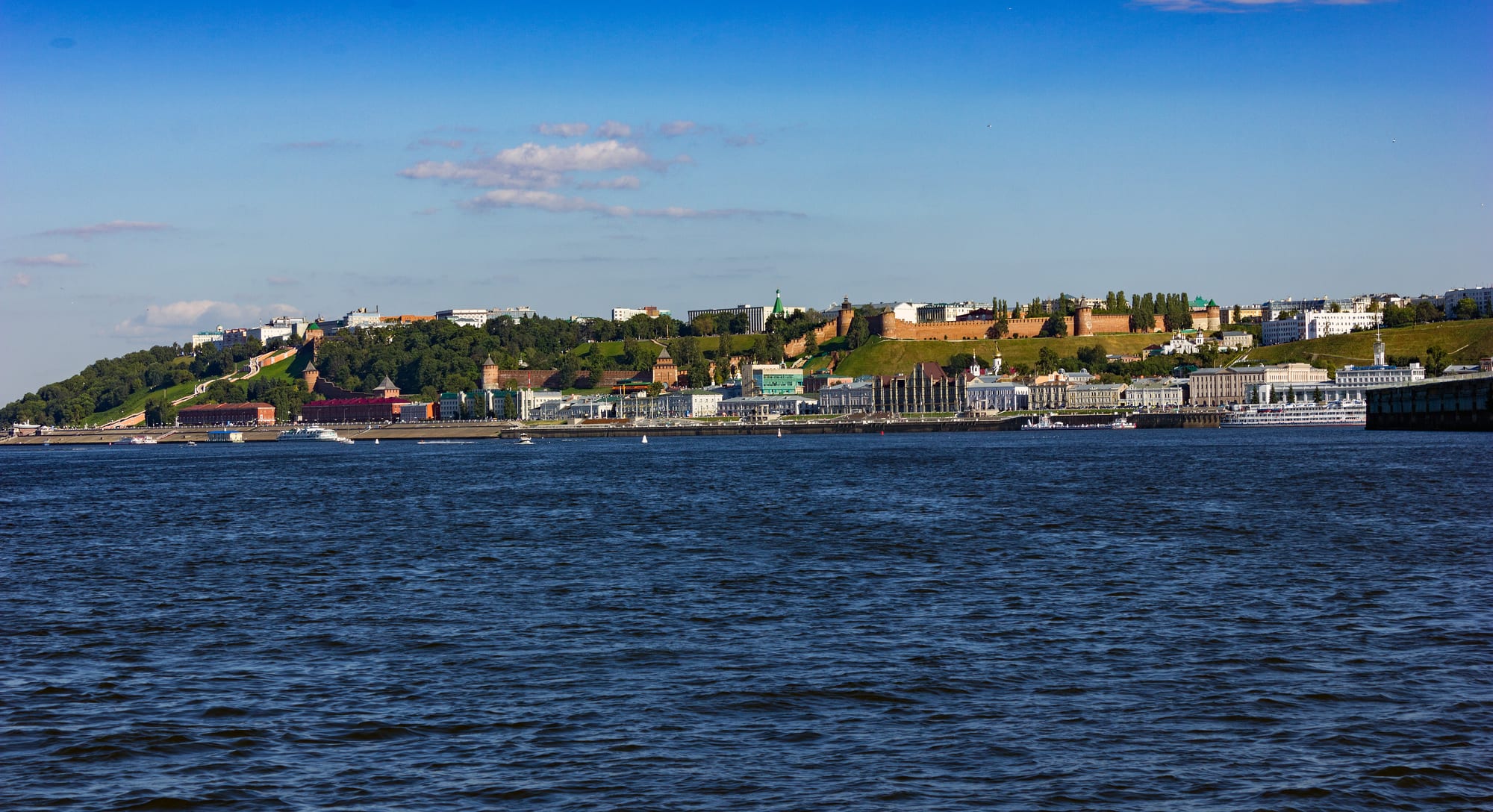
A green hillside above a wide blue river topped by red-brick fortress walls and towers, with embankment buildings along the shore

The Volga, Russia

Nizhny Novgorod

The Nizhny Novgorod Kremlin on its bluff above the Volga embankment. (Bestalex / Wikimedia Commons · CC BY-SA 4.0)

Russia's sixth-largest city, founded in 1221 where the Oka meets the Volga. A red-brick kremlin on the bluff above the confluence recalls its frontier past; the great fair made it the empire's trading capital, and as Gorky, closed to foreigners, it built cars and weapons. This page is written to explain the city, not to encourage travel.

Neighbourhoods

  • The Kremlin and Bolshaya Pokrovskaya
    • First-time visitors
    • Historic district
    • Shops and cafés

    The heart of the Upper City. Minin and Pozharsky Square lies in front of the Kremlin, and from it Bolshaya Pokrovskaya — the old street of the nobility, now the pedestrian high street — runs to Gorky Square past the old State Bank building, mansions, shops and restaurants.

    Open in Maps
  • Rozhdestvenskaya Street and the Lower Town
    • Architecture
    • Nightlife
    • Walks

    The old merchant street of the Lower Town below the Kremlin, lined with stone merchant houses and banks of the 18th and 19th centuries and the Stroganov Church.

    Open in Maps
  • The Upper Volga embankment
    • Viewpoints
    • Walks

    A promenade high above the Volga, with long views over the river; the Chkalov Stairs link it with the Lower Volga embankment.

    Open in Maps
  • Kanavino and the fair
    • History
    • Close to public transport

    Across the Oka on the low western bank, the district of the great fair and the main railway station, with the Alexander Nevsky Cathedral and the stadium on the Strelka, the spit at the confluence.

    Open in Maps
  • Avtozavodsky
    • Local life
    • Industrial heritage

    The Lower City district built around the Gorky Automobile Plant, with the airport on its outskirts.

    Open in Maps

Things to do

The Kremlin and the old town

  • Nizhny Novgorod Kremlinlandmark

    The red-brick fortress whose main work was built from 1508 to 1515, which held off Tatar sieges in 1520 and 1536 and still houses the city, regional and federal-district authorities.

    Open in Maps
  • Chkalov Stairslandmark

    The longest staircase in Russia, a monumental flight of steps linking Minin and Pozharsky Square with the Upper and Lower Volga embankments.

    Open in Maps
  • Bolshaya Pokrovskaya Streetneighborhood

    One of the city's oldest streets and its main pedestrian high street, lined with historic public buildings, shops and restaurants.

    Open in Maps
  • Stroganov Churchlandmark

    The richly carved Church of the Nativity on Rozhdestvenskaya Street, built in 1696–1719 for the merchant Grigory Stroganov.

    Open in Maps

Churches and monasteries

  • Pechersky Ascension Monasterylandmark

    The principal monastery of the diocese, beside the Volga, with an austere five-domed cathedral of 1632 and two tent-roofed churches of the 1640s.

    Open in Maps
  • Alexander Nevsky Cathedrallandmark

    An 87-metre Russian Revival cathedral, consecrated in 1881 on the grounds of the old fair at the Strelka, one of the city's unofficial symbols.

    Open in Maps

Museums

  • Nizhny Novgorod State Art Museummuseum

    A large art gallery with Russian painting including works by Kustodiev and Roerich, and Western European art including Cranach and Bellotto.

    Open in Maps
  • Main Fair Buildingmuseum

    The headquarters building of the old fair, now an exhibition centre, where the multimedia exhibition "Russia is My History", centred on the history of the city, opened in 2017.

    Open in Maps
  • Kashirin Housemuseum

    The childhood home of Maxim Gorky, kept as a museum named after his grandfather, who owned it.

    Open in Maps

The rivers

  • Nizhny Novgorod Cablewaytransit hub

    A gondola line opened in 2012 that crosses the Volga to the town of Bor in a 900-metre span, with panoramic views from the cabins.

    Open in Maps
  • Upper Volga embankmentviewpoint

    The promenade high above the Volga, with wide views over the river.

    Open in Maps
  • Sovcombank Arenaattraction

    The 44,899-seat stadium on the Strelka, built for the 2018 World Cup, where six matches were played.

    Open in Maps

Short trips from the city

  • Borattraction

    The town across the Volga, reached by cable car, by bridges built in 1965 and 2017 or by ferry.

    Open in Maps
  • Gorodetsattraction

    An old Volga town of Old Believer merchants, known for wood carving and painting, with a Gingerbread Museum and a Samovar Museum.

    Open in Maps
  • Makaryev Monasterylandmark

    The walled convent on the Volga where the great Makaryev Fair was held until it moved to Nizhny Novgorod after a fire in 1816.

    Open in Maps

Eat and drink

Long-standing places and food districts in Nizhny Novgorod. Hours, ratings and directions come from your maps app, always current.

Volga classics

  • Russian home cookingrestaurant

    Borsch and shchi, pelmeni dumplings, blini and pickled foods — the staples of Russian cooking.

    Open in Maps
  • Gingerbread and teacafe

    Tea, by far the most common drink in Russia, and gingerbread, which has its own museum in Gorodets, upriver.

    Open in Maps

Food streets

  • Bolshaya Pokrovskaya Streetneighborhood

    The pedestrian main street, lined with shops and some of the city's main restaurants.

    Open in Maps
  • Rozhdestvenskaya Streetneighborhood

    The old merchant street below the Kremlin, with a pedestrian part and restaurants and bars in its historic buildings.

    Open in Maps

Experience Nizhny Novgorod

History

Grand Prince Yuri II of Vladimir founded a wooden hillfort here on 4 February 1221, at the meeting of the Volga and the Oka, as the easternmost Russian outpost. The Mongols took it after Yuri's death in 1238, but in 1350 it became the seat of the Suzdal principality, and its prince Dmitry Konstantinovich built a stone citadel and had the Laurentian Codex, the oldest surviving copy of the Primary Chronicle, written here in 1377. Absorbed by Moscow in 1392, the town became the great stronghold against Kazan, and the red-brick Kremlin, built mainly from 1508 to 1515, withstood Tatar sieges in 1520 and 1536.

In 1612 a local merchant, Kuzma Minin, and Prince Dmitry Pozharsky raised the militia that drove the Poles out of Moscow and ended the Time of Troubles; Minin is buried in the Kremlin. The Stroganov merchant family made the city a base, and in 1817 the Makaryev Fair moved here, making Nizhny Novgorod the trading capital of the empire. The All-Russia Exhibition of 1896 showed off Popov's radio receiver and Shukhov's first hyperboloid tower, and the Sormovo works made it an industrial hub.

In 1932 the city was renamed Gorky after the writer, who was born here in 1868. Henry Ford helped build the GAZ truck and tractor plant, earning the city the nickname "Russian Detroit"; German air raids struck the city from 1941 to 1943, and for decades it was closed to foreigners. The physicist Andrei Sakharov was exiled here from 1980 to 1986. The old name and open status returned in 1990. The city hosted World Cup matches in 2018 and celebrated its 800th anniversary in 2021; in 2022 Intel suspended its operations here.

Culture & Customs

Nizhny Novgorod's culture is rooted in its merchant past and its literature. Maxim Gorky is remembered in the Kashirin House, his grandfather's home and the setting of his autobiographical story Childhood, and Sakharov's exile is commemorated in a museum of its own. The city has eight theatres, five concert halls and a wide range of museums, from the State Art Museum's Russian and European collections to an open-air museum of wooden architecture.

The surrounding oblast is famous for its crafts: Khokhloma, the painting of wooden household items with red, black and gold flowers, berries and leaves, first appeared in the second half of the 17th century in a village of the oblast, and Gorodets upriver is known for wood carving and painting. A distinct Stroganov school of icon painting and architecture developed in the city around 1700.

The city's symbols are the Dmitrievskaya Tower of the Kremlin, the Strelka at the confluence and the Chkalov Stairs. Russians make up about 95 per cent of the population, with Tatar, Armenian, Azerbaijani, Uzbek and Jewish communities, and the city has a cathedral mosque. Football is played at the Sovcombank Arena on the Strelka, built for the 2018 World Cup.

Daily Life

The 2021 census counted about 1.23 million people in the city and about two million in the urban area, making it Russia's sixth-largest city. The Oka divides it in two: the hilly Upper City on the east bank, with the Kremlin, the historic centre and the Nizhegorodsky, Prioksky and Sovetsky districts, and the larger, lower, more industrial city on the west bank, annexed in 1929–31, with the Avtozavodsky, Kanavinsky, Leninsky, Moskovsky and Sormovsky districts.

Since the Soviet era the economy has rested on mechanical engineering, metalworking and information technology. Avtozavodsky is built around the Gorky Automobile Plant, the Sokol aircraft plant has its own airfield in Moskovsky, the Krasnoye Sormovo works and the Volga Shipyard stand in Sormovsky, and in 2016 a new air-defence plant of Almaz-Antey opened. The city is the administrative centre of the Volga Federal District and handles the majority of Russia's river tourism.

Transport has been modernised in recent years: new metro stations, electric buses from 2024, contactless payment, city rail lines and a restored early 20th-century funicular, reopened in 2024. The mayor is appointed by the City Duma rather than elected directly, and a former mayor, Oleg Sorokin, was arrested in 2017. Summer life moves to the embankments and the Strelka, while snow usually lies from late November to mid-April.

Food

Food in Nizhny Novgorod is Russian cooking shaped by a long cold season: soups, grains, breads and pies, and dishes made to be preserved. Shchi, the cabbage soup that was the main first course for over a thousand years, and borsch, a sour soup whose best-known red beetroot version originates in Ukraine, are served with sour cream; pelmeni are small dumplings with a minced-meat filling, beef stroganoff is sautéed beef in a sour-cream sauce, and blini pancakes are served at Maslenitsa, the Butter Week before Lent.

Salted, pickled and smoked fish are eaten as zakuski, hors d'oeuvres, and herring "under a fur coat" is chopped salted herring under a layer of shredded cooked beet. Kasha porridge, okroshka, a cold soup based on kvass, and pirozhki, small stuffed buns, are familiar dishes; kvass itself is a fermented, low-alcohol drink made from rye bread, and tea is by far the most common drink.

The oblast adds its own traditions. Gorodets, upriver, has a Gingerbread Museum and a Samovar Museum, with a large collection of tea kettles, and Khokhloma painting of the region, in red, black and gold, is traditionally applied to wooden household items. The cafés and restaurants of Bolshaya Pokrovskaya and Rozhdestvenskaya streets are the centre of eating out.

Planning tools

Budget

Nizhny Novgorod is markedly cheaper than Moscow, with moderate prices for hotels, food and transport. The payment problem is the same as everywhere in Russia: most foreign credit and debit cards no longer work, so cash brought into the country is the main way to pay.

Daily Budget Midrange
USD 85–170 (mid-range hotel, restaurants, museums, the cable car and taxis)
Daily Budget Shoestring
USD 30–60 (hostel, canteens and markets, metro and buses)

Carry enough foreign cash for the whole trip; most foreign bank cards cannot be used at Russian ATMs.

Best Time to Visit

June to August, when summer temperatures settle around 15–20°C and river cruises call at the city; the rainiest month is July. Snow lies from late November to mid-April, and winter skies are mostly overcast.

Suggested Number of Days

Two or three days cover the Upper City, the embankments and the far bank. Allow four or five to add the old Volga towns and monasteries of the surrounding oblast.

First Visit
2–3 days
With Surroundings
4–5 days

Transportation

The metro has two lines and 15 stations, linking the main station with the Lower City and the Strelka, and is supplemented by city rail lines, buses, trams and trolleybuses. The cable car crosses the Volga to Bor, and a restored early 20th-century funicular reopened in 2024.

Carry passport, visa and migration card on every train and flight, and expect airport closures and delays at short notice.

Airport & Station Connections

Strigino International Airport lies about 14 km south-west of the centre, on the outskirts of Avtozavodsky district. Fast trains reach Moscow in less than four hours from the main station in Kanavino, and direct trains continue east along the Trans-Siberian Railway.

Walkability

The Upper City centre is compact and good on foot: the Kremlin, Bolshaya Pokrovskaya, Rozhdestvenskaya Street and the embankments are close together, though the slopes down to the rivers are steep. The Lower City across the Oka is spread out and needs the metro.

Safety

Beyond the ordinary crime of a large European city, the decisive risks are political and legal: near-total loss of consular support, a real risk of arbitrary arrest and lengthy detention of foreigners on politically motivated charges (and their use in prisoner swaps), sweeping wartime censorship laws, and the possibility that men of certain ages, including dual nationals, face conscription or exit bans. The Volga region is far from the front line yet not out of the war: since March 2024 Ukrainian drones have attacked Kstovo, an oil-refining town in the oblast, and the city's many defence and industrial plants are sensitive sites.

Most governments advise against all travel to Russia and against any travel near the Ukrainian border. Do not photograph factories, airfields, bridges, refineries or military sites, and keep political opinions offline. Check current official travel advice before travelling.

Climate

Humid continental and similar to Moscow's, though colder in winter. Winter lasts from late November to late March with permanent snow cover, and the winter sky is overcast most of the time.

Summer
warm — July averages about 19°C, with short, heavy summer rain
Winter
cold and snowy — January averages about −9°C, and days often fall to between −10°C and −20°C

Local Customs

Nizhny Novgorod is overwhelmingly Russian, and locals call their city simply Nizhny. Residents are known as Nizhegorodians.

Dress modestly in churches and monasteries, and ask before photographing people.

Common Payment Methods

The currency is the rouble (RUB). Most foreign credit and debit cards no longer work in Russia, most foreign bank cards cannot be used at Russian ATMs, and wire transfers from foreign accounts are not possible, so cash brought into the country is the reliable means of payment.