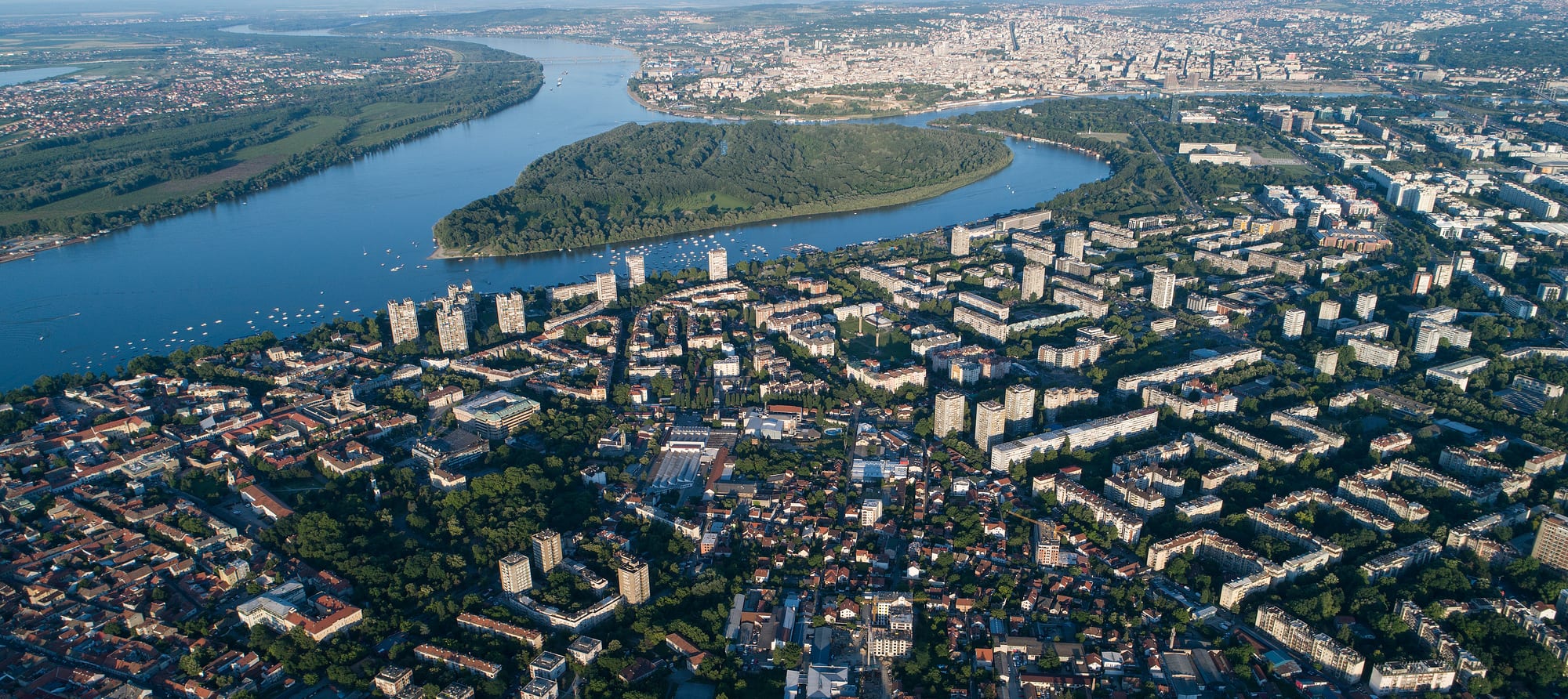
Aerial view over Zemun's rooftops and tower blocks to the wooded Great War Island and the Danube, with central Belgrade beyond

Belgrade & Vojvodina, Serbia

Belgrade

Zemun, the Great War Island and the Sava–Danube confluence, with the old centre of Belgrade on the far ridge. (Kristijan Ilic / Wikimedia Commons · CC BY-SA 4.0)

Serbia's capital, on the ridge where the Sava flows into the Danube — a site fought over in more than a hundred wars, from Roman Singidunum to the NATO bombing of 1999. Today it is a loud, sociable city of about 1.2 million, with a fortress park above the rivers, bohemian kafanas, river-barge nightlife and a construction boom along the Sava.

Neighbourhoods

  • Stari Grad and Kalemegdan
    • First-time visitors
    • Historic district
    • Close to public transport

    The old town on the ridge above the confluence. Kalemegdan Park and the Belgrade Fortress fill its tip, Knez Mihailova, the main pedestrian street, runs from the fortress to Republic Square, and the National Museum and National Theatre stand on the square.

    Open in Maps
  • Dorćol
    • Cafés and bars
    • Historic district
    • Quiet and residential

    The oldest surviving neighbourhood, sloping down from the centre to the Danube bank. Its residential streets have filled with cafés, galleries and small bars since the 2000s, and the city's oldest house, built in 1724–27, stands here.

    Open in Maps
  • Skadarlija
    • Best for food
    • Nightlife
    • Historic district

    A short cobbled street and its surroundings that were Belgrade's bohemian quarter, where poets and artists gathered in the 19th and early 20th centuries. Old kafanas line it, and bands play starogradska, the old-town songs, at the tables.

    Open in Maps
  • Vračar
    • Quiet and residential
    • Markets
    • Local life

    The smallest and most densely populated municipality in Serbia, south-east of the centre, with embassies, museums and leafy streets of apartment buildings. The Church of Saint Sava rises on its plateau and the Kalenić market is its everyday food hall.

    Open in Maps
  • Savamala and Belgrade Waterfront
    • Riverside
    • New development
    • Nightlife

    The old quarter on the Sava bank below the centre, revived by clubs and galleries in the 2010s and now partly rebuilt as Belgrade Waterfront, a government-backed project of towers, flats, shops and a riverside promenade begun in 2014.

    Open in Maps
  • Zemun
    • Riverside
    • Best for food
    • Historic district

    A separate town, under Habsburg rule from 1717 until the First World War, that was absorbed into Belgrade in 1934, on the Danube upstream from the centre. Its old core climbs Gardoš hill, and its Danube quay is a long promenade with barge cafés.

    Open in Maps
  • New Belgrade
    • Business travel
    • Modernist architecture
    • Close to public transport

    The planned city built from 1948 on empty land across the Sava, now the country's main business district. Large socialist-era housing blocks stand beside new office towers, the Belgrade Arena and shopping centres, with river barges along its banks.

    Open in Maps

Things to do

Famous landmarks

  • Belgrade Fortress and Kalemegdan Parklandmark

    The citadel of Upper and Lower Town and the park around it, on the ridge above the confluence — the historic core of the city and a Monument of Culture of Exceptional Importance since 1979.

    Open in Maps
  • Pobedniklandmark

    Ivan Meštrović's 14-metre bronze Victor, cast in 1913 and raised in 1928 in the Upper Town to mark Serbia's victories in the Balkan Wars and the First World War, looking out across the rivers.

    Open in Maps
  • Knez Mihailova Streetneighborhood

    The main pedestrian and shopping street, about a kilometre long, lined with 19th-century mansions and protected as one of the city's oldest landmarks.

    Open in Maps
  • Republic Squarelandmark

    The central square and meeting point, framed by the National Museum and the National Theatre.

    Open in Maps
  • Church of Saint Savalandmark

    One of the largest Orthodox churches in the world, begun in 1935 on the Vračar plateau where the Ottomans are believed to have burned the saint's relics.

    Open in Maps
  • House of the National Assemblylandmark

    The domed seat of the Serbian parliament on Nikola Pašić Square, one of the set pieces of the city centre.

    Open in Maps

Museums

  • National Museum of Serbiamuseum

    The largest and oldest museum in Belgrade, founded in 1844, with a collection of over 400,000 objects from prehistory to foreign masterpieces, reopened in 2018 after a long reconstruction.

    Open in Maps
  • Museum of Yugoslaviamuseum

    The most visited museum in Serbia, on the history of Yugoslavia and the life of Josip Broz Tito, who is buried with his wife Jovanka in the House of Flowers in its grounds.

    Open in Maps
  • Nikola Tesla Museummuseum

    A science museum on the inventor's life and work and his final resting place, holding an archive inscribed on UNESCO's Memory of the World register in 2003.

    Open in Maps
  • Military Museummuseum

    Founded in 1878 inside the fortress, with arms and armour from Roman times onwards in a long hall and tanks and guns lined up outside on the walls.

    Open in Maps
  • Ethnographic Museummuseum

    One of the oldest museums in the Balkans, established in 1901, showing the rural and urban life of the region through costume, crafts and household objects.

    Open in Maps
  • Museum of Contemporary Artmuseum

    Founded in 1958 as the Modern Gallery and one of the first museums of its kind in the world, it shows art made in Serbia and Yugoslavia since 1900 in a modernist building in New Belgrade.

    Open in Maps

Parks and the rivers

  • Ada Ciganlijabeach

    A river island on the Sava turned into a peninsula, with the artificial Lake Sava, about 8 km of beaches and sports grounds — the city's summer playground.

    Open in Maps
  • Great War Islandpark

    An uninhabited, wooded island at the confluence of the Sava and the Danube, valued for its wildlife and birds.

    Open in Maps
  • Gardoš Towerviewpoint

    The Millennium Tower on the hill above Zemun's old core, built on the remains of the old Gardoš fortress, with views over the Danube.

    Open in Maps
  • Topčider and Košutnjakpark

    Two adjoining forest parks south of the centre, a green belt of picnic lawns, running and cycling trails and sports facilities.

    Open in Maps

Music, sport and nights out

  • Rajko Mitić Stadiumattraction

    The Marakana, home of Red Star Belgrade and the largest stadium in Serbia, with seats for about 49,000.

    Open in Maps
  • Belgrade Arenaattraction

    One of the largest indoor arenas in Europe, in New Belgrade, which staged the Eurovision Song Contest in 2008.

    Open in Maps

Short trips from the city

  • Avala Towerviewpoint

    A 205-metre television tower on Mount Avala south of the city, destroyed in the 1999 NATO bombing and rebuilt, with views over Belgrade.

    Open in Maps
  • Smederevo Fortresslandmark

    A vast triangular fortified town on the Danube, built in 1427–30 for Despot Đurađ Branković as the capital of the Serbian Despotate.

    Open in Maps

Seasonal events

  • FESTfirst quarter of the year

    The Belgrade International Film Festival, founded in 1971 and the largest film festival in Serbia and South-Eastern Europe.

  • Belgrade Beer FestAugust

    A five-day festival of beer and concerts held every August since 2003, drawing hundreds of thousands of visitors.

  • BITEFSeptember

    The Belgrade International Theatre Festival, a showcase for new and experimental theatre.

Eat and drink

Long-standing places and food districts in Belgrade. Hours, ratings and directions come from your maps app, always current.

Belgrade classics

  • Kafana ?restaurant

    The oldest traditional tavern still in business in Belgrade, by the Orthodox cathedral, named with a single question mark.

    Open in Maps
  • Skadarlija's kafanasneighborhood

    Some of the city's oldest traditional taverns, serving grilled meats and Serbian home cooking to the sound of old-town bands.

    Open in Maps
  • Splavovi on the riversneighborhood

    Floating restaurants moored in Zemun, New Belgrade and around Ada Ciganlija serve fish soup, fish stew, carp, catfish and zander; many become bars or clubs at night.

    Open in Maps

Markets

  • Kalenić marketmarket

    One of the main open green markets of the city, in Vračar, with fruit, vegetables, cheese and kajmak.

    Open in Maps
  • Zeleni Venac marketmarket

    A covered market hall beside the bus terminus of the same name, just below the centre.

    Open in Maps
  • Bajloni marketmarket

    A large market hall where Džordža Vašingtona Street meets Skadarska, by Skadarlija.

    Open in Maps

Experience Belgrade

History

People have lived where the Sava meets the Danube for thousands of years: the Neolithic Vinča culture developed around Belgrade in the sixth millennium BC. Celts settled the ridge after 279 BC and called it Singidūn, and the Romans made it Singidunum, a frontier fortress on the Danube that gained city rights in the second century; across the Sava stood Taurunum, today's Zemun. Slavs settled in the 520s, and after centuries of changing hands the Serbian king Stefan Dragutin made it his seat in 1284. It was the capital of the Serbian Despotate under Stefan Lazarević, was returned to Hungary in 1427, and held out against the Ottomans in the siege of 1456, still remembered by the noon bell rung in churches across the Christian world.

The Ottomans took Belgrade in 1521, and for two centuries it changed hands between the Ottomans and the Habsburgs. Serbian rebels held it from 1807 to 1813, and it grew into the capital of the new Serbian state; by 1914 it had passed 100,000 people. Austro-Hungarian monitors shelled the city on 29 July 1914, and it was captured that December. Between the wars it became the capital of Yugoslavia and absorbed Zemun.

The Second World War opened for Belgrade with a Luftwaffe raid on 6 April 1941 that killed up to 2,274 people, and Allied bombs fell again at Orthodox Easter in 1944. After 1948 New Belgrade was built across the Sava. In 1999 the NATO bombing campaign targeted a number of buildings in Belgrade, and the Avala Tower was destroyed. The city has been fought over in 115 wars and razed 44 times. Since 2014 the Belgrade Waterfront project has rebuilt the Sava bank, and the city is preparing to host Expo 2027.

Culture & Customs

Belgrade is proud of its nightlife. Its best-known feature is the splav, a barge moored on the Sava or Danube that serves as a restaurant by day and a bar or club at night. The older tradition lives in the kafana, the tavern where people eat, drink and talk for hours, and in Skadarlija, the 19th-century bohemian quarter of poets and painters, bands still play starogradska, the old-town music of northern Serbia's cities.

The city has a dense cultural calendar: FEST, the film festival held since 1971; BITEF, the international theatre festival every September; BEMUS, the oldest classical music festival in Serbia, founded in 1969; the Belgrade Book Fair; and the Beer Fest every August. Belgrade hosted the Eurovision Song Contest in 2008, after Marija Šerifović won the year before, and the performance artist Marina Abramović, who was born here, held a major exhibition at the Museum of Contemporary Art in 2019.

Sport divides the city between Red Star and Partizan, Serbia's two biggest football clubs and rivals in basketball as well. Red Star won the European Cup in 1991, and the rivalry is one of the fiercest in world football. Most Belgraders are Orthodox, and family life follows the slava, the household's patron saint's day, along with Orthodox Christmas and Easter; the city also has smaller Muslim, Catholic and Protestant communities.

Daily Life

The 2022 census counted about 1.2 million people in the city proper and about 1.68 million in the wider administrative area, roughly a quarter of the population of Serbia. Belgrade is the political, financial and media centre of the country: in 2024 it held almost 30 per cent of Serbia's jobs and produced more than 43 per cent of its GDP. New Belgrade has become the main business district, with offices for a growing IT sector, and cranes stand over Belgrade Waterfront and many other new developments.

Most Belgraders live in flats — in the 19th-century streets of Stari Grad and Vračar, the concrete blocks of New Belgrade, or the suburbs spreading south and east. Since January 2025 the city's buses, trams and trolleybuses have been free to ride, and a metro is being built. Traffic, air pollution and rising rents are constant complaints, and since late 2024 student-led anti-government protests and road blockades have been part of life in the city.

The day moves at a relaxed pace: coffee on a terrace, a late lunch as the main meal, and an evening walk along Knez Mihailova or the river. In summer the beaches of Ada Ciganlija fill up, and on warm nights the riverbanks and splavovi stay busy until late.

Food

Grilled meat dominates. Ćevapi, small fingers of minced meat, and pljeskavica, a spiced patty of minced pork, beef and lamb, are served almost everywhere, often with kajmak, a milk cream, ajvar, a pepper relish, and onions, or in lepinja, a flatbread. Karađorđeva šnicla — a rolled veal, pork or chicken steak stuffed with kajmak, breaded and fried — was created in Belgrade: the chef Mića Stojanović first made it in the 1950s at a restaurant in Košutnjak. Kafanas also serve sarma, pickled cabbage leaves stuffed with minced meat and rice, and podvarak, roasted sauerkraut with meat.

Burek, a flaky pastry filled with cheese, meat, spinach or potato, is the breakfast and quick meal of choice, traditionally with drinkable yoghurt; palačinke, thin crêpes, are the sweet street snack. On the rivers, floating restaurants serve riblja čorba, fish soup, and riblji paprikaš, fish stew, with carp, catfish, zander and perch.

The city's open and covered markets — Kalenić in Vračar, Zeleni Venac below the centre and Bajloni by Skadarlija — sell fruit, vegetables, cheese and kajmak. Rakija, fruit brandy, is the drink for toasts, and coffee is drunk all day.

Planning tools

Budget

Belgrade is the most expensive place in Serbia, and hotel prices in the centre and on the riverfront have risen, but it remains cheap by Western European standards. Grill food, bakeries and kafana lunches keep eating costs low, and public transport has been free since January 2025.

Daily Budget Midrange
USD 100–180 (central hotel, kafana dinners, museum tickets, taxis by app)
Daily Budget Shoestring
USD 45–70 (hostel bed or private room, burek and grill food, free city transport)

The fortress park, Knez Mihailova, Zemun's quay and Ada Ciganlija cost nothing; save money for evenings in Skadarlija or on the river.

Best Time to Visit

May, June and September are the best months for the river terraces, Kalemegdan and the beaches of Ada Ciganlija. July and August are hot, and the city empties a little as residents head for the coast. Winter is cold and grey, but suits the museums and kafanas.

Suggested Number of Days

Two or three days cover the old centre, the main museums and Zemun. Four or five allow time for the river parks and a trip down the Danube or north into Vojvodina. Nightlife and the spread-out museums add time for many visitors.

First Visit
2–3 days
With Surroundings
4–5 days

Transportation

Buses, trams, trolleybuses and the BG Voz commuter trains cover the city, and since January 2025 all public transport in Belgrade has been free. A metro is under construction. Taxis are cheap by European standards but scams are common; ordering through an app or by phone records the ride. Driving in the centre is slow, and yellow lanes are reserved for buses and taxis.

Use only marked city taxis ordered through an app or by phone, and insist on the meter.

Airport & Station Connections

Belgrade Nikola Tesla Airport, the hub of Air Serbia, is near Surčin, about 18 km west of downtown; bus 72 and the A1 minibus run to the centre, and taxis are best booked by app. Belgrade Centre station (Prokop), the de facto main railway station, serves trains including the high-speed line to Novi Sad opened in 2022, and the central bus station has daily links across Serbia and Europe.

Walkability

The old centre is compact: the fortress, Knez Mihailova, Republic Square, Skadarlija and Dorćol are all within walking distance of each other. Belgrade is hilly, though, with steep climbs up from both rivers, and Zemun, New Belgrade and the Church of Saint Sava are better reached by bus or tram. Riverside paths along the Sava and Danube are good for long walks and cycling.

Safety

Serbia is a safe country for visitors, with low violent crime. In Belgrade the common problems are pickpocketing on Knez Mihailova, at the stations and on crowded buses, and taxi overcharging, above all from drivers waiting at the airport and bus stations. Large anti-government protests have been frequent since late 2024, and the Red Star–Partizan derby can bring disorder.

Order taxis by app, keep valuables close in crowds, avoid protest crowds and football match days, and swim only at designated beaches such as Ada Ciganlija. Check current official travel advice before travelling.

Climate

Four distinct seasons, on the border between humid subtropical and humid continental. Monthly averages run from about 2°C in January to about 24°C in July. The košava, a cold, squally south-easterly wind, reaches the city along the Danube.

Summer
hot — July averages about 24°C, and the temperature reaches 30°C or more on about 45 days a year
Winter
cold — January averages about 2°C, with frost on around 50 nights a year

Local Customs

Belgrade is informal and sociable, and long hours in cafés and kafanas are part of the culture. Families celebrate their slava, a patron saint's day, and Orthodox Christmas and Easter set the calendar. Modest dress is expected in Orthodox churches. Football loyalties to Red Star or Partizan run deep.

Tips to taxi drivers are welcome but not required. Cover shoulders and knees in churches, and avoid wearing club colours near the stadiums on match days.

Common Payment Methods

The currency is the Serbian dinar (RSD). Cards are widely accepted in Belgrade, and ATMs are easy to find; carry cash for markets, small bakeries and kiosks. Euros are easily exchanged.