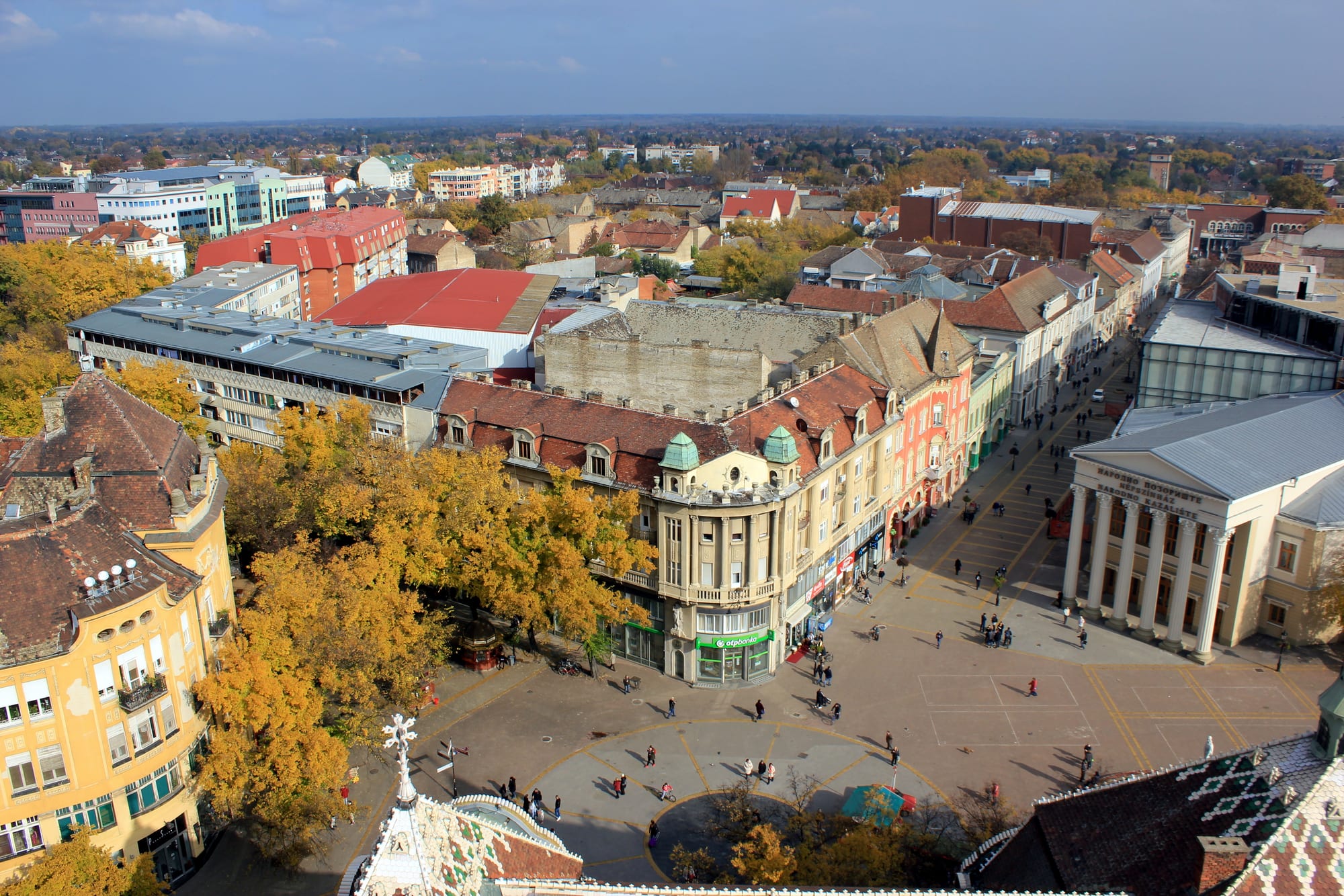
A bird's-eye view over a pedestrian square with a colonnaded theatre, ornate old buildings and autumn trees, with a flat city stretching to the horizon

Serbia

Belgrade & Vojvodina

Central Subotica and its National Theatre, seen from the tower of the town hall. (Julian Nyča / Wikimedia Commons · CC BY-SA 3.0)

Serbia's capital and the flat, fertile plain north of the Sava and Danube — the autonomous province of Vojvodina, with Novi Sad, Subotica and the Fruška Gora hills. Once the Habsburg frontier, it is the country's most multi-ethnic region, its breadbasket, and home to about half of Serbia's people.

Explore Belgrade & Vojvodina

History

Belgrade stands where the Sava meets the Danube, a site so defensible that it has been fought over for two thousand years. The Celtic Scordisci settled there before Rome made it Singidunum, a legionary fortress on the Danube frontier; Slavs gave it its name, "white city", and Byzantines, Bulgarians, Hungarians and Serbs held it in turn. The Ottomans took it in 1521, and Austrians and Turks traded it several times in the 18th century. It became the capital of the revived Serbian state, and the last Ottoman garrison left the fortress in 1867.

North of the rivers the story was different. After the Ottoman retreat of the 1680s the plain passed to the Habsburgs, who ran it as the Military Frontier and resettled it. Serbs fleeing the Ottomans arrived in the Great Migration of 1690, followed by Hungarians, Germans, Slovaks, Romanians and Rusyns, creating the patchwork that still defines Vojvodina. Prince Eugene of Savoy defeated the Ottomans at Senta in 1697, and the Treaty of Karlowitz was signed at Sremski Karlovci two years later. Karlovci became the seat of the Serbian church in the Habsburg lands, and in 1848 an assembly there proclaimed a Serbian Vojvodina, which gave the region its name.

In 1918 Vojvodina joined Serbia and the new Yugoslav kingdom. During the Second World War Hungary occupied Bačka and carried out the Novi Sad raid of January 1942, and in 1944–45 most of the German-speaking population fled with the retreating German army or was interned in camps. Vojvodina became an autonomous province, lost much of its autonomy under Milošević at the start of the 1990s, and regained part of it after 2000. On 1 November 2024 the collapse of a canopy at Novi Sad railway station killed sixteen people and set off a nationwide protest movement.

Culture & Customs

Vojvodina calls itself Serbia's most tolerant corner. The province has six official languages — Serbian, Hungarian, Slovak, Romanian, Croatian and Rusyn — and Hungarians have lived since the 18th century in towns along the Tisa such as Kanjiža and Senta and in Subotica, where the Catholic Bunjevci also live. Orthodox, Catholic, Protestant and Greek Catholic churches stand in the same villages. Kovačica, a Slovak village in the Banat, is known for its naive painting, bright scenes of village life by self-taught local painters.

The plain has its own manners: slower speech, a reputation for calm and hospitality, tamburica string bands and the Hungarian csárdás in the countryside, and a strong wine and harvest culture in Srem and around Vršac. Novi Sad's EXIT, a summer music festival that grew out of the 2000 student movement for democracy, was held at Petrovaradin until its last edition in 2025.

Belgrade is a different animal: loud, sociable and proud of its nightlife, from the river barges known as splavovi to the kafanas where old-town bands play starogradska songs. Red Star and Partizan split the city in football and basketball. As everywhere in Serbia, families celebrate their slava, a patron saint's day, and Orthodox Christmas and Easter set the calendar.

Daily Life

Belgrade has about 1.7 million people, a quarter of Serbia's population, and is the country's political, financial and media centre, with a growing IT and outsourcing sector and a construction boom symbolised by the Belgrade Waterfront towers on the Sava. Zemun, once a separate Habsburg town, is now part of the city. Novi Sad, with about 370,000 people, has a large university and a strong tech scene; Subotica, Zrenjanin, Pančevo and Sombor are the other main towns.

Vojvodina's black soil makes it the country's granary: maize, wheat, sunflowers, sugar beet and soya fill the plain, and food processing, oil refining in Pančevo and car and tyre plants add industry. Villages are shrinking and ageing, and many young people from the Hungarian minority have moved to Hungary or further into the EU.

The day runs on coffee — Turkish-style domaća kafa or espresso on a café terrace — with a late lunch as the main meal and evenings on the promenades of Knez Mihailova in Belgrade and the old centre of Novi Sad. Traffic and air pollution are constant complaints in the capital, and since late 2024 student-led protests and road blockades have been part of city life.

Food

The plain cooks Central European as much as Balkan. Paprikaš, a paprika stew of chicken or pork, and perkelt, its thicker Hungarian cousin, come from the Hungarian kitchen; riblja čorba or fish paprikaš, carp, catfish and pike simmered in a cauldron over an open fire, is the dish of the Danube and Tisa riverbanks. Srem is known for its smoked sremska kobasica sausage, and Bački Petrovac for kulen, a spicy paprika-cured pork sausage made by the local Slovak community. Pork crackling, smoked ham and fresh sausages mark the winter pig slaughter, the svinjokolj.

Sweets show the Habsburg legacy: štrudla s makom, a poppy-seed strudel, and štrudla s orasima with walnuts, knedle, plum dumplings rolled in breadcrumbs, and šnenokle, meringue islands floating in vanilla custard.

Belgrade adds the national grill — ćevapi, pljeskavica patties, with kajmak, a salty clotted cream — along with burek at dawn and karađorđeva šnicla, a rolled breaded veal cutlet stuffed with kajmak that was created in the city. Drink is rakija, especially plum šljivovica and pear viljamovka, and wine from Fruška Gora and Vršac; Sremski Karlovci's bermet, a sweet aromatised wine, is the local speciality.

Attractions & Natural Wonders

In Belgrade, Kalemegdan is the place to begin: the Belgrade Fortress, its walls, gates and military museum set in a park on the ridge above the Sava–Danube confluence, with the Victor monument looking out over Zemun and the plain. Skadarlija, a short walk away, is the cobbled bohemian street of kafanas and musicians. Knez Mihailova leads between the two, and further afield are the Church of Saint Sava, the Nikola Tesla Museum, the Museum of Yugoslavia with Tito's tomb, the riverfront of Zemun and the island lake of Ada Ciganlija.

Novi Sad's centre is a compact Habsburg town of squares, the town hall and Dunavska street. Across the Danube, the Petrovaradin fortress, built by the Habsburgs through the 18th century, has underground galleries and a clock tower whose hands are reversed, the large one marking the hours so boatmen could read it from the river. Sremski Karlovci, a few kilometres downstream, has the Patriarchate palace, the cathedral, the Four Lions fountain, the Chapel of Peace and wine cellars.

Behind it rise the Fruška Gora hills, a national park of linden and oak woods holding more than a dozen Orthodox monasteries, among them Krušedol, Novo Hopovo, Grgeteg and Vrdnik. In the far north, Subotica has an Art Nouveau town hall, a Secession-style synagogue and the Raichle palace, and Lake Palić, a short ride away, has a lakeside park, villas and a zoo. Further sights include Vršac's hilltop tower, the Deliblato Sands and the wetlands of Carska Bara and Obedska Bara.

Cities in Belgrade & Vojvodina

Planning basics

Budget

Belgrade is the most expensive place in Serbia, with rising hotel prices in the centre and on the riverfront, though still cheap by Western European standards. Novi Sad costs a little less. Subotica, Sombor, the Banat towns and the farm-stay salaši of the plain are good value.

Daily Budget Midrange
USD 90–170 (central hotel, kafana dinners, a wine tasting or monastery trip)
Daily Budget Shoestring
USD 40–65 (hostel or private room, bakeries and grill stands, city buses)

Eat the set lunch at a kafana rather than dinner on the riverfront.

Safety

The region is safe. Belgrade has pickpocketing on Knez Mihailova, at the stations and on crowded buses, taxi overcharging, and occasional disorder around the Partizan and Red Star football derby. Large anti-government protests have been frequent in Belgrade and Novi Sad since the Novi Sad station collapse of November 2024. Summer heat and river currents are the main natural hazards.

Use taxi apps, avoid protest crowds and football match days, and swim only at designated beaches such as Ada Ciganlija or the Novi Sad Štrand. Check current official travel advice before travelling.

Climate

The most continental part of the country: the open Pannonian plain has hot, dry summers that regularly pass 35°C and cold winters with fog and snow. The košava, a strong, cold south-easterly wind, blows through Belgrade and the Banat in autumn and winter, and the Danube and Sava can flood in spring.

Summer
hot and often dry, 28–38°C, with thunderstorms
Winter
cold and grey, around −5 to 5°C, with fog, snow and the košava wind

Transportation

Belgrade Nikola Tesla airport serves the whole region. A high-speed line links Belgrade and Novi Sad in well under an hour, and frequent buses reach Subotica, Sombor, Zrenjanin, Pančevo and Vršac. Sremski Karlovci is a short bus ride from Novi Sad, but the Fruška Gora monasteries are scattered and best reached by car or organised tour. The plain is flat and well suited to cycling along the Danube route.

Book the Belgrade–Novi Sad train a day ahead at busy times, and take a car or tour for more than one or two Fruška Gora monasteries.

Best Time to Visit

May, June and September are ideal for Belgrade's river terraces and the Fruška Gora hills. July and August bring heat to the cities, and September is grape-harvest time in Srem. Winter suits Belgrade's museums and kafanas, and December brings the city's festive lights.