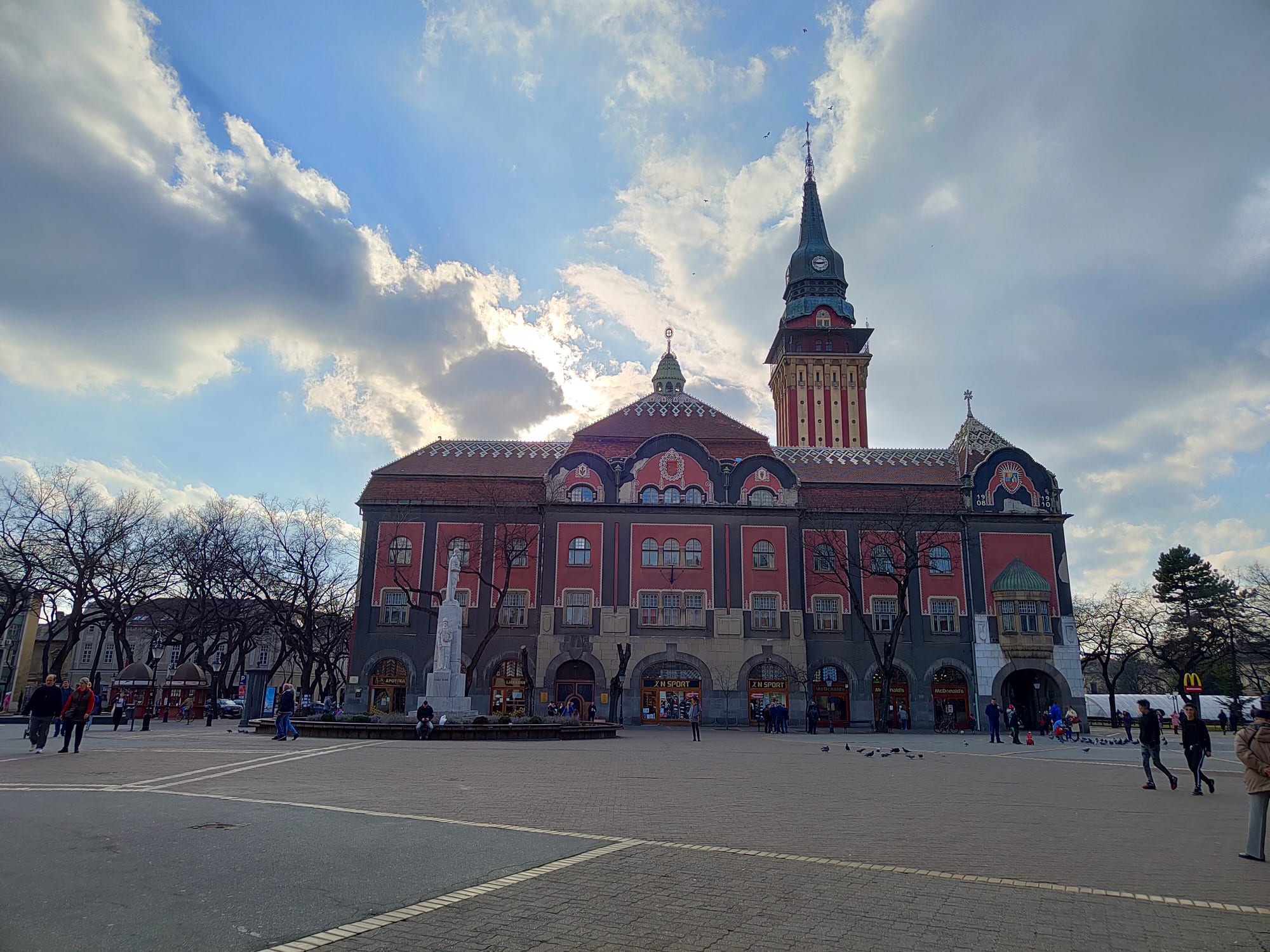
The red and cream Art Nouveau City Hall of Subotica with its tall clock tower, behind a broad paved square with a monument and bare trees

Belgrade & Vojvodina, Serbia

Subotica

Subotica City Hall, built in the Hungarian Secession style in 1908–1912, on the main square. (Nter25 / Wikimedia Commons · CC BY-SA 4.0)

Serbia's northernmost city, on the plain near the Hungarian border — a Habsburg free royal town whose Hungarian, Bunjevac, Croatian and Serbian communities still share its streets and languages. Its wealth around 1900 paid for its Hungarian Art Nouveau buildings, led by the red-and-gold City Hall and the synagogue, with Lake Palić's resort a short ride away.

Neighbourhoods

  • The centre and Korzo
    • First-time visitors
    • Architecture
    • Cafés and bars

    The walkable core around the City Hall and the main square, where the pedestrian Korzo is lined with Art Nouveau and Jugendstil buildings. Matija Korvina, a street off the Korzo, has a run of popular bars and restaurants, and fountains and café terraces fill the squares.

    Open in Maps
  • Palić
    • Lakeside
    • Quiet and residential
    • Festivals

    A small lakeside town about 8 km east of the centre, part of the City of Subotica and reached by city bus. Its Art Nouveau Water Tower, Women's Lido and Grand Terrace, its zoo and its spa make it the city's resort.

    Open in Maps
  • Donji Tavankut and the villages
    • Rural life
    • Folk art
    • Quiet and residential

    The villages of the City of Subotica's countryside, some with Hungarian and some with Croat majorities. Donji Tavankut, a village of about 2,000 people, keeps the local tradition of straw art, with a gallery in an old village house.

    Open in Maps

Things to do

Art Nouveau landmarks

  • Subotica City Halllandmark

    Marcell Komor and Dezső Jakab's red-and-cream town hall of 1908–1912 in the Hungarian Secession style, with a tall tower, the third town hall on the site.

    Open in Maps
  • Subotica Synagoguelandmark

    A Hungarian Art Nouveau synagogue completed in 1903, also by Komor and Jakab, renovated and reopened in 2018 as a cultural venue that still serves the small Jewish community.

    Open in Maps
  • Raichle's Palacelandmark

    The architect Ferenc Raichle's own house and office, completed in 1904 and considered his masterpiece, now a Cultural Monument of Great Importance.

    Open in Maps
  • Cathedral of St. Theresa of Avilalandmark

    The baroque Catholic cathedral and minor basilica, built in 1773–79, with twin bell towers, in a city where almost half the people are Catholic.

    Open in Maps

Lake Palić

  • Lake Palićpark

    A shallow lake of almost 4 square kilometres beside the resort of Palić, with lakeside parks, villas and Art Nouveau pavilions.

    Open in Maps
  • Palić Zooattraction

    A 10-hectare zoo and gardens founded in 1949 at Palić.

    Open in Maps
  • Palić Water Tower and Grand Terracelandmark

    The Art Nouveau water tower, whose gate marks the entrance to the Great Park at Palić, and the Grand Terrace beside it, built together in 1909–1912.

    Open in Maps

Short trips from the city

  • Straw Art Gallery, Donji Tavankutmuseum

    A gallery of straw-work pictures, a naive folk art fostered in the Subotica area, in a village house where a straw art colony has met since 1986.

    Open in Maps
  • Szegedattraction

    The third-largest city of Hungary and home to one of its leading universities, reached by bus or regional train across the border.

    Open in Maps

Nature around the city

  • Ludaš Lakepark

    A shallow lake and special nature reserve near the city, listed since 1977 as a wetland of international importance.

    Open in Maps
  • Subotička Peščarapark

    The Subotica Sands, an inland dune landscape of sand and woodland along the Hungarian border north of the city, protected as a landscape area.

    Open in Maps

Seasonal events

  • Palić European Film Festivalsummer

    A festival of European cinema held at the lakeside resort, with programmes that include new Hungarian film and children's films.

  • DužijancaJuly and August

    The Bunjevci harvest festival, giving thanks for the harvest, celebrated in Subotica with a festive procession at its heart.

Eat and drink

Long-standing places and food districts in Subotica. Hours, ratings and directions come from your maps app, always current.

Subotica classics

  • Grill housesrestaurant

    Places with the sign roštilj serve ćevapi in lepinja flatbread, pljeskavica and other grilled meats.

    Open in Maps
  • Bakeries and burekrestaurant

    Burek, a pastry with cheese, minced meat or mushroom, is sold in most bakeries, often with drinkable yoghurt.

    Open in Maps

Bars and nights out

  • Matija Korvina streetneighborhood

    A street off the Korzo with a cluster of popular bars and restaurants, the busiest corner of the centre in the evening.

    Open in Maps
  • Palić lakesideneighborhood

    The resort by the lake, with restaurants and cafés among its villas and parks.

    Open in Maps

Experience Subotica

History

The town first appears in records in 1391 as Zabotka or Zabatka, a small settlement in the medieval Kingdom of Hungary; the name probably comes from a Slavic word for a place with a Saturday market. Under Ottoman rule from the 16th century much of the population fled and settlers came from the Balkans, and in 1687 Catholic Dalmatians, the ancestors of today's Bunjevci, arrived in large numbers. Under the Habsburgs the town was renamed Sent-Maria in 1743 and Maria-Theresiapolis in 1779, when Empress Maria Theresa made it a free royal town.

In the 19th century the population doubled twice as Hungarians and Jews settled beside the Bunjevci and Serbs. The theatre opened in 1854, the railway arrived in 1869, and at the turn of the century the town's grain wealth paid for the Hungarian Secession buildings of Marcell Komor, Dezső Jakab and Ferenc Raichle: the synagogue completed in 1903, Raichle's palace of 1904 and the City Hall of 1908–1912.

In 1918 Subotica joined the Kingdom of Serbs, Croats and Slovenes, and between the wars it was the third-largest city in Yugoslavia, after Belgrade and Zagreb. Hungarian troops entered in April 1941; the city lost about 7,000 people in the war, mostly Serbs, Hungarians and Jews, and about 8,000 more, mainly Hungarians, were killed by the Partisans in 1944–45. During the wars of the 1990s Serb refugees arrived from Croatia, Bosnia and Kosovo while many Hungarians and Croats left. The old theatre, though a protected monument, was demolished in 2007 to make way for a new building.

Culture & Customs

Subotica is built on the overlap of peoples. Serbian is the most used language, but almost 30 per cent of residents use Hungarian every day, and the Bunjevci — a South Slavic Catholic community regarded by some as Croats and by others as a separate people — have their own harvest festival, Dužijanca. Schools teach in Serbian, Hungarian and Croatian; the Hungarian daily Magyar Szó is published in the city, alongside newspapers in Serbian and Croatian. Almost half the population is Catholic, the highest share of any city in Serbia, with a third Orthodox.

Architecture is the city's pride. Its Hungarian Secession buildings combine Art Nouveau plant ornament and symbolic figures with traditional Hungarian motifs, and Komor and Jakab, the architects of the City Hall and the synagogue, also designed the Grand Terrace and the Women's Lido at Palić.

Subotica calls itself a festival city, with more than 17 festivals a year. The Palić European Film Festival brings cinema to the lake each summer, and Dužijanca, the Bunjevci harvest festival of July and August, gives thanks for the harvest with a procession through town. Straw art, a naive folk art of pictures made from straw, is kept alive in the villages around the city.

Daily Life

The 2022 census counted about 89,000 people in the city proper and about 124,000 in its administrative area, which includes the town of Palić and 17 villages, some with Hungarian and some with Croat majorities. It is the administrative centre of the North Bačka District and the fifth-largest city in Serbia.

The farmland around the city feeds its economy. Food companies include the confectioner Pionir, the cereal maker Fidelinka, a dairy and a maker of spirits, while the largest export industry is a Siemens factory making wind turbine generators. A faculty of the University of Novi Sad teaches trainee teachers in Hungarian here, and tourism centres on the lake.

Life is calm and centred on the Korzo and the squares, where fountains and café terraces draw people in the evening, and in summer many families head to Palić's lakeside. Since 2025 the high-speed train has put Belgrade within easy reach, and Szeged in Hungary is a short trip across the border.

Food

The kitchen mixes the Balkan grill with the Central European stew pot. Gulaš and paprikaš, meat stews of Hungarian origin, are local favourites, and grill houses marked roštilj serve ćevapi in lepinja flatbread and pljeskavica, a patty of spiced minced meat. Palačinke, thin pancakes, come with savoury fillings such as chicken or minced meat with cream, or sweet ones.

Burek is the local fast food: a pastry filled with cheese, minced meat or mushroom, sold in most bakeries and often eaten with drinkable yoghurt. The grain, fruit and dairy farms of the surrounding plain supply the city's food industry, from the confectioner Pionir to the cereal maker Fidelinka.

Many households in the region make their own rakija from local stone fruit, apples, pears and grapes, and Gorki List, a bitter herbal liqueur whose name means "bitter leaf", is a local speciality. There are traditional wineries close to the city.

Planning tools

Budget

Subotica is good value, cheaper than Belgrade or Novi Sad. Local food is inexpensive, buses and taxis are cheap by Western standards, and the main sights can be seen from the street or the square for nothing.

Daily Budget Midrange
USD 80–150 (central hotel or Palić guesthouse, restaurant meals, a winery or lake trip)
Daily Budget Shoestring
USD 35–60 (hostel or guesthouse, burek and grill food, city buses)

Stay at Palić in summer for the lake, or in the centre for the architecture and bars; bus 6 links the two.

Best Time to Visit

Late spring to early autumn, when Palić's lakeside and the city's festivals are at their liveliest: the film festival at the lake in summer and the Dužijanca harvest celebrations in July and August. Winter is cold and quiet but suits a visit to the architecture and cafés.

Suggested Number of Days

One day covers the Art Nouveau centre; a second adds Lake Palić. Allow an extra day for the nature reserves and the villages around the city, which are easiest by car.

First Visit
1–2 days
With Surroundings
2–3 days

Transportation

JP Subotica Trans runs city and suburban buses and a line to Szeged in Hungary. Palić is reached by city bus 6. Taxis are not expensive by Western standards, and ranks stand next to the City Hall and the railway station. The centre itself is best seen on foot.

Buy tickets at the back of articulated buses and from the driver on single buses.

Airport & Station Connections

The Soko high-speed trains, running since October 2025, link Subotica with Belgrade via Novi Sad, and regional trains run from Szeged across the border. The A1 motorway connects the city with Novi Sad and Belgrade to the south and Szeged to the north, and buses run to Novi Sad, Belgrade, Budapest, Szeged and Sombor. Belgrade Nikola Tesla Airport is the nearest airport with airline service.

Walkability

The centre is flat and compact: the City Hall, the synagogue, Raichle's Palace, the cathedral and the Korzo are all within a few minutes' walk. Palić and the nature reserves need a bus, a car or a bicycle on the flat roads of the plain.

Safety

Serbia is a safe country for visitors, with low violent crime. Subotica is a quiet city, and the usual precautions against petty theft at the stations are enough. Lake Palić is shallow, and swimming is best kept to the organised bathing areas.

Use taxis from the ranks or by phone rather than unmarked cars. Check current official travel advice before travelling.

Climate

A climate with a continental character, open to the Pannonian plain: harsh winters, warm summers and unsettled rainfall. The average annual temperature is about 11.4°C, and strong winds blow on about 104 days a year.

Summer
warm — the highest temperature measured at Lake Palić is 39.6°C, in August 1952
Winter
harsh — the lowest temperature measured at Lake Palić is −26.7°C, in February 1954, and snow lies on the ground on about 59 days a year

Local Customs

Subotica lives in several languages: Serbian is the most used, Hungarian is used by almost 30 per cent of the people every day, and Croatian and Bunjevac are heard too, with schools and newspapers working in more than one language. Almost half the population is Catholic, and Orthodox churches stand alongside the Catholic ones.

A greeting in Serbian or Hungarian is welcome; dress modestly in churches and the synagogue.

Common Payment Methods

The currency is the Serbian dinar (RSD). Cards are widely accepted in larger towns; carry cash for markets, buses and small bakeries. Euros are easily exchanged, and Hungarian forints may be useful for trips across the border.