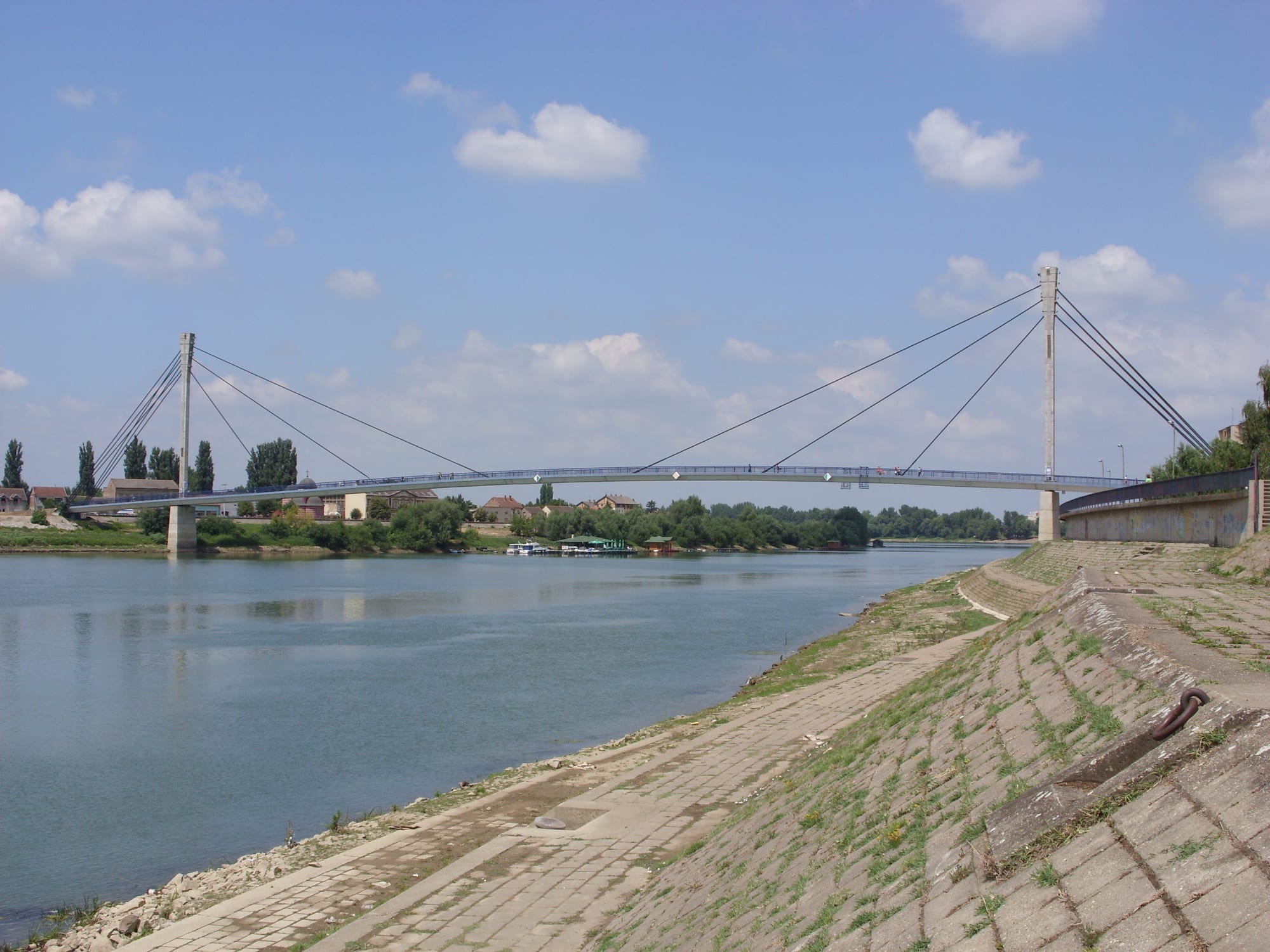
A slender cable-stayed footbridge spanning the wide, calm Sava river, with a paved embankment in the foreground under a blue sky

Belgrade & Vojvodina, Serbia

Sremska Mitrovica

The cable-stayed footbridge over the Sava at Sremska Mitrovica. (Julian Nyča / Wikimedia Commons · CC BY 3.0)

A quiet market town on the left bank of the Sava, built over Sirmium — one of the four capitals of the Roman Empire in the tetrarchy and the birthplace of ten emperors. Roman ruins lie open in the middle of town beside baroque squares and churches, and the town is now the centre of Syrmia, between the river and the Fruška Gora hills.

Neighbourhoods

  • Town centre and Roman Sirmium
    • First-time visitors
    • Historic district
    • Roman remains

    The compact centre around the baroque square, Trg Ćire Milekića, with its Orthodox church and the Stone Flower fountain. Excavated Roman remains lie in the open all over town, from the Imperial Palace site to basilica foundations in a basement.

    Open in Maps
  • The Sava quay
    • Riverside
    • Summer swimming
    • Walks

    The embankment along the river, with a town beach in summer and the long cable-stayed footbridge across to the far bank, built where a Roman bridge once stood.

    Open in Maps
  • Mačvanska Mitrovica
    • Quiet and residential
    • Across the river

    The small town on the south bank of the Sava, in the Mačva region, part of the city of Sremska Mitrovica and reached by the footbridge or the road bridge.

    Open in Maps

Things to do

Roman Sirmium

  • Imperial Palace sitelandmark

    Excavated remains of the palace complex of Roman Sirmium, one of the four capitals of the empire under the tetrarchy, in the town centre.

    Open in Maps
  • Museum of Sremmuseum

    The town museum, founded in 1946 on the back of the finds from Sirmium, covering the archaeology and history of the Syrmia region.

    Open in Maps

Churches and the town

  • Church of St. Archdeacon Stephenlandmark

    The Small Church by the Sava, the oldest place of worship still standing in the town, with icons by Teodor Kračun.

    Open in Maps
  • Church of St. Demetriuslandmark

    The Great Church, the Serbian Orthodox church on the town's baroque main square.

    Open in Maps
  • Cathedral of St. Demetriuslandmark

    The Catholic cathedral and minor basilica of the Diocese of Srijem, built in 1810.

    Open in Maps
  • St. Irenaeus Footbridgelandmark

    A long cable-stayed pedestrian bridge over the Sava, opened in 1994 on the site of a Roman bridge and named after Irenaeus, the first bishop of Sirmium, who was executed on one of the Sava bridges in 304.

    Open in Maps

Short trips from the town

  • Zasavicapark

    A bog and special nature reserve in Mačva, one of the last well-preserved wetlands in Serbia, where beavers were reintroduced in the 2000s.

    Open in Maps
  • Fruška Gorapark

    The hills to the north, Serbia's oldest national park, with Orthodox monasteries scattered through the woods and vineyards.

    Open in Maps
  • Obedska barapark

    A large swamp-forest and nature reserve on an old horseshoe meander of the Sava.

    Open in Maps

Eat and drink

Long-standing places and food districts in Sremska Mitrovica. Hours, ratings and directions come from your maps app, always current.

Syrmian food and drink

  • Pork and fish kitchensrestaurant

    Syrmia is known for pork specialities — bacon, sausages and other cured pork — and for river fish from the Sava and the Danube.

    Open in Maps
  • Fruška Gora wineneighborhood

    Wine from the slopes of the hills north of town, the best-known drink of the Syrmia region.

    Open in Maps

Experience Sremska Mitrovica

History

People have lived here since about 5000 BC, and Sirmium was already an old settlement when the Romans took it in the 1st century BC. It became a colony of Roman citizens and a military base on the Pannonian frontier, from which Trajan, Marcus Aurelius and Claudius II prepared their campaigns; Marcus Aurelius probably wrote part of his Meditations here. In 103 it became the capital of Pannonia Inferior, and in 293, under the tetrarchy, one of the four capitals of the Roman Empire, with Trier, Milan and Nicomedia. Ten emperors were born in or near the city, among them Aurelian, Probus and Constantius II, and Theodosius I became emperor here. It was also an early Christian centre and the seat of a bishop.

Huns took the city in 441, and after Goths, Gepids and Byzantines the Avars destroyed it in 582. A medieval town grew on the ruins as Civitas Sancti Demetrii, after the martyred Saint Demetrius, from which comes Mitrovica. Under the Ottomans from 1521 it was the largest settlement of Syrmia, a mainly Muslim town with 17 mosques by 1573. The Habsburgs took it in 1717, and Serbian, Croatian and German settlers replaced the fleeing Muslims.

In the Second World War the town was attached to the Independent State of Croatia, and one of its largest camps operated here; up to 10,000 Serbs, Jews and antifascists were killed. In 1991–92, during the Yugoslav wars, Croatian prisoners of war were held in a camp at the town's prison, where many prisoners were tortured and abused. Since 1944 Sremska Mitrovica has been part of Vojvodina, and of an independent Serbia since 2006.

Culture & Customs

The Roman past shapes the town's sense of itself. Excavations lie open in streets and courtyards, the Museum of Srem grew out of the finds, and a wine festival is dedicated to the emperor Probus. The town keeps the name of its patron, Saint Demetrius, in its Orthodox and Catholic churches alike.

The Orthodox Church of St. Archdeacon Stephen, the Small Church, is the oldest place of worship in the town and holds icons by Teodor Kračun, including an unusual image of Christ holding a shovel. The Catholic Diocese of Srijem has its seat here, while most residents belong to the Orthodox Eparchy of Srem.

The town keeps a busy calendar for its size, from a string-instrument festival and jazz-and-blues and rock festivals to a folk festival, a watermelon fair and a strudel festival, and a Christmas and New Year market fills the main square. Sport includes the first American football club in Serbia, the Sirmium Legionaries, and a canoe club on the Sava.

Daily Life

The 2022 census counted about 37,000 people in the town and about 73,000 across its administrative area, which includes Mačvanska Mitrovica on the south bank of the Sava and a string of villages in Syrmia and Mačva. Most settlements have a Serb majority, and the town is the centre of the Srem District.

Life follows the rhythm of a provincial market town: shopping and coffee around the baroque square, walks along the Sava embankment and the footbridge, and in summer swimming at the town beach. The town is also home to the largest prison in Serbia.

Belgrade is about 70 km away by the motorway, with buses and trains throughout the day. The memorial park and cemetery by the architect Bogdan Bogdanović, raised in 1960 to the victims of fascism in the Second World War, is one of the town's monuments, and the railway station was the first building rebuilt in Yugoslavia after the war.

Food

Syrmia is known above all for pork: bacon, sausages and other cured and smoked meats from the household pig. Its position between the Sava and the Danube also puts river fish on the table, served in kafanas and riverside restaurants.

The Fruška Gora hills to the north make Syrmia a wine region, and the town's own wine festival honours Probus, one of the emperors born here. Beer is the usual drink with restaurant meals, and rakija, a brandy made from plums, apricots or apples, is the traditional drink of welcome and celebration.

Grill food, burek from bakeries and the everyday dishes of Serbian home cooking fill the rest of the menu.

Planning tools

Budget

Sremska Mitrovica is inexpensive, a small provincial town where meals, rooms and buses all cost less than in Belgrade or Novi Sad. Most of the Roman remains and the riverside can be seen for nothing.

Daily Budget Midrange
USD 75–140 (hotel in town, restaurant meals, museum tickets, a Fruška Gora or Zasavica trip)
Daily Budget Shoestring
USD 35–55 (private room or guesthouse, bakeries and grill food, buses)

A car or a tour helps for the monasteries and wetlands around the town.

Best Time to Visit

Late spring to early autumn, when the Sava beach is open and the wetlands and Fruška Gora are green. Summer is hot. Winter is cold and quiet, with a Christmas and New Year market on the main square.

Suggested Number of Days

A day is enough for the Roman remains, the churches and the river. Two or three allow time for the wetlands and the hills nearby, which need a car.

First Visit
1 day
With Surroundings
2–3 days

Transportation

The town centre is small enough to walk. Buses link it with Belgrade, Novi Sad and other towns, and the Belgrade–Šid railway passes through. Reaching the Fruška Gora monasteries or Zasavica is easiest by car.

Use taxis from the ranks or booked by phone rather than unmarked cars.

Airport & Station Connections

Sremska Mitrovica is about 70 km from Belgrade by the E70 motorway, the same road that leads to Belgrade Nikola Tesla Airport. Trains run from Belgrade Centre station, and buses come from Belgrade, Novi Sad and further afield.

Walkability

Flat and compact: the square, the churches, the Roman sites, the museum and the Sava quay are all within a short walk of each other, and the footbridge leads straight across the river.

Safety

Serbia is a safe country for visitors, with low violent crime. Sremska Mitrovica is a quiet town, and ordinary care with belongings is enough. The Sava has strong currents.

Swim only at the town beach in season. Check current official travel advice before travelling.

Climate

A climate on the border between humid subtropical and humid continental, with hot summers and cold winters. In Belgrade, about 70 km away by road, monthly averages run from about 2°C in January to about 24°C in July.

Summer
hot — in Belgrade July averages about 24°C
Winter
cold — in Belgrade January averages about 2°C

Local Customs

Most people in the town are Orthodox, with a Catholic diocese seated here as well. Churches and monasteries expect modest dress, and the Roman heritage is a matter of local pride.

Cover shoulders and knees in churches and monasteries, and ask before photographing services.

Common Payment Methods

The currency is the Serbian dinar (RSD). Cards are widely accepted in larger towns but less so in small places here; carry cash for buses, markets, monasteries and rural areas. Euros are easily exchanged.