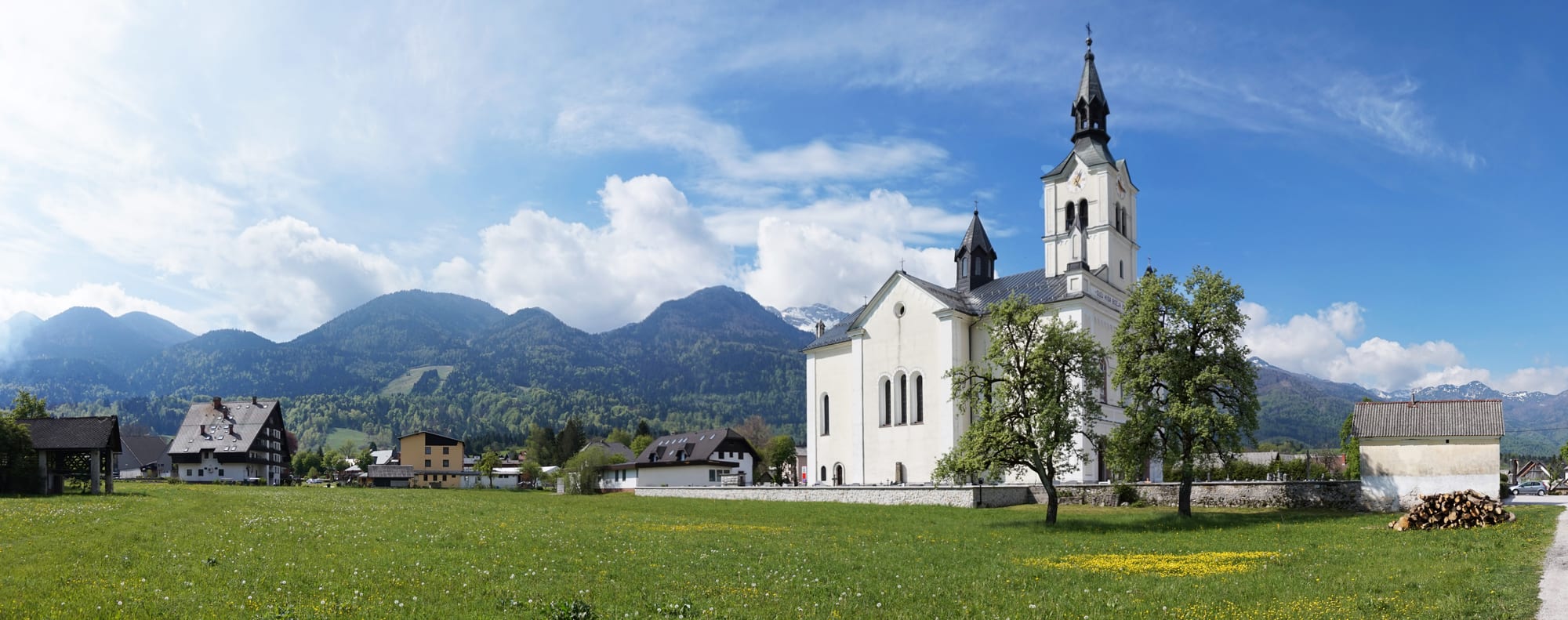
A white church with a tall spire beside a green meadow, with village houses and forested mountains behind under a blue sky

Ljubljana, Bled & the Julian Alps, Slovenia

Bohinjska Bistrica

St Nicholas's Parish Church in Bohinjska Bistrica, with the mountains of the Bohinj valley behind. (Tiia Monto / Wikimedia Commons · CC BY-SA 3.0)

The largest village of the Bohinj valley in the Julian Alps, at the eastern end of the basin whose head is Lake Bohinj, on the edge of Triglav National Park. Once an iron-working and herding community at the mouth of the Bohinj Railway's long tunnel, it is now the valley's administrative centre and a quieter base for the lake and the mountains.

Neighbourhoods

  • Village centre
    • Close to public transport
    • Local life
    • Value

    The road to the railway station divides the village into its upper and lower hamlets, Zgornja Vas and Spodnja Vas, between the Bistrica and Belica creeks. Shops, the museum, the Zois mansion and the station are all here, and buses leave for the lake, Bled and Ljubljana.

    Open in Maps
  • Ribčev Laz
    • First-time visitors
    • Lake views
    • Swimming

    The settlement at the eastern end of Lake Bohinj, mostly hotels and holiday homes, with the lakeside church of St John the Baptist and the monument to the first climbers of Triglav.

    Open in Maps
  • Stara Fužina
    • Hiking
    • Quiet and residential

    A village on the north-eastern shore of the lake whose land reaches up to the summit of Triglav and whose name recalls its old ironworks, with the alpine dairy museum and the path into the Mostnica gorge.

    Open in Maps

Things to do

In the village

  • Tomaž Godec Museummuseum

    A museum of Bohinj history in the old Godec family tannery by the creek, with displays on tanning, finds from the area's archaeological sites, the Battles of the Isonzo and the Iron Route across the Alps.

    Open in Maps
  • Zois mansionlandmark

    The Zois family's mansion in the village, with its tower clock.

    Open in Maps
  • Bohinj Railwaytransit hub

    The Austro-Hungarian line of 1900–1906 from Jesenice to Trieste, which enters the 6,327-metre Bohinj Tunnel at the village on its way to the Soča valley.

    Open in Maps

Lake Bohinj and the valley

  • Lake Bohinjpark

    Slovenia's largest permanent lake, a glacial lake dammed by a moraine at the head of the valley, used for swimming, kayaking and fishing in summer.

    Open in Maps
  • Savica Fallstrail

    A 78-metre waterfall fed by a karst spring above the western end of the lake; its stream is the lake's main source.

    Open in Maps
  • Mostnica gorgetrail

    A gorge about 2 km long and up to 20 m deep between Voje and Stara Fužina, crossed by the Devil's Bridge, with the Mostnica waterfall, about 20 metres high, further up the valley.

    Open in Maps
  • Alpine Dairy Museummuseum

    In Stara Fužina, a museum of cheesemaking and mountain herding, with a wooden herders' hut partly brought down from the Zajamniki pasture.

    Open in Maps

Mountains and skiing

  • Vogel Ski Resortattraction

    A ski area opened in 1964 above the lake, with about 22 km of slopes, reached by cable car.

    Open in Maps
  • Pokljukapark

    A forested plateau of high pastures inside Triglav National Park, with cross-country skiing and the World Cup biathlon centre.

    Open in Maps

Seasonal events

  • Spring Flower Festivalspring

    Guided walks through the valley's meadows when the wildflowers are in bloom.

  • Cow BallSeptember

    Kravji bal, the festival that closes the summer season near the lake, held with decorated cows.

Eat and drink

Long-standing places and food districts in Bohinjska Bistrica. Hours, ratings and directions come from your maps app, always current.

Bohinj classics

  • Bohinj cheesemarket

    The valley is known throughout Slovenia for its alpine cheeses, made from the milk of cattle grazed on the high pastures; mohant, a soft, strong-smelling cows'-milk cheese, is a protected local speciality.

    Open in Maps
  • Inns of Stara Fužinarestaurant

    Village inns, among them Gostilna Mihovc near the Alpine Dairy Museum.

    Open in Maps

Food districts

  • Ribčev Lazneighborhood

    The lakeside settlement, made up mostly of hotels and holiday homes, and the handiest place to eat by the lake.

    Open in Maps

Experience Bohinjska Bistrica

History

People lived in the Bohinj valley in prehistory, and the first villages took shape in the Iron Age, when deposits of bean ore, a type of iron ore, began a long tradition of iron-working. East of Bohinjska Bistrica, the Giant's Castle site, Ajdovski gradec, is a fortification of the 5th century BC that served as a refuge in late Roman times, and two more sites nearby show artificial terraces, one with traces of buildings from the late Iron Age and the Roman era. The village appears in written sources in 1253 as Vustris; its name means "Bistrica in Bohinj", from the Slavic word for a quick-flowing stream.

For centuries herding cattle on the high pastures was the basis of farming here, and ironworking, with the charcoal burning that supplied it, was the basis of the economy. The Zois family left a mansion with a tower clock in the village and another in Stara Fužina, and Baron Žiga Zois had the Devil's Bridge built over the Mostnica gorge. In 1778 four men from Bohinj made the first ascent of Triglav.

The Bohinj Railway, built by Austria-Hungary between 1900 and 1906 to link southern Germany and Austria with Trieste, enters its 6,327-metre tunnel at Bohinjska Bistrica. In the First World War it carried most of Austria's supplies to the Isonzo Front, and late in 1915 a narrow-gauge line was laid from the station to Ukanc at the far end of the lake. In the Second World War the valley saw Partisan fighting, and memorials to the fallen stand in its villages. Today the village is an important tourist destination and the seat of the Municipality of Bohinj.

Culture & Customs

Bohinj's culture grew out of mountain herding. The valley is one of the places most associated with the Cika, Slovenia's only native breed of cattle, a red to chestnut-brown dairy cow used to grazing on Alpine pastures. The alpine dairy museum in Stara Fužina is devoted to cheesemaking and the life of herders on the high pastures, and each September the Cow Ball near the lake marks the end of the grazing season. In spring a flower festival with guided walks celebrates the valley's meadows, home to Alpine plants such as Zois's bellflower and the Triglav gentian.

The village keeps its own history in the Tomaž Godec Museum, in the old tannery of the Godec family, with exhibits on tanning, the Isonzo battles of 1915–17 fought in the mountains towards the Soča, and the Iron Route across the Alps. The valley has a place in Slovene literature, with novels by Janez Jalen set in the valley.

Outdoor life sets the rhythm. In summer the river and the lake are used for swimming, sailing, kayaking, rafting and fishing, and the valley for walking, climbing and mountain biking; in winter skiers take the ski bus to Vogel, Soriška Planina and the Pokljuka cross-country trails.

Daily Life

About 1,700 people live in Bohinjska Bistrica, the largest of the 24 villages of the Bohinj valley and the seat of its municipality, with the valley's railway station. The village is divided by the station road into Zgornja Vas and Spodnja Vas. The politician and author France Bučar was among the people who were born or lived here.

Tourism is a large part of local life, with the lakeside settlement of Ribčev Laz given over largely to hotels and holiday homes, while farming and herding continue in the surrounding villages. For centuries Bohinj was the country's strongest centre of alpine herding: from May to mid-July the herders moved the cattle up to the lower and then the high pastures, and in autumn brought them gradually back down to the valley. Most of Bohinj, and all of its high mountains, lie within Triglav National Park and are protected by a special law. Summer brings crowds to the lake, served by the free weekend park-and-ride bus and the cycle route through the meadows, and winters are quieter, centred on skiing.

Food

Bohinj is known throughout Slovenia for its locally made Alpine cheeses, a tradition rooted in the summer herding of cattle on the high pastures. Mohant, a soft cows'-milk cheese with a strong smell and a piquant, sometimes bitter taste, is the valley's best-known speciality and has protected status.

The rest of the table is the farmhouse cooking of Gorenjska. Žganci, made from buckwheat, maize or wheat flour and regarded as a national dish of Slovenia, especially as buckwheat ajdovi žganci, is often compared with polenta. Štruklji, rolled dumplings boiled, steamed or baked with many kinds of filling, were once kept for feast days and are now everyday food, and Carniolan sausage, kranjska klobasa, is served in the inns. Mushrooms have always been popular, and creamy mushroom soup is a common dish on feast days. Inns are spread through the villages, from Srednja Vas to Stara Fužina, and the lakeside settlement of Ribčev Laz is the handiest place to eat by the water.

Planning tools

Budget

Bohinj is better value than Bled, and staying in Bohinjska Bistrica rather than at the lake is cheaper still. There is free parking near the village with a free bus to the lake on weekends and holidays. Ski passes, the Vogel cable car and guided activities are the main extra costs.

Daily Budget Midrange
USD 140–260 (guesthouse or lake hotel, restaurant dinners, cable car and activity tickets)
Daily Budget Shoestring
USD 65–100 (campsite, hostel or private room, supermarket and bakery food, buses)

Leave the car at the free park-and-ride near the village and take the bus or cycle path to the lake.

Best Time to Visit

Late May, June and September for hiking and quieter trails; July and August for swimming, kayaking and the high routes towards Triglav. The meadows flower in spring, the Cow Ball closes the summer in September, and winter is ski season at Vogel and on Pokljuka.

Suggested Number of Days

Two or three days cover the lake, the waterfall and the gorges at an easy pace. Hikers who want the high pastures or the mountains, or skiers in winter, usually stay four days or more.

First Visit
2–3 days
With Surroundings
4–6 days

Transportation

Regular buses link the village with the lake and with Bled and Ljubljana, and in summer local buses run to trailheads around the valley. A cycle route crosses the meadows from the village to the lake in about 35 minutes, and in winter a ski bus runs from the railway station to Vogel and to Pokljuka.

Use the free weekend and holiday bus from the park-and-ride to the lake instead of driving to the shore.

Airport & Station Connections

Bohinjska Bistrica station is on the Bohinj Railway, with direct trains several times a day to Jesenice and Nova Gorica. Hourly buses come from Ljubljana via Kranj and Bled. There is no direct public transport from Ljubljana's airport, but a shuttle runs to Bled bus station and, for an extra fee, on to Bohinj. Venice and Trieste airports are also linked by rail and bus.

Walkability

The village is small and easy on foot, and the valley floor is flat enough for walking and cycling between villages. The lake is some way west, best reached by bus or bicycle, and the paths to the waterfalls and pastures climb steeply.

Safety

Slovenia is one of the safest countries in Europe, with low crime. Around Bohinj the risks are in the mountains: weather that changes fast, afternoon storms, avalanche danger in winter and spring, and the long, exposed routes towards Triglav.

Check the mountain forecast before hiking, start early, and use a helmet and via ferrata kit on the Triglav routes. Check current official travel advice before travelling.

Climate

An Alpine valley climate with snowy winters, when the valley becomes a winter sports centre and skaters use Lake Bohinj. The lake water stays cool even in summer.

Summer
fresh — Lake Bohinj's surface water averages about 18°C in August; in Ljubljana, the nearest city, July and August highs are generally 25–30°C
Winter
cold and snowy — Lake Bohinj's surface water averages under 2°C in February; in Ljubljana, January temperatures are mostly around 0°C

Local Customs

Bohinj is a farming and herding valley as well as a resort, and much of it lies in Triglav National Park, where rules protect plants and wildlife. Most larger villages have a memorial to local Partisans and hostages of the Second World War, and the parish cemetery holds a Partisan burial ground.

Follow the national park's rules, which protect plants and wildlife, and treat the war memorials and the Partisan graves with respect.

Common Payment Methods

The currency is the euro. Cards are accepted in most hotels, shops and restaurants, but mountain huts and farm sellers may prefer cash, so keep some to hand.