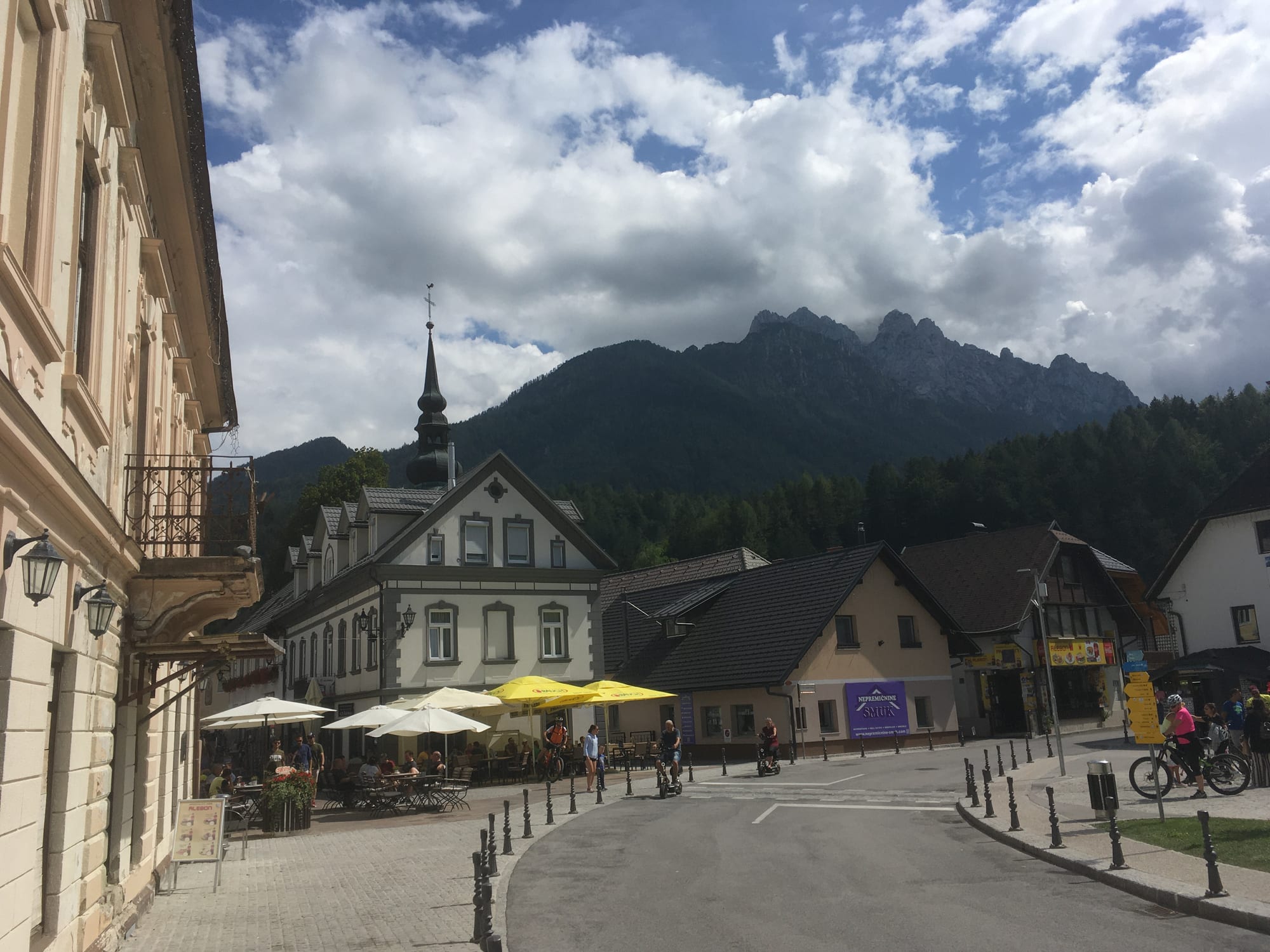
A small street of old houses and café umbrellas below a church spire, with a forested mountain and jagged peaks behind

Ljubljana, Bled & the Julian Alps, Slovenia

Kranjska Gora

The centre of Kranjska Gora, with the spire of the Church of the Assumption and the Julian Alps behind. (.snoopy. / Wikimedia Commons · CC BY-SA 4.0)

An Alpine village on the Sava Dolinka in the far north-west of Slovenia, close to the Austrian and Italian borders, below the peaks of the Julian Alps. A medieval trading stop on the road to Tarvisio, it became Slovenia's first ski resort after the Second World War and is now a year-round base for skiing, hiking and cycling below the Vršič Pass.

Neighbourhoods

  • Old village and resort centre
    • First-time visitors
    • Skiing
    • Best for food

    The old village core, once called Borovska vas, around the Church of the Assumption, ringed by a newer resort quarter of hotels, holiday flats, shops and ski lifts. The slopes of Vitranc rise directly behind it, and cycling and walking paths start from the centre.

    Open in Maps
  • Jasna
    • Quiet
    • Hiking

    A small holiday settlement by the two Jasna lakes on the road up to the Vršič Pass, at the mouth of the Pišnica valleys, with walking paths around the water and the trailheads into the mountains.

    Open in Maps
  • Podkoren
    • Quiet and residential
    • Skiing

    A village a couple of kilometres west of the centre, home to the Podkoren 3 World Cup course and a quieter, older-style place to stay.

    Open in Maps
  • Gozd Martuljek
    • Hiking
    • Mountain views

    A dairy-farming and tourist village east of the town, a base for hikes into the Julian Alps and the Karawanks, known for its views of Mount Špik.

    Open in Maps

Things to do

In the village

  • Liznjek Farmmuseum

    An 18th-century farmhouse in the centre, furnished to show the life of a wealthy peasant family of the mid-19th century, with an exhibit on the writer Josip Vandot, author of the Kekec children's books.

    Open in Maps
  • Church of the Assumptionlandmark

    The late Gothic parish church with Carinthian rib vaulting, two 15th-century sculptures and paintings by Leopold Layer, on the site of a 14th-century church of Our Lady on the White Gravel.

    Open in Maps
  • Kranjska Gora Ski Resortattraction

    Slovenia's oldest ski resort, opened in 1948 below Mount Vitranc, with about 20 km of slopes and 40 km of cross-country tracks.

    Open in Maps

Lakes and springs

  • Lake Jasnapark

    Two linked artificial lakes at the meeting of the Mala and Velika Pišnica, with walking paths and a bronze ibex on a rock by the shore.

    Open in Maps
  • Zelencipark

    A nature reserve at the source of the Sava Dolinka, where water re-emerges through the bed of a shallow lake of a deep, brilliant green.

    Open in Maps

Mountains and passes

  • Vršič Passviewpoint

    At 1,611 metres the highest pass in Slovenia, crossed by a road of hairpin bends linking the Sava valley with the Trenta valley and the Soča.

    Open in Maps
  • Russian Chapellandmark

    A wooden Orthodox chapel dedicated to Saint Vladimir on the road to Vršič, built by Russian prisoners of war forced to work on the road during the First World War and now a war memorial.

    Open in Maps
  • Planicaattraction

    The valley south of Rateče famous for ski jumping, where the first jump of more than 100 metres was made in 1936 and the Nordic World Ski Championships were held in 2023.

    Open in Maps
  • Ratečeneighborhood

    The border village near the Italian crossing, closest to Peč, the mountain where Slovenia, Austria and Italy meet.

    Open in Maps

Seasonal events

  • Vitranc Cupwinter

    The FIS Alpine Ski World Cup slalom and giant slalom races held on Podkoren 3, one of the oldest active races on the circuit, first run in 1961.

  • Planica ski flyingMarch

    The ski-flying World Cup season finale, traditionally held in mid-March on the hills of the Planica valley.

Eat and drink

Long-standing places and food districts in Kranjska Gora. Hours, ratings and directions come from your maps app, always current.

Mountain classics

  • Ajdovi žgancirestaurant

    Buckwheat žganci, a dish of buckwheat flour regarded as a national dish of Slovenia and often compared with polenta, served in the traditional inns.

    Open in Maps
  • Carniolan sausagerestaurant

    Kranjska klobasa, the parboiled pork-and-bacon sausage of the Carniola region, a staple on the menus of mountain inns.

    Open in Maps

Cafés and bars

  • Cafés in the village centrecafe

    Terraces on the main street around the church, busy with cyclists in summer and skiers in winter.

    Open in Maps

Experience Kranjska Gora

History

Slovenes from Carantania are believed to have settled the upper Sava valley in the 11th century, and by the 12th century the area was a fief of the Counts of Ortenburg. The village first appears in written records in 1326 as Chrainow; its Slovene name is a reworking of the German one, and in the past it was also called Borovska vas. In the 14th century a trade route to Tarvisio already ran through the village, and the Ortenburgs founded a church dedicated to Our Lady on the White Gravel beside the Pišnica. In 1431 the Counts of Celje built a castle at what is now part of Tarvisio, which belonged to Kranjska Gora until 1848. The village was attacked by the Ottomans in 1476.

The railway arrived in 1870. During the First World War, Russian prisoners of war forced to build a road over the Vršič Pass put up a wooden chapel above the village; in 1916 and 1917 more than a hundred prisoners died in avalanches, and a small cemetery lies nearby.

Tourism grew after the Second World War. The ski resort opened in 1948, the first in Slovenia, lifts were built on Mount Vitranc from 1949 onwards, and in 1961 the first Vitranc Cup was raced from the top of the mountain. In 1968 the village hosted the first World Cup alpine ski race in Yugoslavia, and in 1982 a record crowd of 32,000 watched Bojan Križaj become the first Slovene to win a World Cup race on home snow.

Culture & Customs

Kranjska Gora's identity is bound up with winter sport. The Vitranc Cup, held since 1961 and a regular World Cup fixture since 1968, is one of the oldest races on the circuit, and for giant slalom the village is counted among the three most prestigious and demanding venues in the world. In the nearby Planica valley ski jumping has been practised since before 1930; the first jump of more than 100 metres was made there in 1936, and the valley hosted the Nordic World Ski Championships in 2023. The village's ice hockey club, founded in 1961, played in the Yugoslav and Slovenian leagues until it folded in 2006, and Anže Kopitar played for it early in his career.

The village has a literary side too. The writer Josip Vandot, author of the Kekec stories for children, is remembered in an exhibit at the Liznjek Farm, an ethnographic museum in an 18th-century farmhouse that shows how a wealthy peasant family lived in the 19th century. The late Gothic parish church keeps sculptures from the 15th century and paintings by Leopold Layer.

Memory of the First World War is strong. Commemorations are held each year at the Russian Chapel on the Vršič road, a war memorial dedicated to Saint Vladimir and built by men of many nations from the Russian Empire.

Daily Life

About 1,500 people live in Kranjska Gora, the seat of the Municipality of Kranjska Gora in the upper Sava valley. Around the old village core a newer, largely tourist settlement has grown up, with hotels, holiday flats and houses, recreation facilities, shops and ski lifts, and a network of cycling and walking paths. Together with Podkoren, Gozd Martuljek and Rateče, the village forms one tourist area busy in both summer and winter.

Tourism is the main source of work, alongside farming in the surrounding villages: in Rateče the harsh climate has kept people in livestock farming with summer grazing on high pastures, and Gozd Martuljek lives from dairy farming and tourism. The year has two peaks, the ski season and the summer hiking and cycling months, with quieter weeks between. Mount Peč, where the borders of Slovenia, Austria and Italy meet, rises above Rateče, the village closest to its summit, and the Rateče crossing into Italy lies further up the valley.

Food

The food of the upper Sava valley is the farmhouse cooking of Gorenjska. Žganci, a dish of buckwheat, maize or wheat flour regarded as a national dish of Slovenia, especially as buckwheat ajdovi žganci, is often compared to polenta but differs in texture and preparation. Štruklji, rolled dumplings that can be boiled, steamed or baked with a wide range of fillings, were once reserved for feast days and are now everyday food. The Carniolan sausage, kranjska klobasa, a parboiled sausage of pork and bacon seasoned with garlic and pepper, is served in the local inns.

Mushrooms have always been popular in Slovenia, and many people pick them in the forests in season; creamy mushroom soup is a common choice on feast days. The Liznjek Farm in the centre shows how a wealthy peasant family lived in the mid-19th century. Restaurants and cafés in the village serve skiers, hikers and cyclists through both seasons.

Planning tools

Budget

Kranjska Gora is cheaper than Bled and Ljubljana, especially outside the ski season. Ski passes and equipment hire are the main extra in winter; in summer, hiking and cycling cost little beyond food and transport. Holiday flats and guesthouses in the surrounding villages are often cheaper than the resort hotels.

Daily Budget Midrange
USD 140–260 (resort hotel or apartment, restaurant dinners, ski pass or bike hire)
Daily Budget Shoestring
USD 65–100 (hostel or private room, supermarket and bakery food, buses)

Look at holiday flats in Podkoren or Gozd Martuljek, and visit in late spring or autumn for lower prices.

Best Time to Visit

December to March for skiing, with the World Cup races and the Planica ski flying as highlights. June to September for hiking, cycling and the drive over the Vršič Pass, whose upper road is impassable in heavy snow for much of the winter. Spring and late autumn are the quietest times.

Suggested Number of Days

Two or three days give time for the village, the lakes and springs nearby and a crossing of the pass. Hikers, cyclists and skiers usually stay four days or more, and longer stays allow trips over the pass to the Soča valley.

First Visit
2–3 days
With Surroundings
4–6 days

Transportation

The village is small and walkable, and the surrounding villages are linked by cycling and walking paths along the valley. Regular buses run to Jesenice and Ljubljana, there are buses to Bled, and in summer a bus crosses the Vršič Pass to Bovec. A car or bicycle is the easiest way to reach the valleys, but the pass road is narrow, steep and busy in summer.

Check conditions before driving the Vršič Pass, which closes in snow, and take care on its hairpin bends.

Airport & Station Connections

Most visitors arrive by road from Ljubljana, or by bus from Ljubljana or Jesenice, which has the nearest railway station. The village is close to the Italian border at Rateče and to the Austrian border, and in summer the Vršič Pass road links it with the Soča valley.

Walkability

The centre is compact and flat, with shops, cafés and ski lifts a few minutes apart. A network of walking and cycling paths runs along the valley floor to Podkoren, Rateče, Zelenci and Gozd Martuljek; mountain paths beyond are steep and need proper footwear.

Safety

Slovenia is one of the safest countries in Europe, with low crime. In Kranjska Gora the real risks are in the mountains — fast weather changes, summer storms, avalanche danger in winter and spring, and the demands of long Alpine walks.

Check the mountain forecast, start hikes early, and take avalanche advice seriously off the marked pistes. Check current official travel advice before travelling.

Climate

An Alpine climate with cold, snowy winters and warm summers, and frequent afternoon thunderstorms in the mountains. Across the border in Tarvisio, which has an Alpine climate despite lying at 754 metres, about 250 cm of snow falls in an average year.

Summer
warm in the valley and cool in the mountains, with afternoon storms; across the border in Tarvisio the record high is 37°C
Winter
cold and very snowy; in Tarvisio the record low is −23°C, set in January 1985

Local Customs

This is a small village whose life revolves around tourism and, in the surrounding villages, livestock farming with summer grazing on the high pastures. Much of the mountain land around it lies in Triglav National Park. Commemorations are held at the Russian Chapel every year, and it is visited as a war memorial.

Respect the chapel and the small war cemetery near it, and keep to marked paths in the national park.

Common Payment Methods

The currency is the euro. Cards are accepted in hotels, ski schools, shops and most restaurants, but mountain huts and small farm sellers may prefer cash.