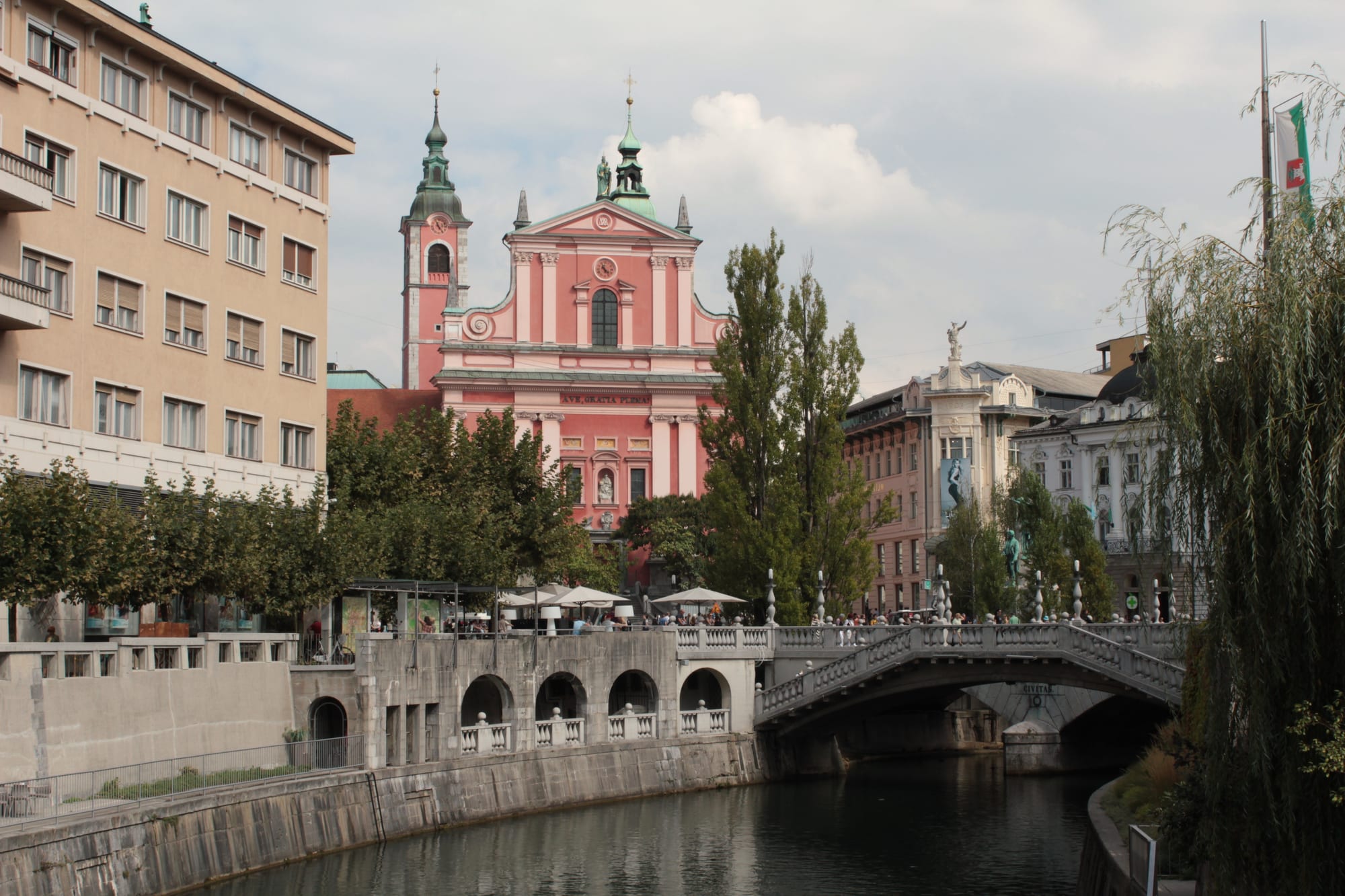
A pink twin-towered church above a stone bridge with white balustrades over a river lined with willows

Ljubljana, Bled & the Julian Alps, Slovenia

Ljubljana

The Ljubljanica at the Triple Bridge, with the Franciscan Church of the Annunciation on Prešeren Square beyond. (Valerio2468 / Wikimedia Commons · CC BY-SA 4.0)

Slovenia's capital, on the Ljubljanica river at the edge of the country's largest marsh, below a castle on its hill. Roman Emona, Habsburg Laibach and a Yugoslav republic capital, it was rebuilt after earthquakes in 1511 and 1895 and reshaped by the architect Jože Plečnik; today it is a compact, largely car-free university city of riverside cafés and bridges.

Neighbourhoods

  • Old Town
    • First-time visitors
    • Historic district
    • Best for food

    The medieval town on the right bank of the Ljubljanica below Castle Hill, around Mestni trg (Town Square) and Stari trg (Old Square), with the cathedral, the central market and the castle funicular. Its narrow lanes and riverside terraces are closed to cars and fill with café tables in the warmer months.

    Open in Maps
  • Center
    • Close to public transport
    • Museums
    • Shopping

    The left-bank heart of the city around Prešeren Square, Čop Street, Congress Square and Slovene Street, with the university, the Philharmonic, the National Museum and the Nebotičnik tower.

    Open in Maps
  • Trnovo and Krakovo
    • Quiet and residential
    • Local life

    The oldest suburbs, south of the centre along the Gradaščica, known for their market gardens and cultural events. Plečnik's Trnovo Bridge stands in front of Trnovo Church, and the embankments make a gentle walk back to the old town.

    Open in Maps
  • Metelkova and Tabor
    • Nightlife
    • Arts and culture
    • Students

    East of the railway station, a former army barracks built in 1882 is now the autonomous cultural centre of Metelkova, full of small clubs, studios and galleries, beside the Museum of Contemporary Art and the National Museum's applied-art collections. It is at its most crowded on Friday and Saturday nights.

    Open in Maps
  • Šiška
    • Local life
    • Live music

    The city's most populous district, north-west of the centre, built over the former villages of Spodnja and Zgornja Šiška. It is mostly residential, with Koseze Pond and the Kino Šiška cultural centre for indie and rock concerts.

    Open in Maps
  • Bežigrad
    • Quiet and residential
    • Sport

    The northern district along Vienna Street, largely residential with low buildings and single-family houses, home to Stožice Stadium, Plečnik's Bežigrad stadium and Žale, the city's main cemetery.

    Open in Maps

Things to do

Castle, bridges and squares

  • Ljubljana Castlelandmark

    The castle complex on Castle Hill above the old town, a medieval fortress largely rebuilt in the 15th to 17th centuries, with a viewing tower of 1848 looking over the city.

    Open in Maps
  • Ljubljana Castle funiculartransit hub

    An inclined lift running since 2006 from Krek Square, beside the central market, up to the castle.

    Open in Maps
  • Triple Bridgelandmark

    The oldest crossing in the city, to which Plečnik added two angled footbridges in the early 1930s; it joins the medieval town to Prešeren Square and is part of the UNESCO listing of his work.

    Open in Maps
  • Prešeren Squarelandmark

    The central square, with the pink Franciscan Church of the Annunciation and the 1905 monument to the poet France Prešeren, and the meeting point for festivals, concerts and protests.

    Open in Maps
  • Dragon Bridgelandmark

    A Vienna Secession road bridge of 1901 with dragon statues at its four corners — the dragon is the city's symbol.

    Open in Maps
  • Cobblers' Bridgelandmark

    Plečnik's pedestrian bridge of columns and lamps, linking two major parts of the medieval town.

    Open in Maps
  • Ljubljana Cathedrallandmark

    The Cathedral of St Nicholas beside the market, a Baroque church of the early 18th century that replaced a Gothic one.

    Open in Maps
  • Nebotičnikviewpoint

    A thirteen-storey tower opened in 1933 and one of the city's most recognisable landmarks, with a café, bar and observation deck on its top floors.

    Open in Maps

Museums and libraries

  • National and University Librarylandmark

    Plečnik's library of brick and stone, built between 1936 and 1941 and considered one of his finest works.

    Open in Maps
  • National Museum of Sloveniamuseum

    The country's oldest scientific and cultural institution, near Tivoli Park, with archaeology, coins and banknotes, sharing its building with the Slovenian Museum of Natural History.

    Open in Maps
  • Museum of Modern Artmuseum

    The central gallery of Slovenian art of the 20th and 21st centuries.

    Open in Maps
  • City Museum of Ljubljanamuseum

    The story of the city from Emona onwards, in Turjak Palace on Gosposka Street.

    Open in Maps
  • Metelkovaattraction

    An autonomous social and cultural centre in seven former barracks buildings, with clubs, artists' studios, galleries and concerts.

    Open in Maps

Parks and green spaces

  • Tivoli City Parkpark

    The largest park in the city, laid out in 1813 and renovated by Plečnik, with the Jakopič Promenade, Tivoli Castle and the National Museum of Contemporary History.

    Open in Maps
  • Rožniktrail

    The wooded hill rising behind Tivoli Park, a favourite walking and running destination for residents.

    Open in Maps
  • Ljubljana Botanical Gardenpark

    Founded in 1810 beside the Gruber Canal, the oldest botanical garden in South-eastern Europe.

    Open in Maps
  • Ljubljana Zooattraction

    The national zoo, open all year, with about 500 animals of more than a hundred species.

    Open in Maps

Markets and nights out

  • Ljubljana Central Marketmarket

    Plečnik's riverside colonnades of 1931–39 between the Triple Bridge and the Dragon Bridge, with open-air stalls of produce on Vodnik Square beside them.

    Open in Maps
  • Križankeattraction

    A former monastery that Plečnik turned into an open-air theatre for the Ljubljana Festival in the 1950s.

    Open in Maps

Short trips from the city

  • Ljubljana Marshpark

    The country's largest marsh, south of the city, where prehistoric pile dwellings and the oldest known wooden wheel were found; the pile-dwelling sites are part of a UNESCO World Heritage Site.

    Open in Maps
  • Škofja Lokaattraction

    A historic town below Loka Castle, held for centuries by the bishops of Freising, with its old centre on terraces above the river.

    Open in Maps
  • Kamnikattraction

    An old town with three castles at the foot of the Kamnik Alps.

    Open in Maps
  • Stična Abbeylandmark

    The oldest monastery in Slovenia, and the only Cistercian house in the country still in use.

    Open in Maps
  • Postojna Caveattraction

    A karst cave system more than 24 km long, carved by the Pivka river and visited by underground train.

    Open in Maps

Seasonal events

  • Book Weeklate April

    Book sales and literary events on Congress Square, beginning each year on World Book Day.

  • Ljubljana PrideJune

    The national LGBTIQ pride march and a week of events before it, supported by the city.

  • Ljubljana Festivalsummer

    Founded in 1953, the country's oldest festival, with classical music, opera, ballet, theatre and jazz at Križanke, Cankar Hall and Congress Square.

  • Ljubljana MarathonOctober

    Slovenia's largest running event, held since 1996, with a marathon, half marathon and 10 km race through the city.

Eat and drink

Long-standing places and food districts in Ljubljana. Hours, ratings and directions come from your maps app, always current.

Ljubljana classics

  • Carniolan sausagerestaurant

    Kranjska klobasa, a parboiled sausage of pork and bacon seasoned with garlic and black pepper, sold at snack stands and served in inns across the city.

    Open in Maps
  • Burekrestaurant

    Flaky pastry pies filled with meat or cheese, sold by burek shops and bakeries and eaten as a late-night or on-the-go snack.

    Open in Maps

Food districts and markets

  • Ljubljana Central Marketmarket

    The open-air produce stalls on Vodnik Square, with cheese, bread and meat sellers in the adjacent colonnades.

    Open in Maps
  • Odprta kuhnamarket

    The 'Open Kitchen', a Friday street-food market beside the central market from spring to autumn, with food stalls set up on the square.

    Open in Maps
  • Petkovšek Embankmentneighborhood

    The riverside embankment across the Butchers' Bridge from the market, lined with restaurants and bars.

    Open in Maps

Cafés and bars

  • Union Breweryrestaurant

    The brewery founded in the city in 1864 and part of Heineken since 2015; brewing moved to Laško in 2022, but the pub and a beer museum remain at its premises.

    Open in Maps
  • Riverside caféscafe

    The terraces on both banks of the Ljubljanica between the Cobblers' Bridge and the Dragon Bridge, the centre of the city's café life.

    Open in Maps

Experience Ljubljana

History

Around 2000 BC people lived in pile dwellings on the Ljubljana Marsh south of the city, and the oldest known wooden wheel was found there. Around 50 BC the Romans built a military camp that became the settlement of Iulia Aemona, home to 5,000 to 6,000 people. The town appears in records in the 12th century — its German name, Laibach, in 1144 and the Slovene form two years later. Around 1200 market rights were granted to Stari trg, one of three walled districts linked by bridges over the Ljubljanica below the castle.

The town became the capital of Carniola under the Habsburgs. After the earthquake of 1511 it was rebuilt in Renaissance and Baroque style on Italian and Venetian models. From 1809 to 1813 it was the capital of Napoleon's Illyrian Provinces, which introduced schooling with more Slovene, and in 1821 it hosted the Congress of Laibach. In 1895 another earthquake struck a town of 31,000, killing 21 people and destroying about a tenth of its 1,400 buildings; whole districts were rebuilt in the Vienna Secession style, and between the wars Jože Plečnik reshaped the riverbanks, bridges, squares and parks.

In 1941 Fascist Italy occupied the city, and from February 1942 it was ringed with barbed wire to cut the resistance inside off from the Partisans outside. After the war it became the capital of the Socialist Republic of Slovenia within Yugoslavia, and in 1991 the capital of the independent state. The centre was closed to motor traffic in 2007, the city was European Green Capital in 2016, and in 2021 Plečnik's works were added to the UNESCO World Heritage List.

Culture & Customs

Ljubljana is the cultural centre of the country, with more than 10,000 cultural events a year. The Ljubljana Festival, founded in 1953, brings orchestras, opera and ballet to Plečnik's open-air theatre at Križanke each summer; the Slovenian Philharmonic and the Slovene National Opera and Ballet Theatre are based here, and Cankar Hall is the country's largest cultural and congress centre. UNESCO named the city World Book Capital in 2010, and each spring Book Week fills Congress Square with stalls.

The alternative scene is as much part of the city's identity. Metelkova, a former army barracks taken over as an autonomous cultural centre, is the Ljubljana counterpart of Copenhagen's Christiania, and the old Rog factory reopened in 2023 as Center Rog, with studios, a library branch and event spaces. Kino Šiška hosts indie, punk and rock concerts, and the city's LGBT film festival, founded in 1984, is the oldest of its kind in Europe.

The dragon on the castle tower of the coat of arms is the city's emblem, repeated on the Dragon Bridge and on souvenirs everywhere. Residents spend free time outdoors — walking and running on Rožnik, cycling, and gathering for a bonfire on the hill at the start of May. Football's Olimpija play at Stožice Stadium, the country's biggest football stadium, and the Tacen whitewater course on the Sava has hosted world canoe slalom championships.

Daily Life

About 300,000 people live in Ljubljana, the seat of the government, parliament and most of the country's institutions. The city is divided into 17 districts, from the compact Center to the populous residential Šiška and the low-rise northern district of Bežigrad. More than 15,000 enterprises operate here, most of them in services, and the University Medical Centre is the largest hospital in Slovenia.

The University of Ljubljana, founded in 1919, has more than 63,000 students, and students make up about one-seventh of the population, giving the city a young feel. Daily routines are built around the river: the market in the morning, coffee on the terraces, and walks along Plečnik's embankments in the evening. Cycling is common, and the city ranked eighth on the Copenhagenize index of bicycle-friendly cities in 2016. Buses are paid by card or phone, and about three-quarters of households are heated by the city's district heating network.

Floods are a recurring concern; the southern and western parts of the city are most at risk, and in August 2023 the Sava and the Gradaščica flooded in their upper reaches.

Food

The Carniolan sausage, kranjska klobasa, is the city's everyday staple: a parboiled sausage of pork and bacon, seasoned with salt, a little garlic and black pepper, stuffed into pork casing and made under strict rules on its ingredients. It is sold at snack stands and inns and eaten with bread and mustard. Štruklji, rolled dumplings that can be boiled, steamed or baked and filled with anything from ricotta to tarragon or walnuts, were once reserved for special occasions and are now everyday dishes, and potica, a rolled festive pastry, appears at holidays.

Burek, a flaky pastry pie filled with minced meat or cheese, is the classic cheap snack, sold by specialist burek shops in the centre. Plečnik's central market on the river, with open-air stalls on Vodnik Square and cheese, bread and meat in the colonnades, supplies home cooks and restaurants alike, and on Fridays from spring to autumn the Odprta kuhna, or Open Kitchen, fills the neighbouring square with food stalls.

The riverside terraces are the centre of eating out, especially on the Petkovšek Embankment across the Butchers' Bridge from the market. The Union brewery, founded in the city in 1864 and part of Heineken since 2015, moved its brewing to Laško in 2022 but keeps a beer museum and a pub at its old brewery on Celovška Street.

Planning tools

Budget

Ljubljana is one of the more expensive places in Slovenia, especially for rooms in the old town in summer, though meals and transport cost less than in many Western European capitals. The central market, burek shops and sausage stands keep daytime eating cheap, and much of the centre, the riverside and Tivoli Park cost nothing to enjoy.

Daily Budget Midrange
USD 150–260 (central hotel, restaurant dinners, castle and museum tickets)
Daily Budget Shoestring
USD 70–100 (hostel bed, market and bakery food, city buses)

Use an Urbana card, the app or a contactless bank card on city buses, and rent a BicikeLJ shared bike for short hops around the centre.

Best Time to Visit

May to September, when the river terraces are open and the Ljubljana Festival fills the summer evenings; late spring and early autumn are quieter. Winters are cold and often foggy, but the city is less crowded.

Suggested Number of Days

Two or three days cover the compact centre at an easy pace. Four or five allow trips to the marshes, the medieval towns of Gorenjska or the Karst caves, all within easy reach by road or rail.

First Visit
2–3 days
With Surroundings
4–5 days

Transportation

The centre is small and the core has been closed to motor traffic since 2007, so most visitors walk. City buses run by LPP cover the rest of the city, paid with an Urbana card, the Urbana app or a contactless bank card; small electric Kavalir shuttles carry people inside the pedestrian zone, and a funicular climbs to the castle. The BicikeLJ bike-share scheme has stations around the inner city.

Parking machines accept the Urbana card; leave a car outside the centre, which is largely closed to traffic.

Airport & Station Connections

Ljubljana Jože Pučnik Airport is at Brnik, about 24 km north-west of the city, linked by buses and shared shuttles as well as taxis. Airports in Venice, Trieste, Zagreb, Klagenfurt and Vienna are other options. The main railway station, with the central bus station beside it, is on the northern edge of the centre, with trains and coaches to the rest of Slovenia and to neighbouring countries.

Walkability

Very walkable. The old town, Prešeren Square, the market, Congress Square and the museums near Tivoli Park are all within a short stroll of each other along the river, and the pedestrian zone keeps cars out. The castle hill is a steep climb on foot, with the funicular as the alternative, and the city is flat and well suited to cycling.

Safety

Slovenia is one of the safest countries in Europe, with low crime. In Ljubljana the main risk is pickpocketing in the busy centre and around the bus and railway stations. Cyclists share many central streets and embankments with pedestrians, so both need to keep an eye out.

Watch bags in crowded spots in the old town and at the stations. Check current official travel advice before travelling.

Climate

Ljubljana lies in a basin with warm summers and moderately cold winters, bordering on oceanic and humid subtropical. The city has up to 90 days of frost a year, winter fog is common, and floods occasionally reach the southern and western districts.

Summer
warm — July and August highs generally between 25 and 30°C, with occasional days above 30°C
Winter
cold — January temperatures mostly around 0°C, with frequent frost and fog

Local Customs

Slovene is the language of daily life, and English is widely spoken, especially by younger people. The city is largely secular, though the cathedral and the old churches are working places of worship where visitors are expected to keep quiet during services. Café culture is strong, and a coffee on a riverside terrace can comfortably last an hour.

Cyclists and pedestrians share many central streets, so keep an eye out for bikes when walking along the river.

Common Payment Methods

The currency is the euro. Cards and contactless payment are accepted almost everywhere, including on city buses, but a little cash is useful for market stalls and small purchases. Cash machines are easy to find in the centre.