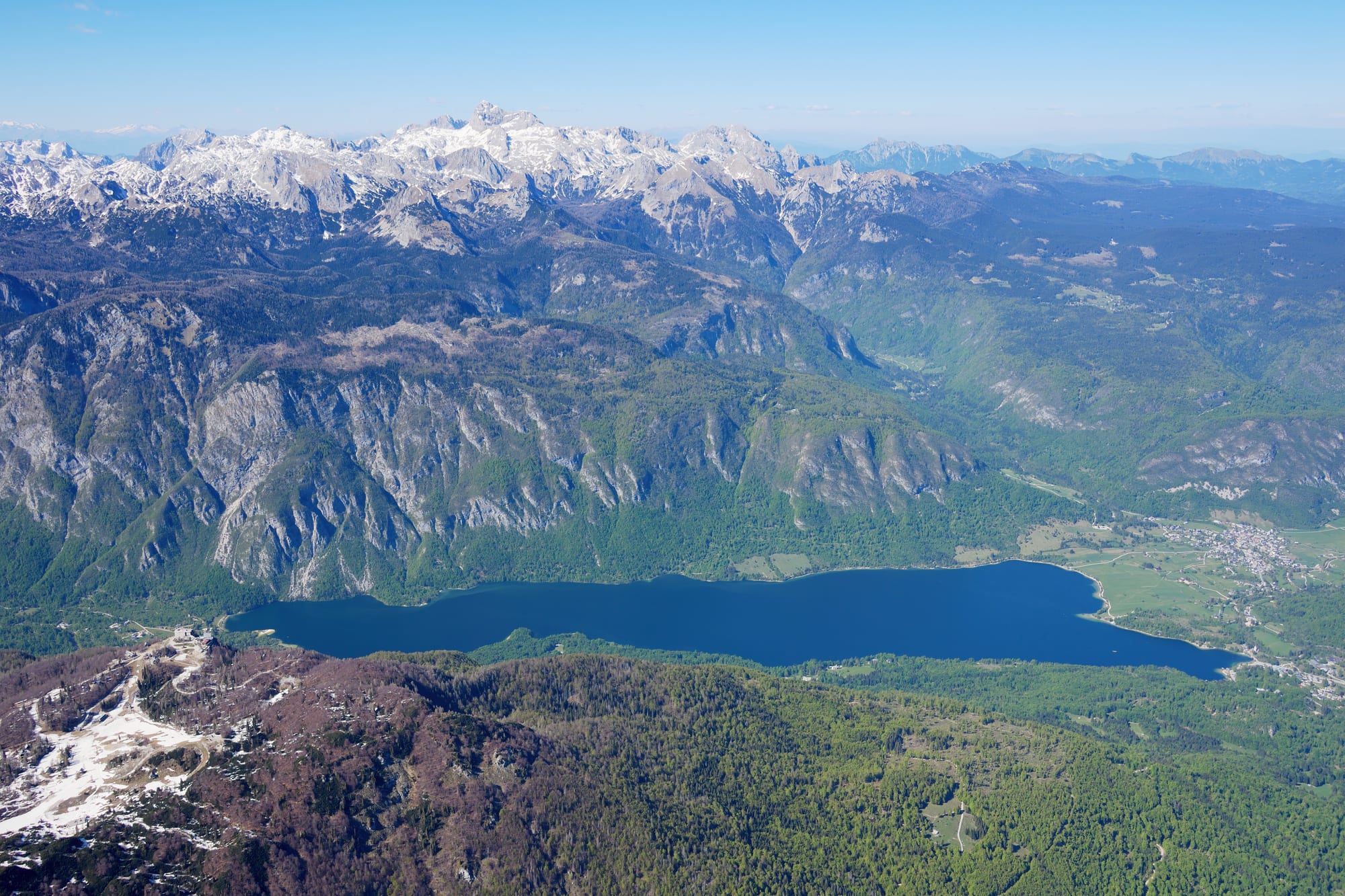
Aerial view of a long dark-blue lake below forested slopes and grey cliffs, with snowy Alpine peaks beyond

Slovenia

Ljubljana, Bled & the Julian Alps

Lake Bohinj from the air, with the Julian Alps and Triglav behind, in Triglav National Park. (Carsten Steger / Wikimedia Commons · CC BY-SA 4.0)

The heart and the high north-west of Slovenia — the capital, Ljubljana, in its basin on the Ljubljanica, the Alpine province of Gorenjska with Lake Bled, Lake Bohinj and Triglav, and the old coal valleys of Zasavje — a region of Habsburg towns, Plečnik's architecture, dairy pastures and the country's best-known mountains.

Explore Ljubljana, Bled & the Julian Alps

History

People lived in pile dwellings on the Ljubljana Marshes more than 5,000 years ago, and a wooden wheel found there is among the oldest known. The Romans founded Emona on the site of Ljubljana early in the 1st century AD, and stretches of its walls survive in the city. Slavs settled the Sava basin in the 6th century, and from the Middle Ages the land was Carniola, with Ljubljana as its capital: German rulers granted Bled to the bishops of Brixen in 1004 and Škofja Loka to the bishops of Freising in 973, and the Habsburgs held Carniola from 1335.

Under the Habsburgs the Alpine valleys lived from iron — Kropa's nail-smiths, the forges of Jesenice — as well as farming and trade over the passes. Ljubljana was a centre of the Protestant Reformation until the Counter-Reformation, briefly the capital of Napoleon's Illyrian Provinces, and host of the Congress of Laibach in 1821. France Prešeren, born in Vrba, worked as a lawyer in Kranj, where he died in 1849. After an earthquake in 1895 Ljubljana was rebuilt with Vienna Secession façades, and between the wars the architect Jože Plečnik reshaped its centre.

In the Second World War Ljubljana was annexed by Italy and ringed with barbed wire, while Gorenjska was occupied by Germany and saw fierce Partisan fighting. Under Yugoslavia the steelworks of Jesenice and the coal mines of Zasavje grew, Tito kept a villa at Bled, and in 1991 Ljubljana became the capital of independent Slovenia.

Culture & Customs

Ljubljana is the country's political, academic and cultural capital, home to its main university, national theatres, opera and the Ljubljana Festival each summer. Its identity is closely bound up with Plečnik, whose works in the city were listed as a UNESCO World Heritage Site in 2021, and with the student and alternative scene of Metelkova, a former barracks turned into an arts centre.

Gorenjska has a reputation within Slovenia for thrift, hard work and practical mountain sense. Its traditions include beekeeping, with painted hive panels collected at the museum in Radovljica, gingerbread hearts, lace-making, and the sound of Oberkrainer music, popularised worldwide by the Avsenik brothers of Begunje. The Škofja Loka Passion Play, staged in the town's streets in costume, is inscribed on UNESCO's intangible heritage list. On Velika Planina herders still bring cattle up to the pasture huts for the summer.

Climbing Triglav at least once is regarded as a rite of passage for Slovenes, and ski jumping at Planica draws huge crowds each March. Zasavje, the mining valley of Trbovlje, Hrastnik and Zagorje, has a distinct working-class culture and gave rise to the band Laibach in 1980. The region is Catholic in tradition, with pilgrimage churches on many hilltops, though Ljubljana is largely secular.

Daily Life

Ljubljana has about 295,000 people and its commuter belt a good deal more. Kranj, with about 38,000, is the second town, followed by Domžale, Kamnik, Škofja Loka, Jesenice and the Zasavje towns. The region holds the country's government, university, head offices and much of its pharmaceutical and IT industry, and Gorenjska adds engineering, electrical goods, the Elan ski factory at Begunje and tourism at Bled, Bohinj and Kranjska Gora.

Zasavje, long dependent on its coal mines, is still adjusting to the decline of mining, while the glassworks at Hrastnik continues. Many Gorenjska villages commute daily into Ljubljana, and the motorway north towards the Karawanks tunnel and Austria carries heavy traffic.

Life is urban and café-centred in Ljubljana, with the central market, the river terraces and cycling as daily routines, and outdoor in Gorenjska, where weekends mean hiking, cycling or skiing. Housing costs in Ljubljana, overtourism and parking at Bled and Bohinj, and the pressure of second homes on Alpine villages are the main local debates.

Food

The Carniolan sausage, kranjska klobasa, a smoked pork sausage with a protected designation, is the region's best-known product, often eaten with mustard and bread. Bled's kremšnita is a square of vanilla custard and whipped cream between layers of pastry, sold in the lakeside cafés. Štruklji, rolled dumplings filled with cottage cheese, tarragon or walnuts, and buckwheat žganci with cracklings are traditional in farmhouse cooking.

The Alpine pastures produce cheese. Mohant, a soft, pungent cheese from the Bohinj valley, has a protected designation; Bohinj also makes hard mountain cheeses, and Velika Planina's herders make trnič, a small, hard, pointed cheese stamped with decorative patterns and traditionally given as a love token. Trout from the Sava Bohinjka and the Alpine streams is served grilled or smoked.

Ljubljana's cooking is increasingly international, but its Friday Open Kitchen food market and its central market bring regional produce together. Honey from the Carniolan bee, Radovljica's decorated gingerbread and blueberry brandy from the mountains are common souvenirs, and Ljubljana's Union brewery, founded in 1864, makes one of Slovenia's two big beers.

Attractions & Natural Wonders

Ljubljana's centre is compact: the castle on its hill, the Triple Bridge and Prešeren Square, Plečnik's market colonnades, Cobblers' Bridge and National and University Library, the cathedral of St Nicholas, and Tivoli Park. South of the city the Ljubljana Marshes hold the sites of the UNESCO-listed pile dwellings, and the Cistercian abbey of Stična lies to the east.

Lake Bled's island church, reached by pletna boat, and the castle on its cliff are the region's classic view, with the Vintgar Gorge's wooden walkways a short way north. Lake Bohinj, larger and quieter, lies within Triglav National Park, Slovenia's only national park, with the Savica waterfall, the Vogel cable car and the Seven Lakes Valley above it; Triglav itself, at 2,864 metres, is climbed from Bohinj, the Vrata valley or the Krma valley. Kranjska Gora sits in the upper Sava valley near the Planica ski-flying hills and Lake Jasna, and the road over the Vršič Pass winds past the Russian Chapel, built by prisoners of war in the First World War.

Radovljica has a small old town with a beekeeping museum, and Kropa preserves its nail-making forges. Škofja Loka has a castle, a painted town square and a stone bridge. Kamnik's old town lies below its Little Castle, with the Kamnik–Savinja Alps beyond; a cable car climbs from the Kamniška Bistrica valley towards Velika Planina, where the oval herders' huts with shingle roofs reaching almost to the ground stand around a chapel.

Cities in Ljubljana, Bled & the Julian Alps

Planning basics

Budget

This is Slovenia's most expensive region. Ljubljana's old town and Bled in July and August have the country's highest hotel prices, and lakeside restaurants charge accordingly. Bohinj, Kranjska Gora outside the ski season, Radovljica, Škofja Loka and Kamnik are better value, and farm stays in the valleys offer good half board.

Daily Budget Midrange
USD 150–290 (hotel in Ljubljana or Bled, restaurant dinners, cable cars, park parking and boat tickets)
Daily Budget Shoestring
USD 70–100 (hostel or farm stay, market and bakery food, buses and trains)

Stay in Radovljica or Bohinj rather than Bled in high summer, and use the frequent Ljubljana–Bled buses instead of paying for lakeside parking.

Safety

The region is very safe. Pickpocketing is possible in Ljubljana's busy centre and on crowded Bled lakeside paths in summer. The serious risks are in the mountains: exposure and rockfall on Triglav's secured routes, afternoon storms, avalanche danger in winter and spring, and underestimating long Alpine walks.

Use a helmet and via ferrata kit on the Triglav routes, start early, and check the mountain forecast. Check current official travel advice before travelling.

Climate

Ljubljana lies in a basin with warm summers and cold, often foggy winters. Gorenjska becomes more Alpine towards the north-west: Bled and Bohinj are cooler and wetter, and Kranjska Gora and the high Julian Alps have long, snowy winters. Summer afternoon thunderstorms are common in the mountains.

Summer
25–30°C in Ljubljana, 20–26°C at the lakes, cool and changeable in the high mountains
Winter
around -3 to 4°C in Ljubljana with frequent fog; snowy and colder in the Alpine valleys

Transportation

Ljubljana's airport at Brnik lies in Gorenjska, about half an hour north of the capital. Buses run frequently from Ljubljana to Bled, Bohinj and Kranjska Gora, trains serve Kranj, Škofja Loka, Kamnik and the Bled–Bohinj line, and summer shuttles link parts of Bohinj and the Vršič road. A car helps in the valleys, but parking at the lakes is limited and charged.

Ljubljana to Bled is about an hour by bus; check winter conditions before driving the Vršič Pass, which closes in snow.

Best Time to Visit

Late May, June and September are the best balance of weather and crowds at Bled and Bohinj; July and August are warmest and busiest. High routes to Triglav are usually safe only from late June to September. Velika Planina's herders are up on the pasture in summer. December to March is ski season at Kranjska Gora, Vogel and Krvavec, and Planica hosts ski-flying in March.