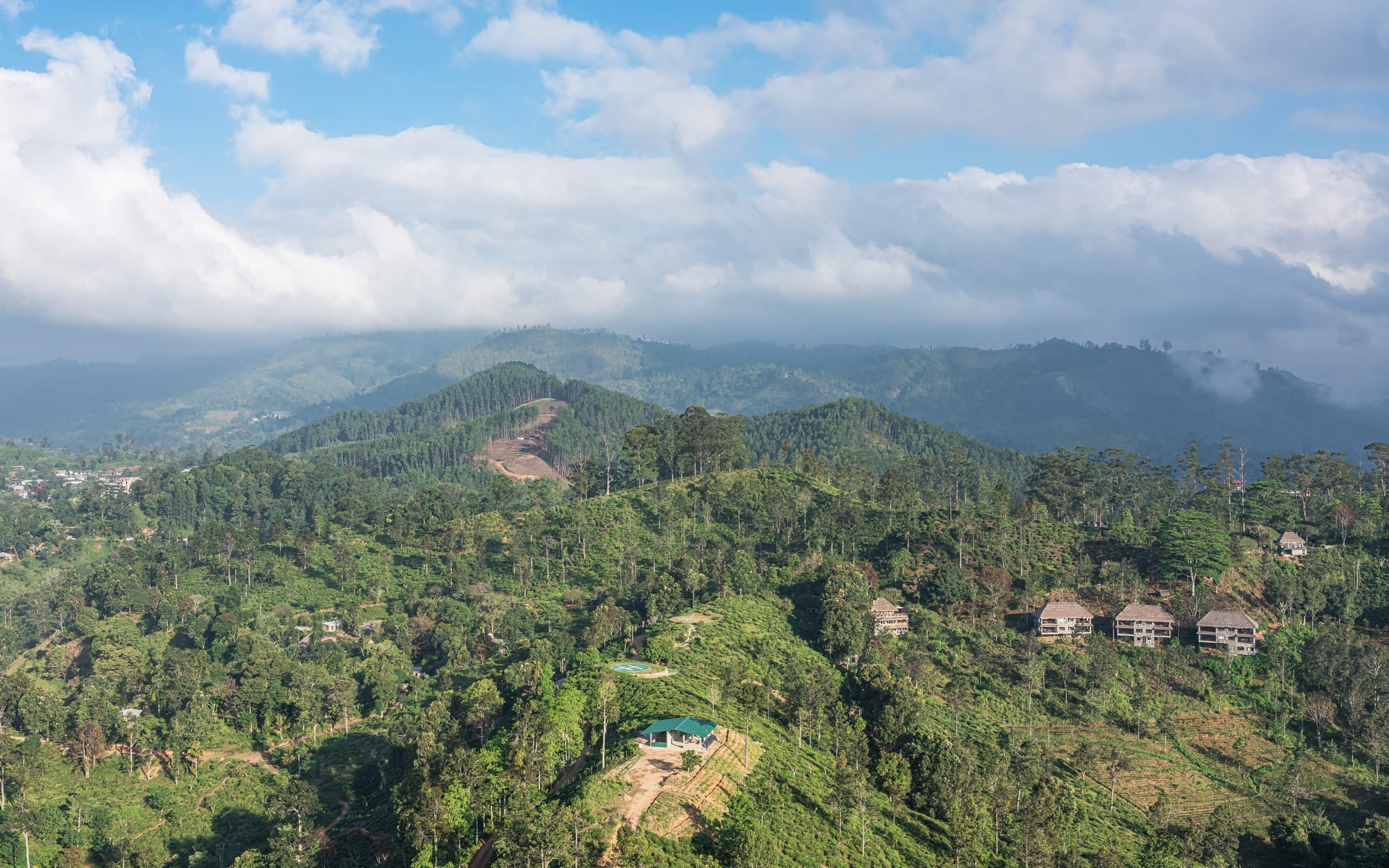
Forested green hills and tea slopes around Ella, with low cloud over distant ridges and a few houses on the hillside

Kandy & the Hill Country, Sri Lanka

Ella

The hills and tea country around Ella, seen from Little Adam's Peak. (A.Savin / Wikimedia Commons · FAL)

A small town in the Uva hills of southern Sri Lanka, set on a ridge above a gap in the mountains where the land falls away towards the southern plains. Tea estates, cloud forest and waterfalls surround it, the hill railway crosses the Nine Arch Bridge nearby, and a village of a few streets has become one of the island's busiest walking and backpacking centres.

Neighbourhoods

  • Ella town centre
    • First-time visitors
    • Best for food
    • Close to public transport

    A single main street of cafés, restaurants, guesthouses, tour desks and shops running down from the railway station, with the bus stop at its lower end. Almost everything in Ella happens along it, and it is busy well into the evening.

    Open in Maps
  • The Passara Road ridge
    • Views
    • Quiet and residential

    The road climbing east out of town towards Passara, lined with hotels and homestays on the slope, many with terraces looking over the tea and down the valley. Quieter than the centre and a short walk from the Little Adam's Peak path.

    Open in Maps
  • Kithalella and the Ella Gap
    • Quiet and residential
    • Walks

    The lower ground south-west of the town, where the land drops sharply towards the plains and the Ella Gap gives long views on a clear day. Scattered houses, tea smallholdings and paddy, with the railway running above.

    Open in Maps
  • Demodara
    • Railway
    • Quiet and residential

    A village a few kilometres down the line, known for the Nine Arch Bridge and for the spiral loop where the railway passes under its own track. A handful of guesthouses sit among the tea slopes around it.

    Open in Maps

Things to do

Walks and viewpoints

  • Little Adam's Peakviewpoint

    A modest hill of about 1,140 metres south-east of the town, reached by a path through tea bushes and a final flight of steps, with a view over the Ella Gap and the surrounding ridges.

    Open in Maps
  • Ella Rockviewpoint

    The larger cliff above the town, a harder walk of several hours that follows the railway line before climbing through forest and tea to an open summit.

    Open in Maps
  • Ravana Fallsattraction

    A wide waterfall beside the road below the Ella Gap, named for the demon king of the Ramayana, at its fullest after heavy rain.

    Open in Maps
  • Ravana Caveattraction

    A small cave high on the hillside above the town, linked in legend to the Ramayana and reached by a long flight of steps.

    Open in Maps

The hill railway

  • Nine Arch Bridgelandmark

    A curved viaduct of nine arches in the tea country near Demodara, completed in 1919 in concrete and locally made sand-cement blocks, and the sight most visitors to Ella come for.

    Open in Maps
  • Bandarawela railway stationtransit hub

    The station in the larger town up the line from Ella, a junction point for buses across Uva and one of the main stops on the hill-country railway.

    Open in Maps
  • Demodara railway stationtransit hub

    The station beside the Demodara loop, where the track spirals to lose height and passes beneath itself through a tunnel under the platform.

    Open in Maps

Short trips from the town

  • Lipton's Seatviewpoint

    The lookout above the Dambatenne estate near Haputale, where Thomas Lipton is said to have surveyed his tea lands, reached through kilometres of tea bushes.

    Open in Maps
  • Diyaluma Fallsattraction

    Sri Lanka's second highest waterfall at about 220 metres, dropping in a long ribbon off the escarpment near Koslanda on the road south towards Wellawaya.

    Open in Maps
  • Buduruwagalalandmark

    A rock face in the dry lowlands near Wellawaya carved with seven colossal figures, including the island's tallest standing Buddha at about 16 metres, dating from around the 10th century.

    Open in Maps
  • Horton Plains National Parkpark

    A high plateau of grassland and cloud forest west of Ella, part of the Central Highlands World Heritage Site, with the sheer drop at World's End and Baker's Falls.

    Open in Maps

Seasonal events

  • Sinhala and Tamil New Yearmid-April

    The island's main holiday, when village games, sweets and auspicious rituals fill the hill communities and Sri Lankan holidaymakers travel to the hills.

  • VesakMay, at the full moon

    The Buddhist festival of the Buddha's birth, enlightenment and death, marked with lanterns along the hill roads and free food at dansal stalls.

  • Thai PongalJanuary

    The Tamil harvest festival, kept by the estate communities of the Uva tea country with boiled rice offerings, decorated doorways and new clothes.

Eat and drink

Long-standing places and food districts in Ella. Hours, ratings and directions come from your maps app, always current.

Ella classics

  • Hill-country rice and curryrestaurant

    The local version comes with a spread of small dishes — dhal, jak fruit, beans, greens cooked as mallung, coconut sambol — and is cooked to order in many guesthouses.

    Open in Maps
  • Curd and kithul treaclecafe

    Buffalo curd in a clay pot with treacle tapped from the fishtail palm, sold at roadside stalls on the hill roads around the town.

    Open in Maps
  • Uva teacafe

    The surrounding estates are part of the Uva district, whose high-grown teas have a distinctive flavour; factories nearby sell and brew their own leaf.

    Open in Maps

The main street

  • Ella main street cafésneighborhood

    The town's single street is lined with small restaurants and cafés serving both Sri Lankan food and the pancakes, smoothies and pasta that long-staying visitors ask for.

    Open in Maps
  • Evening kottu stallsneighborhood

    Kottu roti chopped on hot plates, hoppers and short eats appear along the street after dark, when the town's cooking is at its liveliest.

    Open in Maps

Experience Ella

History

Ella is a young settlement in an old landscape. The Uva hills around it were part of the Kandyan kingdom's eastern country, and the wider region rose against British rule in the Uva–Wellassa rebellion of 1817–18, which was crushed with great severity and left villages burned and land confiscated across the district. The gap itself, where the mountains fall away towards the southern plains, was long a route between the hill country and the lowlands, and local legend attaches the surrounding caves and falls to the Ramayana story of the demon king Ravana and the captive Sita.

What made the modern village was tea. Coffee planting spread through Uva in the mid-19th century and collapsed after a leaf disease struck in 1869; tea replaced it, and the slopes around Ella were cleared into estates worked by Tamil labourers brought from South India. The railway arrived to serve them: the line from Nanu Oya was pushed east through Haputale to Bandarawela and on to Badulla, reaching Ella early in the 20th century. The Nine Arch Bridge at Demodara, completed in 1919, and the spiral loop below it were built as part of that effort, the viaduct raised by local labour under British supervision in concrete and cement block rather than steel.

For most of the last century Ella was a stop on the line, a small settlement of estate offices, shops and a few bungalows. Travellers began arriving in numbers in the late 20th century, and after the civil war ended in 2009 the town grew quickly into a centre for walking and for the train journey through the hills. Guesthouses now climb the slopes on both sides of the valley, and the village has more beds than long-term residents.

Culture & Customs

Two populations share the valley. Sinhalese villagers farm smallholdings, paddy and vegetable plots and run most of the businesses in town, while the estates around Ella are worked largely by up-country Tamils, descendants of the labourers brought from South India in the 19th century, who live in estate settlements with their own Hindu kovils, Tamil-medium schools and festivals. Their community was left stateless for decades after independence and remains among the poorest in the country. Thai Pongal and Deepavali are kept on the estates, the Sinhala and Tamil New Year in April across the whole valley.

Buddhism shapes the calendar for the majority. Poya days are public holidays and local temples fill; the roadside Dowa temple between Ella and Bandarawela, with its rock-cut standing Buddha, is the best known nearby. Hindu shrines stand at the estate divisions, and small Christian congregations meet in the larger towns.

The third culture here is the visitors'. Ella's main street works in English, and its cafés, yoga classes, cooking lessons and tour desks exist for people passing through on the hill-country circuit. The result is a village where guesthouse-keeping, driving and guiding are common trades and where the contrast between the main street and the tea lines a few hundred metres away is sharp. Residents are used to walkers crossing their land, but the paths cross working estates and private gardens, and permission and politeness still matter.

Daily Life

Ella is small: the town has only a few thousand residents, and the wider division that surrounds it is made up of villages and estate settlements scattered across the slopes. Badulla, the provincial capital about 20 kilometres away, and Bandarawela are the towns people go to for offices, hospitals and bigger shopping.

Tea remains the backbone of the valley's economy. Pluckers, mostly women, work the estate fields by the kilogram, and smallholders sell green leaf to nearby factories. Vegetable plots, paddy in the lower ground and spices such as pepper and cardamom add to it. Tourism is the other pillar and the one that has changed the place: guesthouses, restaurants, tuk-tuk driving, guiding and shops now employ a large share of working-age residents, and the money is better than estate work but far more exposed to bad years.

Days begin early and cool, with mist in the gap, pluckers heading out at first light and the first train whistles carrying up the valley. Shops and cafés open late by rural standards and stay open into the evening. The village's pressures are those of fast tourist growth in a small place: water supply, waste and drainage, building on steep slopes, land prices, and crowding at the bridge and on the trails. Landslides after heavy rain are a recurring danger across the district.

Food

The everyday food is hill-country rice and curry, plainer and more vegetable-led than on the coast. A plate might hold dhal, jak fruit or breadfruit, beans, pumpkin, a green mallung of chopped leaves and a coconut sambol, with a fish or chicken curry for those who want it, all cooked with coconut milk and the island's roasted curry powder. Many guesthouses cook it to order, and the spread is the reason a number of them run cooking classes.

Hoppers, bowl-shaped rice-flour pancakes often with an egg set in the centre, and string hoppers with dhal and sambol are morning and evening staples, and kottu roti is the noisy late dish, flatbread chopped on a hot plate with egg, vegetables and spice. Roti with coconut, short eats from the bakeries and vadai and thosai from the estate shops fill the gaps. Curd from buffalo milk, set in clay pots and eaten with kithul treacle, is sold along every road in these hills.

Tea is the local product, and the estates around Ella belong to the Uva district, whose high-grown leaf is prized for its distinctive flavour; several factories nearby sell their own. Alongside that, the main street has developed a second menu for long-staying travellers — banana pancakes, smoothies, fruit bowls and coffee — which sits oddly beside the village kitchens but has become part of the place.

Planning tools

Budget

Ella is cheap by the standards of the hill country, with guesthouse rooms and simple meals costing very little, though prices on the main street are set for visitors and rise sharply in the high season. The regular extras are guides and tuk-tuks to trailheads, train tickets, and a car for the waterfalls and viewpoints further along the hill roads.

Daily Budget Midrange
USD 60–150 (hotel or hillside homestay with a view, restaurant meals, reserved train seats, a driver for a half-day out)
Daily Budget Shoestring
USD 20–40 (guesthouse room, rice and curry, trains and local buses)

Reserved seats on the hill line sell out early; the walks, the bridge and the viewpoints themselves cost nothing.

Best Time to Visit

January to April is the driest and clearest stretch in Uva, with long views from the ridges and the best chance of a cloudless morning. Ella lies partly in the rain shadow of the southwest monsoon, so the middle of the year is often better here than on the western slopes, while October to December brings the heaviest rain from the northeast monsoon.

Suggested Number of Days

Two days are enough for the walks close to the town. Three or four allow longer hikes, the waterfalls and viewpoints along the hill roads, and time to sit still, which is much of the point of coming here.

First Visit
2 days
With Surroundings
3–4 days

Transportation

The town is small enough to cross on foot, and tuk-tuks handle everything else, including trailheads and the Nine Arch Bridge. Buses run along the winding roads to Bandarawela, Badulla, Wellawaya and the south coast, and the railway links Ella with Badulla in one direction and Haputale, Nanu Oya, Kandy and Colombo in the other. Many visitors hire a car and driver for the longer hill routes.

Train seats in reserved classes are limited and sell out well in advance; unreserved carriages are crowded but always available.

Airport & Station Connections

Most visitors arrive by train, the slow hill-country line from Kandy and Nuwara Eliya taking six to seven hours to reach Ella through tea estates and tunnels. By road the town is about 200 kilometres from Colombo, six hours or more, and roughly an hour from Bandarawela or Badulla. The road south through Wellawaya drops to the coast at the southern beaches.

Walkability

The town itself is one walkable street, and the paths to Little Adam's Peak, the Nine Arch Bridge and the tea slopes start within a kilometre or two of it. Everything is on a slope, the main street is narrow with buses and tuk-tuks pushing past, and the longer walks are steep, rough underfoot and slippery after rain. Sturdy shoes matter more than distance here.

Safety

Ella is safe, with little crime beyond overcharging and pushy touts on the tourist circuit. The risks are practical: walkers lose the path on the Ella Rock route, trails are slippery and leech-ridden after rain, and people are injured or killed posing on the railway line and the Nine Arch Bridge, which carries working trains. Landslides close hill roads in heavy rain.

Keep off the tracks and the bridge deck when a train is due, take a guide or clear directions for Ella Rock, and start long walks early. Check current official travel advice before travelling.

Climate

At around 1,000 metres Ella is mild rather than hot, typically 18–27°C by day with cool nights, and mist rolls through the gap on many afternoons. Its position on the eastern side of the hills means its wet season differs from that of the western slopes.

Summer
May to September: drier than the western hills, around 20–27°C, often clear in the morning with cloud building later
Winter
December to March: cool and increasingly clear, around 17–26°C, with cold nights and rain early in the season

Local Customs

This is a village where tourism arrived recently and dominates the main street, while the valleys around it remain farming and estate country. Dress modestly away from the cafés, remove shoes and hats at temples and cover shoulders and knees, and ask before photographing tea pluckers, whose work is not a performance. A greeting in Sinhala or Tamil is appreciated.

Alcohol is not sold in shops on poya (full moon) days; take litter off the trails, which suffer from the numbers walking them.

Common Payment Methods

The currency is the Sri Lankan rupee. Larger hotels and some restaurants on the main street take cards, but guesthouses, tuk-tuks, buses, stalls and guides expect cash. There are a small number of ATMs in the town, and they can run empty at busy times, so it is worth arriving with rupees.