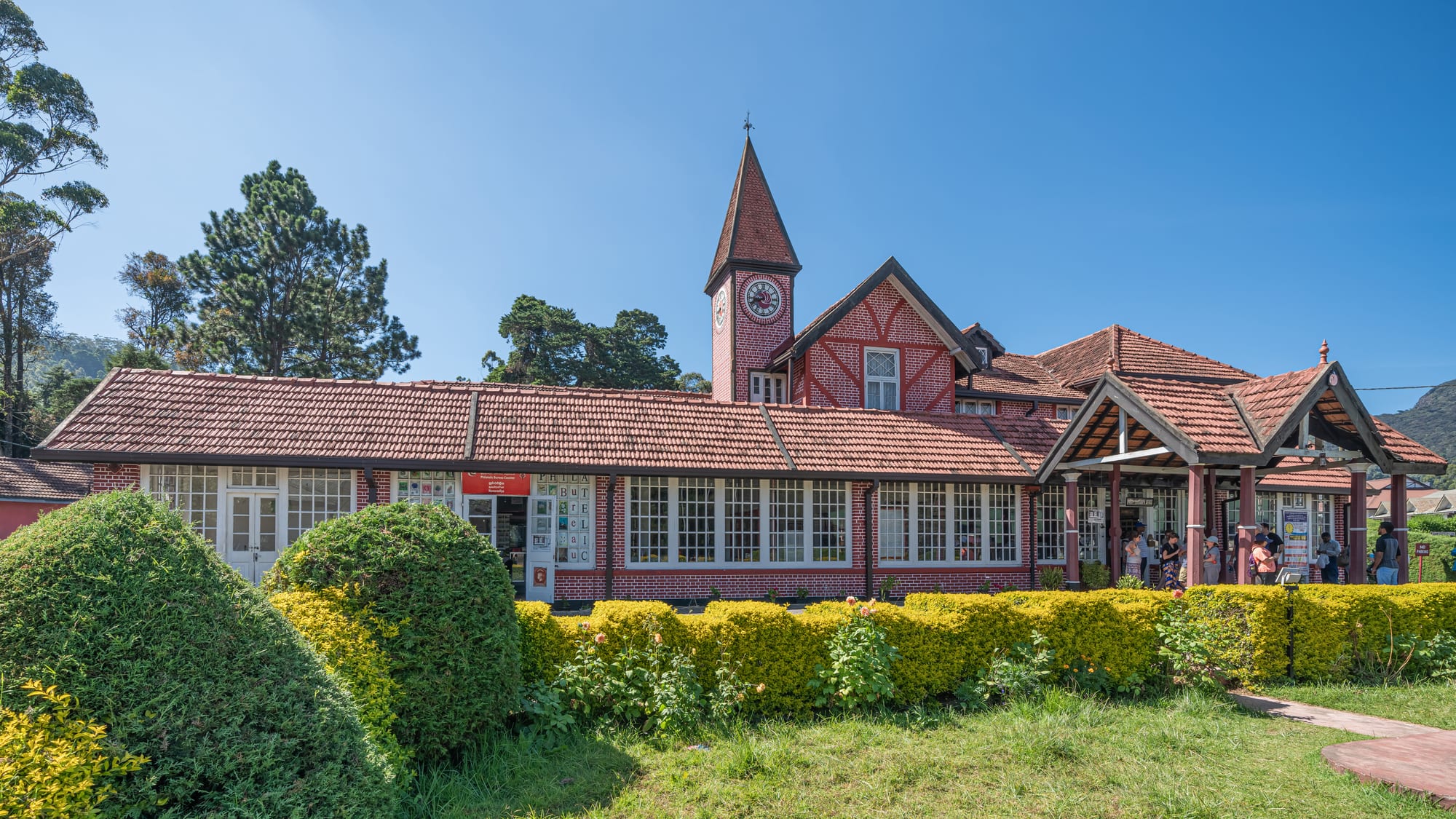
A red brick Tudor-style post office with a clock tower, tiled roofs and clipped hedges in front, under a clear blue sky

Kandy & the Hill Country, Sri Lanka

Nuwara Eliya

The old post office in the centre of Nuwara Eliya. (A.Savin / Wikimedia Commons · FAL)

A highland town in central Sri Lanka, set in a bowl of tea estates at about 1,900 metres below Pidurutalagala, the island's highest mountain. Built by British planters and officials as a hill station in the 19th century, it kept its hedges, brick bungalows and racecourse, and is still a cool-weather resort for Sri Lankan and foreign visitors alike.

Neighbourhoods

  • The town centre
    • First-time visitors
    • Markets
    • Close to transport

    A few busy streets around the old post office and the bus stand, lined with shops, cheap eating houses and the produce market. Most guesthouses, banks and buses are within a short walk, and the racecourse and Victoria Park are at the edge of it.

    Open in Maps
  • Around Lake Gregory
    • Walks
    • Views
    • Quiet and residential

    The southern side of town, where the lake fills the valley floor and a path runs along its shore. Hotels and larger houses sit on the slopes above, and boats, ponies and food stalls gather at the water's edge at weekends.

    Open in Maps
  • The colonial quarter
    • Historic district
    • Architecture

    The rise north and west of the racecourse, where the Hill Club, the older hotels, the golf club and brick bungalows with gardens and hedges stand among pines and eucalyptus. It is the part of town that earned the nickname 'Little England'.

    Open in Maps
  • The estates and Nanu Oya
    • Tea country
    • Rail travellers

    Beyond the built-up area the slopes turn into tea, with estate factories, workers' settlements and market gardens. Nanu Oya, the nearest railway station, lies about eight kilometres west, and the road on to Hatton runs through some of the highest tea land on the island.

    Open in Maps

Things to do

Town landmarks

  • Post Officelandmark

    The red-brick Tudor-style post office with its clock tower, built in the colonial period and one of the oldest post offices in the country.

    Open in Maps
  • Nuwara Eliya Racecourseattraction

    A turf racecourse laid out in 1900 in the middle of town, the only remaining horse racing venue in the country and the centre of the April season, when five meetings are run.

    Open in Maps
  • Victoria Parkpark

    A formal public garden of lawns, flower beds and a stream in the centre of town, known among birdwatchers for migrant species in the early months of the year.

    Open in Maps

Lakes, gardens and green space

  • Hakgala Botanical Gardenpark

    A terraced garden of roses, ferns and temperate trees on the slopes of Hakgala rock south-east of the town on the Badulla road, established in 1861 as an experimental cinchona plantation.

    Open in Maps
  • Galway's Land National Parkpark

    A small patch of montane forest on the edge of town, one of Sri Lanka's smallest national parks and a refuge for highland birds.

    Open in Maps

Walks and viewpoints

  • Pidurutalagalaviewpoint

    Sri Lanka's highest mountain at about 2,520 metres, rising directly behind the town; the summit carries military and communications installations and access is restricted.

    Open in Maps
  • Seetha Amman Templelandmark

    A brightly painted Hindu temple at Seetha Eliya, a few kilometres from town, associated in the Ramayana tradition with the place where Sita was held.

    Open in Maps

Short trips

  • Horton Plains National Parkpark

    A high plateau of grassland and cloud forest south of the town, part of the Central Highlands UNESCO World Heritage Site and crossed by a circular walking trail.

    Open in Maps
  • World's Endviewpoint

    The escarpment at the southern edge of Horton Plains, where the plateau drops away for hundreds of metres towards the lowlands; mist usually closes the view by mid-morning.

    Open in Maps
  • Baker's Fallsattraction

    A wide waterfall on the Belihul Oya within Horton Plains, on the same loop trail as World's End.

    Open in Maps
  • Ambewelaattraction

    A high, treeless stretch of grassland south of the town given over to dairy farming, with Ambewela Farm and the New Zealand Farm and the country's milk powder factory, reached by road or by the hill railway.

    Open in Maps
  • Devon Fallsattraction

    A waterfall of about 97 metres beside the Hatton road west of the town, seen from a roadside viewpoint among tea estates.

    Open in Maps
  • St. Clair's Fallsattraction

    A broad, terraced waterfall on the Kotmale Oya near Talawakele, one of the widest on the island and known as its 'Little Niagara'.

    Open in Maps
  • Nanu Oya railway stationtransit hub

    The station that serves Nuwara Eliya, on the main hill line between Kandy and Badulla, about eight kilometres from the town.

    Open in Maps

Seasonal events

  • The April seasonApril

    The town's busiest weeks, when Sri Lankan holidaymakers fill it for the race meetings, golf tournaments, the flower show at the end of the month and parties in the hotels, and prices reach their peak.

  • Sinhala and Tamil New Yearmid-April

    The national new year, marked with family meals, oil-cake sweets and games; in Nuwara Eliya it coincides with the season and the crowds.

  • Thai PongalJanuary

    The Tamil harvest festival, kept in the estate settlements around the town with boiled milk-rice cooked outdoors and decorated doorways.

  • VesakMay

    The full-moon festival of the Buddha's birth, enlightenment and death, when lanterns and illuminated panels appear along the streets.

Eat and drink

Long-standing places and food districts in Nuwara Eliya. Hours, ratings and directions come from your maps app, always current.

Nuwara Eliya classics

  • Up-country rice and curryrestaurant

    Small eating houses around the town centre serve rice with curries built from the vegetables grown on the terraces above the town — leeks, carrots, beans, beetroot and potato — with dhal, coconut sambol and a fried fish or egg.

    Open in Maps
  • Hill Clubrestaurant

    A former planters' club of 1876 near the racecourse, kept as a hotel with panelled rooms, log fires and a dining room that has held to its colonial-era formalities.

    Open in Maps

Markets and food streets

  • Nuwara Eliya marketmarket

    The town's produce market, piled with the highland vegetables, strawberries and temperate fruit that are trucked from here across the island.

    Open in Maps
  • New Bazaar Streetneighborhood

    The main shopping street, with bakeries selling short eats, tea shops, sweet stalls and cheap rice-and-curry kitchens used by townspeople rather than visitors.

    Open in Maps

Tea

  • The estate tea factoriescafe

    Several working factories on the roads out of town show the withering, rolling and firing of high-grown leaf and pour tastings of the light, brisk Nuwara Eliya style afterwards.

    Open in Maps

Experience Nuwara Eliya

History

Before the British arrived the high plateau was largely empty grassland and forest, used for hunting and as a route between the Kandyan kingdom and Uva rather than settled. British officers crossed the plain early in the 19th century, a road was pushed up into the hills, and a sanatorium and official residence were established for people who needed relief from the heat of the lowlands. The founding of the town itself is credited to Samuel Baker, later the explorer of Lake Albert and the upper Nile, who settled there in 1846.

The town that grew there was deliberately English in temper. Officers and planters laid out a racecourse, a golf course and a park, planted hedges, eucalyptus and pines, built brick and half-timbered houses with fireplaces, and founded the Hill Club in 1876. Coffee estates spread over the surrounding slopes until leaf disease destroyed the crop after 1869; tea replaced it, and the high ground around Nuwara Eliya turned out to produce some of the lightest and most valuable leaf on the island. Tamil labourers brought from South India cleared and planted the estates and settled in the lines of workers' housing that still ring the town.

The railway reached Nanu Oya in 1885, bringing visitors as well as tea chests, and from then until independence in 1948 the town was the summer capital of the colonial establishment. After independence Sri Lankan holidaymakers took over the season, the estates were nationalised in the 1970s and later leased to private companies, and tourism grew alongside market gardening into the town's second industry.

Culture & Customs

Nuwara Eliya's identity rests on the oddity of a piece of transplanted Britain sitting at the centre of Sri Lanka. The nickname 'Little England' is used by the town itself, and the hedges, gabled roofs, log fires, race meetings and rose gardens are maintained as much for Sri Lankan visitors as for foreign ones. The old clubs kept their rules and dress codes long after the planters left, and part of the pleasure of the place for domestic tourists is dressing for the cold in a country where cold is rare.

Underneath that the town is a meeting point of three communities. Sinhalese traders and officials run much of the town centre; up-country Tamils, descendants of the estate labourers brought from South India in the 19th century, form the majority of the surrounding population and keep Hindu kovils, Tamil schools and festivals such as Thai Pongal and Deepavali; and a Muslim merchant community holds many of the shops and the mosque near the bazaar. Their history includes long decades of statelessness after independence, only fully resolved by citizenship laws in the 1980s and 2000s.

April is the town's cultural high point, when the Sinhala and Tamil New Year, the racing season, the flower show and school holidays coincide and the population briefly multiplies. Outside that month the rhythm is quieter and more local: early buses to the estates, evening walks by the lake, and the mist coming down by mid-afternoon.

Daily Life

Only a few tens of thousands of people live in the town itself, with a much larger population in the estate settlements and villages spread across the surrounding hills. Most working households depend on one of two things: tea and the market gardens. Pluckers, almost all of them women, work the estate slopes and are paid by weight, and the level of the daily wage has been a recurring political dispute; other families grow carrots, leeks, cabbages, potatoes and strawberries on the terraces, selling through the town market and the wholesale trade to Colombo and Dambulla.

The town's third employer is tourism, which is seasonal and concentrated. Hotels, guesthouses, drivers, tuk-tuk operators and boat owners at Lake Gregory work hard in the first months of the year and through April, then face quieter, wetter months. Government offices, schools and the hospital account for much of the rest.

Days start early and cold, with mist on the valley floor and buses grinding up the estate roads before dawn. Housing is the town's clearest problem: many estate families still live in the old 'line rooms', terraces of single rooms built in the 19th century, and successive schemes to replace them have moved slowly. The local pressures are familiar ones for the hill country — landslides after heavy rain, young people leaving for Colombo or for work abroad, and the effect of high visitor numbers on a small town's water and waste systems.

Food

The food of Nuwara Eliya is built on what grows around it. A rice and curry here comes with the temperate vegetables the district is known for: leeks and carrots cooked in coconut milk, beetroot curry, potato, green beans, and mallung of shredded leaves with grated coconut, alongside dhal, pol sambol and a fried fish or egg. Small kitchens in the bazaar serve this at midday, and parippu and roti are the everyday food of the estate settlements.

Tamil cooking gives the town its snack culture. Vadai, deep-fried lentil rings, thosai and string hoppers are sold with sambar and coconut chutney in tea shops around the centre, and short eats — fish cutlets, patties, rolls — sit in glass cases in the bakeries along the main street. Sweet buns and Ceylon-style bakery cakes suit the cold, and the plain milk tea served everywhere, strong and heavily sugared, is the local drink at any hour.

The district's produce also appears in forms visitors notice quickly: strawberries grown in the plots around Ambewela and sold with cream at roadside stalls, fresh dairy from the highland farms, and temperate fruit rarely seen elsewhere in Sri Lanka. Above all there is the tea itself. Nuwara Eliya's high-grown leaf makes a pale, brisk liquor that is usually drunk without milk by those who take it seriously, and estate factories around the town sell it by the packet after a tasting.

Planning tools

Budget

Nuwara Eliya is one of the more expensive places to sleep in Sri Lanka. Its colonial hotels and restored estate bungalows charge far above the national average, and rates climb steeply in April, when Sri Lankan holidaymakers fill the town. Guesthouses in the centre remain cheap, as do meals, buses and trains; the extras that add up are a car and driver to Horton Plains and the park entry fee there.

Daily Budget Midrange
USD 75–180 (boutique hotel or estate bungalow, restaurant meals, reserved train seats, a driver for Horton Plains)
Daily Budget Shoestring
USD 25–40 (guesthouse, rice and curry, local buses and trains)

Avoid mid-April unless the season is the reason for coming, book Horton Plains transport the night before, and bring enough cash for the park fee.

Best Time to Visit

January to April brings the clearest mornings and the best chance of a view from World's End, and April adds the races and the flower show along with crowds and high prices. May to September is misty and wet on these western slopes, and October to December sees the second rains. Nights are cold in every season.

Suggested Number of Days

Most visits last a day or two, with a third for the highland excursions and the tea estates. Weather is the main variable, since mist can take the point out of the viewpoints, and travel times on the hill roads are slower than the distances suggest.

First Visit
1–2 days
With Surroundings
3 days

Transportation

The town is small enough to cross on foot, and tuk-tuks handle everything else within it. Buses run from the central stand to Kandy, Colombo, Badulla and Hatton and to villages on the estate roads. Nanu Oya station, about eight kilometres west, is the railhead; taxis and buses shuttle between it and the town. A hired car and driver is the usual way to reach Horton Plains, which is a pre-dawn departure.

Agree a tuk-tuk fare before setting off, and allow for slow, winding roads with heavy lorry traffic on the climbs.

Airport & Station Connections

Most visitors come by road from Kandy, roughly three to four hours through the tea country, or from Ella and Bandarawela to the south-east. The hill railway from Colombo and Kandy to Badulla stops at Nanu Oya, the station for Nuwara Eliya, and the Kandy–Nanu Oya run takes about four hours. The nearest airport is in Colombo, some six hours away by road.

Walkability

The centre is compact and flat enough to walk, and the racecourse, Victoria Park, the market and the post office are all within a few minutes of one another. Beyond that the ground rises sharply, pavements give out on the estate roads, and the altitude makes climbs harder work than they look. The Lake Gregory shore is the pleasantest walk in town.

Safety

Nuwara Eliya is a calm town with little crime beyond occasional overcharging. The real hazards are the weather and the roads: cold, wet mist at altitude, slippery trails, sheer unfenced drops at viewpoints, and landslides that close hill roads during heavy rain. Leeches are common on forest paths in the wet months.

Carry warm and waterproof layers even in the dry season, keep to marked trails at Horton Plains, and check road conditions after heavy rain. Check current official travel advice before travelling.

Climate

At about 1,900 metres the climate is cool all year, far cooler than the coasts, with frequent mist and a wide swing between day and night. Rain comes chiefly with the southwest monsoon from May to September, and the early months of the year are the driest and clearest.

Summer
May–September: misty, damp and often grey, with daytime temperatures around 16–20°C and long spells of drizzle
Winter
December–March: the clearest season, with sunny days near 18–20°C, nights close to freezing and occasional ground frost in January and February

Local Customs

Tipping is not obligatory but small amounts are welcomed, and a service charge is often added in hotels. Shoes and hats come off at Buddhist and Hindu temples, and shoulders and knees should be covered; turning one's back on a Buddha image for a photograph causes offence. The town is a mix of Sinhalese, Tamil and Muslim communities, and Tamil is widely spoken on the estates. Poya days, at each full moon, are public holidays when alcohol is not sold.

Ask before photographing tea pluckers or estate homes, dress modestly in temples and remove footwear, and expect shops and bars to close on poya days.

Common Payment Methods

The currency is the Sri Lankan rupee. Cards are taken by hotels and larger restaurants, but guesthouses, tuk-tuks, buses, market stalls and the smaller eating houses run on cash. There are ATMs and bank branches in the town centre, though machines can run empty at weekends and during the April season, so it is worth carrying rupees before heading out to the estates or to Horton Plains.