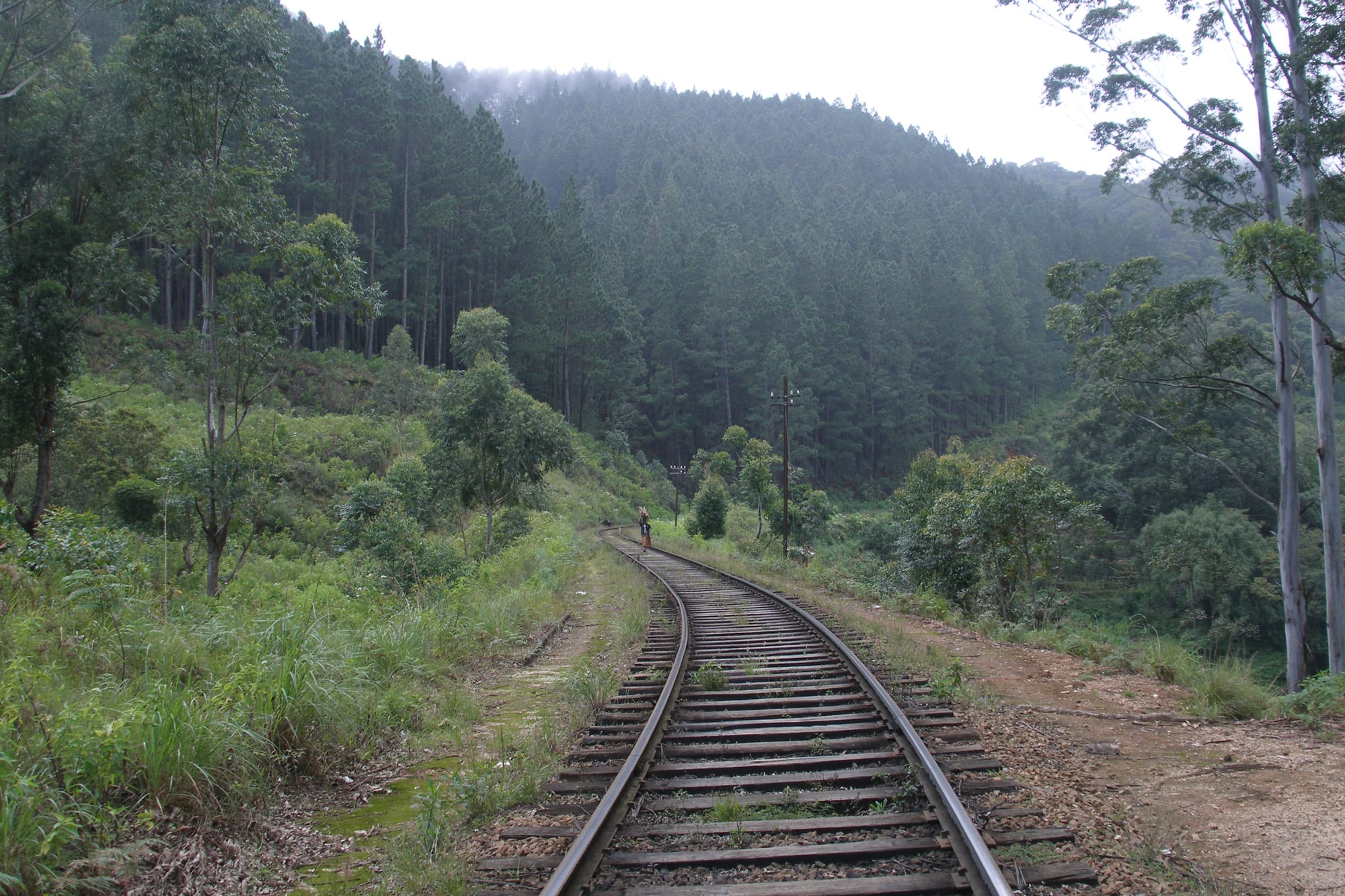
A single railway track curving through green forested hills of eucalyptus and pine under a pale misty sky

Kandy & the Hill Country, Sri Lanka

Haputale

The hill railway line on the ridge west of Haputale, towards Idalgashinna. (Vyacheslav Argenberg / Wikimedia Commons · CC BY 4.0)

A small town on a narrow ridge in the Uva hills of southern Sri Lanka, about 1,400 metres up, where the land falls away towards the southern plains and, on clear days, the sea. Tea estates planted in the 19th century surround it, and the hill railway from Colombo to Badulla runs through the middle of the town.

Neighbourhoods

  • The town centre and the ridge
    • First-time visitors
    • Views
    • Close to transport

    A few hundred metres of shops, tea kiosks and small hotels strung along the main road on the crest of the ridge, with the bus stand at one end. The ground drops sharply on both sides, so views open between the buildings, and almost everything in town is within a short walk.

    Open in Maps
  • Around the railway station
    • Rail travellers
    • Budget stays

    The station sits just below the main street, on the line between Colombo and Badulla. Guesthouses cluster on the lanes above and below it, and the track itself, running along the hillside, is a favourite walk out of town.

    Open in Maps
  • The Dambatenne road
    • Tea country
    • Walks

    East of town the road climbs through the Dambatenne estate towards Lipton's Seat, past tea slopes, workers' settlements and a factory. It is the route most visitors take out of Haputale and is walked as well as driven.

    Open in Maps
  • The Adisham slope
    • Quiet and residential
    • Gardens

    The wooded hillside west of the centre, where pines and eucalyptus surround the stone country house of Adisham and a monastery garden. Houses here are scattered and quiet, a short climb above the noise of the main road.

    Open in Maps

Things to do

Tea country and viewpoints

  • Lipton's Seatviewpoint

    A lookout above the Dambatenne estate where Thomas Lipton is said to have surveyed his tea land, with a wide view over the Uva hills and the plains when the mist lifts.

    Open in Maps
  • Adisham Halllandmark

    A grey stone country house built in 1931 for the British planter Sir Thomas Villiers, in Tudor and Jacobean style, now a Benedictine monastery and open to visitors.

    Open in Maps

Walks and nature

  • Haputale railway stationtransit hub

    The station on the main hill line, one of the highest in Sri Lanka, where trains from Colombo and Kandy continue to Ella and Badulla.

    Open in Maps
  • Idalgashinnaviewpoint

    A small station and settlement on the ridge a few kilometres west, where the line runs along a watershed with valleys falling away on both sides.

    Open in Maps

Short trips

  • Diyaluma Fallsattraction

    One of the tallest waterfalls in Sri Lanka, dropping about 220 metres beside the road down to Wellawaya, with pools on the terraces above it.

    Open in Maps
  • Bambarakanda Fallsattraction

    The highest waterfall in the country at about 260 metres, in a side valley north-west of the town near Kalupahana.

    Open in Maps
  • Bandarawelaneighborhood

    The nearest town of any size, about eight kilometres north-east, with a busy market, banks and bus links across the Uva hills.

    Open in Maps
  • Ellaneighborhood

    A village in a gap in the hills east of Haputale, known for its gorge views, Little Adam's Peak and the Nine Arches Bridge at Demodara.

    Open in Maps
  • Horton Plains National Parkpark

    The high plateau of grassland and cloud forest west of the town, part of the Central Highlands UNESCO World Heritage Site, usually reached from the Ohiya road or station.

    Open in Maps

Seasonal events

  • Sinhala and Tamil New Yearmid-April

    The national new year, when families cook milk rice and oil-cake sweets, estates pause and the town fills with people home from Colombo and abroad.

  • Thai PongalJanuary

    The Tamil harvest festival, widely kept in the estate settlements around Haputale with boiled milk-rice cooked outdoors and decorated doorways.

  • VesakMay

    The full-moon festival marking the Buddha's birth, enlightenment and death, when lanterns are hung along the main street and free food is handed out at roadside stalls.

  • DeepavaliOctober or November

    The Hindu festival of lights, observed in the kovils of the tea estates with oil lamps, new clothes and sweets.

Eat and drink

Long-standing places and food districts in Haputale. Hours, ratings and directions come from your maps app, always current.

Haputale classics

  • Rice and curry in the town centrerestaurant

    Small eating houses along the main road serve rice with several vegetable curries, dhal and coconut sambol, using the leeks, carrots, beans and potatoes grown on the terraces nearby.

    Open in Maps
  • Estate tea shopscafe

    Roadside kiosks pour strong, sweet milk tea from morning onwards and sell vadai, rolls and short eats from glass cases — the usual stop before an early bus or train.

    Open in Maps

Markets and food streets

  • Haputale marketmarket

    A compact produce market in the centre where highland vegetables, dried fish and spices are sold, busiest early in the day and on Sundays.

    Open in Maps
  • Temple Road and the main streetneighborhood

    The short run of bakeries, tea kiosks and Tamil eating houses either side of the bus stand, where thosai, string hoppers and short eats are the everyday food.

    Open in Maps

Tea

  • Dambatenne Tea Factorycafe

    The estate factory on the road to Lipton's Seat shows the withering, rolling and firing of Uva leaf and sells the finished tea, which is sold under the Uva name.

    Open in Maps

Experience Haputale

History

Haputale was a forested ridge on the edge of the Uva country before the British came, used as a boundary and a route between the hill kingdom and the southern plains rather than as a town. The Kandyan kingdom's southern frontier lay in these hills, and the area was caught up in the Uva–Wellassa rebellion of 1817–18, which British forces suppressed with great severity, burning homes and paddy and killing livestock across the district.

The town as it stands is a creation of the plantations. Coffee was planted on the surrounding slopes in the mid-19th century and destroyed by leaf disease after 1869, and tea replaced it. In 1890 Thomas Lipton, the Glasgow grocer, bought several estates in the district, among them Dambatenne, and built a factory there to process his own leaf for sale in his shops — one of the first attempts to run tea from bush to counter under a single name. Tamil labourers recruited from South India cleared the land and worked it, and their descendants still make up much of the population of the estates.

The railway arrived at the end of the 19th century as the line was pushed up from Nanu Oya towards Badulla, reaching Haputale in 1893 and Bandarawela the following year, and giving the estates a way to move tea to Colombo. The town grew along the ridge beside the station as a market and transfer point. Adisham, the stone house on the slope west of town, was built in 1931 by the British planter Sir Thomas Villiers and passed to the Benedictine order in the 1960s. After independence the estates were nationalised in the 1970s and later leased to private companies, and Haputale has since added a modest tourist trade to its work as an estate town.

Culture & Customs

Haputale's character comes from the meeting of two communities on one hillside. The town centre is largely Sinhalese and Muslim, with shops, eating houses and a mosque along the main street, while the estates that surround it are overwhelmingly Tamil, descended from the workers brought from South India in the 19th century. Tamil is heard on the estate roads, Sinhala in the shops, and both languages appear on signs. Hindu kovils stand among the tea, Buddhist temples above the town, and churches serve a Christian minority that includes the Benedictine community at Adisham.

The up-country Tamil community keeps its own calendar and customs: Thai Pongal in January, Deepavali later in the year, temple festivals on the estates, and a strong attachment to schooling as the route out of estate work. Their history is a difficult one — decades of statelessness after independence, poor housing in the old line rooms, and long campaigns over the daily wage — and it is part of the everyday conversation of the district.

Daily manners are those of rural Sri Lanka: modest dress, footwear removed at temples and in homes, and hospitality offered as a cup of sweet tea. The rhythm of the town is set by the estates and the trains. Work starts early, the buses and the first train fill before dawn, and by late afternoon cloud has usually risen from the plains and closed the long view that is the town's chief possession.

Daily Life

The town itself holds only a few thousand people, with a far larger population spread through the estate settlements and villages on the slopes around it. Tea is the economy. Pluckers, nearly all women, work the Dambatenne and neighbouring estates and are paid by weight, and the daily wage is a recurring political issue; men work in the factories, on maintenance and in transport. Market gardening adds a second income on the higher ground, with carrots, leeks, cabbage and beans trucked down to the wholesale markets.

Government service, schools, small shops and the bus and rail trades employ much of the town centre, and tourism is a growing but seasonal addition — guesthouses, drivers and guides for Lipton's Seat, the waterfalls and Horton Plains. Many families also depend on remittances from relatives working in Colombo or in the Gulf.

Housing is the district's clearest problem: many estate families still live in line rooms, terraces of single rooms dating from the plantation era, and replacement schemes have moved slowly. Landslides are a genuine risk in heavy rain, and the road and rail links along the ridge can be cut for days. Younger people leave for the cities, and the town's quiet streets fill again at the April new year when they return.

Food

Everyday food in Haputale is rice and curry, built on what the hills produce. A plate comes with dhal, a vegetable or two — beans, leeks, carrot, potato, beetroot — a mallung of shredded greens with coconut, coconut sambol, and sometimes dried fish or an egg. The vegetables are the district's own, grown on the terraces above the town, and the cooking is plainer and less coconut-rich than on the coasts.

Tamil food is everywhere on the estate side of town. Thosai and string hoppers with sambar and coconut chutney, vadai fried in the afternoon, roti with dhal, and pittu, steamed cylinders of rice flour and coconut, are the staples of estate households and of the small kitchens near the bus stand. Bakeries sell short eats, fish buns and sweet rolls, and the tea kiosks that punctuate the main street pour strong milk tea all day.

Tea is also the town's product rather than just its drink. Uva is one of the island's main tea districts, alongside Nuwara Eliya and Dimbula, and the leaf grown on these slopes and processed at factories such as Dambatenne is sold as a regional style in its own right. Factory shops sell leaf by the packet, and buffalo curd with kithul treacle, sold in clay pots on roads down towards the lowlands, is the usual sweet.

Planning tools

Budget

Haputale is one of the cheapest bases in the hill country. Guesthouses on the ridge, many of them family-run, cost little, meals in the town are inexpensive, and trains and buses are very cheap. The costs that add up are a tuk-tuk or jeep to Lipton's Seat before dawn, a car for the waterfalls, and the park fee if Horton Plains is on the list. Higher-end accommodation means a converted estate bungalow rather than a hotel.

Daily Budget Midrange
USD 75–180 (boutique hotel or estate bungalow, restaurant meals, reserved train seats, a driver for Horton Plains)
Daily Budget Shoestring
USD 20–35 (guesthouse, rice and curry, buses and trains)

Share the early-morning tuk-tuk to Lipton's Seat, and book reserved train seats as soon as they are released, since the hill line fills quickly.

Best Time to Visit

Uva lies partly in the rain shadow of the central mountains, so its pattern differs from the western hills. February to September is generally the drier, clearer stretch, with good views from the ridge, and October to January brings the northeast monsoon and most of the rain. Mornings are the clearest time of day in any season; cloud usually rises from the plains by late morning.

Suggested Number of Days

One or two nights suit the town and the tea country immediately around it, and three allow the waterfalls and the high plateau to the north. Cloud and rain are the main variable, since the long views that justify the ridge can be closed for a whole day.

First Visit
1–2 days
With Surroundings
3 days

Transportation

The town is small enough to walk from end to end in about fifteen minutes, and tuk-tuks handle the climbs and the estate roads. Buses from the central stand run to Bandarawela, Badulla, Wellawaya and Colombo, and to villages on the estate roads. Trains on the Colombo–Badulla hill line call at the station, with Ella about an hour away and Nanu Oya, for Nuwara Eliya, to the west.

Agree tuk-tuk fares in advance, and allow extra time on hill roads, which are narrow, steep and slow after rain.

Airport & Station Connections

Most visitors arrive by train on the hill line, either from Kandy and Nanu Oya to the west, a ride of several hours, or from Ella and Badulla to the east, a ride of one to two hours. Buses connect the town to Bandarawela, Badulla and Colombo, and the road from the south coast climbs up through Wellawaya and past Diyaluma Falls. The airport most visitors use is Colombo's, a long day's travel away.

Walkability

The centre is compact and walkable, though the main street carries buses and lorries and its pavements are narrow. Everything beyond the ridge involves a climb, and the estate roads have no footways. Walking along the railway line towards Idalgashinna is a local habit and a popular route, but trains use it and there is no separate path.

Safety

Haputale is a quiet town with very little crime. The hazards are practical: fast traffic on a narrow main road, unfenced drops at viewpoints, mist that reduces visibility within minutes, slippery paths and leeches in the wet months, and the real dangers of walking on an active railway line. Waterfall pools have strong currents after rain.

Take warm and waterproof layers for early starts, keep well clear of the rails when trains are due, and do not swim above or below waterfalls after heavy rain. Check current official travel advice before travelling.

Climate

At about 1,400 metres the town is cool and often cloudy, with strong wind along the ridge. Uva sits partly in the rain shadow of the central mountains, so the southwest monsoon brings less rain here than to Nuwara Eliya, and the heaviest falls come with the northeast monsoon late in the year. Nights are cold all year.

Summer
May–September: windy and often misty, with daytime temperatures around 18–22°C and showers rather than long rain
Winter
October–January: the wettest months, around 16–21°C by day with heavy showers and cool, damp nights near 10°C; February to April is drier and clearer

Local Customs

The town and the estates around it are a mix of Sinhalese, up-country Tamil and Muslim communities, and Tamil is the first language of most estate families. Shoes and hats are removed at Buddhist temples and Hindu kovils, and shoulders and knees should be covered. Tipping is modest and not expected in small eating houses. Poya days, at each full moon, are public holidays when alcohol is not sold.

Ask before photographing tea pluckers or estate housing, dress modestly at temples and remove footwear, and greet people with a nod and 'ayubowan' or 'vanakkam'.

Common Payment Methods

The currency is the Sri Lankan rupee. A few hotels take cards, but almost everything else in Haputale — guesthouses, tuk-tuks, buses, the market, tea kiosks and factory shops — runs on cash. There are bank branches and ATMs on the main street, but they are fewer than in Bandarawela or Nuwara Eliya, so it is worth drawing enough before heading out to the estates.