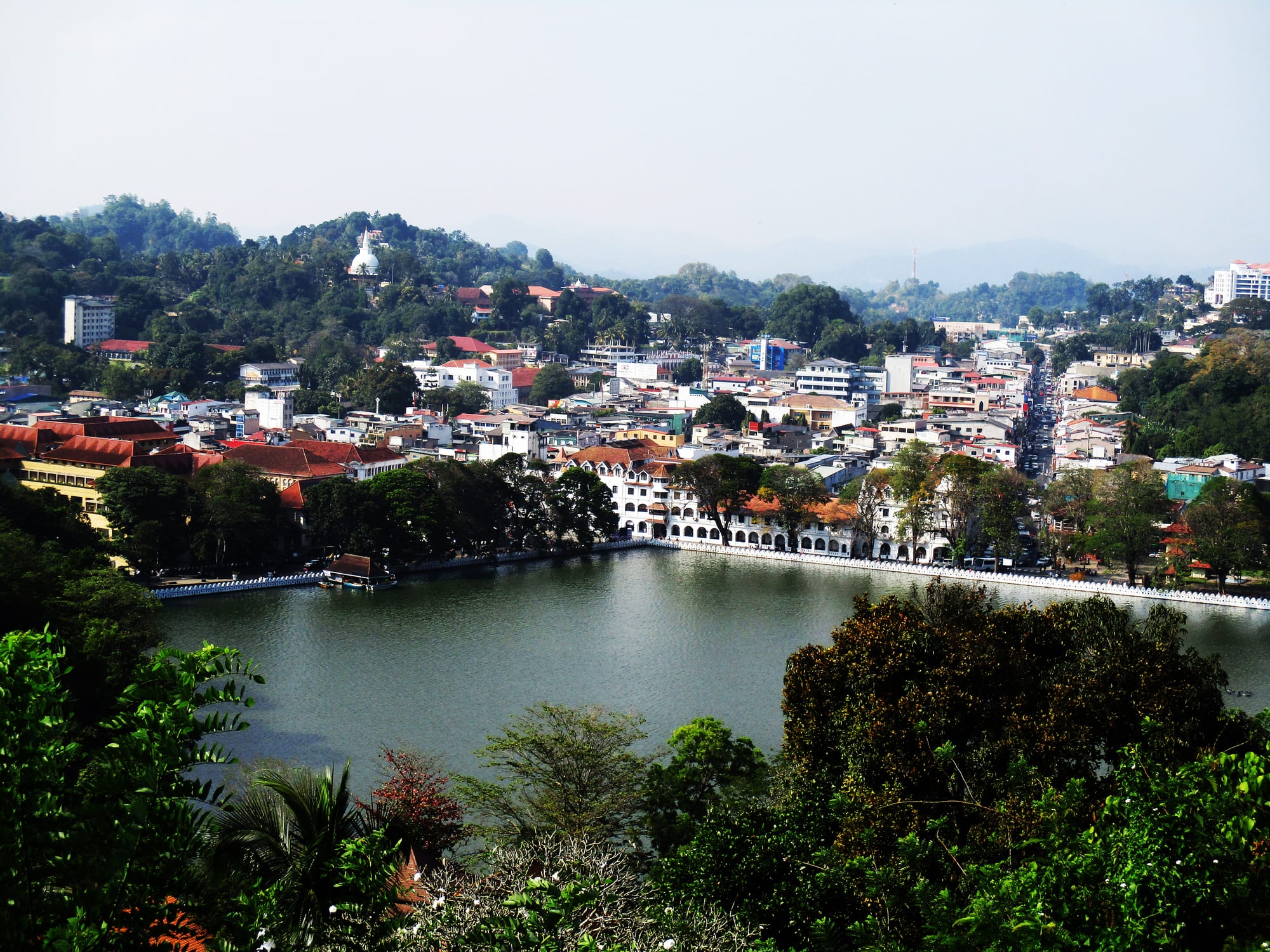
Kandy's lake in the foreground with the town's red and white roofs, a white stupa on a wooded hill and blue ridges behind

Kandy & the Hill Country, Sri Lanka

Kandy

Kandy and its lake seen from the hillside lookout above the town. (Charles R. Benedict / Wikimedia Commons · CC BY-SA 4.0)

The last capital of the Sinhalese kings, set in a bowl of hills around an artificial lake at about 500 metres in central Sri Lanka. The Temple of the Tooth beside the water holds the island's most venerated Buddhist relic and anchors a sacred city listed by UNESCO. Kandy is also a university and market town, and the gateway to the tea country.

Neighbourhoods

  • The city centre
    • First-time visitors
    • Markets
    • Close to public transport

    The grid of streets between the lake and the railway station, centred on Dalada Veediya and the clock tower, holding the market, the bus stands, shops, banks and most of the cheaper places to stay. Crowded and noisy by day, and quiet after the shops close.

    Open in Maps
  • The lake and the sacred quarter
    • Historic district
    • Museums
    • Walks

    The eastern side of the centre, where the Temple of the Tooth, the remains of the royal palace, the national museum and the devales stand together beside Kandy Lake. A walking path circles the water, and the whole area forms the UNESCO-listed sacred city.

    Open in Maps
  • The hillsides above the lake
    • Views
    • Quiet and residential

    Roads climbing steeply from the lake to Rajapihilla Mawatha and beyond, lined with guesthouses and villas looking down on the town. Views are the main reason to stay here, at the cost of a long walk or a tuk-tuk ride into the centre.

    Open in Maps
  • Peradeniya
    • Parks
    • Students
    • Quiet and residential

    About five kilometres west along the Mahaweli River, home to the Royal Botanic Gardens and the University of Peradeniya, whose wooded campus spreads over the hills. A separate, calmer town with its own station and student cafés.

    Open in Maps
  • Katugastota
    • Local life
    • Close to public transport

    A suburb north of the city on the Mahaweli River, where the roads to Matale and the north cross the water. Largely residential and commercial, and a common base for travellers who want cheaper rooms outside the centre.

    Open in Maps

Things to do

The sacred city

  • Temple of the Toothlandmark

    The Sri Dalada Maligawa, the royal temple beside the lake that houses the relic of the Buddha's tooth, where drummers mark the daily offerings and pilgrims queue for a sight of the casket.

    Open in Maps
  • Royal Palace of Kandylandmark

    The remaining buildings of the Kandyan kings' palace next to the temple, including the audience hall with its carved wooden pillars, where the kingdom was surrendered to Britain in 1815.

    Open in Maps
  • National Museum of Kandymuseum

    A museum in the old queens' quarters of the palace, holding Kandyan-period weapons, jewellery, tools and court regalia.

    Open in Maps
  • Trinity College Chapellandmark

    The chapel and grounds of Trinity College above the lake, a school founded by Anglican missionaries whose chapel is modelled on Sinhalese Buddhist architecture, open-sided under a high roof carried on carved stone pillars.

    Open in Maps
  • Kandy Lakepark

    The artificial lake dug by the last king in 1807 in front of his palace, ringed by a walkway and a low parapet wall, with monitor lizards and water birds along the banks.

    Open in Maps

Temples and viewpoints around the city

  • Degaldoruwa Raja Maha Viharalandmark

    A rock temple a few kilometres east of the city, cut into a granite outcrop in the 18th century and known for its Kandyan-period wall paintings.

    Open in Maps
  • Udawatta Kele Sanctuarypark

    A forest reserve on the ridge behind the Temple of the Tooth, once the royal park, now a sanctuary of tall trees, monkeys and birds crossed by walking trails.

    Open in Maps
  • Kandy Garrison Cemeteryattraction

    A small British colonial burial ground above the lake, whose graves record deaths from malaria, cholera, elephants and accidents in the 19th century.

    Open in Maps
  • St Paul's Churchlandmark

    A red-brick Anglican church of the 1840s standing immediately beside the Temple of the Tooth, built for the British garrison.

    Open in Maps

Gardens, tea and sport

  • Royal Botanic Gardens, Peradeniyapark

    Sri Lanka's largest botanic garden, in a loop of the Mahaweli River, with its avenues of palms, a great spreading fig tree, an orchid collection and a spice garden.

    Open in Maps
  • Ceylon Tea Museummuseum

    A museum in a former tea factory at Hantana on the edge of the city, with old rolling and drying machinery and displays on the industry's pioneers.

    Open in Maps
  • Asgiriya Stadiumattraction

    A hillside cricket ground belonging to Trinity College, which hosted 21 Test matches between 1983 and 2007 and is known for its view over the city.

    Open in Maps
  • Pallekele International Cricket Stadiumattraction

    The modern international ground east of the city, built among the hills and used for Test, one-day and Twenty20 matches.

    Open in Maps
  • Kandy railway stationtransit hub

    The terminus of the branch from Peradeniya and the starting point for many travellers heading up the hill line towards Nuwara Eliya and Ella.

    Open in Maps

Short trips from the city

  • Lankatilaka Viharalandmark

    A 14th-century temple on a rock outcrop west of Kandy, built in a mixture of Sinhalese and South Indian styles, with a tall image house and stone inscriptions.

    Open in Maps
  • Gadaladeniya Viharalandmark

    A stone temple of 1344 on a bare rock, built almost entirely of sculptured granite and designed by a South Indian architect.

    Open in Maps
  • Embekka Devalayalandmark

    A 14th-century shrine famous for the carved wooden pillars of its drummers' hall, each with a different design of dancers, birds and mythical beasts.

    Open in Maps
  • Knuckles Mountain Rangetrail

    A rugged massif north-east of Kandy, part of the Central Highlands World Heritage Site, with cloud forest, waterfalls and village trails.

    Open in Maps
  • Pinnawala Elephant Orphanageattraction

    A state-run elephant centre west of Kandy near Kegalle, where the herd is walked down to bathe in the Maha Oya river.

    Open in Maps

Seasonal events

  • Esala PeraheraJuly or August

    Sri Lanka's greatest festival, ten nights of processions from the Temple of the Tooth with whip-crackers, torch-bearers, Kandyan dancers, drummers and caparisoned elephants carrying the relic casket.

  • Sinhala and Tamil New Yearmid-April

    The island's main holiday, marked in Kandyan households with oil-cake sweets, traditional games and rituals timed to auspicious hours.

  • VesakMay, at the full moon

    The Buddhist festival of the Buddha's birth, enlightenment and death, when lanterns and illuminated pandals fill the streets and dansal stalls hand out free food.

  • PosonJune, at the full moon

    The festival marking the arrival of Buddhism in Sri Lanka, when temples fill and pilgrim traffic crosses the hills.

Eat and drink

Long-standing places and food districts in Kandy. Hours, ratings and directions come from your maps app, always current.

Kandy classics

  • Curd and treaclerestaurant

    Buffalo curd set in clay pots and eaten with kithul treacle, the syrup tapped from the fishtail palm, sold in roadside stalls throughout the hills around the city.

    Open in Maps
  • Kandyan sweets and short eatscafe

    Kavum oil cakes, kokis lattice fritters, aluwa and coconut toffee at festival times, and fish buns, cutlets and Chinese rolls on bakery counters all year.

    Open in Maps
  • Biriyani and Muslim cookingrestaurant

    The city's long-established Muslim eating houses serve buriyani, kottu and watalappan, a jaggery and coconut-milk custard, and are busiest around Friday prayers.

    Open in Maps

Food districts and markets

  • Kandy Municipal Marketmarket

    The covered produce market near the clock tower, piled with hill-country vegetables, fruit, spices, jaggery and dried fish.

    Open in Maps
  • Dalada Veediya and the centreneighborhood

    The main street and the lanes around it hold most of the city's rice-and-curry canteens, tea rooms and bakeries, with short eats sold from counters through the day.

    Open in Maps
  • Peradeniya Roadneighborhood

    The road towards the university and the botanic gardens, lined with student cafés, South Indian vegetarian places and roadside fruit stalls.

    Open in Maps

Experience Kandy

History

Kandy began as Senkadagala, a settlement in a defensible river bend in the central hills, and rose in the late 15th century as the seat of an independent kingdom while the coasts fell to European powers. Its position made it almost unassailable: a ring of mountains, dense forest, narrow passes and malarial lowlands separated it from Colombo, and its rulers used the terrain rather than fortifications, abandoning the city when invaders came and returning when disease and supply lines broke them. Portuguese armies were destroyed in the passes more than once.

The kingdom became the guardian of the Tooth Relic, the object that legitimised Sinhalese kingship. Wherever the court moved the relic went with it, and the temple beside the palace was rebuilt in the 17th and 18th centuries into the complex seen today. The Kandyan kings played the Portuguese, Dutch and British against one another for three centuries, ceding coastal territory and trade while keeping the interior. The last dynasty, the Nayaks, came from South India and gradually lost the confidence of the Kandyan chiefs.

In 1815 those chiefs signed the Kandyan Convention, handing the kingdom to Britain and ending more than two thousand years of Sinhalese monarchy; a rebellion in 1817–18 was put down with severity. The British cut the road through Kadugannawa, brought the railway up in 1867, planted coffee and then tea across the hills, and made Kandy the administrative centre of the interior. Twentieth-century Kandy grew as a market, school and university city. The sacred city was inscribed as a UNESCO World Heritage Site in 1988, and in 1998 a bomb badly damaged the front of the temple complex, which was rebuilt.

Culture & Customs

Kandy is the capital of Kandyan Sinhalese identity, which keeps customs distinct from the low country: a body of Kandyan customary law recognised in marriage and inheritance, the osariya style of draping the sari, and a particular formality of speech and manner. Kandyan dance, performed in beaded silver breastplates and elaborate headdresses to the double-headed geta bera drum, is a temple art turned into a national symbol, and is taught in schools and staged nightly in halls around the city.

The religious calendar runs on the Temple of the Tooth. Offerings with drumming and horns are made three times a day, and each full moon brings crowds in white. The Esala Perahera in July or August is the high point: ten nights of processions in which the four devales of the city join the temple, and the relic casket is carried through the streets on a tusker among hundreds of dancers, drummers and torch-bearers. The city has also been the seat of the two great monastic chapters, Malwatte and Asgiriya, since the 18th century.

Kandy is a school city as much as a temple one, with old institutions such as Trinity College and Dharmaraja shaping local loyalties, and the annual school cricket matches are major social events. There is a substantial Muslim population in the city and in towns such as Akurana, alongside Tamil and Christian communities; in 2018 anti-Muslim rioting in the district around Digana, east of the city, brought a ten-day state of emergency.

Daily Life

Something over a hundred thousand people live in the city itself, with several hundred thousand more in the surrounding urban district, and the daytime population is far higher: Kandy is the market, hospital, government and education centre for the whole of the central hills, and buses pour in from the villages each morning.

The economy is services, government and tourism rather than industry. The Temple of the Tooth and the botanic gardens draw visitors year round, hotels and guesthouses run up the hillsides, and gem and jewellery shops, craft workshops and tea sellers cluster in the centre. The University of Peradeniya, the teaching hospital and the schools employ many, and tea, rubber and spice estates surround the city. Remittances from relatives working abroad matter here as elsewhere.

The day begins early with temple drumming and the first commuter buses, and the centre is choked with traffic by mid-morning. Lunch is rice and curry, the offices close in the late afternoon, and in the evening families walk the lakeside path. The city's chronic problems are congestion in a valley with no room to widen roads, air pollution, housing costs on the limited flat land, and landslides after heavy rain. The cost of living since the 2022 economic crisis remains the dominant worry for most households.

Food

Kandyan food is hill food: rice and curry built on vegetables grown nearby, with jak fruit, breadfruit, manioc, greens cooked as mallung, and dhal, all finished with coconut milk and served with pol sambol and papadam. Meat is less central than on the coast, and freshwater fish and dried fish from the sea substitute for it in many households. Kiribath, rice cooked in coconut milk and cut into diamonds, marks the first of the month, New Year and other auspicious days, eaten with a fiery lunu miris of onion, chilli and lime.

The city's signature snack is curd and treacle: thick buffalo curd set in a clay pot, eaten with kithul treacle tapped from the fishtail palm, sold at stalls on every road into the hills. Festival sweets are the Kandyan speciality — kavum, oil cakes of rice flour and treacle, kokis, crisp lattice fritters, aluwa, and coconut toffee — made in quantity for the April New Year.

Everyday eating in the centre runs on rice packets at lunchtime, hoppers and string hoppers in the evening, and kottu roti chopped noisily on hot plates at night. Muslim restaurants serve buriyani and watalappan, South Indian places near Peradeniya do thosai and vadai, and bakeries sell short eats all day. Tea is everywhere, drunk strong with milk and plenty of sugar, and the hills around the city are where much of it is grown.

Planning tools

Budget

Kandy costs less than Colombo and has a wide spread of places to stay, from backpacker rooms in the centre to hillside villas with a view and colonial hotels by the lake. The steady costs are the entry charge at the Temple of the Tooth and the botanic gardens, both priced for foreign visitors, and hiring a car and driver for the temples outside the city.

Daily Budget Midrange
USD 80–180 (hotel or hillside guesthouse, restaurant meals, entry tickets, a driver for a half-day out)
Daily Budget Shoestring
USD 25–45 (guesthouse room, rice and curry, buses, trains and tuk-tuks)

Rooms are scarce and expensive during the Esala Perahera and around the April New Year, so book well ahead for those weeks.

Best Time to Visit

January to April gives the clearest weather and the best views across the hills. The Esala Perahera in July or August is the great event of the Kandyan year and fills the city for ten nights. October to December is the wettest period, with heavy afternoon rain, though the city stays green and comfortable all year.

Suggested Number of Days

Two days cover the sacred city, the lake and the gardens without rushing. Three or four suit anyone adding the old temples in the surrounding valleys or walking in the hills, and a perahera night is worth a day of its own.

First Visit
2 days
With Surroundings
3–4 days

Transportation

Tuk-tuks are the everyday way to move around, and ride-hailing apps work in the city. Buses leave the central stands for every direction, including Peradeniya, Katugastota and the surrounding villages, and are cheap and frequent. Trains run down to Colombo and up the hill line towards Nuwara Eliya and Ella. The streets around the lake are congested for much of the day.

Agree the tuk-tuk fare before setting off or use an app, and expect the hill roads out of the city to be slow.

Airport & Station Connections

Kandy is about 115 kilometres from Colombo, roughly three hours by road or by train from Colombo Fort, and the expressway route via Kadugannawa can be quicker outside peak times. Trains continue from Peradeniya up the hill line to Nanu Oya, Haputale, Ella and Badulla. Bandaranaike International Airport is about three hours away by road.

Walkability

The centre is compact and best seen on foot: the market, the clock tower, the temple and the lake are all within fifteen minutes of one another, and the lakeside path makes a pleasant circuit of a few kilometres. Beyond that the ground rises steeply in every direction, pavements are narrow and traffic is heavy, so the hillside guesthouses and viewpoints usually mean a tuk-tuk.

Safety

Kandy is a safe city with little serious crime against visitors. The usual problems are touts around the Temple of the Tooth offering guided tours or gem deals, overcharging by tuk-tuk drivers, and pickpocketing in market crowds and on packed buses. Monkeys around the lake and the forest reserve snatch food and bags. Traffic on the narrow streets is the real hazard, and heavy rain brings landslides on the hill roads.

Decline unsolicited offers of tours and gems, keep food and bags closed near monkeys, and take care on the roads and on wet hill paths. Check current official travel advice before travelling.

Climate

At around 500 metres Kandy is warmer than the high tea country but cooler and fresher than the coast, typically 22–30°C by day with nights in the high teens. Rain falls in every month, with the heaviest totals from October to December.

Summer
May to September: warm and humid, around 23–30°C, with showers from the southwest monsoon and misty mornings
Winter
December to March: the clearest months, around 20–29°C, with cool evenings and occasional heavy rain early in the season

Local Customs

The Temple of the Tooth is the most sacred Buddhist site in the country and dress rules are enforced: white or light clothing is usual, shoulders and knees must be covered, shoes and hats are removed at the entrance, and photographs taken with the back to a Buddha image cause serious offence. Kandyans are formal in manner, and the city is proud of its distinct customs, dress and dialect.

Alcohol is not sold in shops on poya (full moon) days and temples are busiest then; ask before photographing worshippers, dancers or drummers.

Common Payment Methods

The currency is the Sri Lankan rupee. Hotels, larger restaurants and shops take cards, while the market, tuk-tuks, buses and small eating houses are cash only. ATMs are plentiful in the centre, and temple and garden entry charges for foreign visitors are usually paid in cash rupees.