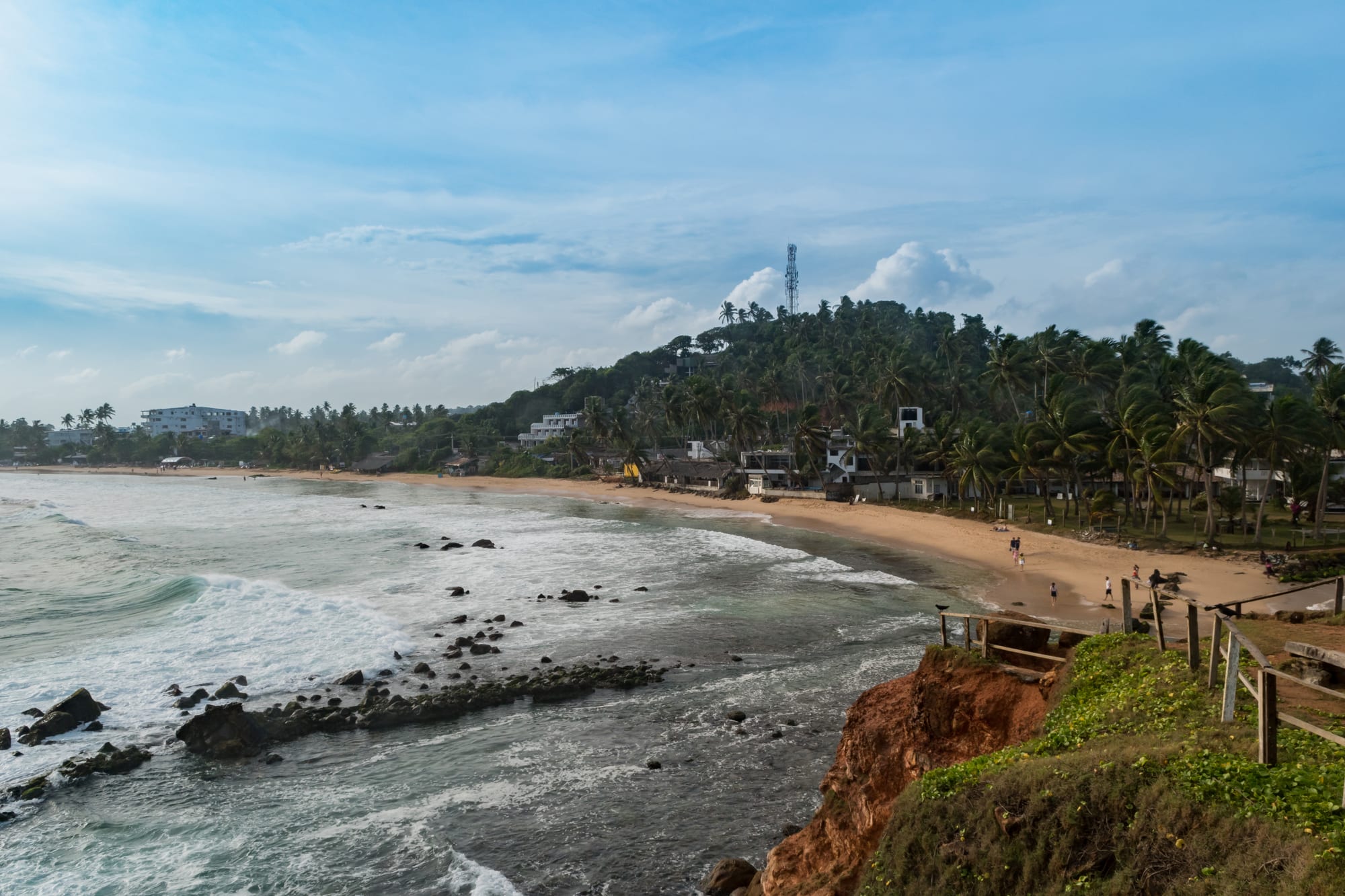
A curving sandy bay with surf breaking over dark rocks, palm trees and low houses on a green headland behind

Galle & the South Coast, Sri Lanka

Mirissa

The bay and palm-backed shore at Mirissa on Sri Lanka's south coast. (dronepicr / Wikimedia Commons · CC BY 2.0)

A small fishing town on Sri Lanka's south coast between Weligama and Matara, built around a crescent beach backed by coconut palms and a working harbour. Since the late 2000s it has become the island's main departure point for blue whale and dolphin watching, and its bay has filled with guesthouses, surf schools and beach restaurants.

Neighbourhoods

  • The beach strip
    • Beaches
    • Nightlife
    • First-time visitors

    The line of guesthouses, restaurants and bars set back from the sand along the main bay. It is the busiest part of town in season, with tables on the beach in the evening, and it empties when the monsoon surf arrives.

    Open in Maps
  • The harbour and headland
    • Local life
    • Sea views

    The fishing harbour at the eastern end of the bay, where the whale-watching boats tie up beside multi-day fishing craft, below a low wooded headland with paths and viewpoints over the water.

    Open in Maps
  • The village and the main road
    • Quiet and residential
    • Close to public transport

    The inland part of Mirissa along the Galle–Matara road, with the temple, shops, bus stops and the homes of most residents. Rooms here are cheaper and quieter than on the sand, though the road is busy.

    Open in Maps
  • Polwathumodara and the eastern coves
    • Quiet and residential
    • Beaches

    The smaller bays and stretches of palm-fringed shore between Mirissa and Matara, with scattered villas and small hotels and very little nightlife.

    Open in Maps

Things to do

The bay and the sea

  • Weligamabeach

    A wide, shallow bay a few kilometres west, the main surfing beach on this stretch of coast and the place where stilt fishermen are most often seen.

    Open in Maps
  • Unawatunabeach

    A sheltered crescent of sand closer to Galle, calmer than the open beaches and a centre for diving on the south-west coast.

    Open in Maps

Short trips

  • Galleattraction

    The walled Dutch fort town about 30 kilometres west, a UNESCO World Heritage Site of ramparts, churches, a mosque and a lighthouse.

    Open in Maps
  • Mataraattraction

    The nearest city, with a Dutch fort and a separate star fort on the Nilwala river, a long beach, and a railway that ran here from 1895 and now continues east to Beliatta.

    Open in Maps
  • Dondra Headlandmark

    The southernmost point of Sri Lanka, marked by a tall stone lighthouse, near the ancient temple town of Devinuwara.

    Open in Maps
  • Tangalleattraction

    A quieter town of coves and long beaches about 35 kilometres east, a fishing port on one of the largest bays in Sri Lanka, sheltered by an enclosing reef.

    Open in Maps
  • Hummanayaattraction

    The only known blowhole in Sri Lanka, on the rocky coast at Kudawella beyond Dikwella, where swell forced through a cleft shoots a plume of spray into the air.

    Open in Maps
  • Mulkirigalalandmark

    A rock temple inland on a 205-metre outcrop, with cave shrines, reclining Buddha images and painted interiors on terraces climbing the rock.

    Open in Maps

Seasonal events

  • Whale watching seasonNovember to April

    Boats leave the harbour at first light through the calm months to look for blue whales, sperm whales and dolphins in the deep water off the south coast.

  • VesakMay full moon

    Lanterns and illuminated pandals appear at the temple and along the road for the full moon marking the Buddha's birth, enlightenment and death.

  • Sinhala and Tamil New YearApril

    Families gather for the April new year with sweets, games and auspicious ceremonies, and business slows for several days.

  • Esala festival at DevinuwaraJuly or August

    The temple town at Dondra Head holds an eight-day fair and perahera in the month of Esala, drawing crowds from across the region.

Eat and drink

Long-standing places and food districts in Mirissa. Hours, ratings and directions come from your maps app, always current.

Mirissa classics

  • Grilled fish on the beachrestaurant

    Restaurants along the bay show the day's catch — seer fish, tuna, prawns, cuttlefish and crab — and cook it grilled, devilled or in coconut curry.

    Open in Maps
  • Rice and curryrestaurant

    The everyday meal of the south — rice with dhal, a fish curry, a coconut sambol and vegetable dishes, served in small village kitchens and guesthouses.

    Open in Maps

Where to eat and drink

  • The beach roadneighborhood

    The strip behind the sand holds most of the town's restaurants, juice bars and evening drinking spots, quieter out of season.

    Open in Maps
  • Weligama fish marketmarket

    The morning auction and market in the neighbouring town, where the coast's boats land tuna, seer fish and skipjack.

    Open in Maps

Experience Mirissa

History

Mirissa's history is a fishing village's rather than a town's. The bay gave shelter on a coast with few natural harbours, and its people lived from the sea and from coconut and cinnamon smallholdings behind the shore, within the old kingdom of Ruhuna that had its seat further east. The settlement lay between two more important places — Weligama, whose bay was long a port of call, and Matara, which the Dutch fortified in the 17th century — and it saw colonial rule at a distance, as taxes on cinnamon and coconut rather than as garrisons.

Through the 20th century the village grew slowly along the Galle–Matara road and the coastal railway that reached this stretch of coast, with fishing, copra and rice supporting most families. Small numbers of travellers had discovered the beach by the 1980s, but the civil war and the country's reputation for instability kept numbers low.

Two events shaped the modern town. The Indian Ocean tsunami of December 2004 struck the south coast with great force, destroying houses, boats and the railway along the shore and killing people throughout the district; rebuilding took years and changed the look of the beachfront. Then, from the late 2000s, the discovery that blue whales could be seen reliably in the deep water off Dondra Head made the south coast a whale-watching destination, and Mirissa, with its harbour, became the departure point. Guesthouses, surf schools and restaurants followed, and a fishing village of a few thousand people became one of the best-known beaches in Sri Lanka.

Culture & Customs

Mirissa is a Sinhalese Buddhist village with a tourism economy laid over it. The temple and the monthly poya full moon still order village life; families mark births, coming of age and weddings with ceremonies at home, and the astrologer's auspicious times are widely observed, especially at the April new year, when the whole coast stops for several days of rituals, games and sweets.

The sea shapes the rest. Fishing crews work multi-day boats far offshore and small craft close in; the harbour has its own rhythms of blessing, departure and auction, and whale-watching skippers are often fishermen who have changed trade for the season. Traditional coastal practices survive nearby — the stilt fishermen of Weligama, now largely a photographic performance, and low-country dance and drumming at temple festivals.

Visitors meet a relaxed version of southern manners, but the village standards remain. Swimwear is for the sand, loud parties near houses are resented, and monks are greeted with a slight bow rather than a handshake. Relations between residents and the tourism business have their frictions — over land prices, beach access, noise and who profits — and these are discussed openly in local politics. Cricket is followed keenly, and improvised matches appear on the beach and on any flat ground in the evening.

Daily Life

Mirissa is home to a few thousand people, part of a densely settled coastal strip in Matara District, which has roughly 800,000 residents. Most households depend on fishing, tourism or both, and many combine them: a boat in the morning, a guesthouse or a tuk-tuk in the afternoon. Coconut, cinnamon and small-scale farming continue inland, and remittances from family working in the Gulf or at sea support many homes.

The season governs everything. From December to April rooms are full, boats go out at dawn and restaurant tables reach the sand; from May the monsoon empties the beach, staff return to fishing or go home to inland villages, and repairs and building are done. The pandemic and the economic crisis of 2022, with their fuel shortages and power cuts, hit the town hard, and the recovery of visitor numbers since has been the dominant local story.

Daily routines start early: boats in before sunrise, fish sold at the harbour, children in white uniforms on the road to school, a long hot afternoon, then the evening walk and the sea breeze. Persistent local issues include coastal erosion, unplanned building along the shore, rubbish and waste water, and crowding of the whales by too many boats — matters on which the town's livelihood and its environment pull in different directions.

Food

The kitchen here is southern and coastal. Ambul thiyal, the sour fish curry of tuna cooked dry with black pepper, goraka and spices, is the regional signature; alongside it come seer fish in coconut milk curry, prawns and cuttlefish devilled with onion and chilli, and crab cooked in thick gravy. Beach restaurants grill and barbecue the same fish for visitors, and dried fish, karawala, is the village store cupboard, fried up with chilli and onion.

The everyday meal is rice and curry: rice with dhal, a fish or vegetable curry, a fried green such as gotu kola mallung, aubergine moju and pol sambol, grated coconut pounded with chilli, lime and dried fish. Hoppers, the crisp-edged bowls of fermented rice-flour batter, appear at breakfast and in the evening, often with an egg; string hoppers, pittu and roti fill out the rest. Late in the day the chopping of kottu sounds from the roadside shops.

Cinnamon, grown in the hills just inland, is used in curries and sweets, and coconut is in almost everything — as milk in the gravies, as oil, as sambol, as thambili, the king coconut sold from roadside stands for its water, and as toddy and arrack. Buffalo curd with kithul treacle is the standard dessert, kalu dodol, a dark sticky sweet of coconut milk and jaggery, is a southern speciality, and fresh fruit juices and strong milky tea are drunk throughout the day.

Planning tools

Budget

Mirissa is cheaper than Galle Fort but not as cheap as inland Sri Lanka. Simple guesthouses and surf hostels sit alongside villas and boutique hotels on the headland, and beachfront restaurants charge noticeably more than village kitchens. Whale-watching trips are the main single expense, followed by surf lessons, board hire and drivers.

Daily Budget Midrange
USD 90–210 (boutique hotel or villa, seafood dinners, a whale-watching trip, a car and driver)
Daily Budget Shoestring
USD 25–45 (guesthouse or hostel, rice and curry and roti shops, buses and tuk-tuks)

Rooms a few streets back from the sand cost far less, and prices across the town fall sharply in the monsoon months.

Best Time to Visit

November or December to April is the season: calm seas, sunshine and the months when whales are most often seen. From about May the south-west monsoon brings rain, rough water and unsafe swimming on some beaches, many businesses slow down and boats often stay in harbour, though prices are low and the surrounding countryside is green.

Suggested Number of Days

Two or three days suit a stay built around the beach and a boat trip. Longer stays are common among surfers and among travellers using the town as a base for the wider south coast. Weather is the main variable, since the sea decides what is possible.

First Visit
2–3 days
With Surroundings
4–6 days

Transportation

The town is small enough to cross on foot, and tuk-tuks handle everything else. Buses run constantly along the Galle–Matara road, and the nearest railway station is at Weligama, on the coastal line that runs from Colombo through Galle and Matara to Beliatta. Scooters are widely rented.

A local licence permit is required to ride a scooter legally, helmets are compulsory, and the coast road is fast and crowded.

Airport & Station Connections

Mirissa lies on the coast road about 30 kilometres east of Galle and 10 kilometres west of Matara. From Colombo the Southern Expressway and the coast road take roughly three hours by car, and express buses follow the same route. Trains on the coastal line stop at Weligama, a short tuk-tuk ride away. The nearest international airport is Katunayake, north of Colombo.

Walkability

The beach strip, the harbour and the village are all within a walk of one another, mostly flat, and the bay itself is easily walked end to end. The main road through town has heavy traffic and narrow verges, and there is little street lighting away from the beach, so a torch is useful after dark.

Safety

Crime is low, and the main dangers are in the water: strong currents and a shore break that causes drownings every year, particularly during the monsoon. Boats can be crowded and some operators crowd the whales. Scooter accidents on the coast road are common, drink spiking and theft from rooms are occasionally reported, and lone women sometimes report unwanted attention on the beach at night.

Swim only where local people do and never when red flags fly, choose whale-watching operators that carry lifejackets and keep their distance from the animals, and wear a helmet on a scooter. Check current official travel advice before travelling.

Climate

Hot and humid all year, usually 26–31°C, with sea breezes. The south-west monsoon brings the wettest, roughest weather from about May to September, and further rain can come in October and November. December to April is the driest and calmest period.

Summer
May–September: monsoon rain, humidity and heavy surf, around 27–31°C
Winter
December–April: sunny, drier and calm, around 25–31°C, the beach and whale-watching season

Local Customs

The village is a conservative Buddhist community a few minutes from a beach where visitors wear swimwear. Covering up away from the sand is expected, and shoulders and knees should be covered at temples, where shoes and hats are removed. Alcohol is not sold on poya full-moon days, and nudity and topless sunbathing are illegal.

Dress modestly in the village and on the road, ask before photographing fishermen or stilt fishermen, who may expect payment, and keep noise down late at night near homes.

Common Payment Methods

The currency is the Sri Lankan rupee. Hotels, dive schools and larger restaurants take cards, while tuk-tuks, small kitchens, markets and boat crews expect cash. ATMs are in the town and more numerous in Weligama and Matara, and small notes are useful for transport.