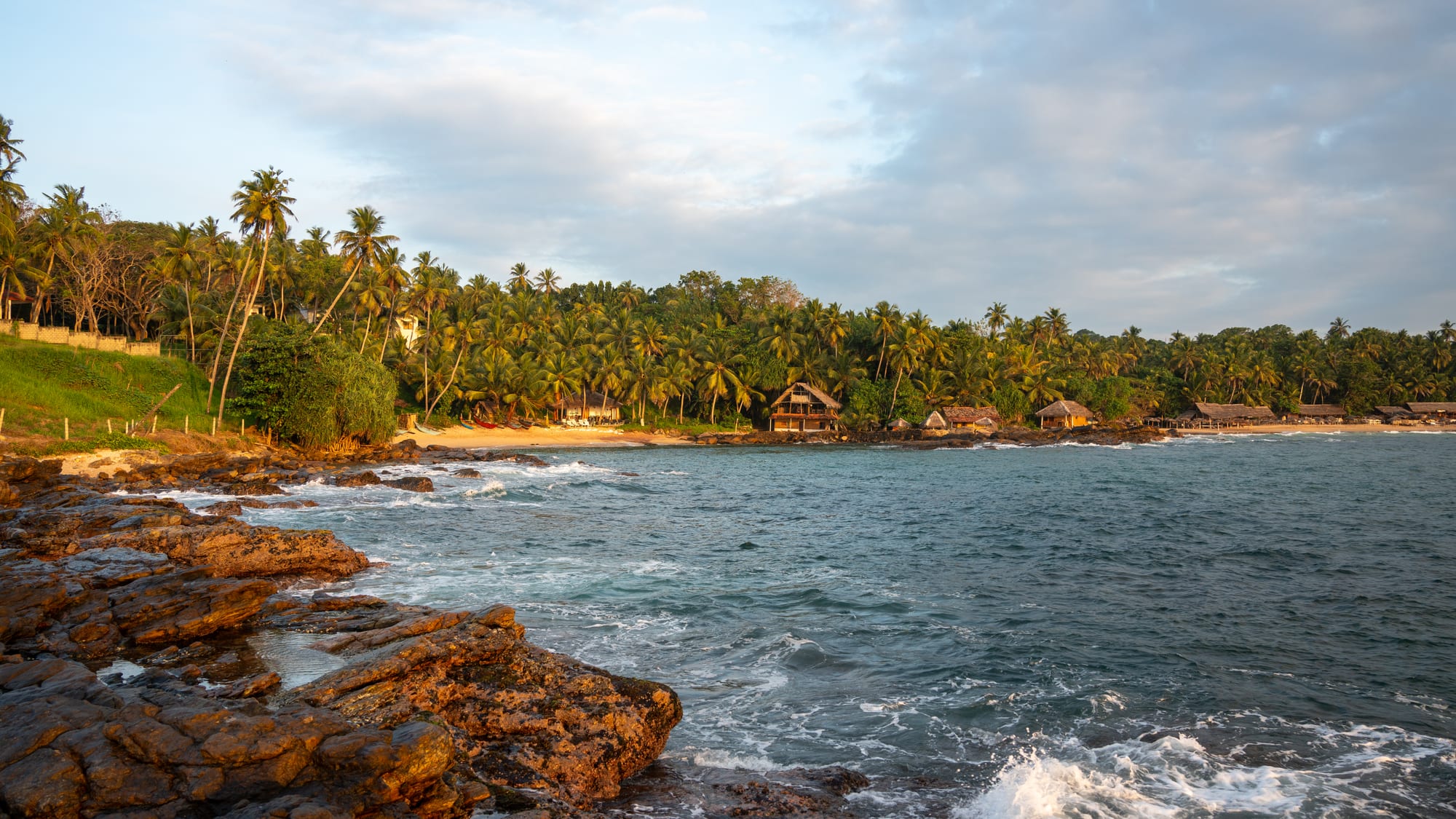
A rocky point and breaking surf in front of a curving sandy cove backed by dense coconut palms and thatched buildings

Galle & the South Coast, Sri Lanka

Tangalle

Goyambokka Beach, one of the coves west of Tangalle on Sri Lanka's south coast. (Satdeep Gill / Wikimedia Commons · CC BY 4.0)

A small town at the dry eastern end of Sri Lanka's south coast, in Hambantota District, built around a natural inlet that has served as a port since Dutch times. A working fishing harbour sits at its centre, and a string of coves and long surf-washed bays backed by coconut palms runs away on either side, making it the quietest of the southern beach bases.

Neighbourhoods

  • The town and the harbour
    • Local life
    • Markets
    • Close to public transport

    The working centre, set around the inlet where the fishing fleet ties up. Banks, the bus stand, the market and the fish auction are all within a few streets, and the old rest house stands on the headland above the bay. Few visitors sleep here, but most pass through it.

    Open in Maps
  • Medaketiya and Marakolliya
    • Beaches
    • Budget stays
    • Sunsets

    The long open beach running north-east from the harbour, lined with small guesthouses, beach cabanas and simple seafood restaurants set back among the palms. The sand continues for several kilometres towards the lagoons and dunes at Marakolliya, growing emptier the further it goes.

    Open in Maps
  • Goyambokka and Pallikaduwa
    • Quiet and residential
    • Small coves
    • Swimming

    West of the town, a series of small coves separated by rocky points, with boutique hotels and villas hidden in gardens above the sand. The bays here are more sheltered than the open beaches east of the harbour, and the lanes down to them are quiet.

    Open in Maps
  • Rekawa and the eastern lagoons
    • Wildlife
    • Quiet and residential

    A stretch of coast east of town where a wide lagoon lies behind the dunes and fishing hamlets sit among the palms. The beach is a nesting ground for sea turtles, watched over by a long-running conservation project, and building is far lighter than on the main strip.

    Open in Maps

Things to do

Beaches and the coast

  • Goyambokka Beachbeach

    A sheltered cove west of the town, framed by rocks and coconut palms, and a favourite swimming spot on this stretch of coast.

    Open in Maps
  • Rekawa Beachbeach

    A dark-sand beach east of Tangalle where green turtles and other species come ashore to nest, guarded by a conservation project that runs night watches.

    Open in Maps
  • Tangalle fishing harbourattraction

    The inlet at the heart of the town, where multi-day boats unload and the morning fish auction fills the quay.

    Open in Maps

Temples and viewpoints

  • Mulkirigala Raja Maha Viharalandmark

    A rock temple north of the town with cave shrines, reclining Buddha images and painted ceilings on terraces climbed by stone steps, and a wide view over the coastal plain.

    Open in Maps

Short trips from the town

  • Hummanaya blowholeattraction

    A sea blowhole on the coast west of Tangalle, where waves forced through a rock fissure send a plume of spray into the air.

    Open in Maps
  • Wewurukannala Viharalandmark

    A temple at Dikwella, west of Tangalle, with Sri Lanka's largest seated Buddha statue, some 50 metres tall, and rooms of painted scenes from the life of the Buddha behind it.

    Open in Maps
  • Yala National Parkpark

    The island's best-known park, of dry scrub, lagoons and rock outcrops, about 100 kilometres east, with leopards recorded at a high density as well as elephants, sloth bears and crocodiles.

    Open in Maps
  • Ussangoda National Parkpark

    A plateau of red-brown earth and low scrub above the sea, protected as a national park and tied in legend to the Ramayana.

    Open in Maps
  • Bundala National Parkpark

    A coastal park of lagoons, salt pans and scrub east of Tangalle, known for flamingos, other migratory birds, elephants and crocodiles.

    Open in Maps
  • Dondra Headlandmark

    The southernmost point of Sri Lanka, marked by a tall colonial-era lighthouse, on the coast west of the town.

    Open in Maps

Seasonal events

  • Turtle nesting season at RekawaYear-round, at night

    Five species of marine turtle come ashore after dark to lay their eggs on Rekawa beach, about 10 kilometres east of the town, where a conservation project organises supervised night watches.

  • Sinhala and Tamil New YearApril

    The main family festival of the year, when the town empties of workers heading home, houses are cleaned and milk rice and oil sweets are prepared for the auspicious hours.

  • VesakMay, on the full moon

    The Buddha's birth, enlightenment and death are marked with paper lanterns, illuminated pandals and roadside stalls giving away free food and drink.

Eat and drink

Long-standing places and food districts in Tangalle. Hours, ratings and directions come from your maps app, always current.

Tangalle classics

  • Rice and curry in the townneighborhood

    Small eating houses around the bus stand and main street serve the southern version of rice and curry, with a fish curry, sambols and several vegetable dishes served on one plate.

    Open in Maps
  • Beach seafood at Medaketiyaneighborhood

    The simple restaurants and cabanas along the beach strip cook the day's catch — seer fish, tuna, prawns and crab — grilled, devilled or in coconut curry.

    Open in Maps

Markets and street food

  • Tangalle town market and fish marketmarket

    Fruit, vegetables, spices and dried fish are sold in the centre of town, with the fish landed at the harbour sold beside it in the morning.

    Open in Maps
  • Evening kottu and hopper stallsneighborhood

    After dark, roadside kitchens chop kottu roti on hot plates and pour egg hoppers, the standard cheap evening meal on this coast.

    Open in Maps

Experience Tangalle

History

The inlet that shelters Tangalle's harbour gave the town its purpose long before it had a name on European maps: small craft could lie safe here on an otherwise open coast, and the surrounding country belonged to Ruhuna, the southern principality whose rulers and monasteries had shaped this part of the island since well before the Christian era. The rock temple at Mulkirigala, a short way inland, shows how old that settled landscape is, with shrines cut into the rock and steps climbing terrace by terrace to the summit.

The Dutch East India Company took the southern ports from the Portuguese in the middle of the 17th century, and Tangalle became one of the minor stations on the coast between Matara and Hambantota, with a small fort above the bay to watch the anchorage and control trade in cinnamon, salt and fish. The British, who took over in 1796, made the town an administrative centre for the surrounding district; the rest house on the headland dates from that colonial era, and the old Dutch fort in the town centre is now used as a prison. Away from the harbour the economy stayed agricultural, growing rice, coconut and the salt and scrub crops of the dry country to the east.

The sea returned in December 2004, when the Indian Ocean tsunami struck the south coast and swept far inland along the low ground around the bay, destroying much of the beachfront, the harbour and many houses. Reconstruction was slow and uneven, but it also brought new roads. In the years that followed, small guesthouses spread along Medaketiya and villas appeared in the western coves, turning a working fishing port into one of the south coast's quieter holiday towns.

Culture & Customs

Tangalle is a Sinhalese Buddhist town, and the rhythm of temple life sets much of its calendar: poya days each full moon, when shops selling alcohol close and white-clad families walk to the temple, and the great festivals of the New Year in April and Vesak in May. The rock temple at Mulkirigala draws pilgrims from across the south, and Devinuwara, along the coast, holds one of the region's biggest temple festivals. Small roadside shrines and bo trees mark junctions all around the town.

The wider south is one of the strongholds of low-country Sinhalese culture, distinct from the Kandyan traditions of the hills: its drumming uses the double-headed yak beraya, its dance forms grew out of healing and exorcism rituals, and the painted wooden masks carved further up the coast at Ambalangoda belong to the same world. Tangalle sees these traditions at temple ceremonies and at the processions, with drummers and dancers, that mark local festivals.

Everyday manners are conservative and courteous. People dress modestly away from the beach, remove their shoes before entering a home or a temple, and greet visitors with ayubowan rather than a handshake. Cricket is followed closely, and improvised games fill any flat ground in the late afternoon. Fishing families keep their own customs around the boats and the first catch of a voyage, and the harbour, not the beach strip, remains the social centre of the town for most residents.

Daily Life

Tangalle is a small town governed by an urban council, serving a much larger rural area of villages, paddy land and coconut smallholdings that stretches inland towards Beliatta and Weeraketiya. It is a divisional centre with a hospital, schools, banks and a busy bus stand, and the daily movement of people is into town in the morning and out again in the evening.

Fishing remains the backbone of the local economy. Multi-day boats work far offshore from the harbour and return to auctions on the quay at first light, while smaller craft fish the inshore waters and the lagoons. Around the town, farming means rice, coconut, bananas and vegetables, with salt pans and drier crops towards Hambantota. Tourism is the third pillar: guesthouses, villas, restaurants, drivers and boatmen support a large share of households along the coastal strip, and it is the sector most exposed to shocks. The Easter attacks of 2019, the pandemic and the economic crisis of 2022 each emptied the beaches in turn before visitors returned.

Days start very early, with the fish auction and the school run before the heat builds; the middle of the day is slow, and the town comes back to life in the late afternoon when the short-haul boats go out and the food stalls open. Many families have relatives working abroad, particularly in the Gulf, and the money they send home is a significant part of local income. Coastal erosion, unregulated building along the beaches and access to the shore for fishermen are recurring local concerns.

Food

Tangalle eats what it lands. Rice and curry is the standard meal, served as a mound of rice ringed by small dishes: a fish curry, dhal, a green leaf, a coconut sambol and often a dry-fried aubergine or breadfruit. The south's best-known dish is ambul thiyal, a sour dry curry of tuna cooked with black pepper, salt and goraka, a dried fruit that both flavours and preserves it, giving a firm, almost black fish that keeps for days. Fish curries in coconut milk, devilled prawns and grilled seer fish appear on every beach menu, and crab and cuttlefish come from the lagoons and inshore waters.

Coconut is everywhere, from the milk in curries to pol sambol, grated coconut pounded with chilli, lime and dried fish, eaten with almost anything. Breakfast is often hoppers, bowl-shaped pancakes of fermented rice flour and coconut milk, sometimes with an egg set in the middle, or string hoppers with a thin curry. In the evening roadside kitchens make kottu roti, flatbread chopped on a hot plate with vegetables, egg and meat in a clatter that carries down the street.

Buffalo curd, sold in earthenware pots and eaten with kithul treacle, is the classic dessert of the southern coast, and the dry country east of the town is known for it. Sweets include kalu dodol, dark and sticky with jaggery and coconut milk. King coconut, thambili, is drunk from the shell at roadside stalls, and the coconut palms behind the beaches supply toddy and arrack.

Planning tools

Budget

Tangalle is cheaper than Galle or Mirissa for food, transport and simple rooms, but it also has some of the most expensive villas and boutique hotels on the south coast, so the range is wide. Guesthouses behind Medaketiya beach and meals in the town cost very little; a hired car and driver, a safari at Yala or Bundala and the villas at the western coves are what push a budget up.

Daily Budget Midrange
USD 85–190 (boutique hotel or villa, restaurant meals, a driver for day trips, a park safari)
Daily Budget Shoestring
USD 25–45 (guesthouse or beach cabana, rice and curry and seafood shacks, buses and tuk-tuks)

Rooms a short walk back from the beach cost a fraction of those on the sand, and agreeing a tuk-tuk fare before setting off avoids arguments later.

Best Time to Visit

December to April is the settled season, with sunshine, calmer water and the best swimming conditions. The southwest monsoon between about May and September brings rain and heavy surf, some beach businesses slow down and the sea can become unsafe, although Tangalle's drier position means it sees less rain than Galle. Turtle nesting continues through much of the year.

Suggested Number of Days

Two or three days suit most visitors, who come here to slow down rather than to work through a list. Four or five allow trips inland to the rock temple and east to the national parks and lagoons. Travellers using Tangalle as a base between Galle and Yala often stay longer.

First Visit
2–3 days
With Surroundings
4–5 days

Transportation

The coast road, the A2, runs through the town, and buses along it link Tangalle with Matara, Galle, Hambantota and Colombo. The southern railway reaches Beliatta, a short drive inland. Tuk-tuks are the everyday way of getting between the town, the harbour and the beaches, and many visitors hire a car with a driver or a scooter for longer trips.

Distances between the separate beaches are longer than they look on a map, and the lanes down to them are unlit at night.

Airport & Station Connections

Most arrivals come by road from Colombo, roughly 190 kilometres away: the Southern Expressway runs most of the way before the coast road, and the drive usually takes about three to four hours. Buses run along the coast from Galle and Matara, and trains reach Beliatta, a short drive inland, from where tuk-tuks continue to the coast. Mattala airport, near Hambantota, has few flights, so international visitors normally land at Colombo.

Walkability

The town centre is small and easily covered on foot, and the beaches are walkable for kilometres at low tide. Between the two it is less pleasant: the coast road carries fast traffic with narrow verges, and the separate bays are linked by lanes rather than pavements, so most people use a tuk-tuk after dark or in the midday heat.

Safety

Tangalle is a quiet town with little crime beyond occasional opportunistic theft, and the main danger is the sea. The open beaches east of the harbour have strong currents and shore breaks, and drownings happen every year, especially in the monsoon months. Scooter accidents on the coast road are common, and wild elephants cross roads inland and towards Hambantota at night.

Swim only where local people do and never when the surf is heavy, wear a helmet on a scooter, avoid unlit beaches alone at night, and take care on roads near the parks after dark. Check current official travel advice before travelling.

Climate

Hot and humid all year, at the point where the wet south-west gives way to the dry zone, so Tangalle is noticeably drier and dustier than Galle. Daytime temperatures stay close to 30°C throughout the year, with sea breezes along the coast.

Summer
May–September: the southwest monsoon brings showers and rough seas, around 27–31°C, though rainfall is lighter here than further west
Winter
December–April: the dry and sunny season, around 25–31°C, with calmer water and the main beach months

Local Customs

This is a conservative Sinhalese Buddhist town. Swimwear belongs on the beach only; shoulders and knees should be covered in the town, and shoes and hats are removed at temples, and turning one's back on a Buddha image for a photograph causes offence. Greetings use ayubowan with the palms together, and the right hand is used for eating and giving. Tipping is not obligatory but small amounts are normal in restaurants and for drivers.

Do not pose beside or point at Buddha images, avoid Buddhist tattoos on show, and ask before photographing people at the harbour or on the beach.

Common Payment Methods

The currency is the Sri Lankan rupee. Hotels and larger restaurants take cards, but guesthouses, tuk-tuks, market stalls and beach kitchens are cash businesses, and ATMs are concentrated in the town centre rather than on the beach strips. Carrying small notes is useful, and changing money is easier in Tangalle town than at the beaches.