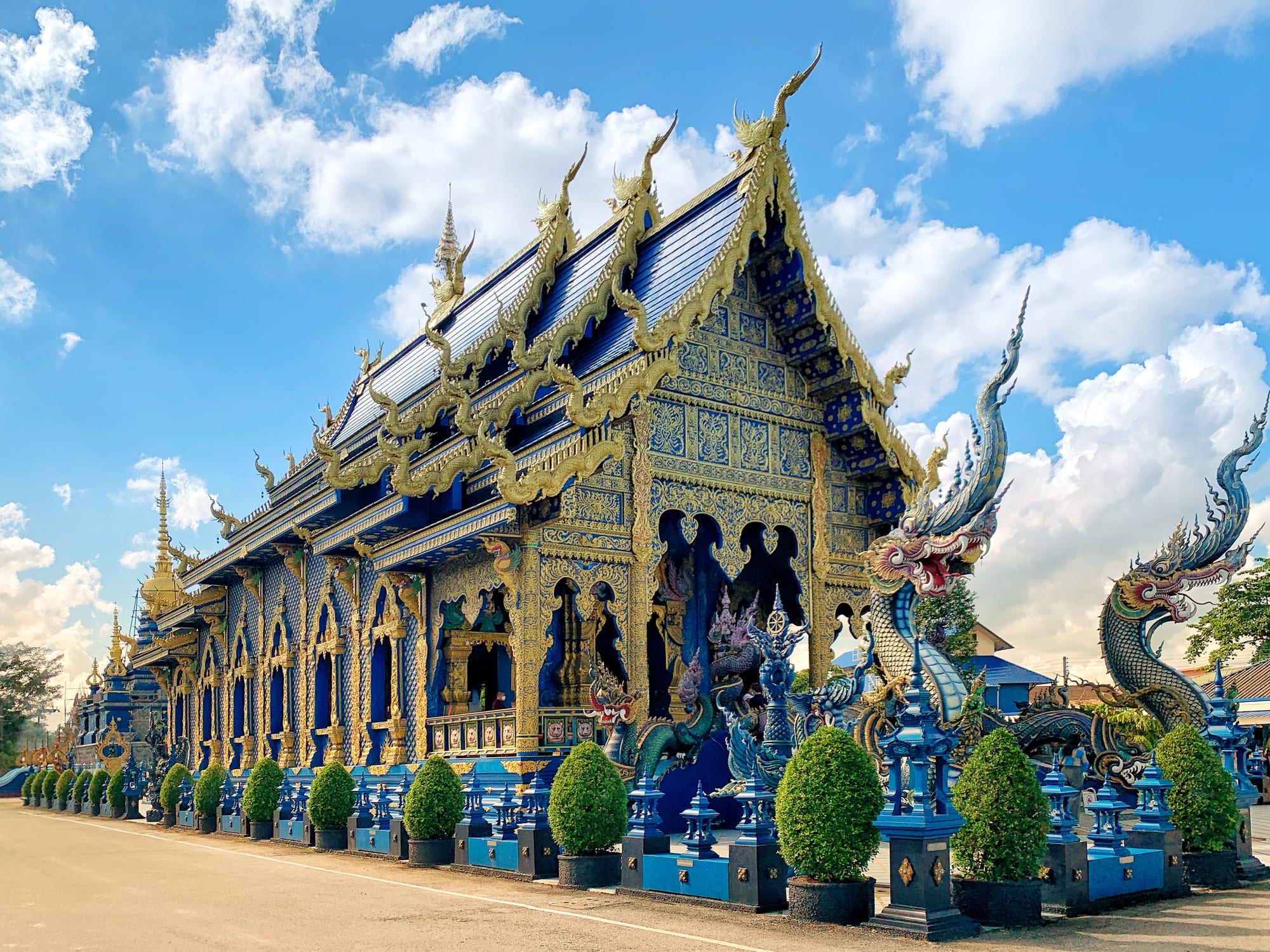
A blue and gold temple hall with tiered roofs and carved naga serpents flanking its entrance under a bright sky

Chiang Mai & the North, Thailand

Chiang Rai

Wat Rong Suea Ten, the Blue Temple, on the northern edge of Chiang Rai. (Chainwit. / Wikimedia Commons · CC BY-SA 4.0)

The northernmost provincial capital of Thailand, founded by King Mangrai in 1262 on the Kok River, more than thirty years before Chiang Mai. A quiet, low-rise town of temples and markets, it has become known for the work of local artists — the white temple of Wat Rong Khun and the black house of Thawan Duchanee — and as the base for the hills towards the Mekong and the Myanmar border.

Neighbourhoods

  • The town centre and the clock tower
    • First-time visitors
    • Close to public transport
    • Markets

    The grid of streets around the gilded clock tower at the main junction, holding most hotels, banks, the night bazaar and the old bus station. Everything in the centre is within a short walk, and the temples of the old town stand a few blocks north.

    Open in Maps
  • Rob Wiang and the old temples
    • Historic district
    • Temples
    • Quiet and residential

    The northern part of the town centre, where Wat Phra Kaew, Wat Phra Singh and smaller monasteries sit among shophouses and lanes of teak and concrete houses. Quieter than the market blocks, with small cafés and guesthouses.

    Open in Maps
  • The Kok riverside
    • Quiet and residential
    • Walks
    • Views

    The north edge of town along the Kok River, with an embankment road, boat landings for trips upstream and a scattering of riverside hotels. Mornings here are cool and misty in the dry season.

    Open in Maps
  • Ban Du and the north
    • Students
    • Local life
    • Art

    The university district a few kilometres north of the centre, past the Blue Temple, with student housing, cheap kitchens and roadside markets. The black-house museum complex lies in the same direction.

    Open in Maps
  • The southern approach
    • Close to transport
    • Families

    The highway side of town towards the airport and Wat Rong Khun, lined with the larger bus terminal, shopping centres and newer hotels. Less atmospheric, but convenient for arriving and moving on.

    Open in Maps

Things to do

Temples and artists' work

  • Wat Rong Khunlandmark

    The White Temple, begun in 1997 by the artist Chalermchai Kositpipat, a brilliant white and mirrored complex south-west of town where reaching hands rise from the ground before the bridge.

    Open in Maps
  • Wat Rong Suea Tenlandmark

    The Blue Temple north of the centre, finished in the 2010s in sapphire blue and gold around a tall white Buddha, the work of a student of Chalermchai.

    Open in Maps
  • Wat Phra Kaewlandmark

    The town's most important monastery, where the Emerald Buddha now in Bangkok is said to have been revealed when lightning split a chedi in 1434.

    Open in Maps
  • Wat Phra Singhlandmark

    An old-town temple with carved wooden doors and a Lanna-style assembly hall, named after the Phra Singh Buddha image linked to it.

    Open in Maps
  • Baan Dam Museummuseum

    The Black House, a compound of dark timber buildings north of town filled with bones, hides, horns and carvings, created by the artist Thawan Duchanee.

    Open in Maps
  • Mae Fah Luang Art and Culture Parkmuseum

    Gardens and teak pavilions west of the centre holding a collection of Lanna wooden art and artefacts.

    Open in Maps

Parks and viewpoints

  • Singha Parkpark

    A large estate of tea terraces, farmland and lakes south-west of the town, with cycling routes and views across the fields.

    Open in Maps
  • Wat Huay Pla Kanglandmark

    A hilltop temple north of the town beneath a very tall white image of Guanyin, with a nine-tiered pagoda and a long view over the valley.

    Open in Maps

Markets and evenings

  • Chiang Rai Night Bazaarmarket

    A nightly market beside the old bus station with food courts, northern music and stalls of textiles, silver and carvings.

    Open in Maps
  • Saturday walking streetmarket

    Thanalai Road closes on Saturday evenings for craft and food stalls run by townspeople and hill communities.

    Open in Maps

Short trips

  • Golden Triangleviewpoint

    The meeting of the Ruak and Mekong rivers at Sop Ruak, where Thailand, Laos and Myanmar face each other across the water, once the centre of the opium trade.

    Open in Maps
  • Chiang Saenattraction

    An old walled town on the Mekong north-east of Chiang Rai, with ruined chedis, a national museum and boats working the river.

    Open in Maps
  • Mae Saiattraction

    A busy border market town in Thailand's far north, facing Tachileik in Myanmar across the Mae Sai River.

    Open in Maps
  • Doi Tungviewpoint

    A mountain near the Myanmar border with the royal villa and gardens of a development project that replaced opium poppies with coffee and flowers.

    Open in Maps
  • Mae Salongattraction

    A hill village of tea terraces settled by Chinese Nationalist soldiers and their families after 1949, where Yunnanese is still spoken.

    Open in Maps
  • Tham Luang Nang Nonattraction

    The cave near Mae Sai where a junior football team was trapped and rescued in 2018, now part of a forest park with an exhibition.

    Open in Maps
  • Phu Chi Faviewpoint

    A cliff on the Laotian border east of the town, climbed before dawn for the sea of cloud that fills the valley below in the cool season.

    Open in Maps

Seasonal events

  • SongkranApril

    The Thai new year, marked with processions of Buddha images, temple merit-making and days of water throwing in the streets.

  • Loy KrathongNovember

    Floating lights are set on the Kok River, with lanterns released as Yi Peng at the same full moon.

  • Poy Sang LongLate dry season

    Shan communities in the province dress boys as princes and parade them on adults' shoulders before their novice ordination.

Eat and drink

Long-standing places and food districts in Chiang Rai. Hours, ratings and directions come from your maps app, always current.

Markets and food streets

  • Chiang Rai Night Bazaarmarket

    Food courts of northern and Thai dishes around an open stage, with grilled river fish, noodles and sticky rice at shared tables.

    Open in Maps
  • Chiang Rai municipal marketmarket

    The town's morning market, where sai ua sausage, chilli pastes, sticky rice and hill-grown vegetables are sold before the heat of the day.

    Open in Maps
  • Saturday walking streetmarket

    Stalls of northern snacks, grilled meat and sweets along Thanalai Road on Saturday evenings.

    Open in Maps

Cafés and tea

  • Cafés around the clock towerneighborhood

    Small roasteries and coffee shops in the central streets serve beans grown on the province's hills at Doi Chang, Doi Tung and Mae Salong.

    Open in Maps
  • Mae Salong tea housesneighborhood

    In the hill village north-west of the town, Yunnanese families serve oolong from their own terraces alongside Chinese Muslim noodle dishes.

    Open in Maps

Experience Chiang Rai

History

Chiang Rai claims to be the oldest of the northern capitals: King Mangrai founded it in 1262, naming it after himself, before he moved on to take Hariphunchai and establish Chiang Mai in 1296. The town on the Kok River remained a northern outpost of Lanna, and its temples kept a reputation out of proportion to its size — Wat Phra Kaew is said to be the place where the Emerald Buddha, now enshrined in Bangkok, was discovered inside a chedi split by lightning in 1434, before it travelled through Lampang, Chiang Mai, Laos and finally the capital.

Like the rest of Lanna, Chiang Rai fell under Burmese rule in the 16th century and stayed there for about two hundred years. It was recovered late in the 18th century and resettled in the 19th, and was administered from Chiang Mai until it became a province in its own right in 1910. The far north long remained remote, reached by river and mule track rather than road.

For much of the 20th century the province was known chiefly for the opium grown in the hills of the Golden Triangle and for the armed groups that moved it. Royal development projects from the 1970s onwards, above all at Doi Tung, replaced poppies with coffee, tea, macadamia and flowers, and the highland communities gradually gained schools, roads and, in many cases, citizenship. Since the 1990s the town has drawn attention instead for the work of artists born in the province — Chalermchai Kositpipat's white temple and Thawan Duchanee's black house — and for tourism towards the Mekong.

Culture & Customs

Chiang Rai is a Lanna town, speaking kham mueang and keeping the northern calendar of temple fairs, but it is also the most ethnically mixed province in Thailand. Akha, Lahu, Lisu, Hmong, Mien and Karen communities live in the hills, Shan families have crossed from Myanmar for generations, and Yunnanese Chinese descended from Nationalist soldiers hold the tea villages around Mae Salong. Churches, mosques and Chinese shrines stand alongside Buddhist monasteries.

Art has become the town's public identity. Chalermchai Kositpipat has built and rebuilt Wat Rong Khun since 1997 as a personal work rather than a commission, and his students have carried the style into other temples, including the Blue Temple; Thawan Duchanee's compound of black timber halls took decades to assemble. The provincial arts scene that grew up around them supports galleries and studios across the town.

Everyday manners are those of the north: greetings with a wai, a softer and slower speech than Bangkok Thai, and unhurried courtesy in shops and offices. Festivals follow the Buddhist year, with Songkran, Loy Krathong and the lantern releases of Yi Peng, while Shan communities hold Poy Sang Long processions before boys enter the monkhood. Coffee and tea culture, a direct result of the crop-replacement projects, is now part of local pride.

Daily Life

About 70,000 people live in the municipality and well over a million in the province, so Chiang Rai functions as a market and service town for a large rural area. Agriculture underpins the economy: rice and maize in the valleys, coffee, tea, lychee, longan and temperate vegetables in the hills, and increasingly organic and speciality crops sold to Bangkok. Tourism, government offices, hospitals and Mae Fah Luang University provide most of the salaried work.

The rhythm is small-town. Fresh markets open before sunrise, offices and schools start early, and the town is quiet by mid-evening apart from the night bazaar and the student streets around Ban Du. Many families keep land in a village and return for planting, harvest and temple festivals. Cross-border trade with Myanmar and Laos, and the Mekong wharves at Chiang Saen, bring lorries and traders through the province.

Current concerns are largely environmental and regional. The burning season fills the valley with smoke from February to April; floods along the Kok and Mekong have damaged riverside districts in recent years, and contamination of the Kok River from mining upstream has become a public issue. The war in Myanmar, just across the border, affects trade, brings people seeking safety and has made drug trafficking a persistent problem for the province.

Food

Chiang Rai eats northern Thai food with an extra Shan and Yunnanese layer. Khao soi, egg noodles in coconut curry broth under a nest of crisp noodles, is as common here as in Chiang Mai, and khanom jeen nam ngiao — fermented rice noodles in a pork and tomato broth flavoured with dried kapok flowers — is a local speciality eaten at breakfast. Sticky rice accompanies grilled meats and the chilli pastes nam phrik num and nam phrik ong, with crisp pork rind for scooping.

Sai ua, the herb-heavy grilled pork sausage, is bought by weight at the morning market, as is naem, a sour fermented pork. Shan cooking contributes tofu dishes and noodle soups from the border districts, while the Yunnanese villages around Mae Salong serve steamed buns, black chicken soup and braised pork leg with Chinese pickles. Mekong catfish and river fish appear on menus in the border towns, grilled whole with salt and lemongrass.

Drinks reflect the hills. Arabica coffee from Doi Chang and Doi Tung is roasted in the town, and oolong tea from Mae Salong is sold loose in the market. Local fruit — lychee in May and June, longan later in the summer, and strawberries in the cool season — fills the stalls, and cold sweet drinks of Thai tea and roasted-rice water are sold everywhere in the heat.

Planning tools

Budget

Chiang Rai costs less than Chiang Mai for rooms and food, and the town is small enough that transport is cheap. The main expenses are day trips to the Golden Triangle, Doi Tung and the hill villages, which usually mean a hired car, a driver or a tour, and entrance fees at the artists' temples and museums.

Daily Budget Midrange
USD 60–130 (boutique hotel, restaurants, a hire car or driver, a day trip to the border country)
Daily Budget Shoestring
USD 20–40 (guesthouse, market meals, local songthaews and a shared scooter)

Two or three of the outlying sights can be combined in one day with a driver, which usually costs less than separate tours; the temples in town cost little or nothing to enter.

Best Time to Visit

November to February is the best window: clear skies, cool mornings with mist on the Kok River, and cloud seas on the border ridges. March and April are hot and often smoky from agricultural burning. The rains from June to October are green and quiet, with mountain roads occasionally blocked by landslides.

Suggested Number of Days

The town itself and the artists' temples fill about two days. Four or five allow the Mekong border country, the tea hills and the mountain viewpoints, all of which need a vehicle. Trekking or a river trip adds more.

First Visit
2 days
With Surroundings
4–5 days

Transportation

The town centre is small enough to walk, and songthaews, tuk-tuks and ride-hailing cover the rest. Buses and minibuses from the main terminal on the southern edge reach Mae Sai, Chiang Saen, Chiang Khong and the provincial towns; a smaller terminal in the centre serves nearby districts. Most visitors hire a car or motorbike for the mountains, and longtail boats run upstream on the Kok River.

Mountain roads to Doi Tung, Mae Salong and Phu Chi Fa are steep and narrow, so allow far more time than the distance suggests and avoid riding them at night.

Airport & Station Connections

Chiang Rai International Airport is about eight kilometres north-east of the town, roughly fifteen to twenty minutes by road, with frequent flights from Bangkok. Buses from Chiang Mai take around three to four hours, and overnight coaches run from Bangkok. There is no railway. The Mekong crossing at Chiang Khong, east of the town, leads to Huay Xai in Laos and the slow boat to Luang Prabang.

Walkability

The centre is flat, compact and easily covered on foot, with the clock tower, the night bazaar, the main temples and most hotels within about a kilometre of each other. Pavements are uneven and often parked over, and the heat slows walking in the middle of the day. Everything beyond the centre, including the White and Blue temples, needs transport.

Safety

Chiang Rai is a calm town with little crime affecting visitors. The main risks are motorbike crashes on mountain bends, smoke haze from February to April, and occasional flooding of the Kok River and low-lying streets in the rainy season. Since 2025 the Kok has been found to carry unsafe levels of arsenic and lead, attributed to mining upstream in Myanmar, and testing in 2026 still showed contamination in places. Along the Myanmar border in this province, conflict and drug trafficking on the far side sometimes lead to closures of crossings and remote areas.

Wear a helmet and ride only with experience, check the air-quality index in the burning season, trek with a licensed guide and follow local advice near the Myanmar border. Check current official travel advice before travelling.

Climate

A tropical climate with three seasons, cooler than most of Thailand because of the latitude and the surrounding hills. Cool and dry from November to February, hot and dry from March to May, and wet from June to October, with the heaviest rain in August and September.

Summer
hot and dry in March to May, often 35–38°C in the afternoon with smoke haze; warm, humid and showery from June to October
Winter
cool and dry from November to February, roughly 13–29°C, with morning mist on the river and near-freezing nights on the highest ridges

Local Customs

Temple etiquette is the same across Thailand: covered shoulders and knees, shoes off inside, feet never pointed at a Buddha image, and no physical contact between women and monks. The province is home to Akha, Lahu, Lisu, Hmong, Mien and Shan communities as well as Yunnanese Chinese families, and visits to their villages are best made with a guide from the community rather than unannounced.

Ask before photographing people in hill villages and monks at prayer; tipping is not expected; dress modestly at temples. Cannabis was decriminalised in 2022 and rules tightened in 2025 classed the flower as a controlled herb, limiting legal sales to medical use.

Common Payment Methods

The currency is the Thai baht. Cash is essential in markets, at village stalls, on songthaews and in the hills, where card machines are rare. Hotels, larger restaurants and shopping centres in town take cards, and ATMs in the centre charge a fixed fee for foreign cards. Carry small notes for day trips.