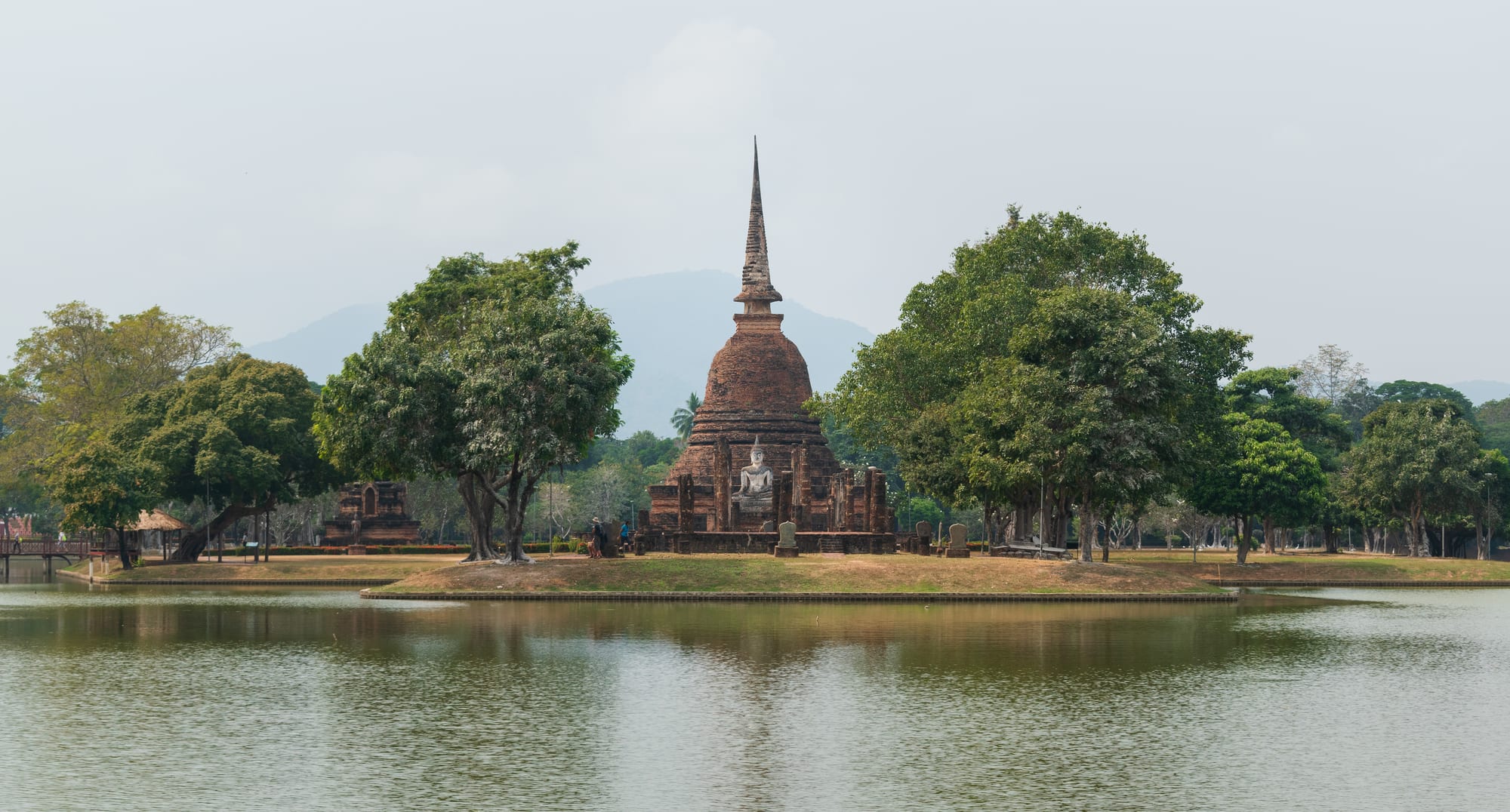
A brick chedi and seated Buddha on an island of trees reflected in a still pond, with low hills behind

Chiang Mai & the North, Thailand

Sukhothai

Wat Sa Si on its island in Sukhothai Historical Park, seen across the lotus pond. (Dominic Nelson / Wikimedia Commons · CC BY-SA 4.0)

A small provincial town on the Yom River in the lower north, best known for the ruined city twelve kilometres west of it. Sukhothai was the capital of a 13th-century Tai kingdom remembered in Thai history as the first Siamese state, and its walls, ponds, lotus-bud chedis and seated Buddha images form a UNESCO World Heritage Site with Si Satchanalai and Kamphaeng Phet.

Neighbourhoods

  • New Sukhothai
    • Close to public transport
    • Best for food
    • Local life

    The modern town on both banks of the Yom River, holding the bus station, markets, banks and most of the cheaper guesthouses. It is an ordinary working provincial town rather than a sight in itself, and the evening market by the river is its social centre.

    Open in Maps
  • Old Sukhothai
    • First-time visitors
    • Historic district
    • Quiet and residential

    The village of Mueang Kao beside the walls of the ancient city, twelve kilometres west, with small hotels, restaurants, bicycle hire and the museum at its gate. Staying here puts the ruins within a few minutes' walk or ride.

    Open in Maps
  • The Yom riverside
    • Quiet and residential
    • Walks

    The embankments and lanes along the river through the new town, lined with wooden houses, temples and food stalls. Floating offerings are set here in November, and the river is the reason the town stands where it does.

    Open in Maps

Things to do

The historical park

  • Sukhothai Historical Parklandmark

    The walled remains of the 13th and 14th-century capital, a UNESCO World Heritage Site of some 70 square kilometres, with about 200 ruined monuments among ponds and lawns, usually seen by bicycle.

    Open in Maps
  • Wat Mahathatlandmark

    The royal temple at the centre of the old city, its lotus-bud chedi ringed by smaller stupas, seated Buddhas and rows of laterite columns.

    Open in Maps
  • Wat Si Chumlandmark

    A tall square mandapa north-west of the walls enclosing Phra Achana, a seated Buddha some fifteen metres high, visible through a narrow vertical slot.

    Open in Maps
  • Wat Sa Silandmark

    A Sinhalese-style chedi and walking Buddha on an island in a pond inside the city walls, reached by a short causeway.

    Open in Maps
  • Wat Si Sawailandmark

    Three Khmer-style prangs inside the walls, built as a Hindu shrine before the Tai kings converted the site to Buddhist use.

    Open in Maps
  • Wat Saphan Hinlandmark

    A hill temple west of the city reached by a slate-paved path, where a standing Buddha about twelve metres tall looks back towards the plain.

    Open in Maps
  • Wat Phra Phai Luanglandmark

    One of the oldest monuments on the site, north of the walls, with a surviving Khmer prang from the period before Sukhothai's independence.

    Open in Maps

Museums and the town

  • Ramkhamhaeng National Museummuseum

    The site museum at the entrance to the park, holding sculpture, ceramics and inscriptions recovered from the old city and its satellites.

    Open in Maps
  • Sukhothai evening marketmarket

    Stalls of grilled meat, curries, sweets and the town's own noodle dish set up near the river in the new town each evening.

    Open in Maps

Short trips

  • Si Satchanalai Historical Parklandmark

    The sister city of Sukhothai up the Yom River, quieter and more wooded, with elephant-buttressed chedis and the kilns that produced Sangkhalok ceramics.

    Open in Maps
  • Sawankhalokattraction

    A riverside town between the two historical parks, long associated with the glazed stoneware exported across Southeast Asia.

    Open in Maps
  • Ramkhamhaeng National Parkpark

    A forested massif south of the old city rising to Khao Luang, with waterfalls and a long climb to summit viewpoints.

    Open in Maps

Seasonal events

  • Loy KrathongNovember

    Sukhothai holds one of the country's best-known celebrations, with floating lights on the ponds of the historical park, fireworks and performances among the ruins.

  • SongkranApril

    The Thai new year, marked with merit-making at the town's temples, processions of Buddha images and water throwing in the streets.

Eat and drink

Long-standing places and food districts in Sukhothai. Hours, ratings and directions come from your maps app, always current.

Markets and food streets

  • Sukhothai evening marketmarket

    The main place to eat in the new town, with grilled river fish and pork, curries ladled over rice, and stalls selling the local noodle soup.

    Open in Maps
  • Sukhothai fresh marketmarket

    The morning market by the river, where noodles, sticky rice, chilli pastes, sweets and produce from the surrounding farmland are sold.

    Open in Maps
  • Old Sukhothai restaurantsneighborhood

    Simple open-fronted kitchens and cafés along the road through the old town serve noodle soups, curries and cold drinks to cyclists coming out of the park.

    Open in Maps

The local dish

  • Sukhothai noodle shopsrestaurant

    Kuaitiao Sukhothai — thin rice noodles in a clear pork broth with roast pork, green beans, crushed peanuts and dried chilli — is sold in small shops all over both towns, often only in the morning.

    Open in Maps

Experience Sukhothai

History

Sukhothai was a provincial centre of the Khmer empire before Tai chiefs took it in the 1230s and set up a kingdom of their own. Its best-known ruler, Ram Khamhaeng, reigned in the late 13th century, and a stone inscription attributed to his time — describing a prosperous, lightly taxed country where a subject could ring a bell at the palace gate to petition the king — became a foundation text of Thai national history, and the source of a claim that he devised the Thai script. Later scholars have debated the inscription's date and authorship, but its picture of Sukhothai as the first Siamese kingdom has held its place in the national story.

The kingdom's power was brief. It reached its greatest extent under Ram Khamhaeng, declined through the 14th century as the rival state of Ayutthaya rose to the south, and was absorbed by Ayutthaya in the 15th century. Its satellite city of Si Satchanalai up the Yom River shared its art and supplied the Sangkhalok kilns, whose glazed stoneware was exported across Southeast Asia. The old city was abandoned when a new town was founded on the river 12 kilometres to the east in 1793, and the ruins were left to the forest.

Restoration began in the 20th century and a major programme, supported by UNESCO, ran through the 1970s and 1980s; Sukhothai, Si Satchanalai and Kamphaeng Phet were inscribed together as a World Heritage Site in 1991. The modern town, Sukhothai Thani, grew as the provincial capital beside the Yom, and the ancient city became a park that supports most of the local tourist economy.

Culture & Customs

Sukhothai carries an unusual symbolic weight for a small province: it is where Thai schoolchildren are taught the nation's story begins, and its art is the reference point for a distinctly Thai style. The walking Buddha of the Sukhothai period — a smooth, elongated figure in mid-stride with a flame finial — is considered one of the great achievements of Southeast Asian sculpture, and the lotus-bud chedi is the period's architectural signature.

Ceramics are the other inheritance. The kilns at Si Satchanalai and Sawankhalok produced celadon and underglaze wares from the 13th century, traded as far as Japan, the Philippines and Indonesia, and modern potters in the area still work in the Sangkhalok tradition. Other local crafts include gold and silver work in the Sukhothai style, with fine granulation, and textile weaving in the villages of Si Satchanalai, where Tai Phuan and Tai Lue communities keep distinct patterns.

Loy Krathong is the town's great occasion. The festival is popularly said to have begun here, though historians treat that origin story as a literary invention of the Bangkok period; Sukhothai marks it with lights on the ponds of the historical park, processions, fireworks and performances among the ruins over several evenings. Otherwise life follows a provincial Buddhist calendar of temple fairs, ordinations and merit-making, and manners are those of the lower north: unhurried, formal with elders, and quieter than Bangkok.

Daily Life

The new town is small, with a population in the tens of thousands, while the province holds around 600,000 people spread through farming districts along the Yom. Rice is the main crop, with sugar cane, maize and tobacco, and much of the province's work is agricultural or in the offices, schools and hospital of the provincial capital. Tourism concentrates in the old town, where guesthouses, restaurants, bicycle hire and guiding support many families.

Daily rhythms are those of a rural province: markets before dawn, alms rounds at first light, office and school hours that begin early, and quiet streets after dark apart from the evening market. Many younger people leave for Bangkok or Chiang Mai to study and work, returning for Songkran and family occasions.

Flooding is the recurring problem. The Yom has no large storage dam — a mega-dam at Kaeng Suea Ten was proposed in 1991 and abandoned, and smaller dams are still argued over — and heavy rain in the northern watershed has repeatedly inundated Sukhothai town and surrounding districts. Drought in the dry season, smoke from field burning in the hot months, and the steady drift of young people to the cities are the other concerns residents raise.

Food

Sukhothai has given its name to a noodle dish found across Thailand: kuaitiao Sukhothai, thin rice noodles in a clear, slightly sweet pork broth with slices of roast pork, chopped green beans, crushed peanuts, coriander and dried chilli, often eaten for breakfast in small family shops. It is the one thing visitors are most often told to try here, and the versions sold in the two towns differ from shop to shop.

Otherwise the cooking belongs to the lower north, a meeting point between central Thai and northern styles. Sticky rice and plain rice are both eaten; freshwater fish from the Yom is grilled whole in salt, fried crisp, or made into sour curries; and chilli pastes served with raw vegetables are a staple, alongside stir-fried greens, spicy salads and grilled pork. Sai ua, the northern herb sausage, appears in markets, as does the tomato and pork relish nam phrik ong.

Sweets and drinks follow the season: mango with sticky rice and lychee in the hot months, tamarind, bananas and palm sugar sweets year round, and iced Thai tea and roasted-rice drinks sold at every market. Local shops also sell the province's crisp fried bananas and sticky-rice cakes grilled in banana leaf, and pottery from the Sangkhalok tradition is used to serve food in some restaurants near the ruins.

Planning tools

Budget

Sukhothai is inexpensive even by Thai standards. Guesthouses in both the new and old towns are cheap, food is market-priced, and the main costs are the entrance fees for the separate zones of the historical park, a hired bicycle or motorbike, and transport between the two towns or out to Si Satchanalai.

Daily Budget Midrange
USD 60–130 (comfortable hotel near the ruins, restaurants, a hire car or driver, entrance fees and a day at Si Satchanalai)
Daily Budget Shoestring
USD 20–35 (guesthouse, market meals, a hired bicycle and songthaews between the towns)

The park is sold in separate ticketed zones, so plan which of them matter; a hired bicycle is by far the cheapest and pleasantest way to cover the central zone.

Best Time to Visit

November to February is the most comfortable season, dry and relatively cool, and Loy Krathong in November fills the ruins with lights. March to May is very hot on the open ground of the park, with haze from agricultural burning. The rains from June to October bring green lawns and full ponds, and occasional flooding along the Yom River.

Suggested Number of Days

Two days cover the walled city and the outlying zones at a reasonable pace. A third or fourth allows Si Satchanalai and the national park. Cycling rather than driving, and the heat of the middle of the day, are what most change the number.

First Visit
2 days
With Surroundings
3–4 days

Transportation

The two towns are twelve kilometres apart and linked by frequent songthaews along the main road, as well as by tuk-tuk and hired motorbike. Inside the historical park bicycles are the usual choice, hired at the gate, with electric shuttle carts for those who prefer not to ride. Buses from the new town's terminal serve Si Satchanalai, Phitsanulok and the north.

Distances between the park's zones are longer than the map suggests and there is little shade, so carry water and consider starting early or late in the day.

Airport & Station Connections

Sukhothai Airport, built and owned by Bangkok Airways in Sawankhalok district north of the town, has flights from Bangkok, and Phitsanulok, roughly an hour away by road, has more frequent services and a station on the main northern railway line; a branch line also reaches Sawankhalok. Buses run from Bangkok in about six to seven hours and from Chiang Mai in about five. Most visitors arrive by bus or by car.

Walkability

Both towns are small and flat, and the village at the park gate is easily walked. The ancient city itself is large — the walls enclose an area roughly two kilometres by one and a half, and further monuments lie beyond them — so walking the whole site is tiring in the heat and a bicycle is the normal solution. Pavements in the new town are patchy.

Safety

Sukhothai is a quiet province with little crime affecting visitors. The practical risks are heat and sun on the open ground of the park, motorbike and bicycle accidents on the road between the towns, dogs around village temples, and smoke haze from February to April. The Yom River floods in some years, affecting low-lying parts of the new town.

Carry water, a hat and sun protection for the ruins, wear a helmet on a motorbike, keep to the left of the road on a bicycle, and check the air-quality index in the burning season. Check current official travel advice before travelling.

Climate

A tropical savanna climate with a long dry season and a wet season from May to October. The lower north is hotter than the mountains around Chiang Mai, and the flat open ground of the historical park holds the heat.

Summer
very hot from March to May, often 35–40°C in the afternoon, with haze from field burning; hot, humid and showery from June to October
Winter
dry and mild from November to February, roughly 17–32°C, with cool mornings and comfortable days for cycling

Local Customs

The ruins are treated as religious sites, not merely archaeology: people still leave offerings at Buddha images in the park, and visitors are asked to dress with shoulders and knees covered, to keep off the brickwork, and never to climb on or pose in front of a Buddha image with their back to it. Removing or handling fragments is illegal.

Dress modestly in the park and at temples, remove shoes where asked, do not climb on the monuments, and ask before photographing monks. Cannabis was decriminalised in 2022 and rules tightened in 2025 classed the flower as a controlled herb, limiting legal sales to medical use.

Common Payment Methods

The currency is the Thai baht. Cash is used for market food, songthaews, bicycle hire and park entrance fees, and small guesthouses often prefer it; hotels and larger restaurants take cards. ATMs are common in the new town and fewer in the old, and charge a fixed fee for foreign cards.