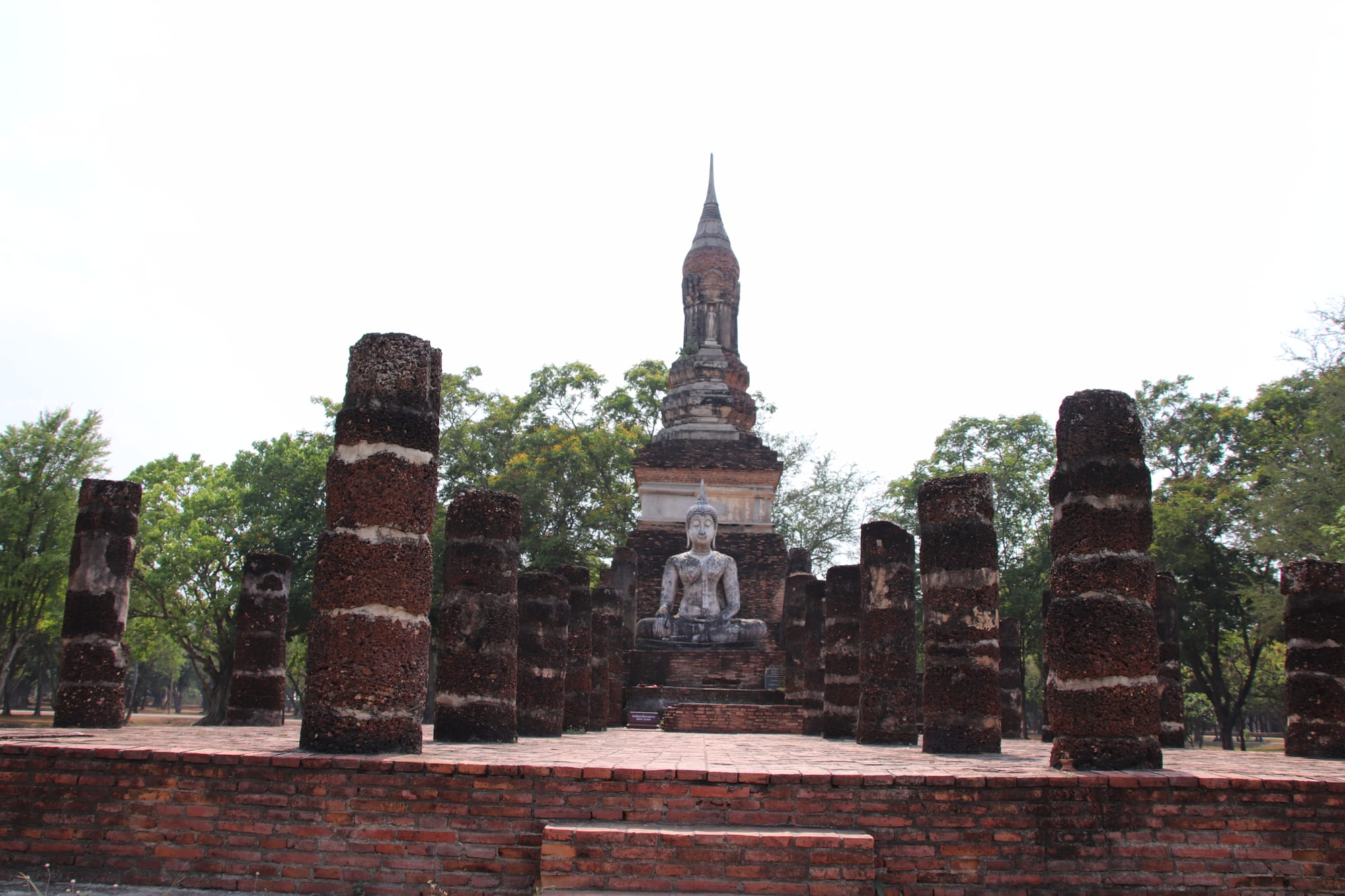
Rows of weathered laterite pillars leading to a seated white Buddha and a slender brick chedi, framed by green trees

Thailand

Chiang Mai & the North

Laterite pillars and a seated Buddha in Sukhothai Historical Park, the ruined 13th-century capital. (Gary Todd / Wikimedia Commons · Public domain)

Thailand's mountainous north, from the old Lanna kingdom of Chiang Mai and Chiang Rai up to the Golden Triangle on the Mekong, west to the Shan-influenced valleys of Pai and Mae Hong Son, and south to the ruined early capital of Sukhothai and the lower-northern city of Phitsanulok.

Explore Chiang Mai & the North

History

Two traditions meet in the north. In the lower valleys, Tai rulers broke from Khmer control in the early 13th century and founded Sukhothai, remembered in Thai history as the first Siamese kingdom; under King Ram Khamhaeng in the late 13th century it spread its influence widely, and its satellite cities of Si Satchanalai and Kamphaeng Phet shared its art. In the 15th century Sukhothai was absorbed by Ayutthaya, and Phitsanulok, on the Nan River, became Ayutthaya's northern stronghold; King Naresuan was born there in 1555–56.

Further north, King Mangrai founded Chiang Rai in 1262, took the old Mon kingdom of Hariphunchai at Lamphun, and in 1296 founded Chiang Mai as the capital of Lanna, "the kingdom of a million rice fields". Lanna flourished in the 15th century as a centre of Buddhist learning, then fell to Burma in 1558 and stayed under Burmese rule for about two centuries. Chiang Mai was retaken in the 1770s with Siamese help and ruled by its own princes as a vassal of Bangkok.

Siam absorbed Lanna and Nan fully around 1900, as teak logging boomed and the Phrae rebellion of 1902 was put down. In the 20th century the Golden Triangle became a centre of opium growing, and royal projects replaced poppies with coffee, tea and vegetables. Tourism, universities and migration have since made Chiang Mai the north's modern capital.

Culture & Customs

Northern Thais call themselves khon mueang and their language kham mueang, a Tai language related to Thai but distinct from it, once written in the Tai Tham script still seen in temples. Lanna identity is a point of pride, visible in teak temples with sweeping tiered roofs, and in the formal courtesy of northern speech.

The mountains are home to peoples who arrived over the last two centuries or more: Karen, Hmong, Akha, Lahu, Lisu and Mien, each with its own language, dress and beliefs. Many have taken up Buddhism or Christianity alongside older spirit practices, and some still struggle to secure Thai citizenship. Mae Hong Son is largely Shan, or Tai Yai, with Burmese-style temples, while Nan and Phrae keep ties to Lao culture across the border.

The calendar is marked by Yi Peng in November, when Chiang Mai releases paper lanterns into the sky at the same time as Loy Krathong; Songkran, celebrated here as Pi Mai Mueang with processions and sand chedis at temples; and Poy Sang Long in Mae Hong Son, when Shan boys are dressed as princes before ordination. Crafts include Bo Sang paper umbrellas, San Kamphaeng silk, Lamphun weaving and silverwork on Wua Lai Road in Chiang Mai.

Daily Life

Chiang Mai is the north's only big city: the municipality has about 130,000 people but the urban area around it exceeds a million, with universities, hospitals, a large community of foreign residents and digital nomads, and an economy built on tourism, trade and services. Chiang Rai, Phitsanulok, Lampang and Mae Sot, on the Myanmar border in Tak, are the other main towns, each with under 100,000 people in the municipality.

Most northerners outside the cities farm — rice in the valleys, maize on hill slopes, longan, lychee, coffee, tea and strawberries — and many younger people work in Bangkok or abroad. Mae Sot is a hub for cross-border trade and for migrants and refugees from Myanmar, and camps along the Tak and Mae Hong Son border have housed Karen refugees since the 1980s.

Days begin early with markets and alms rounds and end with night markets and walking streets, such as Chiang Mai's Sunday market on Ratchadamnoen Road. The main current issue is the annual smoke from burning fields and forests, which closes schools some years; others are floods along the Ping and Kok rivers, overdevelopment in Pai and Chiang Mai, and the war in Myanmar across the border.

Food

Northern food is milder, earthier and more herbal than central Thai cooking, and sticky rice, khao niao, is the staple, rolled into balls by hand. The dish visitors know best is khao soi, egg noodles in a coconut curry broth topped with crispy noodles and served with pickled mustard greens and shallots, a dish tied to the Muslim Chinese traders who crossed from Yunnan. Sai ua is a coarse pork sausage full of lemongrass, chilli and herbs, grilled over coals.

Dips are central: nam phrik num, a paste of pounded green chillies, garlic and shallots, and nam phrik ong, a mild pork-and-tomato relish, both eaten with raw vegetables and kaep mu, crisp pork rind. Gaeng hang lay is a rich Burmese-influenced pork curry with peanuts and tamarind, khanom jeen nam ngiao is rice noodles in a pork-and-tomato broth, and larb mueang is the northern version of minced-meat salad, seasoned with dried spices rather than lime.

The hills produce coffee around Doi Chang and tea at Mae Salong, a village founded by Chinese Nationalist soldiers, as well as strawberries and temperate vegetables from royal projects. Sukhothai gives its name to a noodle soup with pork, peanuts and green beans.

Attractions & Natural Wonders

Chiang Mai's moated old city holds Wat Phra Singh and the ruined chedi of Wat Chedi Luang, and the mountain road climbs to Wat Phra That Doi Suthep and the royal gardens of Doi Pui. Beyond the city lie Doi Inthanon, Thailand's highest mountain at about 2,565 metres, with waterfalls and twin royal chedis; the cave temple and forest of Chiang Dao; and, in Lampang and Lamphun, Wat Phra That Lampang Luang and Wat Phra That Hariphunchai.

To the west, the loop road from Chiang Mai runs to Pai, with its canyon, hot springs and valley viewpoints, and on to Mae Hong Son, where the Shan temples of Wat Chong Kham and Wat Chong Klang reflect in a small lake. Northward, Chiang Rai has the White Temple of Wat Rong Khun and the Blue Temple, and the Golden Triangle at Sop Ruak has the Hall of Opium museum, with Doi Tung's royal gardens and the tea hills of Mae Salong nearby. East lies Nan, with Wat Phumin's murals, Doi Phu Kha National Park and the salt wells of Bo Kluea.

In the lower north, Sukhothai Historical Park preserves Wat Mahathat, Wat Si Chum's massive mandapa and dozens of ruined temples, with Si Satchanalai and Kamphaeng Phet as its UNESCO-listed companions. Phitsanulok's Wat Phra Si Rattana Mahathat houses the Phra Buddha Chinnarat, one of Thailand's most revered Buddha images; the highlands of eastern Phitsanulok have Phu Hin Rong Kla, and Phetchabun the misty hills of Khao Kho.

Cities in Chiang Mai & the North

Planning basics

Budget

The north is cheaper than Bangkok and the beaches. Chiang Mai has a huge range of guesthouses, cafés and markets at low prices, and smaller towns such as Nan, Lampang, Phitsanulok and Mae Hong Son cost less again. Organised treks, elephant sanctuaries, cookery classes and hired motorbikes or cars are the main extra expenses, and rooms fill and prices rise around Yi Peng and the New Year.

Daily Budget Midrange
USD 60–130 (boutique hotel, restaurants, a hire car or driver, a cookery class or sanctuary visit)
Daily Budget Shoestring
USD 25–45 (guesthouse, market and street food, buses and songthaews)

Book Chiang Mai accommodation early for Yi Peng in November, and choose elephant camps that do not offer riding.

Safety

The north is safe and relaxed. The main risks are motorbike crashes on mountain bends, smoke that affects health from February to April, and trekking without a guide. Along the Myanmar border in Tak, Mae Hong Son and Chiang Rai, conflict and drug trafficking on the far side sometimes lead to closures of crossings and remote areas.

Wear a helmet, check the air-quality index in the burning season, trek with a licensed guide and follow local advice near the Myanmar border. Check current official travel advice before travelling.

Climate

The north has the clearest seasons in Thailand. The cool season is genuinely cool in the hills, with mornings near freezing on Doi Inthanon; the hot season is dry and, from about February to April, smoky from crop and forest burning that gives Chiang Mai badly polluted air; the rains from June to October turn the valleys green.

Summer
hot and dry in March–May, often 35–40°C in the valleys, with heavy smoke haze; warm, humid and wet June–October
Winter
cool and dry November–February, about 15–30°C in Chiang Mai and much colder at night in the mountains

Transportation

Chiang Mai and Chiang Rai have airports with frequent flights from Bangkok, and Phitsanulok, Nan and Mae Hong Son have smaller ones. The northern railway runs from Bangkok through Phitsanulok and Lampang to Chiang Mai, including overnight sleepers of about 11–13 hours. Buses and minibuses link the towns; the roads to Pai and Mae Hong Son are famously winding. The river crossing at Chiang Khong leads into Laos.

Take the minibus to Pai slowly if prone to travel sickness; hire a car or motorbike only with experience of steep mountain roads.

Best Time to Visit

November to February, when skies are clear, the air is fresh and the mountains are at their best; Yi Peng lanterns and Loy Krathong fill Chiang Mai in November. February to April is best avoided for the smoke. The rainy season is green and quieter, though mountain roads can suffer landslides.