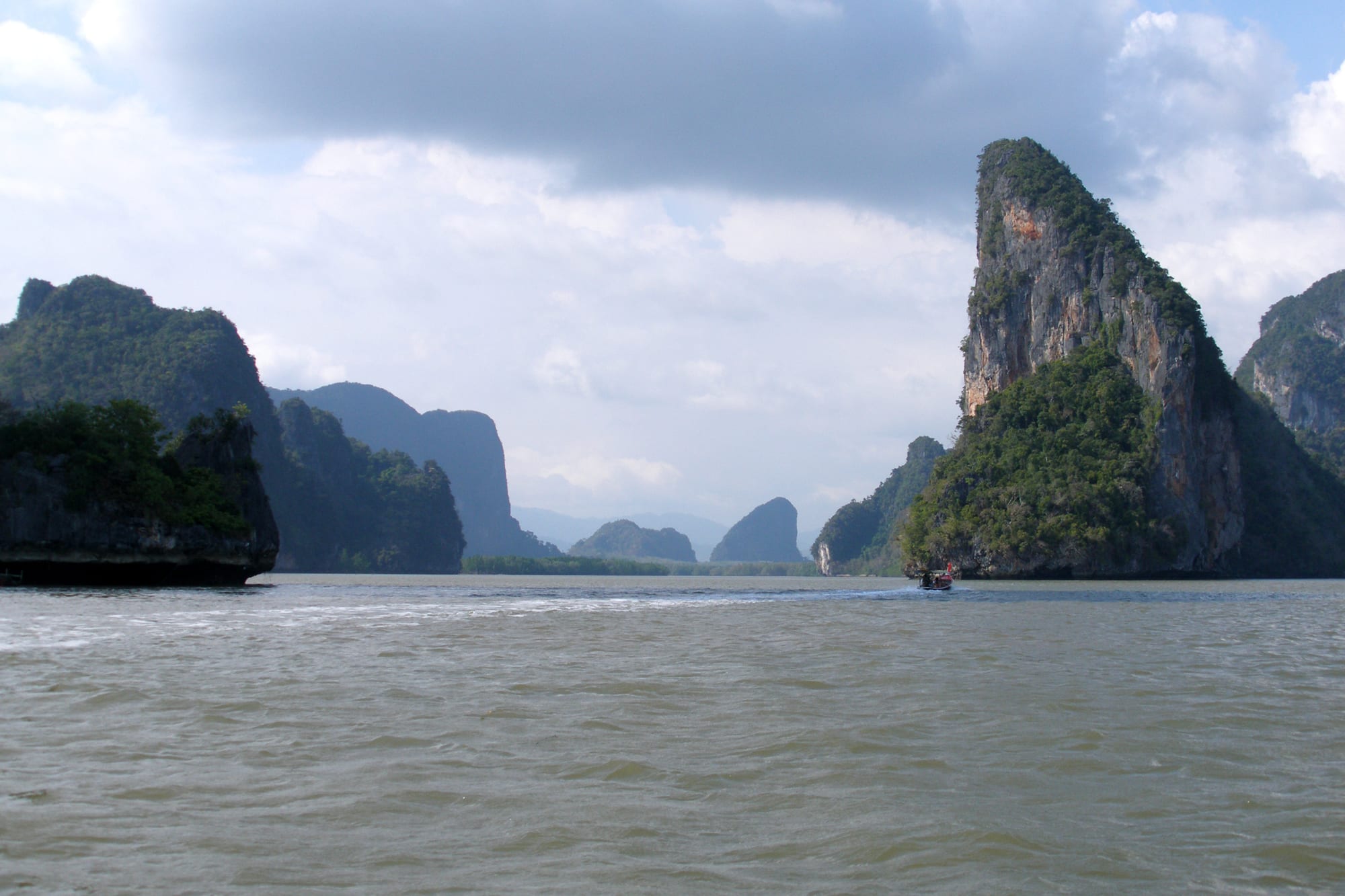
Sheer, forest-topped limestone towers rising from grey-green water, with a small longtail boat passing beneath them

Thailand

Phuket, Krabi & the Andaman Coast

Limestone karst islands in Phang Nga Bay, part of Ao Phang Nga National Park. (Vyacheslav Argenberg / Wikimedia Commons · CC BY 4.0)

Thailand's west coast on the Andaman Sea, running from Ranong on the Myanmar border south through Phang Nga, Phuket and Krabi to Trang and Satun near Malaysia — a coast of limestone towers, coral islands and tin-mining towns, and the country's busiest beach region, still marked by the 2004 tsunami.

Explore Phuket, Krabi & the Andaman Coast

History

The coast lay on sea routes between India and China for centuries, and small ports traded tin, ivory and forest goods under the loose control of Nakhon Si Thammarat, Ayutthaya and the Malay sultanates. The islands were home to the chao le, the sea peoples — Moken, Moklen and Urak Lawoi — who fished and dived among them long before permanent settlement. In 1785 a Burmese army besieged Thalang on Phuket, and two sisters, Thao Thep Kasattri and Thao Si Sunthon, are honoured for leading its defence; their statue stands at the Heroines Monument.

In the 19th century tin made the coast. Chinese miners poured into Phuket and the neighbouring coast, and their merchant families built the shophouses of Phuket Town and ran the mines and ports. Around 1900, Phraya Ratsadanupradit, governor of Trang, promoted rubber planting, which became the backbone of the southern economy. Off Satun, the Tarutao islands held a penal colony for political prisoners from the late 1930s into the Second World War.

Tourism arrived in the 1970s and 1980s, as tin declined, and Phuket, Krabi and Phi Phi grew into mass destinations. On 26 December 2004 the Indian Ocean tsunami struck the coast, killing thousands of Thais and foreigners, worst of all at Khao Lak in Phang Nga, and destroying villages on Phi Phi and the islands. Since then the region has rebuilt, closed Maya Bay for several years to let the reef recover, and grown busier than ever.

Culture & Customs

The Andaman coast is a meeting point. Phuket and Trang have a Peranakan, or Baba, culture of Straits Chinese descent, visible in shophouse architecture and in cooking that mixes Hokkien and Malay flavours. The largest festival is Phuket's Vegetarian Festival, the Nine Emperor Gods festival, when devotees abstain from meat and spirit mediums pierce their cheeks with blades and skewers in street processions.

Muslims form a large part of the population in Krabi, Phang Nga, Trang and especially Satun, where most people are Malay-descended Muslims who speak Thai or the southern dialect; mosques stand beside temples, and village life keeps Islamic customs. The southern Thai dialect, fast and clipped, is spoken throughout. The Moken of the Surin Islands and the Urak Lawoi of Koh Lanta and Koh Lipe keep their own languages and boat-floating ceremonies, though they have struggled for land rights as tourism has spread.

Local arts include nora, a southern dance-drama with elaborate beaded costumes, and nang talung shadow puppetry. Phuket was named a UNESCO Creative City of Gastronomy in 2015, and its Chinese shrines hold festivals throughout the year.

Daily Life

Phuket is the region's centre, with around 400,000 registered residents and many more migrant workers, many from Myanmar, and foreign residents; Phuket Town is the working and administrative hub, Patong the nightlife resort. Krabi Town, Trang, Ranong and Satun are provincial towns, Trang known for its early morning coffee shops and Ranong for its port and border trade with Kawthaung in Myanmar.

Tourism dominates Phuket, Krabi and Khao Lak, while rubber, oil palm and fishing remain the mainstays of Trang, Satun and the rest of the mainland. Ranong lives from fishing and its trade across the border. Coconut and cashew nut plantations add to the mix.

Days on the islands follow the tides and the season: boats leaving at dawn, beach work in high season and a quieter, often jobless rainy season. Current issues include overtourism, reef damage from boats and visitors, and the rights of the sea peoples to the land they live on.

Food

Phuket's cooking is its own. Mu hong, pork belly braised with black pepper and garlic, shows the island's Chinese roots, while o-tao, a fried omelette with taro and small oysters, is a street snack. Breakfast is khanom jeen, rice noodles with curry and a basket of fresh vegetables. Southern curries run hot and yellow with fresh turmeric: kaeng som, also called kaeng lueang, a sour fish curry; kua kling, a dry-fried minced-meat curry; and kaeng tai pla, a pungent curry of fermented fish innards.

Trang has two famous traditions: mu yang Trang, whole roast pork with crackling, eaten at breakfast with coffee and dim sum, and Trang cake, a sponge cake baked in a charcoal oven. Krabi, Phang Nga and Satun have Muslim dishes such as khao mok gai, spiced chicken rice, and roti with curry or sweet toppings.

Seafood is everywhere, from blue crabs to rock lobster and grilled fish, and the traditional coffee shops of Trang, kopi tiam, serve local coffee.

Attractions & Natural Wonders

Phuket has its old town of shophouses, the Big Buddha on Nakkerd Hill, Wat Chalong, the cape of Promthep at the island's southern tip, and a string of west-coast beaches from Patong to Kata, Karon and Kamala. North of the island, Phang Nga Bay's limestone towers include Khao Phing Kan, known as James Bond Island after the 1974 film, and the Muslim stilt village of Ko Panyi.

Krabi province has the most dramatic scenery: Railay's cliffs, beaches and climbing walls; the resort of Ao Nang; the Tiger Cave Temple with its long stair to a hilltop Buddha; and the Phi Phi islands, with Maya Bay on Ko Phi Phi Le. Further south, Koh Lanta has long beaches and a marine national park.

Up the coast, Khao Lak is the base for the Similan Islands and the Surin Islands, and Ranong has hot springs and the quiet island of Ko Phayam. South of Krabi, Trang's islands include Ko Mook with its Emerald Cave, reached through a narrow tunnel, Ko Kradan and Ko Libong, home to dugongs. Satun has Koh Lipe on the edge of Tarutao National Park and the Satun UNESCO Global Geopark.

Cities in Phuket, Krabi & the Andaman Coast

Planning basics

Budget

The Andaman coast is one of the most expensive parts of Thailand. Phuket's west-coast beaches, the Phi Phi islands and Koh Lipe charge resort prices in high season, and boat transfers, dive trips and national park fees add up quickly. Krabi town, Trang, Ranong and Satun are much cheaper, and prices on the islands drop sharply in the rainy season.

Daily Budget Midrange
USD 90–210 (beach resort, seafood dinners, island-hopping tours, a dive day)
Daily Budget Shoestring
USD 30–55 (hostel or bungalow, local food, shared boats and songthaews)

Stay in Phuket Town or Krabi Town for local prices and good food, and book island rooms early for December to February.

Safety

The coast is safe for most visitors, but tourist accidents are a real risk: motorbike crashes on Phuket's hills, drownings in rip currents on west-facing beaches in the monsoon, and speedboat accidents in rough seas. Patong has the usual nightlife problems. Tsunami warning towers and evacuation route signs line the coast.

Obey red flags, avoid swimming in monsoon surf, choose licensed boat operators with life jackets and learn the local tsunami evacuation route. Check current official travel advice before travelling.

Climate

The Andaman coast faces the southwest monsoon directly. From about May to October it is wet, with heavy squalls and rough seas that close the Similan and Surin parks and cancel some boat routes; Ranong is one of the rainiest places in Thailand. From November to April the sea is calm and clear and the weather mostly dry and hot.

Summer
hot and humid year-round, 28–34°C; the monsoon from May–October brings heavy rain and large waves
Winter
the dry season, November–April, is sunny with calm seas, about 24–33°C

Transportation

Phuket's international airport is the main gateway, with Krabi, Trang and Ranong also served by flights; the nearest train station is at Trang. Buses and minivans link Phuket, Khao Lak, Krabi and Trang, and the Sarasin bridge joins Phuket to the mainland. Ferries and speedboats connect Phuket, Krabi, Phi Phi and Koh Lanta, and boats from Pak Bara run to Koh Lipe. Longtail boats are the local taxis to Railay and the smaller islands.

Allow a buffer day before flights when using island boats in unsettled weather, and book Koh Lipe boats ahead in high season.

Best Time to Visit

November to April is the season for beaches, diving and island-hopping, with December to February busiest. The Similan Islands are open to visitors only in roughly the dry half of the year. Phuket's Vegetarian Festival, with processions of spirit mediums, is held in September or October. The rainy season is cheap and green but many small-island resorts close.