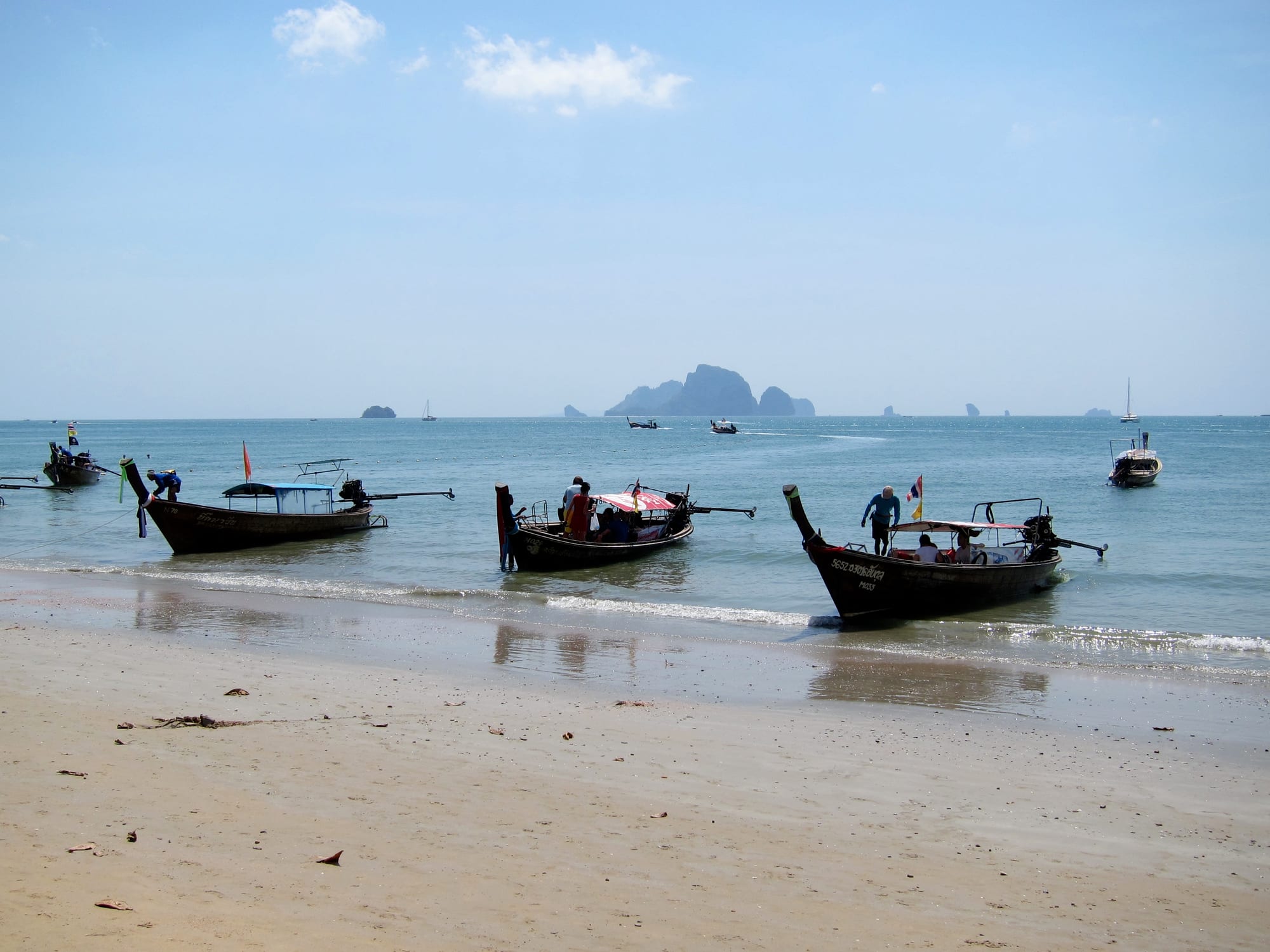
Wooden longtail boats with long propeller shafts drawn up on a sandy beach, with limestone islands on the horizon under a pale blue sky

Phuket, Krabi & the Andaman Coast, Thailand

Ao Nang

Longtail boats on the beach at Ao Nang, with limestone islands offshore. (Jukka from HELSINKI, Finland / Wikimedia Commons · CC BY 2.0)

The main beach resort of Krabi province, on the Andaman Sea about twenty kilometres by road west of Krabi Town. A fishing and rubber-farming coast until the 1980s, it grew into a strip of hotels, restaurants and dive shops behind a single bay, and its pier is the departure point for Railay's cliffs, the Phi Phi islands and the limestone islets offshore.

Neighbourhoods

  • The beachfront and main strip
    • First-time visitors
    • Restaurants
    • Close to the boats

    The single road that runs behind the sand and then turns inland, lined with hotels, tour desks, dive shops, massage places and restaurants. Everything in the resort is within a few minutes' walk, and the longtail boats leave from the beach itself.

    Open in Maps
  • Soi Sunset and the headland
    • Sunset views
    • Seafood

    A short pedestrian lane at the western end of the bay, running under the cliff to a line of restaurants built out over the rocks, with the day's catch on ice at the front and the sunset straight ahead.

    Open in Maps
  • Noppharat Thara
    • Quiet beaches
    • Families
    • Local life

    The long, shaded beach and small village a couple of kilometres north-west, inside a national park, with casuarina trees, food stalls at the car park and far fewer hotels. The national park pier here serves the larger ferries.

    Open in Maps
  • Klong Muang and Tubkaek
    • Resorts
    • Quiet and residential

    Quieter bays further north along the coast, with larger resorts spread along the shore and views across to the islands of Phang Nga Bay. There is little to walk to, so most guests use hotel transport.

    Open in Maps
  • Railay
    • Rock climbing
    • Beaches
    • Car-free

    A peninsula cut off by limestone walls about fifteen minutes away by longtail boat, reachable only by sea. It has beaches, climbing routes, caves and a mix of bungalows and resorts, and no roads at all.

    Open in Maps

Things to do

Beaches and cliffs

  • Railaybeach

    A peninsula of white sand between vertical limestone walls, among the best-known rock-climbing areas in the world and reached only by boat.

    Open in Maps
  • Hat Noppharat Tharapark

    A marine national park whose mainland beach runs north-west from Ao Nang, taking in the sandbars, islets and reefs offshore as well as the Phi Phi islands.

    Open in Maps
  • Ko Podaattraction

    A small island of white sand and clear water a short longtail ride offshore, one of the standard stops on a four-island boat trip.

    Open in Maps

Temples and viewpoints

  • Tiger Cave Templelandmark

    A forest monastery outside Krabi Town with a staircase of more than a thousand steps climbing to a hilltop Buddha image and a view over the province.

    Open in Maps

Short trips from the village

  • Phi Phi Islandsattraction

    Cliff-walled islands offshore, reached by ferry and speedboat from the national park pier, with Maya Bay, snorkelling reefs and one inhabited island.

    Open in Maps
  • Krabi Townneighborhood

    The provincial capital on the river, with a riverside promenade, night markets and everyday prices, about twenty kilometres inland from the beach.

    Open in Maps
  • Than Bok Khorani National Parkpark

    A park of spring-fed pools, limestone caves and mangrove channels north of Krabi Town, popular for swimming and short forest walks.

    Open in Maps
  • Khao Phanom Bencha National Parkpark

    Rainforest around the 1,397-metre peak of Khao Phanom Bencha, with waterfalls and trails, about 20 kilometres north of Krabi Town.

    Open in Maps
  • Ao Phang Nga National Parkpark

    The bay of limestone towers, sea caves and mangroves north of Krabi, reached on longtail or speedboat trips.

    Open in Maps

Seasonal events

  • SongkranApril

    The Thai new year, with visits to temples, water poured over Buddha images and water thrown in the streets of the village and Krabi Town.

  • Loi KrathongNovember

    Decorated floats of banana leaf, flowers and candles are set on the sea and the Krabi River on the full moon.

  • Vegetarian FestivalSeptember or October

    The Chinese-Thai communities of Krabi mark the ninth lunar month with meat-free food stalls, white clothing and shrine processions.

Eat and drink

Long-standing places and food districts in Ao Nang. Hours, ratings and directions come from your maps app, always current.

Ao Nang classics

  • Soi Sunset seafood restaurantsneighborhood

    A row of open-sided restaurants on the rocks at the west end of the bay, where fish, prawns, squid and crab are chosen from the ice and grilled or steamed with lime and chilli.

    Open in Maps
  • Southern curries on the main stripneighborhood

    Family kitchens set back from the beach road serve kaeng som, a sour fish curry, kua kling and massaman, alongside the pad thai and fried rice the resort is built on.

    Open in Maps

Markets and food districts

  • Ao Nang night marketmarket

    Evening stalls behind the beach road selling grilled skewers, som tam, roti and fruit shakes at prices well below the seafront restaurants.

    Open in Maps
  • Krabi Town riverside marketmarket

    Stalls beside the Krabi River in the provincial capital, serving noodle bowls, southern curries, roti and Muslim rice dishes to a mostly Thai crowd.

    Open in Maps
  • Muslim kitchens and roti stallsneighborhood

    Krabi has a large Muslim population, and halal kitchens across the area serve khao mok gai, spiced chicken rice, and roti with curry or condensed milk.

    Open in Maps

Experience Ao Nang

History

The bay was a minor part of Krabi province for most of its history: a coast of fishing villages, rubber smallholdings and oil palm behind, with the limestone country inland yielding shells, bird nests and caves that have yielded traces of human occupation tens of thousands of years old. Krabi Town, on the river to the east, was the administrative and trading centre, and the beaches had no road worth the name.

Travellers began arriving in the late 1970s and early 1980s, following the backpacker route south from Phuket and Ko Samui. The first bungalows went up at Railay and along the sand at Ao Nang, reached by longtail boat or a rough track, and the cliffs drew climbers from the mid-1980s onwards, which made Railay a name in the climbing world long before the resort was known to package travellers. Krabi airport opened to commercial traffic in the following decades, and Ao Nang shifted from bungalows to hotels, with a paved beach road, dive schools and tour offices.

The Indian Ocean tsunami of 26 December 2004 reached this coast, damaging boats, beachfront buildings and the islands offshore, though Krabi province was less badly hit than Phang Nga to the north. Rebuilding was quick, and warning towers and evacuation signs date from that period. Growth since has been steady and largely unplanned: the strip has crept inland and along the coast towards Klong Muang, and questions about water supply, waste and reef damage have grown with it.

Culture & Customs

Krabi is a mixed province. Buddhist and Muslim communities live side by side, with mosques in the villages behind the beaches and temples in the towns, and around Ao Nang the call to prayer and the temple loudspeaker are both part of the morning. That mix shapes the manners of the place: dress away from the sand is modest, alcohol is absent from many local kitchens, and Fridays are quieter in the Muslim villages.

Climbing has given the area a second identity. Since the 1980s Railay and Ton Sai have drawn climbers from around the world, and a semi-permanent community of guides, instructors and returning regulars lives around the peninsula in the dry season, with a calendar of competitions and fire shows. Diving and snorkelling employ a similar international crowd, and English is the working language of much of the beachfront.

Southern Thai culture runs underneath all of this. The dialect is fast and clipped and often unintelligible to visitors from Bangkok; shadow puppetry and the nora dance-drama survive at temple fairs inland; and the sea peoples of the Andaman coast have long-standing communities on the islands nearby. Chinese-Thai families in Krabi Town keep shrine festivals, including the meat-free ninth lunar month, and the province's Buddhist year turns on Songkran in April and Loi Krathong in November.

Daily Life

Ao Nang is a village rather than a town — a few thousand permanent residents in its own sub-district of Mueang Krabi district, which also administers the Phi Phi islands — and its population swells with seasonal workers from the Isan provinces and from Myanmar when the hotels fill. Krabi Town, about twenty kilometres east and home to some tens of thousands of people, holds the hospital, the schools, the government offices and the markets that the resort depends on.

Almost everyone here works in tourism directly or supplies it: hotels, restaurants, dive shops, boat crews, drivers, massage shops and the market stalls that feed the workers. Outside the strip, rubber and oil palm plantations and fishing still support the villages, and prawn farms line parts of the coast. The rhythm is strongly seasonal — long hours from November to April, and a much emptier wet season when some businesses close, staff go home to their provinces and the beach belongs to local families again.

Days begin early, with boats leaving from the sand soon after dawn and markets trading before the heat. Afternoons are slow, and the evening belongs to the beach road. The issues that concern residents are familiar ones on this coast: water shortages at the end of the dry season, waste and sewage, the price of land, and how much the reefs and the Railay cliffs can take.

Food

Southern Thai cooking is the foundation, and it is hotter and more turmeric-heavy than food further north. Kaeng som, a sour orange curry of fish with tamarind and turmeric, is the regional standard; kua kling is minced meat dry-fried with a fierce curry paste; and kaeng tai pla, built on fermented fish innards, is the dish that marks out a truly local kitchen. Plain rice and a plate of raw vegetables and herbs come alongside to cool them.

Seafood is the reason many people eat out here: rock lobster, blue crab, squid, prawns and whole fish, usually sold by weight and grilled over charcoal or steamed with lime, garlic and chilli. The restaurants on the rocks at the west end of the bay do this in plain sight, and the simplest preparations are generally the best.

Krabi's Muslim kitchens give the area its other strand: khao mok gai, chicken and rice cooked with turmeric and spices in the biryani manner; roti, griddled and served either with curry or folded around banana and condensed milk; and sweet, strong tea. Breakfast for Thai residents is often khanom jeen, fermented rice noodles under curry with a tray of vegetables, or rice soup. Fresh fruit — mangosteen, rambutan, durian and pineapple in season — is sold from carts along the beach road, and coffee is drunk thick and sweet.

Planning tools

Budget

Ao Nang is cheaper than Phuket but not cheap by Thai standards, and prices swing hard with the season: a beachfront room in January can cost several times the same room in June. Boat trips, national park entry fees for foreign visitors and diving are the main extras, and eating a street or two back from the sand halves the bill.

Daily Budget Midrange
USD 90–210 (beach resort, seafood dinners, island-hopping tours, a dive day)
Daily Budget Shoestring
USD 25–50 (guesthouse or hostel, market food, shared longtail boats and songthaews)

Staying in Krabi Town or at Noppharat Thara costs much less than the beachfront strip, and rooms are at their cheapest from May to October.

Best Time to Visit

November to April, when the sea is calm and boats run reliably; December to February is the busiest and most expensive stretch. From May to October the southwest monsoon brings squalls, murky water and cancelled island trips, though prices fall sharply and the limestone hills are at their greenest.

Suggested Number of Days

Two or three days suits most first visits. Four to six makes sense for anyone adding the islands and the national parks inland, or taking a diving or climbing course. Weather in the monsoon months can cancel boats, so a spare day before any onward flight is worth having.

First Visit
2–3 days
With Surroundings
4–6 days

Transportation

The resort is small enough to walk, and everything else goes by boat or by road. Longtail boats leave from the beach for Railay and the nearby islands whenever they fill, ferries and speedboats use the Noppharat Thara national park pier, and songthaews run to Krabi Town through the day. Rented scooters and taxis cover the coast road to Klong Muang and the inland parks.

Longtail boats load from the water, so shoes come off and bags get wet; boats to Railay leave when a group has gathered rather than to a timetable.

Airport & Station Connections

Krabi International Airport, about 7 kilometres east of Krabi Town, is under an hour from the resort by road, with domestic flights from Bangkok and a range of regional services. Buses and minivans run from Phuket, Surat Thani and Bangkok to Krabi Town, where songthaews and taxis continue to the beach, and ferries connect the national park pier with Phi Phi, Koh Lanta and Phuket in the dry season.

Walkability

The village itself is easy on foot: the beach road, the lanes behind it and Soi Sunset can all be covered in twenty minutes or so, and the sand runs the length of the bay. Beyond that, pavements give out quickly, the coast road to Noppharat Thara and Klong Muang is narrow and busy, and the hills behind make walking inland unappealing in the heat.

Safety

Ao Nang is safe for most visitors and serious crime is uncommon. The real risks are on the water and the road: longtail and speedboat accidents in rough weather, currents and boat traffic close to the beaches, and scooter crashes on the coast road. Jellyfish appear at times, and the rocks and tides on the smaller beaches catch people out. Tsunami warning towers and evacuation route signs line the coast.

Choose boat operators who provide life jackets and refuse trips in rough seas, obey red flags, wear a helmet on a scooter, and learn the local tsunami evacuation route. Check current official travel advice before travelling.

Climate

Tropical and humid all year, with a dry season from about November to April and a wet season from May to October when the southwest monsoon blows straight onto this coast. Rain usually comes in heavy bursts, often in the afternoon or overnight.

Summer
hot and humid, generally 28–34°C; May to October brings frequent heavy rain and rough seas
Winter
the dry season, November to April, is sunny with calm water and about 24–33°C

Local Customs

Krabi has a large Muslim population alongside its Buddhist communities, and village life away from the beach is conservative: beachwear stays on the beach, and shoulders and knees are covered at temples and near mosques. Shoes come off before entering homes, shrines and many small shops. A wai, the palms-together greeting, is returned rather than offered first by visitors. Tipping is not expected, though small change is usually left.

Insulting the monarchy is a criminal offence in Thailand. Beachwear belongs on the beach, smoking is banned in many public places, alcohol is not served in halal restaurants, and cannabis, decriminalised in 2022, was restricted again in 2025 to medical use — never attempt to carry it out of the country.

Common Payment Methods

The currency is the Thai baht. Hotels, dive shops and larger restaurants take cards, and Thai QR payment is widely used, but longtail boats, songthaews, market stalls and small kitchens are cash only. ATMs stand along the beach road and charge a fixed fee per foreign withdrawal, so fewer, larger withdrawals cost less; always choose to be charged in baht.