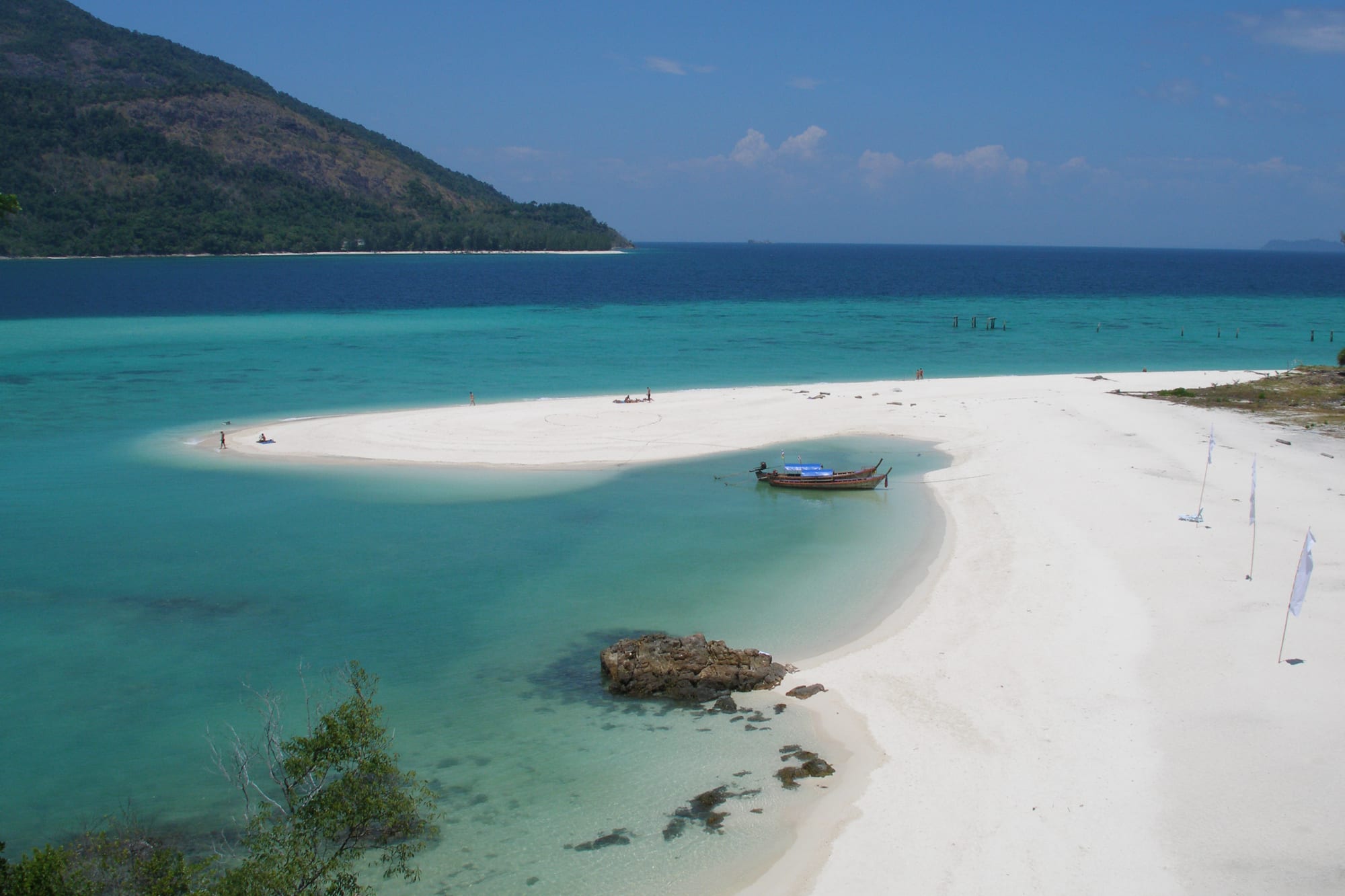
A white sand spit curving into turquoise shallows with a wooden longtail boat moored beside it and a forested island beyond

Phuket, Krabi & the Andaman Coast, Thailand

Ko Lipe

A sand spit and shallow turquoise water on Ko Lipe, in the Andaman Sea off Satun province. (Vyacheslav Argenberg / Wikimedia Commons · CC BY 4.0)

A small island at the southern end of Thailand's Andaman coast, in Satun province close to the Malaysian border and on the edge of Tarutao National Marine Park. Long home to Urak Lawoi sea people, it turned from fishing and boat-building to tourism late, and now packs beaches, reefs and a pedestrian street of guesthouses into a few square kilometres.

Neighbourhoods

  • Pattaya Beach
    • First-time visitors
    • Beaches
    • Nightlife

    The long south-facing beach where the ferries and speedboats drop passengers onto floating piers or into longtail boats. It has the widest choice of resorts, beach bars and restaurant terraces, and the most people on the sand.

    Open in Maps
  • Walking Street
    • Best for food
    • Shopping
    • Close to the boats

    The narrow pedestrian lane that crosses the island between Pattaya Beach and Sunrise Beach, lined with guesthouses, dive shops, massage places, bars and seafood grills laid out on ice at dusk. It is the island's high street and busiest at night.

    Open in Maps
  • Sunrise Beach
    • Quiet and residential
    • Local life
    • Snorkelling

    The east-facing beach, looking out to the islets offshore, with calmer water and a strip of simpler bungalows. The Urak Lawoi village stands at its northern end, and small boats leave from here for the nearby islets.

    Open in Maps
  • Sunset Beach
    • Quiet and residential
    • Sunsets

    A short beach on the north-western side, reached by a footpath through the interior, with a handful of small resorts and little else. It is the quietest of the three main bays and faces the evening sun.

    Open in Maps

Things to do

Beaches and the island itself

  • Ko Lipe's beachesbeach

    Three main bays — Pattaya, Sunrise and Sunset — sit within a walk of one another on an island only a couple of kilometres across.

    Open in Maps
  • Ko Kraattraction

    One of the small islets off Ko Lipe, named with Ko Usen among the usual snorkelling and kayak trips, and ringed by shallow coral.

    Open in Maps

Islands and reefs nearby

  • Tarutao National Marine Parkattraction

    The park of 51 islands in the Strait of Malacca on whose border Ko Lipe sits; a national park admission fee and an environmental fee are charged on arrival.

    Open in Maps
  • Ko Adangattraction

    The park's second-biggest island, directly north across the channel, hilly and jungle-covered, with national park bungalows and camping at its southern tip, the year-round Namtok Chon Salat waterfall and a climb to the Pha Chado viewpoint over Lipe.

    Open in Maps
  • Ko Tarutaoattraction

    The largest island of the park, about 50 kilometres away, which gives the park its name; more than 3,000 criminals and political prisoners were held there between 1938 and 1948, and it is now forest, mangrove and empty shore.

    Open in Maps

On the water

  • Diving and snorkelling tripsattraction

    Longtail and speedboat trips run from the beaches to reefs and islets around the park, and the island has several dive schools.

    Open in Maps
  • Kayaking the channelattraction

    Kayaks are rented on the beaches for the sheltered water between Lipe, Ko Kra and the nearer islets, best in the calm dry season.

    Open in Maps

Seasonal events

  • Urak Lawoi boat-floating ceremonytwice a year

    The Urak Lawoi communities of Lipe and the neighbouring islands build a small wooden boat and set it adrift carrying ancestral spirits and misfortune away from the island, with music and dancing through the night.

  • SongkranApril

    Thai new year, marked on the island with water throwing along Walking Street and the beaches in the hottest part of the year.

  • The dry-season high seasonNovember to April

    The months when seas are calm, boats run to the mainland and, from about mid-October to mid-May, to Langkawi, and the island is at its busiest; many businesses close in the monsoon.

Eat and drink

Long-standing places and food districts in Ko Lipe. Hours, ratings and directions come from your maps app, always current.

Ko Lipe classics

  • Seafood grills on Walking Streetneighborhood

    Restaurants set the day's catch out on ice at the front — squid, prawns, snapper, barracuda and crab — to be grilled to order with lime, garlic and chilli dipping sauces.

    Open in Maps
  • Beachfront restaurants on Pattaya Beachneighborhood

    Tables set on the sand serving Thai standards, southern curries, Western breakfasts and fruit shakes, with low prices rising the closer the table sits to the water.

    Open in Maps

Local and everyday food

  • Sunrise Beach village kitchensneighborhood

    Simple family-run places near the Urak Lawoi village cooking rice and noodle dishes, fish curries and roti for locals and island workers as well as visitors.

    Open in Maps
  • Roti and coffee stallsmarket

    Muslim-run stalls griddle roti with condensed milk, banana or egg, and serve strong local coffee — a southern Thai breakfast found across Satun province.

    Open in Maps

Experience Ko Lipe

History

Ko Lipe's first settled community were Urak Lawoi, one of the sea peoples of the Andaman, who moved among the islands of the far south in wooden boats and were the island's first settlers. That settled population is what set Lipe apart from its neighbours: by the time the archipelago around it was protected, people had been living and fishing here for generations, and the island's history since has turned on the gap between customary occupation and formal title.

In April 1974 the surrounding archipelago became Tarutao National Park, Thailand's second marine national park, a protected area of 51 islands. Ko Lipe sits on the park's border, and that position shaped everything that followed. While the neighbouring islands stayed forest and empty beach under park control, Lipe was built on, and bungalows spread from the village across the flat ground behind Pattaya Beach; the parks department has since tried to check building on land it considers its own.

Growth came late and then quickly. The island had no road link, no airport and no mains electricity, yet it came to have dive schools, resorts, a pedestrian commercial street and seasonal ferries from Malaysia. The change brought land disputes: Urak Lawoi families were pushed off ground that had become valuable, and in 2022 it was reported that 125 families, about half the island's Urak Lawoi community, had lost legal title to the land they occupied. Waste, water and the pressure of visitor numbers on a small island remain live questions.

Culture & Customs

The Urak Lawoi are the island's oldest community, and their language, a Malayic tongue distinct from Thai, is still spoken in the village at the north end of Sunrise Beach. Their calendar turns on the boat-floating ceremony, when a small boat is built, loaded with ancestral spirits and symbols of misfortune, and set adrift after a night of drumming and dancing — a rite shared with Urak Lawoi communities on Ko Lanta, Ko Phi Phi and the Adang group. Fishing knowledge, free-diving and boat-handling are part of the same inheritance, though fewer young islanders now make a living from them.

Layered on top is the culture of Satun province, a Malay state associated with Kedah until 1916 and still the Andaman province closest to Malaysia, where a large Muslim population, southern Thai and Malay are part of everyday life. Mainland staff who work the season bring that with them, and much of the island's food follows it.

The third layer is the seasonal international one: divers, long-stay visitors and business owners from Europe and elsewhere, a scene concentrated on Walking Street that empties out in the monsoon. The three groups mix more than they merge. Visitors are expected to observe ordinary Thai courtesies — modest dress away from the beach, quiet respect near the village, no loss of temper in public — and to remember that the reefs and islands around them are protected ground.

Daily Life

Ko Lipe's permanent population is small — a village-sized community, most of it Urak Lawoi families and Thai residents from Satun — and it multiplies in the dry season with staff who come from the mainland and from Myanmar for the tourist months. Almost every household income now depends on visitors, through rooms, restaurants, boats, dive schools or shops; fishing continues alongside it rather than instead of it.

The island has no mains grid, water supply or waste system of the kind a mainland town takes for granted. Power comes from generators, fresh water from wells and rainwater, and rubbish has to be shipped off the island, which is one of the loudest local complaints. There is a school, a health station and a mosque; anything more serious than routine care means a boat to Pak Bara and a hospital in Satun or Hat Yai.

The day begins early, with boats loading at first light and the piers busy when the ferries arrive in the late morning. Afternoons are quiet in the heat, and the island turns out along Walking Street in the evening when the grills are lit. In the monsoon the pattern breaks: many businesses close, families travel to the mainland, and the island returns to something nearer the fishing village it was fifty years ago.

Food

Seafood is the island's own contribution. Squid, prawns, blue swimming crab, snapper, grouper and barracuda are laid out on ice outside restaurants in the evening and grilled over charcoal, served with nam chim seafood — a sharp dip of chilli, garlic, lime and fish sauce. Whole fish steamed with lime and chilli, pla neung manao, and prawns or squid stir-fried with garlic and pepper are the standard orders, and tom yam goong, the hot and sour prawn soup, appears on almost every menu.

The cooking behind the tourist strip is southern Thai and Malay-influenced, as it is across Satun. Kaeng som, a sour yellow fish curry, and kua kling, minced meat dry-fried with turmeric and chilli, are eaten with rice, while khao mok gai, spiced chicken rice, and satay come from the Muslim kitchens of the mainland. Roti is the island's breakfast and its late-night sweet, griddled and folded with banana and condensed milk, alongside coffee brewed strong and served sweet.

Fruit arrives by boat from Satun and Trang, mangoes and rambutans in their seasons, and coconuts are drunk cold on the beach. Prices reflect the crossing: imported groceries, beer and wine cost noticeably more than on the mainland, and the cheapest good eating is at the small village kitchens rather than on the sand.

Planning tools

Budget

Ko Lipe is expensive by Thai standards. Everything but fish arrives by boat, a national park fee is charged, and the island's small size keeps room supply tight in the dry season, when beachfront resorts charge prices closer to Phuket than to the mainland. Simple bungalows behind the beach and food away from the sand are far cheaper, and rates fall steeply in the monsoon months.

Daily Budget Midrange
USD 90–210 (beach resort, seafood dinners, island-hopping tours, a dive day)
Daily Budget Shoestring
USD 35–60 (fan bungalow or dorm, market and village food, one shared snorkelling trip)

Bring enough cash for the whole stay, since ATMs on the island are few and charge high fees, and book rooms well ahead for December to February.

Best Time to Visit

November to April, the Andaman dry season, when the sea is calm and clear and boats run reliably from Pak Bara, with ferries from Langkawi between about mid-October and mid-May. December to February is the busiest and most expensive stretch. From about May to October the southwest monsoon brings squalls, rough crossings and poor visibility underwater, many resorts and restaurants shut, and from about mid-June to mid-October the speedboat from Pak Bara is the only way in.

Suggested Number of Days

Three or four days suit most visitors: the island is small, and the time goes on the beaches and the water rather than on sights. Longer stays make sense for divers, for trips further into the marine park, or for anyone combining Lipe with the Trang islands or Langkawi.

First Visit
3–4 days
With Surroundings
5–7 days

Transportation

There are no cars. The island is crossed on foot in twenty minutes or so, motorbike taxis and rented scooters use the few concrete lanes, and longtail boats act as taxis between the beaches and out to the islets — the usual way to move when the interior path is muddy or a bay is hard to reach on foot.

Agree the fare with a longtail boatman before setting off, and expect to wade the last stretch to shore at low tide.

Airport & Station Connections

Ko Lipe has no airport and no pier for large ships: passengers transfer to longtail boats offshore, landing at Pattaya Beach. Ferries and speedboats run year-round from Pak Bara in Satun province, the mainland port for the Tarutao islands, and in the high season, roughly October to June, boats also come from Ko Lanta, Phi Phi, Trang and from Langkawi in Malaysia, a crossing of about ninety minutes. Satun province has no airport of its own, so most travellers reach Pak Bara by road from Hat Yai or Trang.

Walkability

Very walkable. Walking Street joins Pattaya Beach to Sunrise Beach in about ten minutes, paths cut through to Sunset Beach, and the beaches themselves are walking routes at low tide. Lanes are narrow, unlit in places and slippery after rain, so a torch is useful at night.

Safety

Ko Lipe is a quiet island with little crime, and the real risks are at sea and on the roads. Currents run strongly through the channels between the islands, boat traffic crosses swimming areas off Pattaya and Sunrise beaches, and scooter accidents on steep, sandy lanes are common. Medical facilities are limited to small clinics, and anything serious means a boat or helicopter transfer to the mainland.

Swim inside marked areas away from boat channels, use operators that provide life jackets, carry travel insurance that covers diving and evacuation, and keep valuables locked in bungalows rather than left on the beach. Check current official travel advice before travelling.

Climate

Tropical and hot all year, close to the equator, with the seasons set by the monsoon rather than by temperature. Days run from about 26°C at night to the low 30s, and humidity is high throughout.

Summer
the southwest monsoon from about May to October brings heavy squalls and rough seas, with days still around 28–34°C
Winter
November to April is the dry season, sunny and calmer, with clear water and about 24–33°C

Local Customs

The island's Urak Lawoi community and its Muslim residents from Satun sit alongside a largely Buddhist Thai workforce, so modest dress away from the beach matters more here than on bigger resort islands. Swimwear belongs on the sand, not on Walking Street or in the village. Tipping is not expected, though small amounts are welcome. Shoes come off at the door of a home or a bungalow.

Ask before photographing people or houses in the Urak Lawoi village, take rubbish off the beach, and do not touch or stand on coral — the reefs lie inside a national park.

Common Payment Methods

The currency is the Thai baht. Larger resorts, dive schools and some restaurants take cards, often with a surcharge, but most small guesthouses, boats, stalls and taxis are cash only. The handful of ATMs charge a fee per withdrawal and can run empty in high season, so many visitors bring cash from the mainland. Malaysian ringgit is not generally accepted.