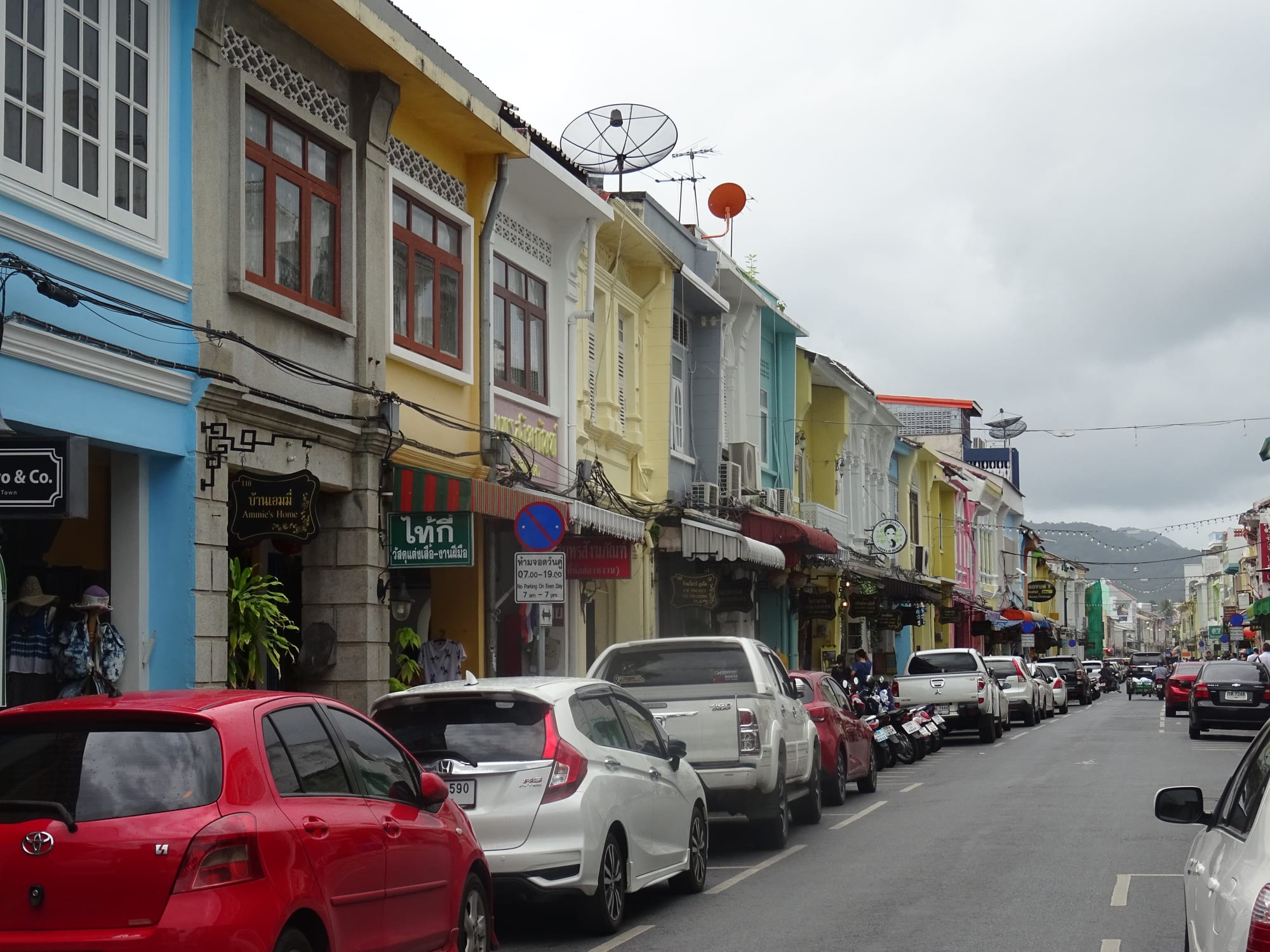
A street of two-storey shophouses painted blue, yellow and pink with shuttered upper windows, cars and motorbikes parked along the kerb

Phuket, Krabi & the Andaman Coast, Thailand

Phuket

Thalang Road, lined with Sino-Portuguese shophouses, in Phuket Old Town. (Christophe95 / Wikimedia Commons · CC BY-SA 4.0)

Thailand's largest island, in the Andaman Sea off the southern west coast and joined to the mainland by a bridge. Tin mining and Chinese merchant families built its old town of Sino-Portuguese shophouses; tourism, arriving from the 1970s, filled the west coast with beaches and resorts from Patong to Kata, and boats now run daily to the limestone islands nearby.

Neighbourhoods

  • Phuket Old Town
    • First-time visitors
    • Historic district
    • Best for food

    The island's administrative and commercial centre on the east side, built by tin-mining families in the 19th century. Thalang, Dibuk and Phang Nga roads keep rows of pastel shophouses, Chinese shrines and mansions, and the cooking here is the island's best value. It is about 45 minutes from the west-coast beaches.

    Open in Maps
  • Patong
    • Nightlife
    • Beaches
    • Close to transport

    The largest and loudest resort, a wide crescent of sand backed by hotels, shopping centres and the bars of Bangla Road. Everything on the island is sold or arranged here, and it is busy at all hours.

    Open in Maps
  • Karon and Kata
    • Beaches
    • Families
    • Surfing in season

    Two long west-facing bays just south of Patong, quieter and more spread out, with a mix of large resorts, guesthouses and beachfront restaurants. Kata gets rideable waves in the monsoon months and both beaches empty out in the evening.

    Open in Maps
  • Rawai and Nai Harn
    • Quiet and residential
    • Seafood
    • Long stays

    The southern tip of the island, where a fishing and long-stay community lives around Rawai's shallow beach and the Chalong bay boat piers. Nai Harn's sheltered bay is the swimming beach, and the seafood grills along Rawai's seafront are a long-standing local habit.

    Open in Maps
  • Kamala and Surin
    • Beaches
    • Quiet and residential

    Mid-coast bays north of Patong, backed by hills and more residential in feel. Kamala keeps a village and a mosque behind its beach, and Surin has a short strip of restaurants and upmarket hotels.

    Open in Maps
  • Bang Tao and Cherng Talay
    • Resorts
    • Families
    • Golf

    A long north-western beach behind which a cluster of large resorts, villas and golf courses grew on reclaimed tin-mine land. The inland village of Cherng Talay has markets and everyday shops.

    Open in Maps
  • Mai Khao and the north
    • Quiet beaches
    • Close to the airport

    The island's longest and emptiest beach, partly within Sirinat National Park and a nesting site for sea turtles, running north from the airport towards the Sarasin bridge.

    Open in Maps

Things to do

Temples and landmarks

  • Wat Chalonglandmark

    The most important of Phuket's Buddhist temples, with a tiered pagoda and shrines to two revered monks, Luang Pho Chaem and Luang Pho Chuang, who led and treated the people of Chalong during the tin miners' unrest of 1876.

    Open in Maps
  • Big Buddhalandmark

    A 45-metre seated Buddha faced in white marble on Nakkerd Hill, visible from much of the south of the island and reached by a winding road with wide views.

    Open in Maps
  • Sarasin Bridgelandmark

    The road crossing that joins Phuket to Phang Nga province on the mainland, with a walkway and views over the channel.

    Open in Maps

Beaches

  • Patong Beachbeach

    A three-kilometre curve of sand at the centre of the island's tourism, lined with hotels, restaurants and watersports.

    Open in Maps
  • Kata Beachbeach

    A west-facing bay about 1.5 kilometres long south of Karon, with a small island offshore, calm in the dry season and open to surf in the monsoon months.

    Open in Maps

Parks and viewpoints

  • Sirinat National Parkpark

    A coastal national park covering the beaches, casuarina groves and mangroves at the north-western corner of the island.

    Open in Maps
  • Karon Beachbeach

    A long, wide beach between Patong and Kata, backed by resorts set back from the sand, with a hill lookout to the south over three bays in a row.

    Open in Maps

Short trips from the island

  • Phi Phi Islandsattraction

    Limestone islands about two hours away by ferry, with Maya Bay, snorkelling reefs and a single inhabited island.

    Open in Maps
  • Ao Phang Nga National Parkpark

    The bay of limestone towers, sea caves and mangrove channels north of Phuket, visited by longtail boat, speedboat or kayak.

    Open in Maps
  • Khao Phing Kanlandmark

    The leaning island in Phang Nga Bay with its detached rock pinnacle, known as James Bond Island after the 1974 film shot there.

    Open in Maps
  • Similan Islandsattraction

    A national park of granite boulders and coral reefs north-west of the island, reached on liveaboard or day dive boats; the park is open from mid-October to mid-May and closed through the rainy season.

    Open in Maps
  • Ko Panyiattraction

    A Muslim fishing village built on stilts against a limestone cliff in Phang Nga Bay, with a mosque and a floating football pitch.

    Open in Maps

Seasonal events

  • Phuket Vegetarian FestivalSeptember or October

    The Nine Emperor Gods festival, nine days of meat-free eating, processions and spirit mediums who pierce their cheeks, centred on the island's Chinese shrines.

  • SongkranApril

    The Thai new year, marked by temple visits, the pouring of water over Buddha images and days of water throwing in the streets.

  • Loi KrathongNovember

    Decorated floats of banana leaf and flowers are set on the water at beaches, ponds and canals on the full moon.

  • Phuket King's Cup RegattaDecember

    An international yacht race week held off the south of the island, run every year since 1987 and usually in the first week of December.

  • Old Phuket FestivalChinese New Year, January or February

    Streets in the old town close for Peranakan food stalls, music and lantern displays around the lunar new year.

Eat and drink

Long-standing places and food districts in Phuket. Hours, ratings and directions come from your maps app, always current.

Phuket classics

  • Mu hong and Hokkien noodles in the old townneighborhood

    Shophouse kitchens around Thalang, Dibuk and Yaowarat roads serve the island's Peranakan dishes — pork belly braised with black pepper and garlic, Hokkien fried noodles and o-tao, an oyster and taro omelette.

    Open in Maps
  • Rawai seafront seafoodneighborhood

    Fish, prawns, crab and shellfish bought from the stalls beside Rawai's pier and grilled at the restaurants behind the seafront.

    Open in Maps

Markets and food districts

  • Phuket Walking Streetmarket

    Thalang Road closes to traffic on Sunday evenings for a street market of local snacks, sweets and southern dishes among the shophouses.

    Open in Maps
  • Chillva and the night marketsmarket

    Evening markets on the edge of Phuket Town sell grilled skewers, noodle bowls, southern curries and fruit shakes to a mostly Thai crowd.

    Open in Maps
  • Bangla Road and the Patong stripneighborhood

    The island's concentrated nightlife, with bars, clubs and late-night food stalls along a short pedestrian street behind Patong beach.

    Open in Maps

Experience Phuket

History

Phuket appears in early charts as Junkceylon, a landfall on the sea route between India and the Malay ports, and its tin was traded long before it was settled in any permanent way. Chao le sea peoples fished among the islands, and Tamil, Malay, Chinese, Portuguese, Dutch, French and English traders all called at the coast. The island lay under the Siamese province of Thalang, whose town stood inland in the north, not on the site of the present city.

In 1785 a Burmese force landed and besieged Thalang. Two sisters, the widow of the governor and her sister, are credited with organising the defence until the siege was lifted, and were honoured with the titles Thao Thep Kasattri and Thao Si Sunthon; their statue stands at the island's main crossroads. A second Burmese invasion in 1809–1810 left Thalang in ruins, and the centre of the island's life shifted south.

Tin made modern Phuket. From the mid-19th century Chinese labourers, mostly Hokkien from Penang and Fujian, came in large numbers to work the mines, and the merchant families who prospered built the shophouses, mansions and shrines of what is now the old town, in the Sino-Portuguese style shared with Penang and Malacca. Rubber followed. When tin prices fell in the 20th century, tourism replaced it: the west-coast beaches were developed from the 1970s, the Sarasin bridge and later the airport brought mass arrivals, and by the 1990s Phuket was Thailand's best-known resort. The 2004 Indian Ocean tsunami struck the west coast on 26 December, part of a disaster that killed about 5,300 people in Thailand, and rebuilding was rapid.

Culture & Customs

The island's distinctive culture is Peranakan, or Baba, the mix of Hokkien Chinese and local Thai and Malay life that grew out of the tin era. It shows in the shophouse architecture of the old town, in wedding costume and in the food, and it is maintained by clan associations and Chinese shrines that keep their own calendars of festivals. The largest is the Vegetarian Festival in the ninth lunar month, when devotees eat no meat, dress in white and carry the Nine Emperor Gods through the streets, and entranced mediums pierce their cheeks with skewers amid strings of firecrackers.

Buddhism shapes the wider rhythm of the year, with Wat Chalong at its centre, while Muslim communities are long established in villages such as Kamala, Rawai and much of the north, and mosques stand close to temples and shrines. The Urak Lawoi and Moken, the sea peoples, live at Rawai and on nearby islands and hold boat-floating ceremonies twice a year, though their claims to the land they occupy have often been contested.

The southern Thai dialect is quick and clipped, and Hokkien words survive in local speech and in dish names. Phuket was named a UNESCO Creative City of Gastronomy in 2015, a title the island takes seriously. Sport is dominated by sailing and by muay thai, with training camps that draw foreign fighters, and the international community — European, Russian, Chinese, Australian — is large enough that some neighbourhoods carry signs in several languages.

Daily Life

Fewer than 400,000 people are registered as living in Phuket province, and the real population is put at around 600,000: migrant workers from Myanmar staff building sites, boats and kitchens, and tens of thousands of foreign residents hold long-stay visas. Phuket City, on the east coast, is where the government offices, schools, hospitals and markets are, and where most islanders live; the west coast is the visitor side, and commuting across the hills between them fills the roads twice a day.

Tourism pays for almost everything. Hotels, restaurants, boats, diving, construction and property dominate employment, with rubber smallholdings, fishing and a little remaining agriculture inland. The pandemic years showed how narrow that base is, when the island emptied and many workers returned to their home provinces; arrivals have since recovered strongly. Rising land prices, villa building on the hillsides, water shortages in the dry season and heavy traffic on the few main roads are the issues that dominate local debate, along with the condition of the reefs.

The day starts early — markets before dawn, school runs and the first boats out of Chalong — and slows in the heat of the afternoon. Evenings belong to the night markets and to the beach for sunset, an occasion Phuket takes at its own unhurried pace.

Food

Phuket cooks differently from the rest of Thailand. Mu hong, pork belly slowly braised with black pepper, garlic and palm sugar, is the island's emblem, and o-tao, a fried batter of taro and small oysters topped with egg and eaten with chilli sauce, is its best-known street dish. Hokkien fried noodles, thick and yellow, come with pork, prawns and squid; loba, offal and pork simmered in five-spice and served with a sharp dipping sauce, is a market staple. Breakfast is often khanom jeen, fermented rice noodles under a curry sauce with a tray of raw vegetables and pickles, or dim sum in the Chinese coffee shops of the old town.

Southern curries are hot, yellow with fresh turmeric and generous with shrimp paste. Kaeng som, a sour orange fish curry, kua kling, a dry-fried minced-meat curry, and kaeng tai pla, made with fermented fish innards, are all eaten here, usually with plain rice and a plate of raw vegetables to cool them. Muslim kitchens add roti, khao mok gai — spiced chicken rice — and massaman-style curries.

Seafood is the other constant: rock lobster, blue crab, squid and whole fish grilled over charcoal, bought by weight at Rawai and along the piers. Sweets show the Peranakan influence, among them o-aew, a jelly of banana and shaved ice served with syrup and red beans, and kanom lod chong, pandan noodles in coconut milk. Local coffee, thick and sweetened with condensed milk, is drunk in old-town kopi shops that open before sunrise.

Planning tools

Budget

Phuket is among the most expensive places in Thailand, and prices vary more by location than by season: a beachfront resort in Patong or Bang Tao can cost many times a guesthouse in Phuket Town, and restaurants on the sand charge several times the price of a shophouse kitchen inland. Boat trips, dive days, national park fees and airport transfers are the other main costs.

Daily Budget Midrange
USD 90–210 (beach resort, seafood dinners, island-hopping tours, a dive day)
Daily Budget Shoestring
USD 30–55 (guesthouse or hostel in Phuket Town, market and shophouse meals, songthaews and a rented scooter)

Staying in Phuket Town or a little back from the beach cuts costs sharply, and rooms across the island are cheapest from May to October.

Best Time to Visit

November to April is the dry season, with calm, clear water and reliable boat services; December to February is busiest and dearest. May to October brings heavy squalls, surf on the west coast and closures of some island trips, but also low prices and green hills. The Vegetarian Festival falls in September or October.

Suggested Number of Days

Three or four days covers a beach base, the old town and one boat trip. Six to eight allows Phang Nga Bay, Phi Phi or a diving course as well. Traffic and the distance between the east and west coasts add time to everything, so fewer moves usually means a better visit.

First Visit
3–4 days
With Surroundings
6–8 days

Transportation

The island is about fifty kilometres long and there is no rail or metro. Songthaews, converted pickup trucks, run between Phuket Town and the beaches during the day but rarely between one beach and the next; smart buses serve the airport road. Most visitors use ride-hailing apps, metered taxis, hotel cars or a rented scooter. Longtail boats and speedboats leave from Rassada and Chalong piers for the islands.

Scooter crashes are the commonest serious accident here; a helmet, an international licence and insurance that covers motorbikes all matter, and the hill roads between bays are steep.

Airport & Station Connections

Phuket International Airport sits at the northern end of the island, about 30 kilometres from Phuket Town and 40 from Patong — roughly an hour by road — and handles domestic flights from Bangkok as well as regional and long-haul services. Buses run from Bangkok in around twelve hours across the Sarasin bridge, and ferries connect Rassada pier with Phi Phi, Krabi and Koh Lanta in season.

Walkability

Individual districts are walkable and little else is. The old town's grid of shophouse streets is the most pleasant walking in the province, and each beach strip can be covered on foot, but the bays are separated by steep headlands and fast roads with narrow or missing pavements. Moving between Phuket Town and the west coast means a vehicle.

Safety

Phuket is safe for most visitors, and serious crime against tourists is uncommon. The real risks are traffic, above all motorbikes on the hills between bays, and the sea: rip currents on the west-facing beaches during the monsoon drown swimmers every year, and red flags mark the days when the water is dangerous. Patong's nightlife brings drink spiking, theft and scams. Tsunami warning towers and evacuation route signs line the coast.

Obey red flags and never swim in monsoon surf, wear a helmet and check any rented vehicle for existing damage before signing, keep an eye on drinks in Patong, and learn the local tsunami evacuation route. Check current official travel advice before travelling.

Climate

A tropical monsoon climate, hot and humid all year, with a dry season from about November to April and a long wet season from May to October driven by the southwest monsoon. Rain usually falls in heavy bursts rather than all day.

Summer
hot and humid, generally 28–34°C; May to October brings frequent heavy squalls and rough seas on the west coast
Winter
the dry season, November to April, is sunny with calm seas and about 24–33°C

Local Customs

Thai temple etiquette applies: shoulders and knees covered, shoes off inside shrines and temple buildings, and no climbing on Buddha images, which are sacred objects rather than ornaments. Beachwear belongs on the beach and not in shops, temples or the old town. A wai, the palms-together greeting, is returned rather than initiated by visitors. The island has a large Muslim population, particularly in the villages, so modest dress matters near mosques. Tipping is not expected, though small change is often left.

Insulting the monarchy is a criminal offence in Thailand. Nudity and topless sunbathing are illegal on public beaches, smoking is banned on most of them, and cannabis rules have tightened in recent years — buy nothing from street sellers and never attempt to carry it out of the country.

Common Payment Methods

The currency is the Thai baht. Cards are accepted in hotels, resorts, malls and larger restaurants, and Thai QR payment is everywhere, but markets, songthaews, longtail boats and small kitchens want cash. ATMs are plentiful and charge a fixed fee per foreign withdrawal, so fewer, larger withdrawals cost less; always choose to be charged in baht.