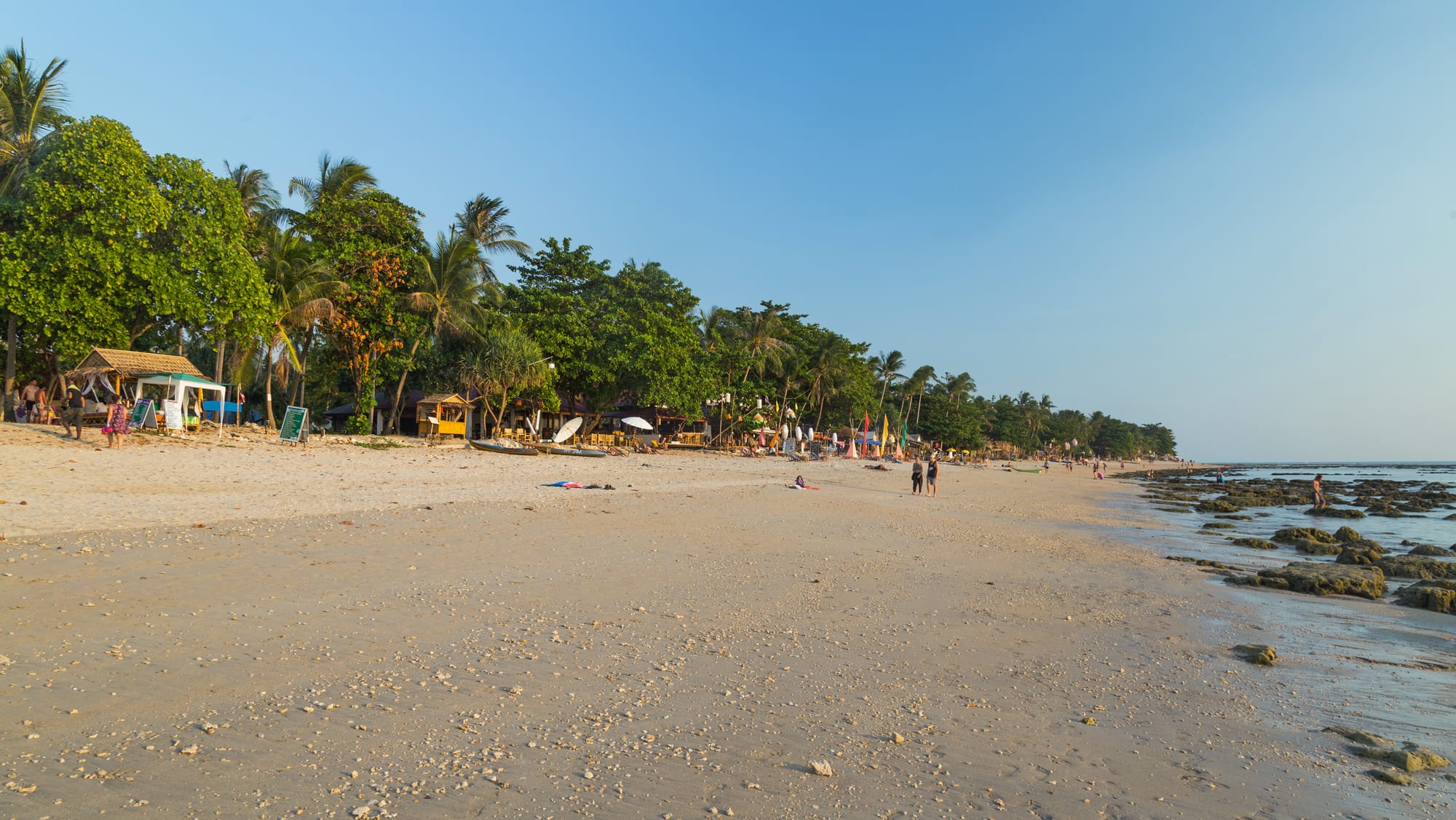
A wide sandy beach in late afternoon light, with palms and low beachfront bars along the treeline and exposed rock at the water's edge

Phuket, Krabi & the Andaman Coast, Thailand

Ko Lanta

Klong Khong beach on the west coast of Ko Lanta Yai, Krabi province. (Marcin Konsek / Wikimedia Commons · CC BY-SA 4.0)

A long island off the coast of Krabi province in the Andaman Sea, joined to its smaller neighbour Ko Lanta Noi by a bridge, with a short car ferry on from there to the mainland. Sea people, Muslim fishing families and Chinese traders settled it long before tourism; the west coast now holds a chain of beaches and low-key resorts, while the east keeps an old town of stilted shophouses and a national park covers the southern tip.

Neighbourhoods

  • Saladan
    • First-time visitors
    • Close to the boats
    • Dive shops

    The village at the northern tip where the ferries and dive boats leave and the bridge from Ko Lanta Noi arrives. Two streets of shops, banks, restaurants over the water, tour desks and a market supply the whole island.

    Open in Maps
  • Khlong Dao and Phra Ae
    • Beaches
    • Families
    • Restaurants

    The two northern beaches, the widest and most developed on the island, with shallow water at Khlong Dao and a long strip of bars, restaurants and mid-range resorts behind Phra Ae, known to visitors as Long Beach.

    Open in Maps
  • Khlong Khong and Khlong Nin
    • Quiet beaches
    • Sunsets
    • Long stays

    The middle of the west coast, where the resorts thin out and rock gives way to sand. Beach bars with cushions and fire shows sit between stretches of empty shore, and the villages behind the road are ordinary Thai ones.

    Open in Maps
  • Kantiang Bay and the south
    • Quiet and residential
    • Snorkelling
    • Viewpoints

    A deep bay backed by hills near the southern end of the island, with a small village, a handful of resorts and a road that climbs over headlands towards the national park at the tip.

    Open in Maps
  • Lanta Old Town
    • Historic district
    • Local life
    • Seafood

    The island's original port on the east coast, a single street of wooden shophouses on stilts over the water, with piers, seafood restaurants, a Chinese shrine and the quiet of a place that trade left behind.

    Open in Maps

Things to do

Parks and the coast

  • Mu Ko Lanta National Parkpark

    The marine national park at the southern cape of the island and over some fifty islands around it, established in 1990, with forest trails and rocky coves.

    Open in Maps

Diving and island trips

  • Ko Kradanattraction

    A Trang island of white sand and shallow reef south of Lanta, reached on the dry-season boat route down the coast.

    Open in Maps
  • Phi Phi Islandsattraction

    The cliff-walled islands to the north-west, reached by ferry or speedboat in the dry season for Maya Bay and the snorkelling reefs.

    Open in Maps
  • Ko Ngaiattraction

    A small island of white sand and reef south of Lanta, in Krabi province but usually reached from Trang on the dry-season boat route down the coast.

    Open in Maps
  • Ko Jumattraction

    A low-key island between Lanta and Krabi with fishing villages, long quiet beaches and few facilities, served by boats in season.

    Open in Maps

Seasonal events

  • SongkranApril

    The Thai new year, marked with temple visits, water poured over Buddha images and water throwing along the island road.

  • Loi KrathongNovember

    Decorated floats of banana leaf, flowers and candles are set on the sea from the beaches and the piers of the old town at the full moon.

  • Ramadan and Eidvaries with the lunar calendar

    Most of the island's permanent residents are Muslim, and the fasting month and the feast that ends it shape village life and when local kitchens open.

  • The sea people's boat ceremonytwice a year

    The Urak Lawoi communities of Ko Lanta set a small wooden boat adrift carrying ancestral spirits, with rong ngeng music and dancing through the night.

Eat and drink

Long-standing places and food districts in Ko Lanta. Hours, ratings and directions come from your maps app, always current.

Island classics

  • Lanta Old Town seafoodneighborhood

    Restaurants on stilts along the old town's single street serve fish, squid, prawns and crab from the boats below, grilled or steamed with lime and garlic.

    Open in Maps
  • Saladan waterfront restaurantsneighborhood

    The village's wooden restaurants are built over the channel by the pier, with the day's catch on ice at the door and the ferries passing in front.

    Open in Maps

Markets and food districts

  • Muslim kitchens and roti stallsneighborhood

    Village kitchens along the main road serve khao mok gai, spiced chicken rice, southern curries and roti folded around banana and condensed milk.

    Open in Maps
  • Saladan morning marketmarket

    The island's fresh market trades early, with fish, vegetables, curry pastes, sweets and bags of ready-made curry sold to residents and cooks.

    Open in Maps
  • Beach bars on the west coastneighborhood

    Simple bars of driftwood and cushions face the sunset between Khlong Khong and Khlong Nin, serving drinks, grills and music after dark.

    Open in Maps

Experience Ko Lanta

History

Ko Lanta's first inhabitants were the Urak Lawoi, one of the sea peoples of the Andaman coast, who moved seasonally among the islands and eventually settled on Ko Lanta Yai, around the old town and at the southern end of the island, where their villages and burial grounds remain. Malay-speaking Muslim families from the coast and further south followed, farming and fishing, and by the 19th century the island's sheltered east coast had become a stopping point on the sailing route between Phuket, Penang and the Malay ports.

That trade built Lanta Old Town. Chinese merchants settled beside the Muslim and Urak Lawoi communities, putting up wooden shophouses on stilts over the water with piers for loading rubber, charcoal and dried fish, and a shrine among them. The town served as the island's administrative centre for generations, and its buildings survive largely because the island's economy moved elsewhere rather than because anyone preserved them.

Roads, electricity and the first bungalows arrived late — mains power reached much of the island only in the 1990s — and development went to the west coast, where the beaches face the sunset. Backpackers came first, then families and long-stayers, and the island settled into a reputation for being quieter than Phi Phi and less built up than Phuket. The 2004 tsunami damaged the west coast and the boats, though far fewer people were hurt or killed here than on the Phi Phi islands. The Siri Lanta bridge to Ko Lanta Noi, opened in 2016, replaced the longer of the two car-ferry crossings and shortened the journey from the mainland.

Culture & Customs

The island is predominantly Muslim, and that shapes ordinary life: mosques in every village, a quieter Friday midday, modest dress away from the beach, and kitchens that serve no alcohol. Ramadan is observed seriously, and the island's rhythm changes during the fasting month. Buddhist and Chinese-Thai families, concentrated in the old town and Saladan, keep temple festivals and shrine ceremonies alongside.

The Urak Lawoi give Lanta a third strand. Their communities at the southern end of the island speak a language related to Malay, maintain distinct burial customs and set a small wooden boat adrift in a ceremony that carries ancestral spirits away, accompanied by rong ngeng music and dancing through the night. Land rights, fishing access and the pressure of resort development on their villages are long-running and unresolved issues.

Among visitors the island has a settled, unhurried culture of its own: many return each dry season, some stay for months, and yoga, diving and beach bars made of driftwood define the west coast rather than nightclubs. The southern Thai dialect is spoken everywhere, mixed with Malay words in the villages, and English is the working language of the beach road.

Daily Life

Ko Lanta district, which covers the two main islands and the smaller ones around them, has a population in the tens of thousands, and the numbers on Ko Lanta Yai swell in the dry season with Thai and Burmese seasonal workers and with long-staying visitors. Saladan is the practical centre — banks, the fresh market, the clinic, the piers — while Lanta Old Town holds the district offices and school, and most residents live in villages along the inland road rather than on the beaches.

Tourism, fishing and rubber support the island in roughly that order. Boats work the reefs and the channels, rubber is tapped before dawn on the inland slopes, and hotels, restaurants and dive shops employ most people from November to April. The wet season brings a real pause: resorts close, families return to farming and fishing, and the beaches empty.

Water supply in the dry months, waste and the price of coastal land are the issues residents raise most often, along with the effect of the bridge, which brought day visitors and construction as well as convenience. Days start early with the market and the boats, slow in the afternoon heat, and end with the sunset, which on this coast falls straight into the sea and is watched from the beach bars as a matter of routine.

Food

Southern Thai cooking with a strong Muslim element is the island's everyday food. Khao mok gai, chicken cooked with turmeric and spices over rice in the biryani manner, is a village staple, and roti — griddled flatbread eaten with curry or folded around banana and condensed milk — is sold from carts morning and evening. Massaman, the mild, aromatic curry of Muslim origin, belongs to the same tradition.

The hotter southern dishes are here too: kaeng som, a sour fish curry sharp with tamarind and yellow with fresh turmeric; kua kling, minced meat dry-fried with a fierce chilli and pepper paste; and kaeng tai pla, made with fermented fish innards, which marks a kitchen cooking for residents. Rice and a plate of raw vegetables and herbs arrive alongside to cool the heat.

Seafood is the reason most visitors eat out: squid, prawns, blue crab and whole fish landed at Saladan and the old town, sold by weight and grilled over charcoal. Lanta's own speciality is the simplicity of it — fish steamed with lime and garlic, or with a chilli and herb sauce. Breakfast for residents is often khanom jeen, fermented rice noodles under curry, or rice soup; coffee is served thick and sweet with condensed milk, and stalls sell mangosteen, rambutan, durian and pineapple in season.

Planning tools

Budget

Lanta is cheaper than Phuket and Phi Phi, with a wide spread between simple bungalows on the middle beaches and the resorts at the northern and southern ends. Food costs little in village kitchens and more on the sand. Ferries, dive days and national park fees are the main extras, and prices fall by half or more outside the dry season.

Daily Budget Midrange
USD 90–210 (beach resort, seafood dinners, island-hopping tours, a dive day)
Daily Budget Shoestring
USD 25–50 (bungalow or hostel, village kitchens and market food, a rented scooter)

The island is long, so the cost of getting about adds up: a rented scooter is usually cheaper than repeated taxi trips between beaches.

Best Time to Visit

November to April, when the sea is calm, the ferries run and most businesses are open; December to February is busiest. From May to October the monsoon brings surf and rain, many resorts and restaurants close, boat services thin out and the island is quiet and inexpensive.

Suggested Number of Days

Three or four days suits a beach stay with a boat trip or two. Five to seven give time for the old town, the national park and diving, and Lanta is a place many people stay longer once they arrive. Ferry schedules shape arrival and departure days.

First Visit
3–4 days
With Surroundings
5–7 days

Transportation

One main road runs down the west coast of Ko Lanta Yai, with a second crossing to the old town; a bridge links the island to Ko Lanta Noi and a short car ferry runs on from there to the mainland. Rented scooters are the usual way to get about; songthaews, minivans and taxis wait at Saladan and the piers, and hotels arrange transfers. Longtail boats and dive boats leave from Saladan and the southern bays.

The road over the southern headlands is steep with tight bends, and a helmet, an international licence and insurance that covers motorbikes all matter; distances between beaches are longer than they look.

Airport & Station Connections

Most visitors come by road from Krabi International Airport, about two hours away by minivan including the ferry and bridge crossings, or from Phuket in around four. In the dry season ferries and speedboats connect Saladan with Phi Phi, Krabi and Phuket, and boats run south to the Trang islands. There is no airport on the island and no railway on this coast.

Walkability

Each beach and village is walkable, and the sand runs for long stretches at low tide, but the island is about twenty-five kilometres from end to end and the beaches are strung along a road with few pavements and little lighting. Saladan and Lanta Old Town are compact and pleasant on foot; everything between them needs a vehicle.

Safety

Ko Lanta is safe for most visitors and crime is uncommon. The practical risks are the road — scooter crashes on the hilly southern stretch are the commonest serious accident — and the sea, where rip currents run on the west-facing beaches in the monsoon and there are few lifeguards. Medical facilities on the island are limited, and serious cases go to Krabi. Tsunami warning towers and evacuation route signs line the coast.

Obey red flags and stay out of monsoon surf, wear a helmet and take the southern hills slowly, choose boat operators with life jackets, and learn the local tsunami evacuation route. Check current official travel advice before travelling.

Climate

Tropical and humid all year, with a dry season from about November to April and a wet southwest monsoon from May to October. Rain usually falls in heavy bursts, and the west coast takes the weather first.

Summer
hot and humid, generally 27–34°C; May to October brings frequent heavy rain and rough seas
Winter
the dry season, November to April, is sunny with calm water and about 24–33°C

Local Customs

Most islanders are Muslim, and village life away from the beaches is conservative: swimwear belongs on the sand, and shoulders and knees are covered in the villages, at shops and near mosques. Shoes come off indoors. A wai, the palms-together greeting, is returned rather than offered first by visitors. Tipping is not expected. The Urak Lawoi communities in the south have their own customs and burial grounds, which are not places for casual visits.

Insulting the monarchy is a criminal offence in Thailand. Swimwear belongs on the beach, alcohol is not served in many local kitchens, and cannabis, decriminalised in 2022, was restricted again in 2025 to medical use — never attempt to carry it out of the country.

Common Payment Methods

The currency is the Thai baht. Resorts, dive shops and larger restaurants take cards, and Thai QR payment is common, but village kitchens, markets, songthaews and longtail boats want cash. ATMs are concentrated in Saladan and charge a fixed fee per foreign withdrawal, so fewer, larger withdrawals cost less; always choose to be charged in baht.