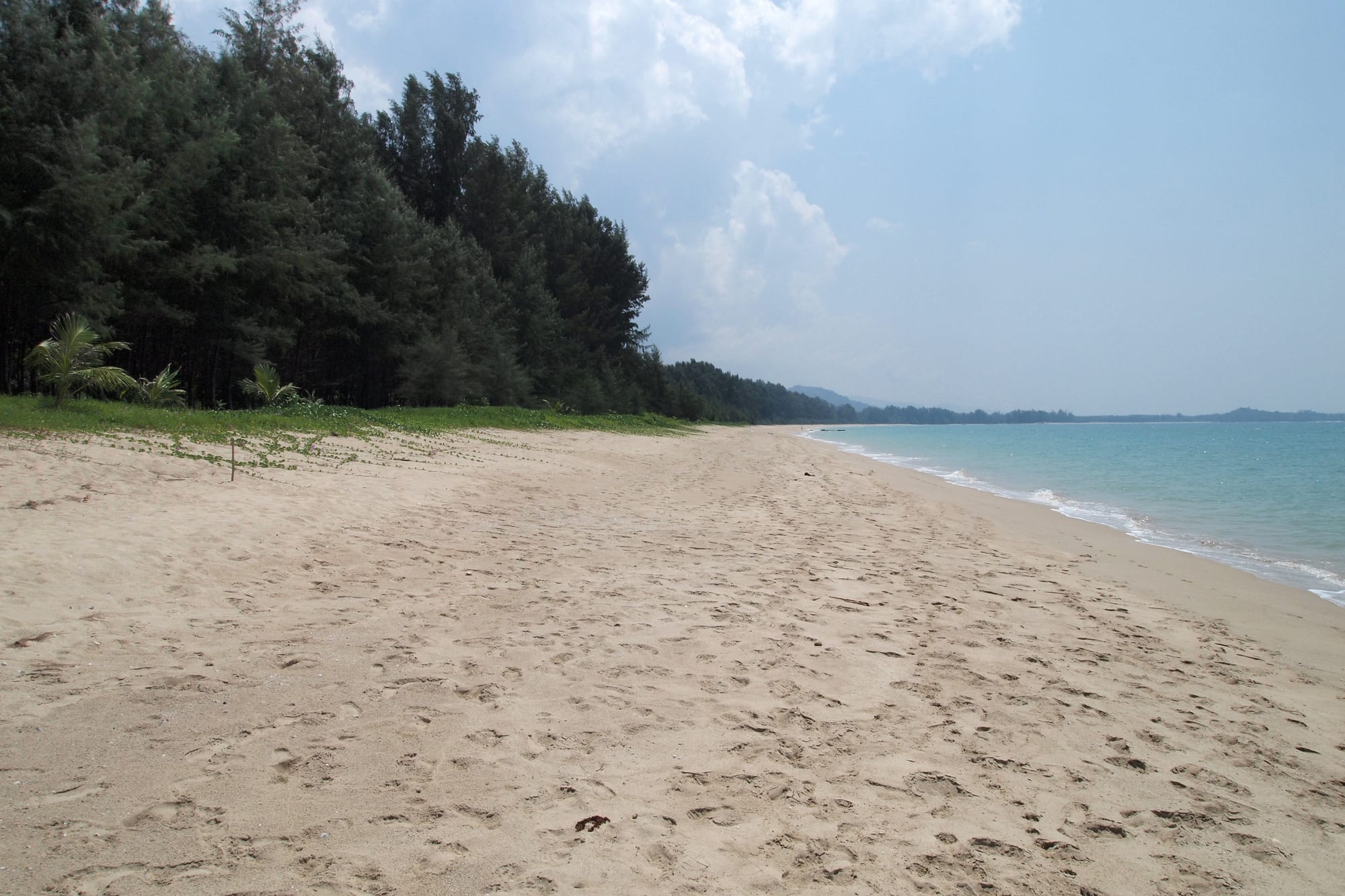
A wide empty beach of pale sand curving into the distance, backed by dark casuarina trees with calm turquoise sea to the right

Phuket, Krabi & the Andaman Coast, Thailand

Khao Lak

An empty beach backed by casuarina trees in Khao Lak–Lam Ru National Park, Phang Nga province. (Vyacheslav Argenberg / Wikimedia Commons · CC BY 4.0)

A string of beaches and low-rise resorts along about twenty-five kilometres of the Phang Nga coast north of Phuket, named after the hills behind them. Rubber, tin and fishing supported the area before hotels arrived in the 1990s; the 2004 tsunami struck here hardest of anywhere in Thailand, and the rebuilt strip is now the main base for diving the Similan Islands.

Neighbourhoods

  • Nang Thong
    • First-time visitors
    • Restaurants
    • Close to shops

    The busiest part of the strip, with the greatest concentration of restaurants, dive shops, minimarkets and small hotels along the main road and the lanes running down to the sand. It is the easiest base for anyone without transport.

    Open in Maps
  • Bang Niang
    • Markets
    • Families
    • Beaches

    Just north of Nang Thong, built around a wide beach and a market that trades several days a week. A police patrol boat carried inland by the 2004 tsunami stands here as a memorial, and the area has a mix of guesthouses and larger resorts.

    Open in Maps
  • Khuk Khak and Bang Sak
    • Quiet beaches
    • Resorts
    • Long stays

    Longer, emptier beaches further north, backed by casuarina groves and spread-out resorts with little in walking distance. This is the quietest stretch of coast, and good for walking at low tide.

    Open in Maps
  • The southern beaches and Lam Ru
    • Nature
    • Viewpoints
    • Quiet and residential

    South towards the national park headquarters the hills come down to the sea, with small coves, forest, a clifftop viewpoint over the coast and a handful of resorts, well away from the main strip.

    Open in Maps

Things to do

Diving and island trips

  • Similan Islandsattraction

    A national park of granite boulders, white sand and coral reefs about 70 kilometres offshore, among Thailand's leading dive and snorkel destinations, with boats running from about mid-October to mid-May.

    Open in Maps
  • Surin Islandsattraction

    A remote island group near the Myanmar maritime border with shallow reefs and a Moken sea-people community, visited on day trips and liveaboards from this coast.

    Open in Maps
  • Richelieu Rockattraction

    A limestone pinnacle that breaks the surface at low tide about 18 kilometres east of the Surin Islands, one of Thailand's best-known dive sites and a place whale sharks are sometimes seen.

    Open in Maps

Parks and the coast

  • Khao Lak–Lam Ru National Parkpark

    The national park that gives the area its name, covering forested hills, streams and cliffs where the ridge meets the sea south of the resorts.

    Open in Maps
  • Si Phang Nga National Parkpark

    Rainforest, waterfalls and pools in the hills north-east of Khao Lak, quiet enough that visitors often have the trails to themselves.

    Open in Maps
  • Ko Phra Thongattraction

    A large island north along the coast with kilometres of empty beach, mangroves and a few hundred residents in small Moken and Thai villages.

    Open in Maps

Towns and short trips

  • Takua Paneighborhood

    The district town inland to the north, whose old quarter of shophouses recalls the years when this was an important tin-dredging area.

    Open in Maps
  • Ao Phang Nga National Parkpark

    The bay of limestone towers, sea caves and mangroves south-east of Khao Lak, usually visited on a day trip by road and boat.

    Open in Maps

Seasonal events

  • SongkranApril

    The Thai new year, marked with temple visits, water poured over Buddha images and water throwing along the main road.

  • Loi KrathongNovember

    Decorated floats of banana leaf, flowers and candles are set on the sea and on the canals at the full moon.

  • Tsunami remembrance26 December

    Ceremonies at the memorials and beaches of Phang Nga mark the anniversary of the 2004 disaster, which killed thousands along this stretch of coast.

  • Vegetarian FestivalSeptember or October

    Chinese-Thai communities in Takua Pa and along the coast keep the meat-free ninth lunar month with shrine processions and street food stalls.

Eat and drink

Long-standing places and food districts in Khao Lak. Hours, ratings and directions come from your maps app, always current.

Khao Lak classics

  • Seafood restaurants along the stripneighborhood

    Fish, prawns, squid and crab grilled over charcoal or steamed with lime and garlic, served at open-sided restaurants on the main road and at the beach ends of the lanes.

    Open in Maps
  • Southern Thai kitchensneighborhood

    Family-run kitchens set back from the beach cook kaeng som, the sour turmeric fish curry, kua kling and stir-fries at a fraction of resort prices.

    Open in Maps

Markets and food districts

  • Bang Niang marketmarket

    The area's main market, trading on set days each week, with grilled skewers, curries by the bag, fruit, sweets and cheap clothing under awnings.

    Open in Maps
  • Takua Pa old townneighborhood

    The shophouse quarter inland keeps Hokkien-influenced dishes, coffee shops and a street market largely aimed at Thai visitors.

    Open in Maps

Experience Khao Lak

History

The coast of Phang Nga north of Phuket lived for centuries on tin, rubber, coconuts and fishing. Takua Pa, a little inland to the north, was the important place: an old trading settlement on a river route across the peninsula, later a tin-mining town whose Chinese merchant families built the shophouses that still line its old street. The beaches themselves held scattered fishing hamlets and plantations, with the forested ridge of Khao Lak behind them, and no road worth the name until the 20th century.

Tourism came late and grew quickly. German and Scandinavian travellers began arriving in the 1980s and 1990s, drawn by empty sand and by diving on the Similan Islands, which had been declared a national park in 1982. Low-rise resorts spread along the beaches through the 1990s, and by 2004 Khao Lak was a substantial destination, busy with European visitors over Christmas.

On the morning of 26 December 2004 the Indian Ocean tsunami came ashore here with greater force than anywhere else in Thailand. The flat, open coast gave no protection; resorts, villages and the fishing fleet were destroyed, and the final death toll along this coast was put at more than 4,000, among them large numbers of foreign visitors. Patrol Boat 813, carried almost 1.25 kilometres inland from Bang Niang beach, was left where it stopped and is preserved as a museum ship, and memorials along the coast mark the events. Rebuilding took years and was accompanied by warning towers, sirens and marked evacuation routes; the resorts returned, and the area's reputation for quiet beaches and serious diving with it.

Culture & Customs

Khao Lak is a working coast that acquired a resort strip, and the two sit side by side. Behind the hotels are villages of rubber tappers, palm growers and fishing families, Buddhist and Muslim in roughly equal measure in parts of Phang Nga, with mosques and temples within a few kilometres of each other. The southern Thai dialect is spoken, quick and clipped, and Hokkien-descended families in Takua Pa keep Chinese shrine festivals, including the meat-free ninth lunar month.

The diving community gives the strip its other character. Instructors and crew from Thailand and abroad live here through the dry season, liveaboards fill and empty at Thap Lamu pier, and conversation on the main road turns on visibility, whale sharks and park closures. Because the Similan and Surin parks shut for the monsoon, the whole area empties in a way that few Thai resorts do, and the seasonal rhythm is more pronounced than in Phuket.

The tsunami remains the defining shared experience. It is commemorated each December, and the memorials — the police boat above all — are visited by Thai and foreign families alike. Residents generally speak of it plainly when asked, but it is a subject approached with care rather than curiosity, and photography at the memorials is best kept discreet.

Daily Life

Khao Lak is not a single town but a line of villages — Khuk Khak, Bang Niang, Nang Thong, Bang Sak and others — mostly in Takua Pa district, with the original Khao Lak village further south in Thai Mueang, together home to only a few thousand permanent residents, plus a seasonal workforce drawn from the Isan provinces and from Myanmar. Takua Pa town, about twenty-five kilometres north, provides the hospital, schools, banks and government offices.

The economy runs on tourism from November to April and on rubber, oil palm, fishing and small-scale farming for the rest of the year. Many families do both: tapping rubber before dawn in the wet months, working in hotels and dive shops when the season turns. Land along the coast has been bought and built on steadily since the rebuilding, and the price of it, water supply in the dry months and the condition of the reefs are the recurring local concerns.

The daily rhythm follows the road and the sea. Dive boats leave Thap Lamu before dawn, markets trade early, the middle of the day is hot and quiet, and the beaches fill again in the late afternoon for the sunset over the Andaman Sea. In the monsoon the strip shrinks to a handful of open restaurants, the surf is loud, and the coast belongs to residents again.

Food

The cooking here is southern Thai, hotter and more turmeric-heavy than in Bangkok. Kaeng som, a sour fish curry coloured orange with turmeric and sharpened with tamarind, is the everyday standard; kua kling is minced meat dry-fried with a fierce paste of chilli, turmeric and pepper; and kaeng tai pla, built on fermented fish innards, marks a kitchen cooking for locals rather than visitors. Rice and a plate of raw vegetables come alongside to temper them.

Seafood is the obvious strength: prawns, squid, crab and whole fish landed at Thap Lamu and the smaller piers, sold by weight and grilled over charcoal. Muslim kitchens in the villages add khao mok gai, spiced chicken with yellow rice, roti folded around banana and condensed milk or eaten with curry, and massaman, the mild, aromatic curry with Muslim roots. Breakfast for residents is often khanom jeen, fermented rice noodles under a curry sauce, or rice soup with pork.

Takua Pa, with its Hokkien Chinese past, brings dishes closer to those of Phuket — braised pork with black pepper and garlic, five-spice stews and noodle soups — and coffee shops that open before dawn and serve coffee thick with condensed milk. Along the resort strip itself the menus are broad, with German and Scandinavian dishes reflecting the visitors who have come here for thirty years, and fruit stalls selling mangosteen, rambutan and durian in season.

Planning tools

Budget

Khao Lak is a resort coast, and accommodation spans simple guesthouses on the main road to large beachfront hotels. Eating and drinking are cheaper than in Phuket if kept away from the hotel restaurants. The largest extras are diving — a liveaboard to the Similans costs many times a day of anything else — and transport, since little is within walking distance of anything else.

Daily Budget Midrange
USD 90–210 (beach resort, seafood dinners, island-hopping tours, a dive day)
Daily Budget Shoestring
USD 25–50 (guesthouse, local kitchens and market food, a rented scooter or songthaews)

Liveaboards and Similan day trips sell out in high season and stop altogether when the park closes, so plan diving around the season rather than the other way round.

Best Time to Visit

Mid-November to April. The Similan and Surin parks take visitors only from about mid-October to mid-May, and the sea is calm and clear in the months either side of the new year; December to February is busiest. From May to October the monsoon brings heavy surf, closed parks and low prices, and many businesses on the strip shut for the season.

Suggested Number of Days

Three or four days suits a beach stay with one boat trip. Five to seven make sense for divers, or for anyone adding the national parks inland and the coast to the north. Liveaboards take several days on their own.

First Visit
3–4 days
With Surroundings
5–7 days

Transportation

Everything strings along Highway 4, the main road, and the resorts sit between it and the sea. Songthaews and minibuses run along the highway, taxis and hotel cars handle transfers, and many visitors rent a scooter or a car to reach the quieter beaches and the parks. Dive boats leave from Thap Lamu pier south of the strip.

The highway carries fast traffic, including lorries, and crossing it on foot after dark takes care; scooter riders need a helmet and insurance that covers motorbikes.

Airport & Station Connections

Phuket International Airport is about 70 kilometres south, roughly an hour and a quarter by road, and most visitors arrive by shared minibus or private transfer. Buses along Highway 4 link Phuket, Takua Pa, Ranong and Surat Thani, and a few services run through from Bangkok. There is no railway on this coast and no passenger ferry to the strip.

Walkability

Each beach village can be walked in twenty minutes or so, and the sand itself runs for kilometres, but the settlements are strung out along the highway with long, hot gaps between them and pavements that come and go. Most people walk within their own stretch and use a vehicle for everything else.

Safety

Khao Lak is safe for most visitors and crime is uncommon. The two real risks are traffic on the highway and the sea: strong rip currents run along these open, west-facing beaches, particularly in the monsoon months, and there are few lifeguards. Diving accidents and boat breakdowns on long offshore trips are the other concern. Tsunami warning towers and evacuation route signs line the coast, a legacy of 2004.

Obey red flags and stay out of monsoon surf, choose dive and boat operators with proper safety equipment, take care crossing the highway, and learn the local tsunami evacuation route inland. Check current official travel advice before travelling.

Climate

Tropical and humid all year, with a dry season from about November to April and a long, wet southwest monsoon from May to October. This stretch of coast is among the wetter parts of Thailand, and rain comes in heavy bursts rather than steady drizzle.

Summer
hot and humid, generally 27–34°C; May to October brings frequent heavy rain and large waves
Winter
the dry season, November to April, is sunny with calm seas and about 24–33°C

Local Customs

Phang Nga has both Buddhist and Muslim communities, and the villages behind the resorts are conservative: swimwear stays on the beach, and shoulders and knees are covered at temples and near mosques. Shoes come off indoors. A wai, the palms-together greeting, is returned rather than offered first by visitors. Tipping is not expected, though small change is usually left. The 2004 tsunami is a living memory here, and memorials are treated as places of mourning rather than attractions.

Insulting the monarchy is a criminal offence in Thailand. Swimwear belongs on the beach, smoking is banned in many public places, and cannabis, decriminalised in 2022, was restricted again in 2025 to medical use — never attempt to carry it out of the country.

Common Payment Methods

The currency is the Thai baht. Hotels, dive centres and larger restaurants take cards, and Thai QR payment is widely used, but market stalls, songthaews and small kitchens are cash only. ATMs stand along the main road in Nang Thong and Bang Niang and charge a fixed fee per foreign withdrawal, so fewer, larger withdrawals cost less; always choose to be charged in baht.