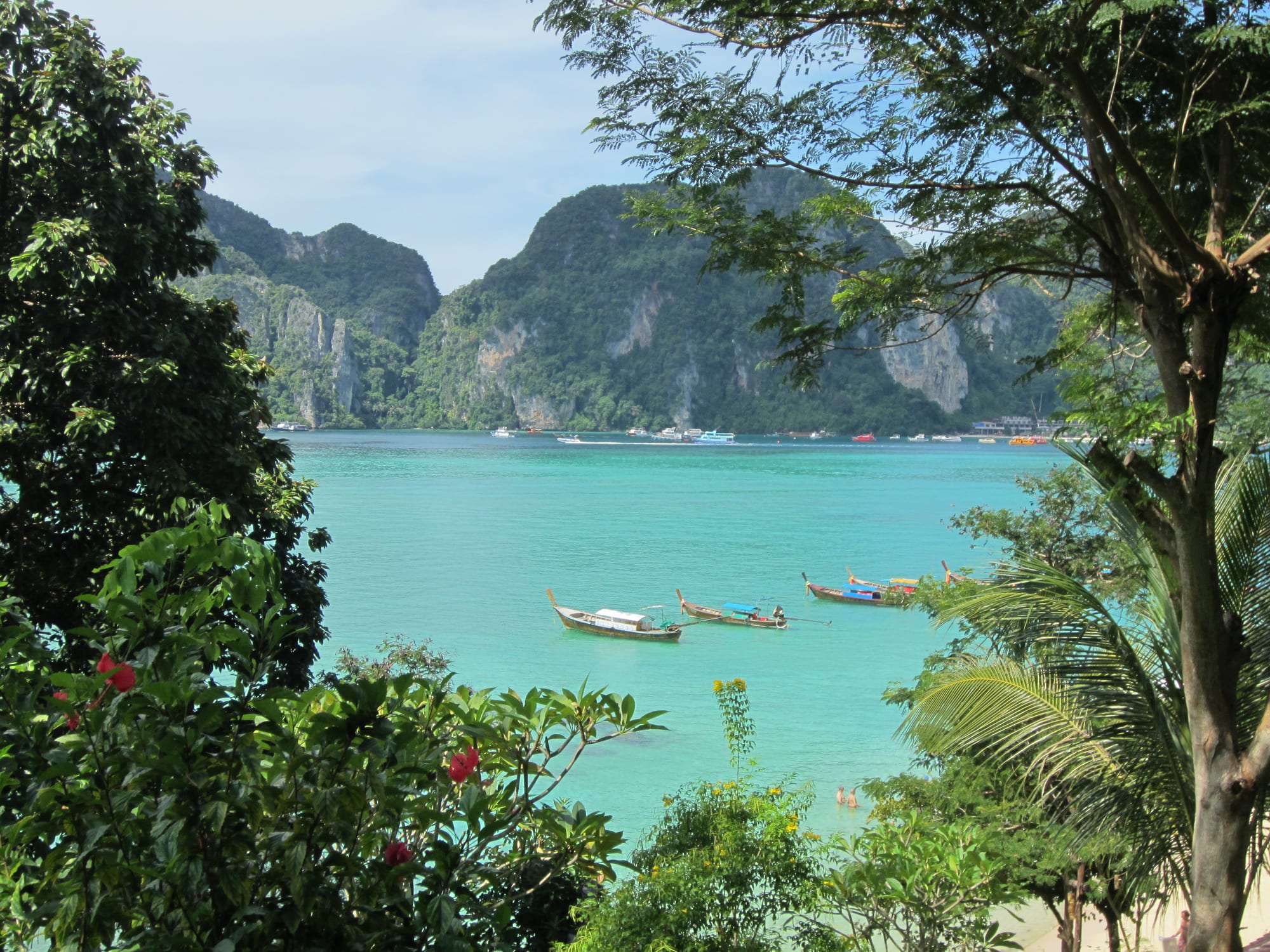
Turquoise bay with wooden longtail boats at anchor, framed by trees and backed by steep green limestone cliffs

Phuket, Krabi & the Andaman Coast, Thailand

Ko Phi Phi

Ton Sai Bay on Ko Phi Phi Don, with longtail boats moored below the limestone cliffs. (Yuriy Surov / Wikimedia Commons · CC BY 3.0)

A small group of limestone islands in the Andaman Sea between Phuket and Krabi, of which only Ko Phi Phi Don is inhabited. A Muslim fishing community lived here before backpackers arrived in the 1980s; the 2004 tsunami destroyed the village on its sand isthmus, and the rebuilt settlement is now a dense strip of guesthouses, bars, dive shops and boat piers.

Neighbourhoods

  • Ton Sai village
    • First-time visitors
    • Nightlife
    • Close to the boats

    The settlement on the flat sand isthmus between two bays, where the ferries dock. Its lanes are closed to motor traffic and are packed with guesthouses, dive shops, tour desks, bars, pharmacies and food stalls, and it is the noisiest place on the island after dark.

    Open in Maps
  • Loh Dalum
    • Beaches
    • Nightlife
    • Swimming at high tide

    The curved northern bay of the isthmus, a few minutes' walk from the pier, with pale sand, shallow water that retreats a long way at low tide, beach bars and the path up to the island's viewpoints.

    Open in Maps
  • Long Beach
    • Quiet beaches
    • Snorkelling
    • Sunsets

    A stretch of sand south-east of the village, reached by longtail boat or a rough coastal path, with reef close to shore, a handful of low-key resorts and a view across to Ko Phi Phi Le.

    Open in Maps
  • Laem Tong and the northern bays
    • Resorts
    • Quiet and residential
    • Diving

    The far north of Ko Phi Phi Don, where larger resorts sit on separate bays reached only by boat, alongside a settlement of Urak Lawoi sea people. There is nothing to walk to, and transfers are arranged by the hotels.

    Open in Maps

Things to do

Islands and bays

  • Ko Phi Phi Leattraction

    The uninhabited southern island, a ring of cliffs around shallow bays and lagoons, protected within a marine national park and visited by boat from Ton Sai.

    Open in Maps
  • Maya Baybeach

    A sand beach enclosed by vertical limestone walls on Ko Phi Phi Le, made famous by a 2000 film, closed for several years to let the reef recover and now visited under strict rules.

    Open in Maps
  • Ko Mai Phaiattraction

    A small flat island between Ko Phi Phi Don and the Krabi coast, known in English as Bamboo Island although casuarinas rather than bamboo cover it, with a sandbank and reef used for snorkelling stops.

    Open in Maps

Nature and the sea

  • Hat Noppharat Thara–Mu Ko Phi Phi National Parkpark

    The marine national park that covers the Phi Phi islands and their reefs, charging an entry fee for visits to Maya Bay and the southern island.

    Open in Maps

Short trips by boat

  • Ko Lanta Yaiattraction

    A much larger and quieter island to the south-east, with long west-facing beaches and an old town of stilted shophouses, reached by ferry in the dry season.

    Open in Maps
  • Mu Ko Lanta National Parkpark

    The marine national park at the southern tip of Ko Lanta and over the islands around it, with reefs and dive sites reached from Phi Phi by boat in the dry season.

    Open in Maps
  • Ko Jumattraction

    A low-key island between Phi Phi and the Krabi mainland, with fishing villages and quiet beaches, served by boats in the dry season.

    Open in Maps

Seasonal events

  • SongkranApril

    The Thai new year, marked on the island with water throwing along the village lanes and temple visits on the mainland.

  • Loi KrathongNovember

    Small decorated floats of banana leaf, flowers and candles are set on the sea from the bays on the full moon.

  • Ramadan and Eidvaries with the lunar calendar

    Much of the island's permanent population is Muslim, and the fasting month and the feast that ends it shape village life and the opening of local kitchens.

Eat and drink

Long-standing places and food districts in Ko Phi Phi. Hours, ratings and directions come from your maps app, always current.

Island classics

  • Seafood grills in Ton Saineighborhood

    Restaurants along the village lanes set out the day's fish, prawns, squid and crab on ice in the evening and grill them over charcoal, usually served with lime, garlic and chilli sauces.

    Open in Maps
  • Thai kitchens and roti stallsneighborhood

    Small kitchens behind the beachfront cook southern curries, fried rice and noodle dishes, and roti stalls fold pancakes around banana and condensed milk late into the night.

    Open in Maps

Cafés and bars

  • Loh Dalum beach barsneighborhood

    The northern bay is the centre of the island's nightlife, with bars spilling onto the sand, fire shows and music that runs late in high season.

    Open in Maps
  • Village cafés and bakeriescafe

    Cafés in the lanes serve Thai iced coffee, fruit shakes and Western breakfasts to divers heading out and to travellers waiting for afternoon ferries.

    Open in Maps

Experience Ko Phi Phi

History

Human use of these islands goes back a long way: the caves on Ko Phi Phi Le hold old paintings of boats, left by the collectors of edible bird nests who have worked the cliffs for generations under licence. Permanent settlement came later. Muslim fishing families from the Malay-speaking coast and from Krabi settled on Ko Phi Phi Don, planting coconut palms on the flat land and working the reefs, and the islands remained a quiet part of Krabi province into the 20th century, with a community of Urak Lawoi sea people in the north.

Travellers found the islands in the late 1970s and 1980s, arriving on fishing boats from Phuket and sleeping in bamboo bungalows on the isthmus. Development followed the usual pattern of the Andaman coast — bungalows, then guesthouses, then dive schools and bars — and accelerated sharply after the 2000 film The Beach was shot at Maya Bay on Ko Phi Phi Le, which made the bay one of the most photographed places in Thailand.

On 26 December 2004 the Indian Ocean tsunami struck both sides of the isthmus almost simultaneously, destroying the village and killing many residents and visitors; it was among the worst-hit places in Thailand. Rebuilding began within months, along with warning towers and marked evacuation routes. Pressure on the reefs and the shoreline grew with the crowds, and in 2018 the authorities closed Maya Bay to allow the coral and the blacktip reef sharks to recover. It reopened in early 2022 under rules that keep boats out of the bay itself, bar swimming and limit how many people are ashore at once.

Culture & Customs

Two quite different populations share a small island. The permanent community is largely Thai Muslim, with a mosque, a school and families who have fished and farmed here for generations, joined by Urak Lawoi sea people in the northern bays; the seasonal population is made up of workers from across Thailand and Myanmar and of travellers, many of them in their twenties, for whom Phi Phi has been a fixture of the backpacker route for four decades. The result is a place where fire shows and Islamic observance sit a few hundred metres apart, and where visitors are expected to notice the difference.

The village keeps the rhythms of the mainland south: markets early, prayers through the day, a quiet Friday midday, and the fasting month of Ramadan altering when and where food is served. Thai Buddhist and Chinese-Thai families add shrine offerings and the usual national festivals.

The sea shapes local identity more than anything. Boat handling, free diving and knowledge of the reefs are ordinary skills here, and many families have moved from fishing to running longtails, dive boats and tours without leaving the water. The 2004 disaster remains a shared reference point, and conservation — the closure and reopening of Maya Bay, limits on boat numbers, rules on where boats may anchor — is a constant subject of local argument and pride.

Daily Life

Only a few thousand people live on Ko Phi Phi Don permanently, and the number on the island at any moment in high season can be several times that. The paved lanes are for pedestrians only, with motor vehicles limited to emergency services: deliveries come off the ferries onto handcarts, rubbish and recycling go back the same way, and generators, desalination and water barged from the mainland keep the village supplied. Electricity, fresh water and waste are the practical limits on how much the island can hold, and shortages are routine at the end of the dry season.

Work is tourism and fishing. Guesthouses, dive schools, restaurants, boats and shops employ most residents and a large seasonal workforce; longtail owners run tours in the morning and fish at other times; and the northern resorts operate almost as separate settlements. The wet season empties the island, many businesses close, and staff return to their home provinces.

The day is shaped by the ferries. Boats from Phuket and Krabi arrive through the morning and early afternoon, the village fills, tour boats leave at dawn and return by late afternoon, and the last departures go before dark. Evening brings the seafood grills and, on Loh Dalum, music until late. Residents live mostly at the eastern end of the village, away from the bars.

Food

Island cooking is southern Thai with a strong Muslim element. Seafood is the staple and the speciality: squid, prawns, blue crab, barracuda and whole reef fish, bought from the boats and grilled over charcoal or steamed with lime and garlic. Restaurants in the village set out the catch on ice in the evening and sell it by weight, and the simplest treatments are usually the best.

Southern curries turn up on every menu that caters for Thais: kaeng som, the sour turmeric fish curry, kua kling, dry-fried minced meat with a hot paste, and massaman, the mild, sweet-spiced curry with Muslim origins that is at home on this coast. Khao mok gai, spiced chicken with yellow rice, and roti, griddled flatbread eaten with curry or folded around banana and condensed milk, come from the same tradition. Breakfast for residents is often rice soup or khanom jeen, fermented rice noodles under curry.

For visitors the food is deliberately international — pizza, burgers, banana pancakes, fruit shakes and buckets of spirits are as much a part of the strip as pad thai — and the better Thai cooking is generally found in the smaller kitchens set back from the beachfront, where southern curries are sold by the plate. Fresh fruit and coconuts are sold from carts, and coffee is served thick and sweet with condensed milk.

Planning tools

Budget

Everything on Phi Phi arrives by boat, so food, drink and basic goods cost noticeably more than on the mainland, while rooms range from cheap dormitories in the village to expensive resorts on the northern bays. Ferries, boat tours, the national park fee and diving are the main additional costs, and prices roughly halve outside the dry season.

Daily Budget Midrange
USD 90–210 (beach resort, seafood dinners, island-hopping tours, a dive day)
Daily Budget Shoestring
USD 30–55 (dormitory or simple fan room, street food, a shared longtail tour)

Long-tail boats hired by the group cost far less per person than a private charter, and the national park fee for Maya Bay is charged separately from the boat trip.

Best Time to Visit

November to April, when the sea is calm, visibility for diving is at its best and ferries run to schedule; December to February is busiest. From May to October squalls and swells close some routes, many small businesses shut and the island is cheap, wet and quiet.

Suggested Number of Days

Two or three days covers the island at a normal pace. Four or five suit divers, or anyone combining it with a neighbouring island. The last ferries leave in the afternoon, so arrival and departure days are largely taken up by the crossing.

First Visit
2–3 days
With Surroundings
4–5 days

Transportation

There are no cars or motorbike taxis on Ko Phi Phi Don: goods move by handcart and everything else is done on foot or by longtail boat. Longtails run from the village beaches to Long Beach, the northern bays and the surrounding islands, and ferries and speedboats connect Ton Sai pier with Phuket, Krabi, Ao Nang and Ko Lanta.

The paths beyond the village are rough and unlit, so a torch is useful after dark, and boats to the outlying bays stop running in the evening.

Airport & Station Connections

The island is reached only by sea. Large ferries cross from Phuket's Rassada pier, from Krabi and from Ko Lanta, with speedboats and smaller boats also running from Ao Nang in the dry season. All arrive at Ton Sai pier in the village, where an island entry fee is collected. The nearest airports are Krabi and Phuket.

Walkability

The village is entirely walkable and there is no alternative: its lanes are narrow, flat and free of traffic, and the two bays are a few minutes apart across the isthmus. Beyond that the ground rises steeply, the path to the viewpoints is a long climb of steps, and the coastal tracks to Long Beach are rough and slippery after rain.

Safety

The island is safe for most visitors, and serious crime is rare, but the practical risks are real: boat accidents in rough seas, currents and propellers near the swimming bays, cuts from coral and rocks, and injuries after heavy drinking around the fire shows on Loh Dalum. Medical facilities are limited to a small clinic, and anything serious means a boat to the mainland. Tsunami warning towers and evacuation route signs line the coast.

Choose boat operators with life jackets and refuse trips in rough weather, keep away from fire shows and buckets of spirits, wear footwear on the reef flats, and learn the local tsunami evacuation route, which climbs inland from the isthmus. Check current official travel advice before travelling.

Climate

Tropical and humid all year. The dry season runs from about November to April with calm, clear water; the southwest monsoon from May to October brings heavy squalls, swell and reduced visibility underwater.

Summer
hot and humid, generally 28–33°C; May to October brings frequent heavy rain and rough crossings
Winter
the dry season, November to April, is sunny with calm seas and about 25–33°C

Local Customs

Most permanent residents are Muslim, and the island's village life is more conservative than the bar strip suggests: swimwear belongs on the beach, and covering up in the lanes, at shops and near the mosque is expected. Shoes come off indoors. A wai, the palms-together greeting, is returned rather than offered first by visitors. Tipping is not expected. Reef etiquette matters here — standing on coral and touching marine life are discouraged or banned in the national park.

Insulting the monarchy is a criminal offence in Thailand. Swimwear belongs on the beach, alcohol is not sold in some village shops out of respect for the Muslim community, and cannabis, decriminalised in 2022, was restricted again in 2025 to medical use — never attempt to carry it out of the country.

Common Payment Methods

The currency is the Thai baht. Resorts, dive shops and larger restaurants take cards, and Thai QR payment is common, but small kitchens, longtail boats and market stalls want cash. There are a few ATMs in the village, they charge a fixed fee per foreign withdrawal and they occasionally run out, so arriving with some cash is sensible.