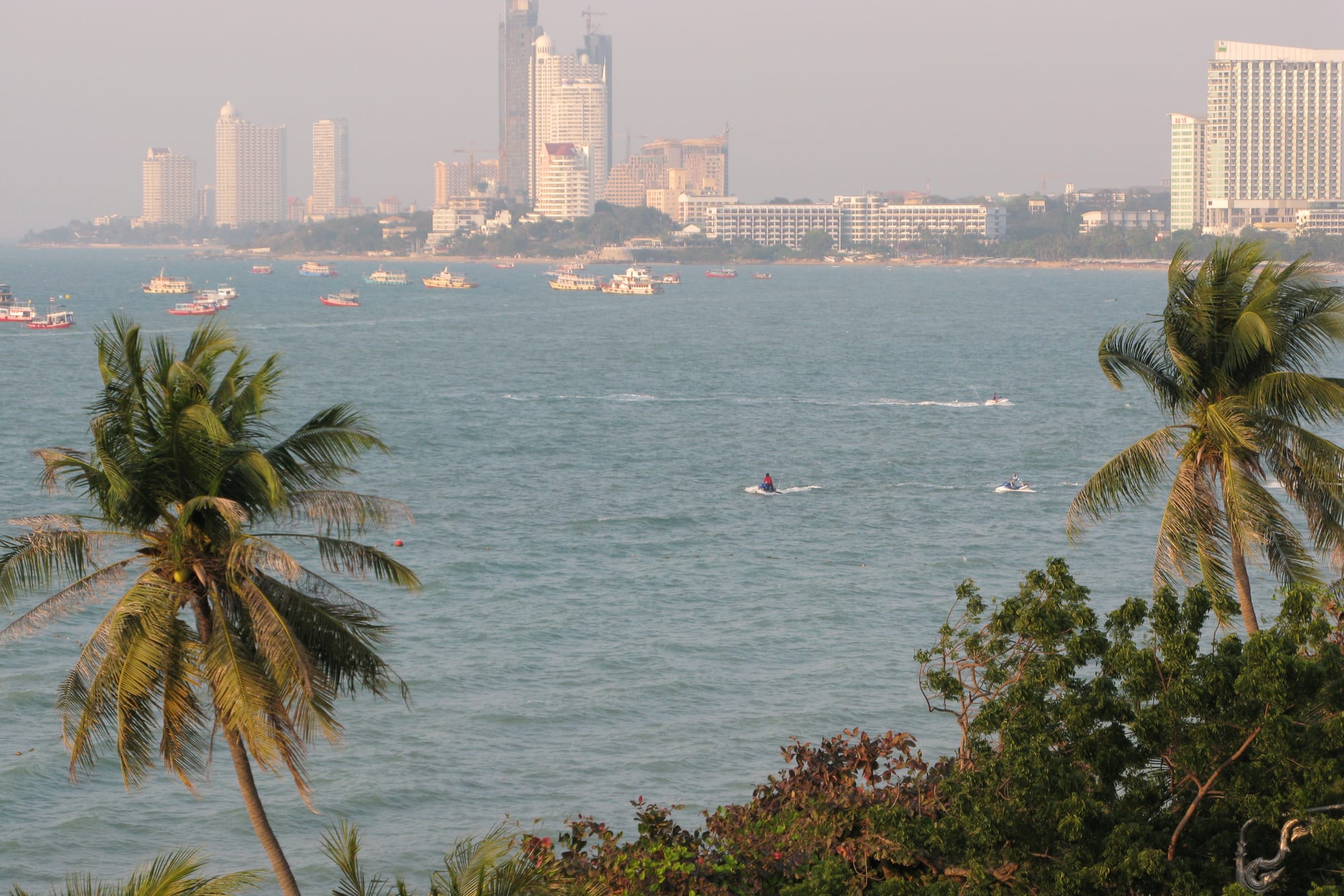
Palm trees framing a wide blue bay dotted with boats and jet skis, with high-rise hotels along the far shore

Thailand

Pattaya & the Eastern Seaboard

Pattaya Bay on the Chon Buri coast, with the resort's hotel towers along the shore. (Vyacheslav Argenberg / Wikimedia Commons · CC BY 4.0)

The coast and hinterland east of Bangkok, running from the ports and industrial estates of Chon Buri and Rayong past Pattaya to the fruit orchards and gem trade of Chanthaburi and the islands of Trat on the Cambodian border — Thailand's industrial engine and the capital's nearest beaches.

Explore Pattaya & the Eastern Seaboard

History

The eastern coast was a string of fishing villages, pepper gardens and orchards for most of its history, looking to Ayutthaya and later Bangkok by sea. Its great moment came in 1767, when the future King Taksin broke out of besieged Ayutthaya, gathered men and ships at Chanthaburi and Rayong, and sailed back up the Chao Phraya to expel the Burmese within the year.

In the late 19th century the east was a pawn in Siam's struggle with France. After the Paknam crisis of 1893, French troops occupied Chanthaburi for about a decade as a guarantee of Siam's good behaviour, and Trat was later held briefly before being returned in the treaty of 1907, when Siam gave up Battambang, Siem Reap and Sisophon to French Cambodia. Vietnamese Catholics began settling in Chanthaburi in the 19th century, and its cathedral is the largest church in Thailand. In 1941 the Battle of Ko Chang, fought between the Thai and Vichy French navies, took place off the islands of Trat.

The Vietnam War transformed the coast: American forces used U-Tapao air base and Sattahip naval base, and Pattaya grew from a fishing village into a resort for servicemen on leave. From the 1980s the government's Eastern Seaboard programme built the deep-sea port of Laem Chabang and the petrochemical complex of Map Ta Phut, and in the 2010s the Eastern Economic Corridor scheme set out to turn Chon Buri, Rayong and Chachoengsao into a high-technology zone. Inland, Sa Kaeo and Prachin Buri took in large numbers of Cambodian refugees after 1979.

Culture & Customs

The east has no single regional language like Isan or Lanna; people speak central Thai with a local accent, and the old Chong minority of the Chanthaburi hills keeps a language of its own. Chinese-Thai families have long dominated trade in the market towns, and Chanthaburi has an old Vietnamese Catholic community, and a 19th-century gem rush drew immigrants from Burma.

Local festivals reflect farming and the sea. Chon Buri holds buffalo races in October, with the animals dressed and paraded before sprinting down a track; Chanthaburi and Rayong stage fruit fairs when the durian comes in; and the coastal towns celebrate their Chinese shrines and the sea goddess Mazu. Rayong honours Sunthorn Phu, the poet whose epic Phra Aphai Mani is set partly on the islands, with a monument near Klaeng and statues of its characters on Koh Samet.

Pattaya stands apart: a city of Russian, Indian, Chinese and European visitors and long-stay retirees, with signs in several alphabets, a notorious nightlife district and a newer family resort industry. Many of its workers come from Isan, and the city's culture is as much theirs as the coast's.

Daily Life

This is Thailand's most industrial region outside Bangkok. Chon Buri, Rayong and Chachoengsao hold car factories, oil refineries, petrochemical plants and the country's biggest container port at Laem Chabang, which together make the eastern provinces among the richest per head in Thailand. Pattaya has around 120,000 registered residents and many more unregistered workers and foreigners; Chon Buri, Si Racha and Rayong are busy industrial towns.

Further east the economy turns green: Chanthaburi and Rayong grow durian, mangosteen, rambutan and longan, much of it exported to China, and fruit orchard owners are among the wealthiest farmers in the country. Chanthaburi is also a long-established gem town, known for rubies and sapphires, though it is no longer the major source of stones it once was. Trat lives from fishing, rubber and island tourism, and Sa Kaeo from farming and trade across the border at Aranyaprathet.

Current issues include pollution and water shortages around the industrial estates, oil spills off Rayong, traffic and crime in Pattaya, and the effect on border trade of tension with Cambodia.

Food

The eastern coast eats seafood and fruit. Chon Buri's Nong Mon market, near Bang Saen, is known for khao lam, sticky rice with coconut milk cooked in bamboo, and snacks for the road. Si Racha gave its name to sot Si Racha, the tangy chilli-garlic sauce now bottled around the world, first made in the town and still eaten there with fried eggs and seafood. Rayong is known for nam pla, fish sauce, and kapi, fermented shrimp paste.

Chanthaburi has the most distinctive dishes: sen chan, flat rice noodles grown famous as the original noodle for pad thai; and mu chamuang, a slow-braised pork curry flavoured with the sour leaves of the chamuang tree, which grows in the east.

Fruit is the pride of the region: durian from Chanthaburi and Rayong, of the Monthong and other varieties, mangosteen, called the queen of fruits, rambutan, longan and salak. In season, from about April to June, stalls pile them along the Sukhumvit Road, and durian is also made into chips and sweet paste.

Attractions & Natural Wonders

Pattaya is the region's biggest draw: the long curve of Pattaya Bay, the view from Phra Tamnak hill, Walking Street's nightlife, the Sanctuary of Truth, a huge wooden structure carved with Hindu and Buddhist figures, and the Nong Nooch tropical garden, with Ko Lan's beaches a short boat ride offshore. Further up the coast are the beach of Bang Saen and the island of Ko Si Chang, where King Chulalongkorn once had a summer palace; south lie Jomtien and the naval town of Sattahip.

From Ban Phe in Rayong, boats cross to Koh Samet, whose bays of fine white sand — Sai Kaew, Ao Wong Duean, Ao Prao — lie inside a marine national park. Chanthaburi's riverside old town has the Cathedral of the Immaculate Conception, the largest church in Thailand, with waterfalls in the Khao Khitchakut and Namtok Phlio parks nearby. Trat is the gateway to Koh Chang's jungle interior, waterfalls and beaches, and to Koh Mak and Koh Kood beyond.

Inland, Chachoengsao has the riverside temple of Wat Sothon on the Bang Pakong river; Prachin Buri reaches into Khao Yai, one of Thailand's great forests, with waterfalls and wild elephants on its southern side; and Sa Kaeo has the Khmer temple of Sdok Kok Thom and the border market at Rong Kluea near Aranyaprathet.

Cities in Pattaya & the Eastern Seaboard

Planning basics

Budget

The east is cheaper than Phuket or Samui but more expensive than inland Thailand. Pattaya has rooms and food at every price, with good deals outside weekends; Koh Samet charges a national park fee and island prices; Koh Chang ranges from hostels to resorts. Chanthaburi, Trat and the inland provinces are inexpensive and see few foreign visitors.

Daily Budget Midrange
USD 75–160 (beach hotel or resort, seafood dinners, ferries and island transport)
Daily Budget Shoestring
USD 25–50 (guesthouse, street food, buses and songthaews)

Visit the islands on weekdays, when Bangkok visitors are fewer and room prices drop.

Safety

The east is generally safe. Pattaya has the usual problems of a big nightlife resort — drink spiking, bar bills, pickpockets, jet-ski damage claims and motorbike crashes — and Koh Chang's steep roads are dangerous on a scooter. Chanthaburi's gem trade has a long record of scams aimed at outsiders. The land border with Cambodia in Sa Kaeo and Trat was affected by the 2025 border conflict, and crossings can close at short notice.

Buy gems only with independent expertise, photograph a jet ski before hiring it, and check the status of Cambodian border crossings. Check current official travel advice before travelling.

Climate

The east follows the national pattern but is wetter towards Cambodia: Chanthaburi and Trat, facing the southwest monsoon, receive some of the heaviest rainfall in Thailand from May to October, with rough seas around Koh Chang. Pattaya and Rayong are drier. November to April is sunny, and the orchards fruit from April to June.

Summer
hot and humid, about 28–35°C from March to May; rainy and stormy May–October, especially in Trat and Chanthaburi
Winter
dry, warm and breezy November–February, about 23–32°C, with calm seas

Transportation

Pattaya is about two hours by road from Bangkok or Suvarnabhumi airport, and buses from Bangkok's Eastern (Ekkamai) terminal serve Rayong, Chanthaburi and Trat. U-Tapao airport near Sattahip and Trat airport have domestic flights. Ferries run from Ban Phe to Koh Samet and from the Laem Ngop area to Koh Chang. The eastern railway reaches Pattaya and Aranyaprathet, and the Aranyaprathet and Hat Lek crossings lead into Cambodia.

Take a bus from Ekkamai rather than a taxi to Pattaya or Ban Phe; on Koh Chang, shared songthaews run along the west coast road.

Best Time to Visit

November to April for the beaches and islands, when seas are calm and skies clear. May and June bring the durian, mangosteen and rambutan harvest to Chanthaburi and Rayong, with fruit fairs. Koh Chang and Koh Kood are much quieter in the rains, and some island resorts and boats run a reduced service.