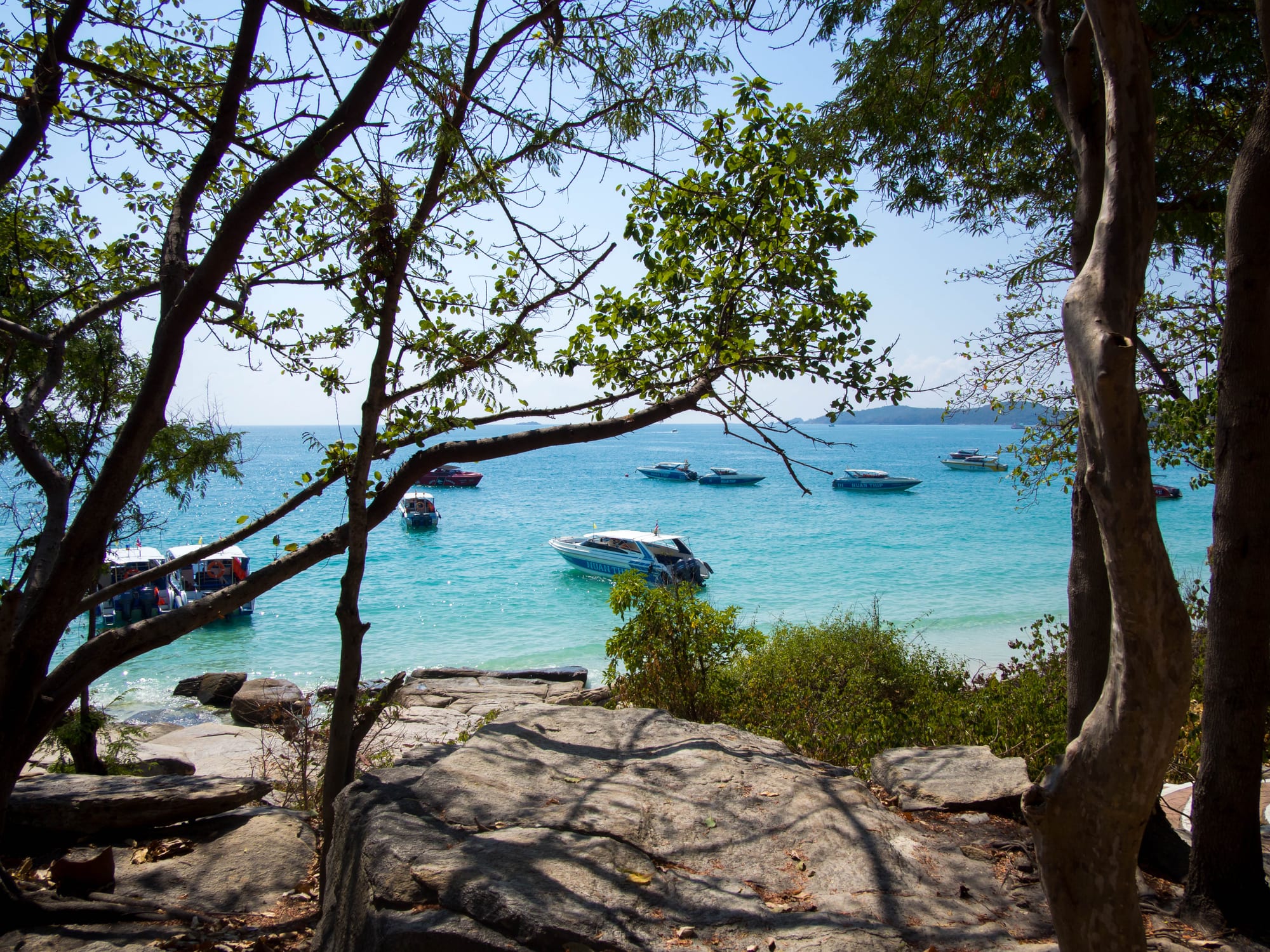
Turquoise water with moored speedboats seen through leaning trees from a rocky shore on a bright day

Pattaya & the Eastern Seaboard, Thailand

Ko Samet

Speedboats moored off a rocky headland on Ko Samet. (kishjar? / Wikimedia Commons · CC BY 2.0)

A small island off Rayong, a short boat ride from the mainland pier at Ban Phe and close enough to Bangkok for a weekend. Most of it lies within a national park, its east coast is a run of short white-sand bays with clear water, and its wooded interior and rocky southern headlands are largely undeveloped.

Neighbourhoods

  • Hat Sai Kaew
    • First-time visitors
    • Beaches
    • Nightlife

    The long beach just south of the arrival pier, with the widest sand, the most hotels and restaurants, and fire shows and music in the evening. It is the busiest part of the island and the noisiest at weekends.

    Open in Maps
  • Ao Hin Khok and Ao Phai
    • Budget stays
    • Beaches
    • Backpackers

    Two small bays immediately south, separated by rocks and reached on foot from Hat Sai Kaew. Simple bungalows and beach restaurants sit close to the water, a short walk from the Phra Aphai Mani statues at the end of Hat Sai Kaew.

    Open in Maps
  • Ao Wong Duean
    • Families
    • Quiet and residential
    • Beaches

    A crescent bay in the middle of the east coast with a sheltered anchorage, mid-range resorts and a cluster of restaurants. It is calmer than the northern beaches without being isolated.

    Open in Maps
  • Ao Thian and the southern bays
    • Quiet and residential
    • Sunrises

    Small rocky coves further south, known by the name Candlelight Beach, with a handful of simple places to stay, little road and very few people outside holidays.

    Open in Maps
  • Ao Phrao
    • Sunsets
    • Quiet and residential

    The one developed bay on the west coast, a short walk or ride across the island, with resorts, calm water and the island's only view of the sunset.

    Open in Maps
  • Na Dan
    • Close to public transport
    • Local life
    • Budget stays

    The island's village, around the pier at the northern tip, where the boats arrive and the shops, school, clinic and market serve residents rather than visitors.

    Open in Maps

Things to do

Beaches

  • Hat Sai Kaewbeach

    The island's longest beach, a broad strip of very fine pale sand on the north-east coast, lined with restaurants and busy at weekends.

    Open in Maps
  • Ao Wong Dueanbeach

    A curved bay of calm shallow water in the middle of the east coast, with boats moored offshore and resorts set back among trees.

    Open in Maps
  • Ao Thianbeach

    A string of small coves broken by rocks near the south-east of the island, quiet and facing the sunrise.

    Open in Maps
  • Ao Phraobeach

    The main bay on the west side, sheltered and shaded, and the place on the island to watch the sun go down.

    Open in Maps
  • Ao Kiubeach

    A pair of narrow bays near the southern end, reached by a rough track or by boat, with almost nothing on them.

    Open in Maps

Park, walks and viewpoints

  • Khao Laem Ya–Mu Ko Samet National Parkpark

    The national park declared in 1981, covering all of the island bar the port village of Na Dan, nine other small islands, the Khao Laem Ya headland and the long Mae Ramphueng Beach on the mainland. A one-off admission fee is charged on arrival.

    Open in Maps
  • The southern headland at Ao Karangviewpoint

    Rocks at the island's southern tip, reached by the coastal track, looking out over open sea and the outlying islets.

    Open in Maps
  • The island crossing to Ao Phraotrail

    A short walk or ride over the low wooded ridge from the east coast to the west, the simplest way to see the island's interior.

    Open in Maps

Village and sights

  • Phra Aphai Mani statueslandmark

    Figures of Prince Aphai Mani and the mermaid who guided him to the island, from Sunthorn Phu's epic poem, standing on Hat Sai Kaew.

    Open in Maps
  • Na Dan village and piertransit hub

    The working village at the north end, with the ferry pier, shops, food stalls and the island's school and health centre.

    Open in Maps

Short trips from the island

  • Ban Pheattraction

    The mainland harbour town where the boats leave from, with a seafront market known for dried squid, fish sauce and shrimp paste.

    Open in Maps
  • Rayongattraction

    The provincial capital on the coast west of Ban Phe, with riverside markets, fish sauce for which the province is Thailand's main producer, and the long Mae Ramphueng Beach between the two.

    Open in Maps
  • Ko Man islandsattraction

    Ko Man Nai, Ko Man Klang and Ko Man Nok, a group of small islands in Klaeng Bay east of Ban Phe, visited on boat trips for snorkelling and quiet water.

    Open in Maps

Seasonal events

  • Songkranmid-April

    The Thai new year fills the island with visitors from Bangkok and Rayong, with water throwing at Na Dan and along the main beaches.

  • Loi KrathongNovember

    Floats of banana leaf, flowers and candles are launched from the beaches on the full moon of the twelfth lunar month.

  • Sunthorn Phu Day26 June

    Thailand marks the poet's birthday, and Rayong province in particular, where his memorial stands at Klaeng; his epic Phra Aphai Mani is set partly on this island.

Eat and drink

Long-standing places and food districts in Ko Samet. Hours, ratings and directions come from your maps app, always current.

Island classics

  • Beachfront seafood on Hat Sai Kaewneighborhood

    Tables set on the sand in the evening, with grilled prawns, squid and whole fish chosen from ice and cooked over charcoal.

    Open in Maps
  • Ao Wong Duean restaurantsneighborhood

    A compact row of Thai kitchens and resort restaurants behind the bay, quieter than the northern beach and easier for a sit-down meal.

    Open in Maps

Markets and everyday food

  • Na Dan village food stallsneighborhood

    Where island workers eat — rice and curry shops, noodle stalls, grilled chicken and som tam near the pier, at mainland rather than beach prices.

    Open in Maps
  • Ban Phe seafront marketmarket

    The mainland market beside the pier, stacked with dried squid and fish, shrimp paste, fish sauce and fruit to take onto the boat.

    Open in Maps

Experience Ko Samet

History

Ko Samet takes its name from the samet, or cajeput, tree that grows on its forested hills, and the island long supported only a few fishing families on its sheltered northern shore. Its literary fame came from the poet Sunthorn Phu (1786–1855), whose father's family came from Klaeng district on the mainland opposite: he set part of his epic Phra Aphai Mani on the island's shores, and statues of the poem's prince and the mermaid who guided him to Ko Samet stand on Hat Sai Kaew today.

For most of the 20th century the island remained a quiet dependency of Ban Phe across the water, with coconut smallholdings, fishing and a village at Na Dan. The government restricted overnight stays on the island until 1981, and cheap bungalows spread along the east-coast bays in the years that followed. In that same year the Royal Forest Department declared the Samet archipelago, nine other small islands, the Khao Laem Ya headland and Mae Ramphueng Beach a national park. Resort building accelerated all the same, and the unclear legal status of land on the island has fed long-running disputes between residents, developers, the Treasury Department and the park authorities; in August 2013 three resorts found by the courts to have been built illegally on park land were demolished.

Proximity to Bangkok decided the island's character: a weekend destination for Thai visitors as much as a backpacker stop, reached in a few hours. A pipeline leak off the Rayong coast in July 2013 sent oil onto Ao Phrao, which was closed and cleared over the following weeks, damaging the island's reputation for a season. Building at the main bays has continued, and the southern third of the island remains largely empty.

Culture & Customs

The island's culture is that of the Rayong coast — fishing families, Chinese-Thai traders and the temples and spirit shrines of the mainland — layered over with the habits of a resort that has served Bangkok for more than forty years. Weekends and public holidays bring a strongly Thai crowd: families taking rooms at Ao Wong Duean, groups of friends eating seafood on the sand, and music that runs late at Hat Sai Kaew.

Sunthorn Phu is the island's cultural anchor. Phra Aphai Mani, one of the best-known works of Thai literature, tells of a prince held by a giantess and helped by a mermaid, and part of it is set on this coast; the statues on Hat Sai Kaew, and the poet's memorial at Klaeng on the mainland, are visited by school groups and marked each 26 June.

Manners follow the national pattern, with the extra sensitivities of a small community. Residents distinguish sharply between the beach and the village: beachwear, drinking and noise belong to the bays, not to Na Dan, the school or the temple. Fire-spinning shows, beach bars and full-moon style parties are part of the northern beaches' evening trade rather than any local tradition. The national park's presence means that rules about collecting, fires and rubbish are enforced, and conservation of the reefs and the turtle nesting sites on nearby islands is taken seriously.

Daily Life

Only a small permanent population lives on Ko Samet, most of it in and around Na Dan at the northern tip, where the pier, the school, the health centre and the everyday shops are. The number of people on the island at any moment is several times higher, made up of resort and restaurant staff from the mainland and of migrant workers, and of visitors, who far outnumber residents at weekends.

Nearly every livelihood depends on visitors: bungalows and resorts, restaurants and beach bars, boats, songthaews, dive and kayak operators, shops and building work. Fishing continues on a small scale, and much of the seafood eaten on the beaches is landed at Ban Phe, where the island's supplies of water, fuel, food and building material also come from.

The rhythm is weekly rather than daily. Fridays bring the boats in full from Ban Phe, the beaches fill on Saturday, and Sunday afternoon empties the island again; midweek it is calm enough for the resorts to catch up. Water is the chronic constraint — the island has no substantial fresh supply of its own and depends on wells, tankers and careful management — along with waste disposal, electricity supply and the long-running argument between development and the national park.

Food

Seafood is what the island cooks: prawns, squid, blue swimmer crab and fish grilled over charcoal on the beachfront in the evening, or steamed with lime, chilli and garlic, or fried with garlic and pepper, served with nam chim seafood, the sour-hot dipping sauce that goes with all of it. Hoi thot, mussels fried in a thin batter with egg and bean sprouts, and tom yam with prawns are standards on nearly every menu.

The mainland supplies the flavourings the coast is known for. Rayong is Thailand's main producer of nam pla, fish sauce, and also makes kapi, fermented shrimp paste, and Ban Phe's seafront market sells both alongside dried squid, dried fish and prawn crackers bought as gifts. The province's orchards send in durian, mangosteen, rambutan and pineapple from about April to June, and pineapple from Rayong is sold sliced along the beach.

Everyday eating on the island is Thai working food, cooked for staff as much as for visitors: rice with one or two curries from a tray, stir-fried basil with pork or chicken and a fried egg, noodle soups, and Isan grills with som tam and sticky rice. Beach bars sell fruit shakes, coconuts and beer on ice, and the coffee is the sweet iced kind drunk everywhere in the country.

Planning tools

Budget

Ko Samet costs more than the mainland: everything arrives by boat, the national park charges admission on arrival, and weekend demand from Bangkok pushes room prices up sharply from Friday to Sunday. There are still simple bungalows at the smaller bays, while the resorts at Ao Phrao and Ao Wong Duean sit at the upper end.

Daily Budget Midrange
USD 75–160 (beach resort, seafood dinners, boat transfers and park fees)
Daily Budget Shoestring
USD 30–55 (simple bungalow, village food stalls, ferry and shared pick-ups)

Come midweek if possible, when rooms are markedly cheaper and the beaches emptier, and keep the national park ticket, which is checked on the island.

Best Time to Visit

November to April is dry, breezy and clear, with calm seas for the crossing. Ko Samet sits in one of the drier corners of the eastern coast and gets less rain than Trat, so even the May to October monsoon brings mainly short afternoon storms, cheaper rooms and quieter beaches, with occasional rough crossings.

Suggested Number of Days

Two or three days is enough for an island this small, and many Thai visitors come only for a weekend. A day or two more allows the mainland coast and the offshore islets. Length of stay depends mostly on how much beach time is wanted.

First Visit
2–3 days
With Surroundings
3–4 days

Transportation

There are no buses. Shared and hired songthaews, open pick-ups, run from the pier at Na Dan along the one surfaced road down the east coast and over to Ao Phrao; prices are fixed per person or per vehicle by beach. Motorbikes can be rented, the southern tracks are rough, and the northern beaches are linked to each other by short coastal footpaths.

Songthaew fares are posted at the pier and rise if a vehicle leaves half empty, so waiting for other passengers costs less; the beach paths are easier than the road for short distances.

Airport & Station Connections

Ferries and speedboats cross from Ban Phe in Rayong province to Na Dan pier and to some of the bays, taking about forty minutes by ferry to Na Dan and around ten minutes by speedboat, which runs to individual beaches. Ban Phe is about three hours from Bangkok by bus from the Ekkamai terminal or by car, and around an hour and a half from Pattaya.

Walkability

The island is small and the northern bays are joined by short paths over the rocks, so walking between Hat Sai Kaew, Ao Hin Khok, Ao Phai and Ao Wong Duean is easy. Further south the coast is broken and the road is unlit, dusty in the dry season and muddy in the rains, so most people ride. Distances overall are modest — the island is about 6.8 kilometres from north to south.

Safety

Ko Samet is a quiet, low-crime island, and the practical hazards are ordinary ones: sunburn, jellyfish in some seasons, boat traffic close to swimming areas, and falls or crashes on the rough southern tracks. Fire shows on the evening beaches involve spinning flame close to spectators. Sandflies can be a nuisance on some beaches.

Swim away from moored boats and jet ski lanes, keep back from fire performances, ride carefully on the unsurfaced roads, and watch belongings left on the sand. Check current official travel advice before travelling.

Climate

Tropical, with a hot season from March to May, a wetter southwest monsoon from May to October bringing short heavy storms, and a dry, breezy period from November to February. This part of the Rayong coast is drier than the provinces further east.

Summer
hot and humid, about 28–34°C from March to May, with warm sea water all year
Winter
dry and pleasant November–February, about 24–31°C, with steady breezes and calm seas

Local Customs

Swimwear is for the beach; a shirt is expected in shops, at the pier and in the village. Shoes come off before entering homes and temple buildings. The wai is the usual greeting, and the national park rules apply across the island: no collecting of shells or coral, no fires outside permitted areas and no litter on the beaches.

Alcohol sales follow Thai national hours and are restricted on Buddhist holidays, smoking is banned on many Thai beaches, and cannabis rules have been tightened, so recreational use should not be assumed to be permitted.

Common Payment Methods

The currency is the Thai baht. Resorts and larger restaurants take cards, and Thai QR payment is widely used, but bungalows, songthaews, beach vendors and village stalls expect cash, and the park admission is paid on arrival. There are few ATMs, mostly near Na Dan and the main beaches, so it is worth bringing cash from the mainland.