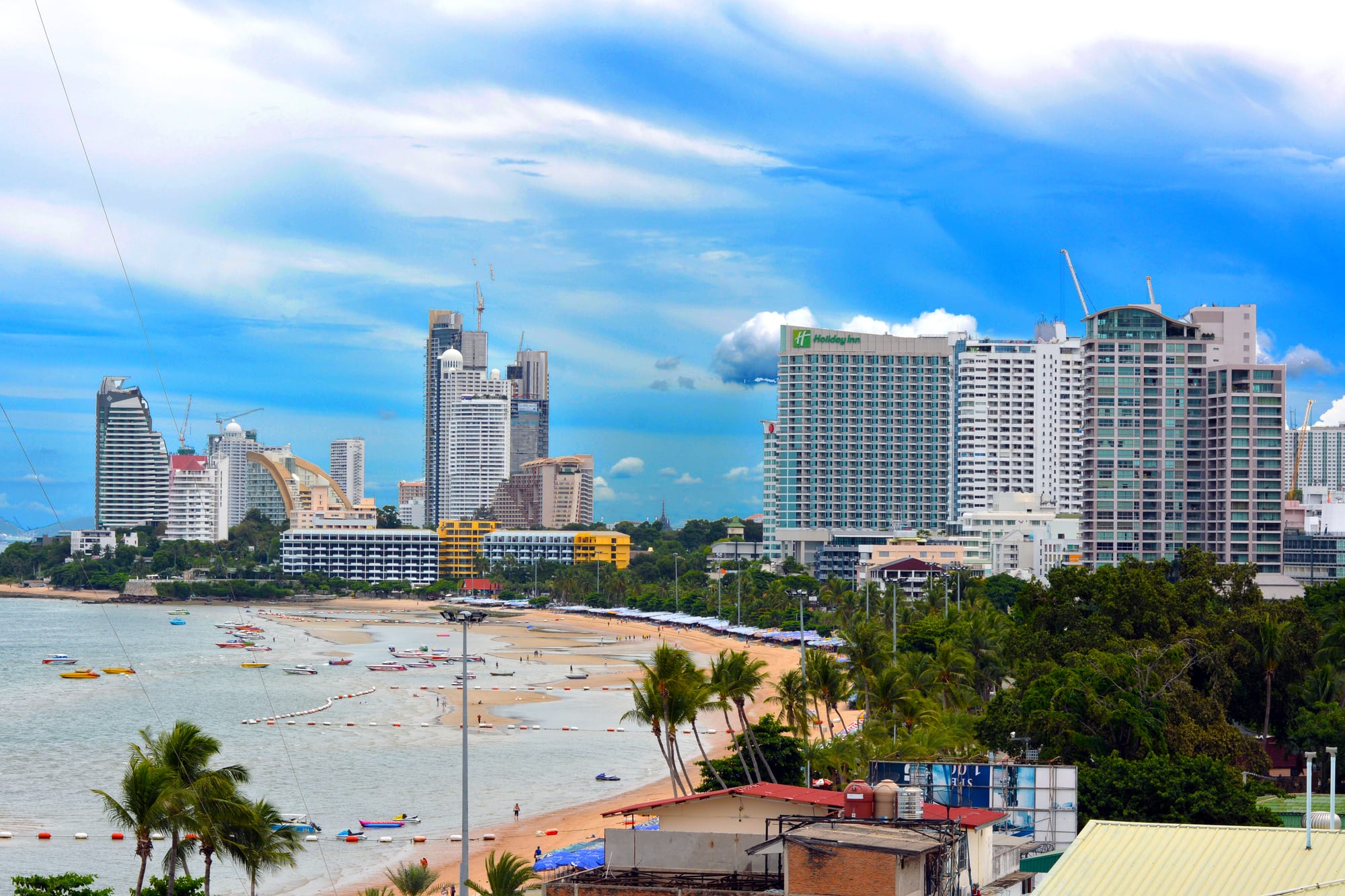
The curving sandy sweep of Pattaya beach lined with palms, speedboats offshore and a wall of white high-rise hotels behind

Pattaya & the Eastern Seaboard, Thailand

Pattaya

Pattaya Bay and the hotel towers along the beachfront, seen from the north. (Don Ramey Logan / Wikimedia Commons · CC BY-SA 3.0)

A beach resort on the Gulf of Thailand about two hours south-east of Bangkok, grown from a fishing village into a city of high-rise hotels and flats along a bay nearly three kilometres long. It is known for its nightlife, for crowded day boats to the island of Ko Lan, and increasingly for family attractions, gardens and long-stay foreign residents.

Neighbourhoods

  • Central Pattaya
    • First-time visitors
    • Shopping
    • Close to public transport

    The middle of the bay, where Beach Road and Second Road run parallel behind the sand. Shopping centres, large hotels, travel agents and restaurants of every nationality are packed into the numbered side lanes, and songthaews run constantly along both roads.

    Open in Maps
  • South Pattaya and Walking Street
    • Nightlife
    • Boat trips

    The southern end of the bay, with the pier for Ko Lan boats and, after dark, the bars, clubs and cabarets of Walking Street. Days are ordinary and shabby here; the district only comes to life in the evening, and it is loud until very late.

    Open in Maps
  • Naklua
    • Quiet and residential
    • Best for food
    • Families

    The older fishing quarter north of the bay, with a working harbour, seafood restaurants, a Chinese shrine and a long-established Thai community. Hotels here are quieter and the Sanctuary of Truth stands on the headland at its southern edge.

    Open in Maps
  • Pratumnak Hill
    • Quiet and residential
    • Viewpoints
    • Beaches

    The wooded rise between Pattaya and Jomtien, with the hilltop temple of the big Buddha, a much-photographed viewpoint over the bay, small coves and a mix of resorts, condominiums and naval land.

    Open in Maps
  • Jomtien
    • Beaches
    • Families
    • Long stays

    A long, straight beach south of the hill, calmer than Pattaya bay and lined with seafood restaurants, deckchairs and rows of tall residential towers. It is where many foreign residents live and where the Thepprasit weekend market is held.

    Open in Maps
  • Bang Saray and the far south
    • Quiet and residential
    • Best for food

    A fishing village beyond Jomtien towards Sattahip, with piers, seafood places and a slower pace, used as a base by people who want the coast without the resort.

    Open in Maps

Things to do

Beaches and islands

  • Pattaya Beachbeach

    The main bay, a crescent of about 2.7 kilometres backed by a palm-lined promenade, busy with deckchairs, parasailing and jet skis; badly eroded, it was the first beach in Thailand to be rebuilt with imported sand.

    Open in Maps
  • Jomtien Beachbeach

    A wider, longer and generally quieter beach south of Pratumnak Hill, popular with families and windsurfers.

    Open in Maps
  • Ko Lanattraction

    An island about seven kilometres offshore reached by ferry or speedboat from the pier, with clear water and several small beaches that fill up at midday.

    Open in Maps

Landmarks and temples

  • Sanctuary of Truthlandmark

    An enormous unfinished building on the shore at Naklua, part temple and part castle, begun in 1981 and made entirely of wood, carved inside and out with figures from Hindu and Buddhist belief.

    Open in Maps
  • Wat Phra Yai on Pratumnak Hilllandmark

    The temple on Pratumnak Hill with a large seated Buddha image visible from much of the bay, reached by a naga-flanked stairway.

    Open in Maps
  • Pattaya Viewpointviewpoint

    The terrace on Pratumnak Hill giving the standard view along the whole curve of the bay, best in the late afternoon.

    Open in Maps

Gardens, parks and family attractions

  • Nong Nooch Tropical Botanical Gardenpark

    A very large landscaped garden south of the city with palm and cycad collections, formal parterres, sculpture and daily cultural and elephant shows.

    Open in Maps
  • Mini Siamattraction

    A park of scale models of Thai monuments and, in a second section, of famous buildings from around the world.

    Open in Maps
  • Pattaya Floating Marketmarket

    A purpose-built market on water south of the city, opened in 2008 and divided into sections representing Thailand's four regions, selling crafts and cooked food from boats and walkways.

    Open in Maps
  • Khao Kheow Open Zooattraction

    A large open-range zoo in the hills of Si Racha north of the city, opened to the public in 1978, where animals are kept in wide enclosures.

    Open in Maps

Markets and nights out

  • Walking Streetneighborhood

    The pedestrianised strip at the south end of the bay, closed to traffic in the evening and lined with bars, clubs, cabarets and seafood restaurants.

    Open in Maps
  • Thepprasit Marketmarket

    A large weekend night market in Jomtien selling clothes, phone accessories, street food and grilled seafood.

    Open in Maps
  • Naklua fish marketmarket

    The morning catch sold beside the old harbour in Naklua, with stalls of dried squid, prawns and cooked food nearby.

    Open in Maps

Short trips from the city

  • Wat Yansangwararamlandmark

    A monastery under royal patronage in landscaped grounds about 20 kilometres south, built in 1976 by the Supreme Patriarch, with pavilions in several regional and national styles set around a lake.

    Open in Maps
  • Ko Sichangattraction

    An island 12 kilometres off Si Racha, north of Pattaya, with the remains of King Chulalongkorn's summer palace, small beaches and quiet lanes.

    Open in Maps
  • Bang Saenbeach

    The beach town near Chon Buri, about 40 kilometres north, where Thai rather than foreign visitors fill the deckchairs at weekends.

    Open in Maps
  • Sattahipattraction

    The naval town about 30 kilometres south of the resort, a base of the Royal Thai Navy since the reign of King Chulalongkorn, with quieter beaches and U-Tapao airport nearby.

    Open in Maps

Seasonal events

  • Wan Laimid-to-late April

    Pattaya and Naklua extend the Thai new year by several days, with water fights, cultural shows, beauty pageants, fireworks and water-sports competitions.

  • Pattaya International Music FestivalMarch

    A free open-air festival of Thai and international acts on stages along Beach Road, held over several days.

  • Chinese New Yearlate January or early February

    The city's large Thai-Chinese community marks the new year with dragon parades, lion dances and fireworks, centred on the shrines in Naklua.

  • Loi KrathongNovember

    Decorated floats of banana leaf and flowers are set on the sea from the beach and the piers on the full moon of the twelfth lunar month.

Eat and drink

Long-standing places and food districts in Pattaya. Hours, ratings and directions come from your maps app, always current.

Pattaya classics

  • Naklua seafood restaurantsneighborhood

    The old fishing quarter keeps the most local seafood cooking — crab, prawns, squid and whole fish grilled or steamed with lime and chilli, often beside the harbour.

    Open in Maps
  • Jomtien beachfront seafoodneighborhood

    A long line of open-fronted places behind the sand serving grilled fish, som tam and beer, with tables set out towards the water in the evening.

    Open in Maps

Food districts and markets

  • Thepprasit Marketmarket

    Weekend night market where much of the interest is edible — grilled squid, skewers, noodle stalls and Isan salads from stands run by migrant workers.

    Open in Maps
  • Soi Buakhao and the Central Pattaya lanesneighborhood

    The inland street where the resort eats away from the beach, with Thai shophouse kitchens, Isan grills and Indian, Russian, Chinese and Middle Eastern restaurants side by side.

    Open in Maps
  • Pattaya Floating Marketmarket

    Regional Thai dishes and sweets cooked on boats and stalls, arranged by the four regions of the country.

    Open in Maps

Experience Pattaya

History

Pattaya was a fishing village on an open bay for most of its history, with a few hundred families, coconut plantations behind the sand and no road worth the name. Its modern life began in 1959, when a party of American servicemen driving down from a base at Korat rented houses at the south end of the beach and word of the bay spread. The air base at U-Tapao and the naval facilities at Sattahip brought many more on leave, bungalows and bars followed, and the Vietnam War gave the village an economy built on visitors almost overnight.

When the American forces left in the 1970s the resort did not collapse, as many expected, but turned to European package tourism. Hotels rose along the bay through the 1980s, and the resort acquired both a reputation as a cheap holiday coast and a notoriety for its sex industry. Growth ran ahead of drainage and sewerage, and by the late 1980s pollution of the bay had become serious enough to threaten the trade; treatment plants, a rebuilt promenade and the periodic replenishment of the beach with imported sand followed.

Since the 1990s the resort has widened its appeal, adding gardens, theme attractions, golf courses and convention space, and drawing very large numbers of Chinese, Indian and Russian visitors alongside Europeans. Pattaya has been administered as a special self-governing city since it was granted city status in 1978, unusually for Thailand, and the Eastern Economic Corridor programme has brought motorway and rail projects, a rebuilt U-Tapao airport and a wave of high-rise residential building along the coast. Tourism collapsed during the pandemic years and has since returned.

Culture & Customs

Pattaya is the least typically Thai of Thailand's cities, and makes no secret of it. Signs appear in Thai, English, Russian, Chinese, Hindi and Arabic; whole streets specialise in one nationality's food and shops; and a large foreign population of retirees, remote workers and long-stay visitors lives alongside Thai residents, most of whom have come from elsewhere in the country to work. Many of the staff in bars, kitchens and hotels are from Isan, and Isan music and food are as much part of the city as anything coastal.

The nightlife is the city's best-known feature and its most criticised. Cabarets with elaborate costumes and lip-synched revues are a long-running Pattaya institution, and the bar strips draw a great deal of attention, but the resort's daytime economy — beaches, gardens, shopping, golf, conferences, medical treatment — is now larger.

Underneath, the Thai calendar holds. Pattaya and neighbouring Naklua celebrate Wan Lai, extending the Songkran new year with their own days of water throwing and sand-pagoda building at the temples in April, and Loi Krathong floats are launched from the beach in November. Chinese shrines in Naklua hold their own festivals, and the temples still receive the morning alms round a few streets from the bars. Visitors are expected to dress properly away from the sand and to treat temples, monks and images of the monarchy with respect.

Daily Life

About 120,000 people are registered as residents of Pattaya City and about 351,000 in the greater Pattaya area, but no reliable total exists and the real figure is thought to be around half a million once migrant workers from Isan and Myanmar, foreign residents and long-stay visitors are counted. The wider Chon Buri province, one of the wealthiest in the country, adds industrial towns, the container port at Laem Chabang and the factories of the eastern seaboard just up the coast.

Nearly everything in the city depends on visitors, directly or at one remove: hotels, restaurants, bars, shops, taxis and boats, and behind them construction, property management and healthcare. Condominium building has been the other great business, and towers now run almost unbroken along Jomtien and up the hill. Hospitals here treat many foreign patients, and international schools serve the resident families.

The rhythm is unlike a Thai provincial town's. Markets and street food open early for workers; the beach fills late in the morning; the hottest hours are quiet; the evening brings the night markets and the bar strips, which run into the small hours, so that whole districts sleep through the morning. Long-running local issues are traffic, flash flooding in the streets behind the beach after heavy rain, water supply, the quality of the sea water, and the dependence of so many livelihoods on a single industry.

Food

The bay's own cooking is seafood, and the most Thai of it is found in Naklua and along Jomtien: prawns and squid grilled over charcoal, whole fish steamed with lime, garlic and chilli or fried with turmeric, blue swimmer crab in curry powder, and mussels in a batter of egg and flour. Seafood is usually eaten with nam chim seafood, a sharp dipping sauce of chilli, garlic, lime and fish sauce.

Chon Buri's specialities reach the city too. Khao lam, sticky rice with coconut milk roasted in a length of bamboo, is sold on roads north towards Bang Saen, and the chilli-garlic sauce named after the town of Si Racha, half an hour up the coast, is on most tables. From the workers who staff the resort come the Isan dishes eaten everywhere: som tam pounded to order, gai yang grilled chicken, sticky rice in baskets and fermented pork sausages, sold from carts and grills along Soi Buakhao and the market lanes.

Pattaya also eats the world. Indian and Middle Eastern restaurants cluster near the centre, Russian shops sell rye bread and pelmeni, and there are Chinese, Korean, Japanese, German and Scandinavian kitchens, many opened by residents. Fruit stalls sell durian, mangosteen and rambutan from the orchards of Chanthaburi and Rayong in the April to June season, along with the mango and sticky rice sold by the box on every beach road.

Planning tools

Budget

Pattaya has accommodation at every level, from cheap guesthouses in the lanes behind Second Road to large beach resorts, and competition keeps prices lower than on the southern islands. Food ranges from market stalls costing very little to international restaurants at Bangkok prices. Weekends, Thai public holidays and the new year period are the expensive times.

Daily Budget Midrange
USD 75–160 (beach hotel or resort, seafood dinners, boat trips and taxis)
Daily Budget Shoestring
USD 25–50 (guesthouse, street food and markets, songthaews, public ferry to Ko Lan)

Rooms are cheapest midweek and outside December to February; sharing the fixed-route songthaews rather than hiring one keeps local transport costs to a few baht.

Best Time to Visit

November to April is dry, sunny and breezy, with calm seas for the islands, and is also the busiest and most expensive period. May to October brings heavy but usually short afternoon storms, cheaper rooms and choppier water; the eastern coast is drier than Trat and Chanthaburi further east, so the rains here are less disruptive than the regional pattern suggests.

Suggested Number of Days

Two or three days is the usual length of a first visit. Four or five suits anyone who also wants the gardens and the coast and islands north and south of the resort. Long-stay visitors often settle in for weeks, which is a different kind of visit.

First Visit
2–3 days
With Surroundings
4–5 days

Transportation

Shared songthaews, called baht buses, run fixed loops along Beach Road, Second Road and out to Jomtien and Naklua for a few baht, and can also be hired privately. Motorcycle taxis wait at most junctions, and ride-hailing apps work well. Ferries and speedboats leave the Bali Hai pier for Ko Lan. Rented motorbikes are widespread and are also the main cause of injuries among visitors.

Confirm that a songthaew is running its normal route, not a private hire, before getting in; an international driving permit and a helmet are required by law for a motorbike.

Airport & Station Connections

Suvarnabhumi Airport in Bangkok is about 120 kilometres away, roughly two hours by road, with airport buses, minibuses and taxis. U-Tapao airport near Sattahip, about 50 kilometres south, has domestic and some international flights. Buses run from Bangkok's Ekkamai terminal through the day, and the eastern railway has a slow service to the town's station east of the centre.

Walkability

The beachfront promenade is pleasant for a long walk, and the numbered side lanes are short. Beyond that the resort is strung out over many kilometres between Naklua and Jomtien, pavements are broken and often blocked by parked motorbikes and stalls, and the heat discourages distance; crossing the busy main roads takes care. Most people walk in their own district and ride between them.

Safety

Pattaya is safe enough by day, and the common problems are those of a large nightlife resort: bar bills that grow, drink spiking, theft from bags and rooms, disputes over damage to hired jet skis and motorbikes, and scams aimed at visitors. Road accidents, particularly on rented motorbikes, injure more travellers than crime does. Rip currents and boat traffic are hazards in the water.

Check a bar bill as it runs, photograph a jet ski or motorbike before hiring it, avoid leaving drinks unattended, swim between the flags away from boat channels, and use metered or app-based transport late at night. Check current official travel advice before travelling.

Climate

A tropical climate with a hot dry season from about March to May, a rainy southwest monsoon from May to October with short heavy downpours, and a dry, breezier period from November to February. Sea temperatures stay warm all year.

Summer
hot and humid, about 28–35°C from March to May, with high humidity before the rains break
Winter
warm and dry November–February, about 23–32°C, with clear skies and calmer seas

Local Customs

Beachwear belongs on the beach: shirts and cover-ups are expected in shops, restaurants and above all at temples, where shoulders and knees must be covered and shoes removed. The wai is the standard greeting, the head is respected and feet are not pointed at people or images. Tipping is not obligatory but small amounts are normal, and a service charge often appears on hotel and restaurant bills.

Smoking is banned on many stretches of Thai beaches and drinking alcohol on the sand is restricted; e-cigarettes are illegal to bring into Thailand, and cannabis rules have been tightened, so assume that recreational use is not permitted.

Common Payment Methods

The currency is the Thai baht. Cards are accepted in hotels, malls and larger restaurants, and Thai QR payment is universal among Thai customers, but markets, songthaews, small bars and beach vendors want cash. ATMs are everywhere and charge a fixed fee for foreign cards; exchange booths in the centre often give better rates than banks.