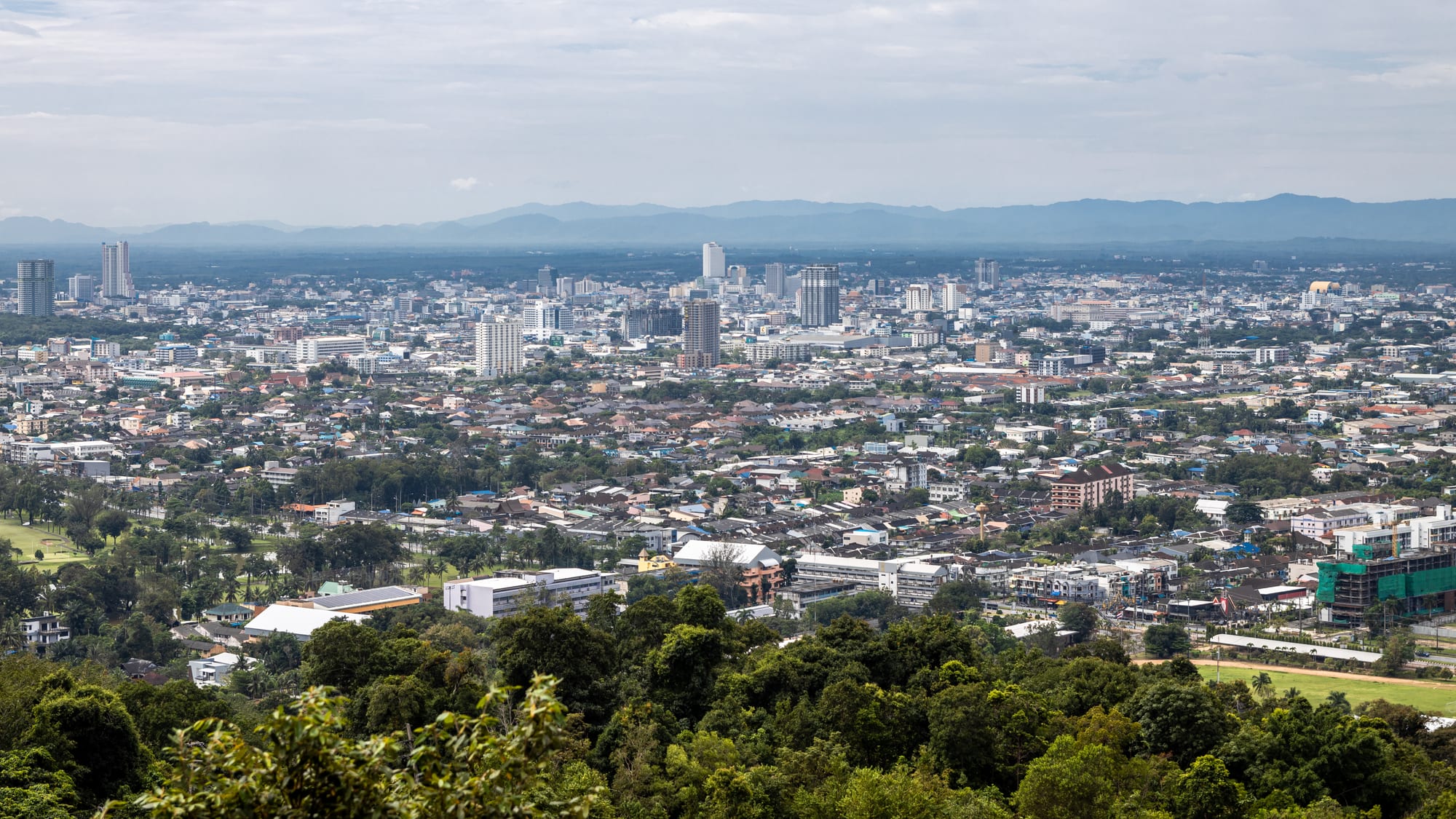
A wide city of low buildings and scattered towers spreading across a green plain towards hazy blue hills

Koh Samui, the Gulf Coast & the Deep South, Thailand

Hat Yai

The skyline of Hat Yai, the largest city of southern Thailand, on the plain of Songkhla province. (Supanut Arunoprayote / Wikimedia Commons · CC BY 4.0)

The largest city of southern Thailand, in Songkhla province near the Malaysian border. It grew from a village into a commercial centre when the southern railway made it a junction in the early twentieth century, and lives today from trade, shopping, hospitals and universities, with Malaysian and Singaporean visitors filling its markets and hotels.

Neighbourhoods

  • The Niphat Uthit streets
    • First-time visitors
    • Shopping
    • Best for food

    The three parallel roads at the heart of the city, named after the man credited with founding it, lined with hotels, gold shops, pharmacies, tailors, restaurants and street stalls. Most visitors stay here, and the night bazaar runs off it.

    Open in Maps
  • Around Kim Yong market
    • Markets
    • Best for food
    • Local life

    The dense block of covered and street market around the city's best-known market building, selling dried seafood, fruit, snacks, clothing and cheap electronics. It is busiest in the morning and at weekends when Malaysian shoppers arrive.

    Open in Maps
  • The railway station quarter
    • Close to public transport
    • Historic district

    The streets around the junction that created the city, with the station clock tower, old shophouses, cheap hotels and the coffee shops where travellers wait for trains south to the border or north to Bangkok.

    Open in Maps
  • Kho Hong and the municipal park
    • Parks
    • Views
    • Quiet and residential

    The hillside district west of the centre, with the large municipal park, its shrines and hilltop Buddha, the university campuses and quieter residential streets under the ridge.

    Open in Maps
  • Khlong Hae
    • Markets
    • Local life
    • Weekends

    A district on the northern edge of the city known for its weekend floating market, where vendors sell food from boats on a canal; otherwise a mix of housing, temples and small businesses.

    Open in Maps

Things to do

Temples and landmarks

  • Wat Hat Yai Nailandmark

    The city's best-known Buddhist temple, holding a reclining Buddha image counted among the largest of its kind in the world.

    Open in Maps
  • Wat Chue Changlandmark

    A Chinese Buddhist temple on Supasarnrangsan Road in the city centre, belonging to the Chinese order of the Thai sangha and long supported by the local Chinese community.

    Open in Maps
  • Phra Phutthamongkhon Maharatlandmark

    A large brass Buddha image on the Kho Hong ridge above the municipal park, cast to mark King Bhumibol's seventy-second birthday and facing the city below.

    Open in Maps
  • Hat Yai Junction railway stationtransit hub

    The junction station that made the city, where the southern line divides towards the Malaysian border at Padang Besar and towards the deep south.

    Open in Maps

Parks and viewpoints

  • Hat Yai Municipal Parkpark

    A large hillside park below the Kho Hong ridge west of the centre, with gardens, shrines, a Guanyin statue on the slope and paths up to viewpoints over the city.

    Open in Maps
  • Ton Nga Chang Waterfallattraction

    A waterfall of seven tiers about 26 kilometres west of the city, in the Ton Nga Chang wildlife sanctuary, its name meaning elephant's tusks in the southern dialect; fullest after rain.

    Open in Maps

Markets and shopping

  • Kim Yong Marketmarket

    The city's landmark market, a warren of stalls selling dried and preserved seafood, fruit, sweets, snacks, clothes and household goods.

    Open in Maps
  • Asian Trade night marketmarket

    One of the city's two big weekend markets on Kanchanavanit Road, with food stalls alongside clothing and household goods.

    Open in Maps
  • Greenway night marketmarket

    The other large weekend market on the same road, an open-air spread of food stalls, grills and seating popular with students and families.

    Open in Maps
  • Khlong Hae Floating Marketmarket

    The first floating market in southern Thailand, held from Friday to Sunday on a canal north of the city, where traders in retro Thai dress sell Thai, southern and Muslim food from boats in coconut shells and bamboo tubes.

    Open in Maps
  • Plaza and department store shoppingattraction

    Air-conditioned shopping centres in the city centre draw cross-border shoppers for clothes, cosmetics and electronics, alongside the older shophouse trade.

    Open in Maps

Short trips from the city

  • Songkhlaattraction

    The old provincial capital about 25 kilometres north-east, between a lagoon and the sea, with Samila beach, an old quarter of shophouses and a national museum.

    Open in Maps
  • Songkhla National Museummuseum

    A museum of southern art and archaeology in the Sino-Thai mansion of the Na Songkhla family, who governed the province; it became a national museum in 1953.

    Open in Maps
  • Songkhla Lakeattraction

    The largest natural lake in Thailand, a shallow lagoon of fishing villages, bird colonies and stilt traps stretching north from Songkhla.

    Open in Maps

Seasonal events

  • Chinese New YearJanuary or February

    Marked across the city by its large Chinese-descended community with shrine offerings, lion dances and street celebrations, and by an influx of visitors from Malaysia and Singapore.

  • Vegetarian FestivalSeptember or October

    The nine-day Chinese festival when devotees abstain from meat, temples and shrines serve vegetarian food and yellow flags appear on stalls across the city.

  • SongkranApril

    Thai new year, with temple merit-making and water throwing along the main streets in the hottest part of the year.

  • Loi KrathongNovember

    Decorated floats of banana leaf and candles are set on the city's canals and ponds on the full moon of the twelfth lunar month.

Eat and drink

Long-standing places and food districts in Hat Yai. Hours, ratings and directions come from your maps app, always current.

Hat Yai classics

  • Hat Yai fried chickenrestaurant

    Kai thot Hat Yai, chicken marinated in spices and fish sauce, deep fried and scattered with crisp fried shallots, sold from stalls and shops across the city and known nationwide.

    Open in Maps
  • Dim sum breakfastsrestaurant

    A local morning habit inherited from the Chinese community — steamer baskets of dumplings and buns eaten with tea or strong local coffee in shophouse restaurants.

    Open in Maps
  • Southern curries and Malay-Muslim foodrestaurant

    Kaeng som, kua kling and kaeng tai pla in Thai kitchens, and roti, satay, khao mok gai and nasi with fish curry in the city's many halal restaurants.

    Open in Maps

Markets and food streets

  • Kim Yong Marketmarket

    Dried squid and fish, preserved fruit, sweets, sauces and snacks sold in bulk, much of it bought by visitors to take home across the border.

    Open in Maps
  • Night market food stallsmarket

    Grilled seafood and skewers, som tam, noodles, roti and fruit shakes fill the evening markets around the centre and the ASEAN bazaar.

    Open in Maps
  • Khlong Hae Floating Marketmarket

    Weekend boats selling grilled fish, curries, southern sweets and coconut desserts to customers on the canal bank.

    Open in Maps

Experience Hat Yai

History

Hat Yai is a young city by Thai standards. The area was farmland and scattered villages until the southern railway was pushed down the peninsula in the early twentieth century, and the line's junction — where the route to the Malaysian border divides from the route into the deep south — turned a small settlement into a town. The original station stood on low, flood-prone ground, and the merchant Khun Nipat Chinnakorn moved the commercial centre to higher land nearby; the three main shopping streets still carry his name.

Trade did the rest. Chinese merchant families settled around the station, and the town grew on rubber and tin from the surrounding provinces and on commerce across the border. By the second half of the twentieth century Hat Yai had overtaken the provincial capital, Songkhla, in size and business, and had become the commercial capital of the whole south, with hospitals, wholesale markets, universities and a growing tourist trade built on Malaysian and Singaporean weekend shoppers.

Two things have marked recent decades. The first is flooding: the city sits on a low plain where canals and the U-Taphao drain slowly, and severe floods have put the centre under water more than once, prompting large drainage works. The worst came in late November 2025, when rain from Cyclone Senyar flooded the city; Songkhla was declared a disaster zone and officially recorded 229 deaths, the heaviest toll of any province, although local accounts put the figure higher. The second is the separatist insurgency in the Malay-Muslim provinces to the south, which resumed on a larger scale in 2004; Hat Yai has been struck by bomb attacks linked to that conflict, most seriously in the 2000s, and visible security has been part of city life since. Trade and visitors have continued through both.

Culture & Customs

Hat Yai is a meeting point of three communities. Thai Buddhists form the majority; a large and long-established Chinese-descended population runs much of the commerce and keeps its shrines, clan associations and festivals, above all Chinese New Year and the nine-day vegetarian festival; and Malay Muslims from Songkhla and the provinces to the south give the city its mosques, its halal restaurants and much of its market trade. Thai, the southern dialect, Chinese dialects and Malay are all heard in the same streets.

The city's culture is commercial rather than ceremonial. Its rhythms are those of markets, wholesale trade, hospitals and universities, and its best-known exports are food and shopping rather than art. Weekends belong partly to visitors from Malaysia and Singapore, who come for markets, restaurants, medical treatment and nightlife, and who have shaped the range of hotels and the trilingual signage across the centre.

Manners are those of the conservative south. Modest dress is expected away from the hotels, shoes come off indoors and in mosques and temples, voices stay calm, and religious buildings of all three traditions are treated with care. The proximity of the conflict in the neighbouring provinces makes political conversation a subject residents approach carefully with strangers, and criticism of the Thai monarchy is a criminal offence.

Daily Life

About 192,000 people lived in the city municipality in 2024 and some 407,000 in the surrounding district, making Hat Yai the largest city of southern Thailand and the fifth largest in the country. Residents live in the shophouse blocks of the centre, in housing estates spreading east and north, and in the university districts under the hills at Kho Hong.

The economy is trade and services: wholesale and retail markets supplying much of the south, cross-border commerce with Malaysia, transport and logistics around the rail junction and the airport, private hospitals that draw patients from across the region, and Prince of Songkla University with its large student population. Rubber and oil palm from the surrounding countryside pass through the city's warehouses and processors.

The day begins with dim sum breakfasts and market deliveries before dawn, slows in the heavy afternoon heat and revives in the evening, when the night markets open and the streets fill. Traffic and parking dominate everyday complaints, alongside drainage and flooding when the monsoon arrives, and the state of the southern economy, which depends heavily on rubber prices and on how freely visitors cross the border.

Food

Hat Yai's signature is kai thot Hat Yai, fried chicken marinated in a mix of spices, garlic and fish sauce, fried until dark and crisp and served under a heap of fried shallots, usually with sticky rice and a sweet chilli sauce. It is sold from stalls, shophouses and dedicated shops across the city and is one of the few regional dishes known by its city's name throughout Thailand.

Breakfast is Chinese. Dim sum — steamer baskets of pork dumplings, buns and spare ribs — is a morning institution here, eaten with tea or with coffee strained through a cloth bag, and jok rice porridge and salapao steamed buns are sold alongside. The southern Thai kitchen supplies the rest of the day: kaeng som, a sour yellow fish curry, kua kling, minced meat dry-fried with turmeric and chilli, kaeng tai pla with fermented fish innards, and khanom jeen rice noodles with curry and a basket of raw vegetables and herbs.

Malay-Muslim cooking is equally present, with roti eaten sweet or with curry, satay, khao mok gai, spiced chicken with rice, and nasi dishes served with fish curry. Kim Yong market sells the products visitors carry home — dried squid and fish, preserved fruit, sweets, sauces and southern coffee — and the night markets grill seafood brought in from both coasts. Bird's nest drinks, durian in season and iced coffee thick with condensed milk round out the city's habits.

Planning tools

Budget

Hat Yai is one of the cheaper cities of its size in Thailand. Hotels in the centre are plentiful and inexpensive, street and market food costs little, and the city is a shopping destination precisely because prices undercut those across the border. Rates rise at weekends, over Chinese New Year and during Malaysian and Singaporean school holidays, when the centre fills.

Daily Budget Midrange
USD 90–210 (resort on Samui, restaurants, ferries, a dive or national park trip)
Daily Budget Shoestring
USD 20–35 (guesthouse room, market and street food, songthaews and walking)

Book a central hotel ahead for weekends and Chinese New Year, and expect the markets to be busiest and most expensive on Saturday.

Best Time to Visit

February to September is the drier half of the year and the easier time to move around, with the vegetarian festival falling in September or October. From about October to December the northeast monsoon brings prolonged heavy rain, and the city and the surrounding lowland are prone to serious flooding, as in late November 2025, when the rains of Cyclone Senyar put much of Hat Yai under water. January is usually clearer and stays busy with cross-border visitors.

Suggested Number of Days

One or two days cover the markets, the temples and the park. Three or four allow for the province around the city — the old lagoon town and the waterfall in the hills — and many travellers stop here only for a night between the border and the rest of the country.

First Visit
1–2 days
With Surroundings
3–4 days

Transportation

Songthaew pick-up trucks run fixed routes across the city for a set fare, and motorcycle taxis, metered taxis and ride-hailing cover the rest. The centre is a grid of one-way streets, congested at market times. Trains and long-distance buses use the station and terminals within or close to the centre, and minivans to the border, Songkhla and the deep south leave from set stops.

Confirm a songthaew's route before boarding, since they run set lines rather than door to door, and agree motorcycle-taxi fares in advance.

Airport & Station Connections

Hat Yai International Airport, about 9 kilometres east of the centre, has flights from Bangkok, other Thai cities and regional destinations and carries more than three million passengers a year, which made it the fifth busiest airport in the country in 2023. The city is the junction of the southern railway, with sleeper trains from Bangkok and services continuing to Padang Besar on the Malaysian border, where connections run to Butterworth and Kuala Lumpur. Buses and minivans link the city with Songkhla, the Andaman coast and Malaysia by road.

Walkability

The commercial centre is compact and walkable, with the main hotels, markets and restaurants inside a grid of a few blocks. Pavements are crowded with stalls and parked motorbikes, traffic is heavy and pedestrian crossings are few, so walking means constant attention. The park, the temples and the outer districts need transport.

Safety

Hat Yai is a busy commercial city and most visits pass without incident, but it sits at the edge of a conflict. In Pattani, Yala, Narathiwat and parts of southern Songkhla, a separatist insurgency has killed thousands since 2004 through bombings and shootings, and many governments advise against all or all but essential travel to those provinces. Hat Yai has also been hit by bomb attacks in the past, among them explosions in the city centre in 2014, and security checks at hotels and shopping centres are routine. Flooding is the other serious hazard: the floods of late November 2025 hit Hat Yai hardest of anywhere in Thailand and killed hundreds of people across Songkhla province. Everyday risks are ordinary ones: road traffic and petty theft in crowded markets.

Avoid Pattani, Yala, Narathiwat and the insurgency-affected districts of Songkhla, keep an eye on official advice and local news while in the city, watch valuables in the markets, and take flood warnings seriously between October and December. Check current official travel advice before travelling.

Climate

Tropical and humid throughout the year, generally between 24 and 34°C, with the seasons set by rainfall. The far south is wetter than most of Thailand, and the heaviest rain comes late in the year with the northeast monsoon.

Summer
hot and comparatively dry from February to September, around 29–34°C, with afternoon thunderstorms
Winter
October to December brings the heaviest rain of the year, with flooding a real risk, and around 24–31°C

Local Customs

Hat Yai is a mixed city of Thai Buddhists, Chinese-descended families and Malay Muslims, and dress and manners are more conservative than in the beach resorts. Shoulders and knees are covered at temples and mosques, shoes come off indoors, and public displays of affection or loss of temper are out of place. Halal food is widely available and alcohol is not served in Muslim-run restaurants. Tipping is not expected.

Dress modestly in markets and religious buildings, ask before photographing people at prayer, and remember that the Thai monarchy is protected by law and criticism of it is a criminal offence.

Common Payment Methods

The currency is the Thai baht. ATMs are everywhere in the centre and charge a fixed fee per foreign withdrawal, and money changers on the main streets handle Malaysian ringgit and Singapore dollars at competitive rates. Hotels, department stores and larger restaurants take cards; the markets, songthaews and street stalls are cash, with QR-code payment through Thai bank apps common among residents.