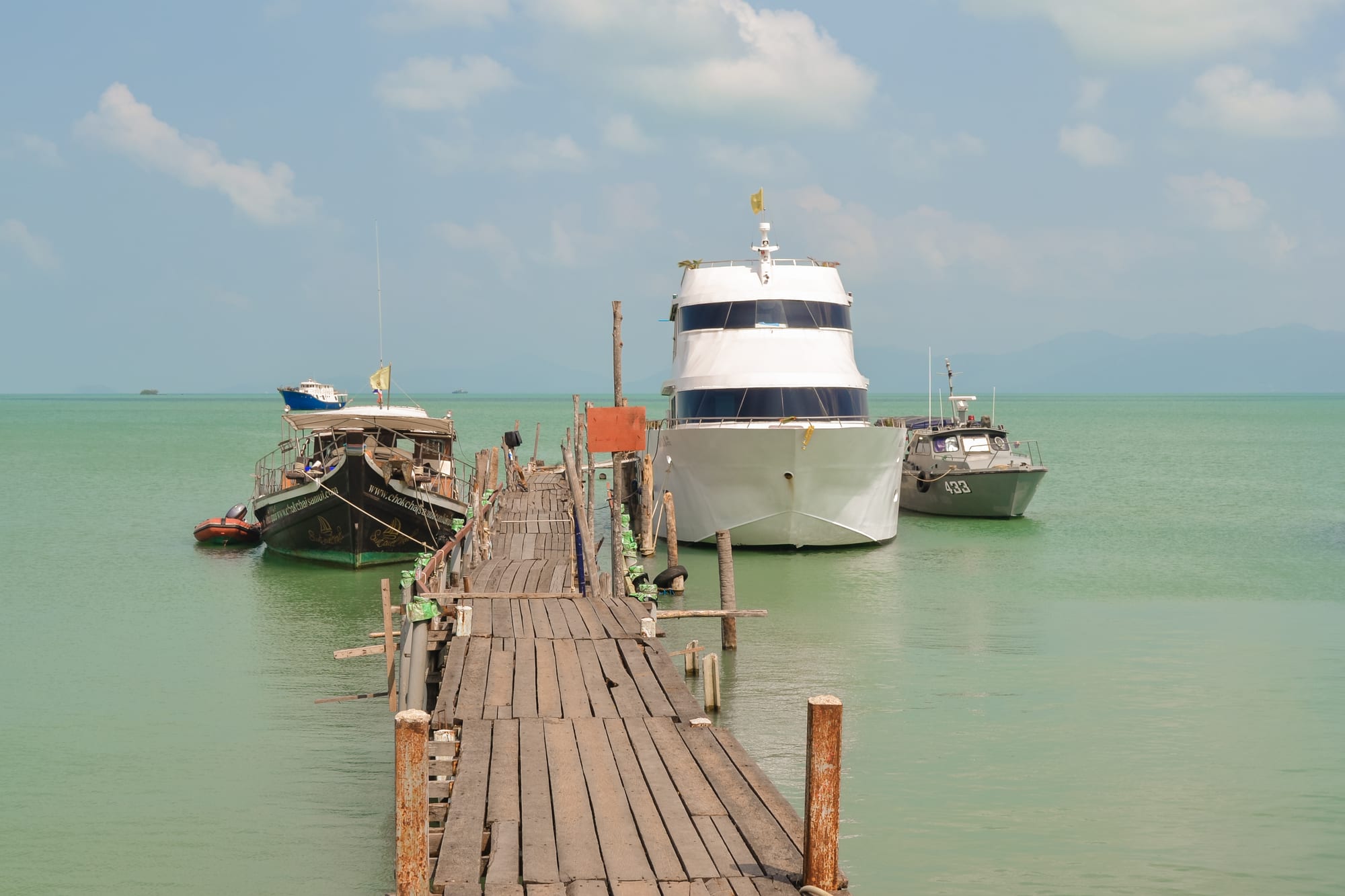
A weathered wooden pier running out over pale green water to a moored white boat and a wooden fishing boat, with hills in the distance

Koh Samui, the Gulf Coast & the Deep South, Thailand

Ko Samui

A wooden boat pier at Bophut on the north coast of Ko Samui. (Ruta Badina / Wikimedia Commons · CC BY-SA 3.0)

Thailand's second-largest island after Phuket and the largest of the Chumphon Archipelago in the Gulf of Thailand, in Surat Thani province, with a mountainous forested interior ringed by a coast road, coconut plantations and a string of beaches. A copra and fishing island until backpackers arrived in the 1970s, it now has an international airport, large resorts and a resident population of tens of thousands.

Neighbourhoods

  • Chaweng
    • First-time visitors
    • Beaches
    • Nightlife

    The long east-coast beach that carries most of the island's tourism, backed by a continuous strip of hotels, shopping centres, bars and restaurants. The sand is wide and white, the water shallow and calm inside a reef, and the noise level the highest on Samui.

    Open in Maps
  • Lamai
    • Beaches
    • Best for food
    • Nightlife

    The island's second resort beach, south of Chaweng, smaller and cheaper, with a night market and a busy bar strip behind the sand. The rock formations of Hin Ta and Hin Yai sit at its southern end.

    Open in Maps
  • Bophut and Fisherman's Village
    • Historic district
    • Best for food
    • Quiet and residential

    An old fishing settlement on the north coast whose lane of Chinese-style wooden shophouses has become a street of restaurants, bars and boutiques. The beach looks north to Ko Pha-ngan, the water is calm, and a walking street fills the lane on Friday evenings.

    Open in Maps
  • Maenam
    • Quiet and residential
    • Beaches
    • Families

    A long, quiet north-coast beach between Bophut and Nathon, with smaller resorts, local shops and a night market, and views across the channel. Boats to Ko Pha-ngan use its pier.

    Open in Maps
  • Choeng Mon and the north-east cape
    • Quiet and residential
    • Beaches
    • Families

    A sheltered bay near the airport and the Big Buddha, with a crescent of sand, a small islet reachable at low tide, and a mix of quiet resorts and villas on the headlands.

    Open in Maps
  • Nathon
    • Local life
    • Close to public transport
    • Markets

    The island's administrative town and main ferry port on the west coast, with government offices, banks, a market, coffee shops and rows of old shophouses. Few visitors stay, but it is where Samui's everyday business is done.

    Open in Maps
  • Taling Ngam and the south-west
    • Quiet and residential
    • Sunsets
    • Views

    The least developed side of the island, with steep hillsides, small bays and views over the islands of Ang Thong. Resorts are spread out and the roads narrow and winding.

    Open in Maps

Things to do

Temples and landmarks

  • Wat Phra Yailandmark

    The temple on the islet of Ko Phan, also spelled Ko Fan, joined to the north-east coast by a short causeway a few kilometres from the airport; its 12-metre gold-painted Buddha, built in 1972, gives Big Buddha Beach its name.

    Open in Maps
  • Wat Plai Laemlandmark

    A modern temple standing in its own lake near the airport, its main image an eighteen-armed Chinese-style Guanyin, with a white statue of the laughing Budai alongside.

    Open in Maps
  • Wat Khunaramlandmark

    A temple on the ring road between Na Muang and Hua Thanon, known for the preserved body of the monk Luang Pho Daeng, who died in 1973 and asked that it be displayed as a reminder of impermanence.

    Open in Maps
  • Hin Ta and Hin Yailandmark

    Weathered granite formations on the shore at the south end of Lamai, called grandfather and grandmother rocks for their suggestive shapes and tied to a local legend of an elderly couple drowned in a storm.

    Open in Maps

Beaches

  • Chaweng Beachbeach

    The long white-sand beach on the east coast where Samui's resort development began, and still its busiest, with calm shallow water behind an offshore reef.

    Open in Maps
  • Lamai Beachbeach

    A curving beach of coarser sand south of Chaweng, with rockier ends, a steeper shelf and a smaller, cheaper resort strip behind it.

    Open in Maps
  • Bophut Beachbeach

    A quiet north-facing beach of darker sand in front of Fisherman's Village, with sheltered swimming and views to Ko Pha-ngan.

    Open in Maps
  • Maenam Beachbeach

    A long, shallow north-coast beach lined with coconut palms, the calmest stretch on the island and the least built up of the main beaches.

    Open in Maps
  • Choeng Mon Beachbeach

    A sheltered bay in the north-east where a sandbar leads at low tide to a small offshore islet.

    Open in Maps

Inland and nature

  • Na Muang Waterfallattraction

    Two waterfalls in the island's interior, the lower one dropping into a pool close to the road, the upper reached by a steep walk through forest.

    Open in Maps
  • Khao Pomviewpoint

    The highest point of Samui's forested central ridge, rising to some 635 metres above the coconut plantations that ring the island.

    Open in Maps
  • Samui's coconut plantationsattraction

    Groves cover much of the lowland and the hill slopes; coconut processing was the island's economy before tourism and still occupies part of it.

    Open in Maps

Markets and nights out

  • Fisherman's Village Walking Streetmarket

    A Friday evening street market along Bophut's old shophouse lane, with food stalls, crafts and live music.

    Open in Maps
  • Lamai night marketmarket

    An evening food market in the middle of Lamai, with grilled seafood, southern curries, noodle stalls and sweets.

    Open in Maps
  • Nathon marketmarket

    The island's main daily market in the port town, selling fish, fruit, vegetables and cooked food to residents rather than visitors.

    Open in Maps
  • Chaweng's bar stripattraction

    The main road behind Chaweng beach holds most of Samui's nightlife, from beach clubs and cabaret to small bars and late-night venues.

    Open in Maps

Short trips from the island

  • Mu Ko Ang Thong National Parkpark

    A national park of 42 forested limestone islands about 28 kilometres from Samui, protected since 1980, with sea caves, viewpoints and inland saltwater lakes, visited on day boats.

    Open in Maps
  • Ko Pha-nganattraction

    The neighbouring island to the north, linked by regular ferries and speedboats, known for Hat Rin's full moon gatherings, quiet northern bays and a jungle interior.

    Open in Maps
  • Ko Taoattraction

    The smaller island further north, reached by boat, with sheltered bays, reefs and a great many dive schools.

    Open in Maps

Seasonal events

  • Samui Regattamid-year

    A week of keelboat racing in the waters off the island, one of the newer events in the island's calendar and an established fixture of Asian sailing.

  • SongkranApril

    Thai new year, marked with temple visits, water pouring over Buddha images and water fights along the beach roads.

  • Loi KrathongNovember

    Small decorated floats of banana leaf and candles are set on the sea and on the island's ponds on the full moon of the twelfth lunar month.

  • Chinese New YearJanuary or February

    Celebrated by Samui's Chinese-descended families with shrine offerings, lion dances and processions in Nathon and the larger villages.

Eat and drink

Long-standing places and food districts in Ko Samui. Hours, ratings and directions come from your maps app, always current.

Samui classics

  • Seafood at Bophut and Bang Porneighborhood

    Restaurants along the north coast serve the day's catch — crab, squid, prawns and whole fish — grilled or steamed with lime and chilli, with tables set close to the water.

    Open in Maps
  • Coconut dishesrestaurant

    Samui's coconut groves show up in the kitchen — coconut milk curries, kaeng khiao wan, and desserts of young coconut flesh, coconut ice cream and sticky rice.

    Open in Maps

Markets and food streets

  • Lamai night marketmarket

    Grilled skewers, som tam, fried chicken, seafood and southern curries sold from stalls and eaten at shared tables, at everyday island prices.

    Open in Maps
  • Fisherman's Village, Bophutneighborhood

    The old shophouse lane holds the island's densest run of restaurants and bars, Thai and international, with a street market taking over on Friday evenings.

    Open in Maps
  • Nathon's shophouse kitchensneighborhood

    Old-style coffee shops and rice-and-curry stalls in the port town, where island residents eat khanom jeen noodles, southern curries and morning coffee.

    Open in Maps

Experience Ko Samui

History

Samui's name may come from a local tree or from a Hainanese phrase brought by early Chinese traders. Oral tradition holds that the island was first settled in about the sixth century by fishermen from the Malay Peninsula, with traders from southern China calling in; from the thirteenth century it lay within Siam's feudal system and worked as an intermediary on the trade between China and India. Chinese immigrants, most of them Hainanese, came in numbers in the nineteenth century and began the island's cotton and coconut plantations, shipping the crop to the mainland by boat.

That isolation lasted a long time. The island had no roads until the early 1970s, when crossing the 15 kilometres from one side to the other could mean a day's trek through the central jungle, and electricity and piped water came later still. Backpackers reached Samui in the same decade, arriving on coconut boats from Surat Thani, and simple bungalows appeared behind Chaweng, where the first resort development began. Ferry services and then the airport, built in 1989 by Bangkok Airways, changed the pace: mass tourism grew through the 1990s, the bungalows gave way to hotels, and Samui became one of Thailand's principal resort destinations, with villas on the headlands and shopping centres behind the beaches.

Growth brought the problems of a small island carrying a large industry — pressure on water and waste, unplanned building on hillsides, land disputes and a road with a bad safety record. Tourism collapsed during the travel closures of 2020 and 2021, when the island's economy had little to fall back on, then returned quickly afterwards. Samui's profile abroad rose again when the third season of an international television series, filmed on the island and elsewhere in Thailand in 2024, was broadcast in 2025.

Culture & Customs

Samui is southern Thai and Buddhist, with a strong Chinese-descended community whose ancestors came from Hainan as traders and planters in the nineteenth century; their temples and shrines stand in Nathon and the older villages, and Chinese New Year is celebrated across the island. Temple life follows the mainland calendar, with merit-making on Buddhist holy days, monks collecting alms in the morning and ordinations attended by whole villages.

Coconuts are the island's oldest identity. Generations lived by planting, harvesting and processing them, and older islanders still speak of Samui as a coconut island first and a resort second. Buffalo fighting, in which two animals push against each other until one turns away, is a southern Thai festival contest held on the island — an old rural custom that sits uneasily with some visitors.

Layered over this is a large foreign and mainland population: long-term residents, hotel and dive workers, and migrant workers who do much of the construction and service work. English is widely spoken in the resort strips and hardly at all in the plantations a few kilometres inland. Visitors are expected to observe temple dress, to keep swimwear to the beach and to treat monks and Buddha images with respect; islanders are used to tourists but not indifferent to bad behaviour.

Daily Life

About 70,000 people were reckoned to be living on Samui in 2023, with more than 200,000 others coming to the island for work. Most live away from the beachfront, in villages along the ring road and on the inland lanes, while the shoreline is occupied by hotels, villas and businesses. Nathon holds the district offices, the hospital, banks and the main market, and is the practical centre of island life.

Tourism supports nearly everything: hotels and restaurants, boat operators, dive schools, transport, construction and the shops that supply them. Coconut plantations still work the hills, and fishing families put out from the northern villages, but neither employs many people now. Wages depend on the season, which runs high from about December to August and slack in the wet months when many staff return to the mainland.

The day starts early, with markets open before dawn, schoolchildren on the ring road and boats loading at Nathon. Afternoons are hot and quiet, and evenings busy along the beach roads. The island's recurring problems are practical ones: fresh water, rubbish disposal, road accidents, traffic on a single circular road, and the strain of building on steep ground where heavy rain brings landslides and flooding.

Food

Samui's cooking is southern Thai with the sea and the coconut at its centre. Local kitchens serve kaeng som, a sour orange fish curry made hot with fresh turmeric, kua kling, minced pork or beef dry-fried with a fierce spice paste, and kaeng tai pla, a pungent curry of fermented fish innards eaten with rice and a plate of raw vegetables. Khanom jeen, fresh rice noodles topped with curry and piled with herbs, is a standard breakfast.

Seafood is the obvious pleasure: blue swimming crab, squid, prawns and whole grouper or snapper, grilled over charcoal or steamed with lime, garlic and chilli, and pu phat phong karee, crab stir-fried with curry powder and egg. Restaurants on the north coast and at the fishing piers buy from local boats, and the night markets sell the same fish more cheaply on skewers.

The coconut runs through the rest. Curries are built on fresh coconut milk, the young flesh goes into desserts and drinks, and coconut sugar sweetens sticky rice and grilled bananas. Island sweets include khanom tom, coconut-filled rice balls, and kalamae, a dark, chewy coconut toffee sold in blocks that is Samui's usual gift to take home. Fruit stalls sell rambutan, mangosteen and durian in season, and every village has a coffee shop brewing strong, sweet local coffee.

Planning tools

Budget

Samui is one of Thailand's more expensive destinations, with five-star resorts and villas on the headlands and beachfront prices in Chaweng and Bophut, especially from December to February. It is also possible to stay cheaply: guesthouses inland, night market food and songthaew rides cost little, and Maenam and Lamai are far cheaper than Chaweng. Flights into Samui's private airport are costly, which pushes some visitors to the ferry route instead.

Daily Budget Midrange
USD 90–210 (resort on Samui, restaurants, ferries, a dive or national park trip)
Daily Budget Shoestring
USD 30–55 (guesthouse room, night market food, shared songthaews, a beach day)

Compare the Surat Thani flight-and-ferry route with flying direct to Samui, and expect resort rates to double over the Christmas and New Year weeks.

Best Time to Visit

The Gulf coast runs on a different calendar from the Andaman side. February to September is the drier half of the year, with calm seas and the best beach weather in the middle of it. October to December brings the northeast monsoon, heavy rain and rough crossings. January is often a clearing month and stays busy; the peak of prices and crowds is December to February.

Suggested Number of Days

Four or five days suit a first visit. A week or more is usual for anyone adding the neighbouring islands and the marine park by boat, or simply staying put on one beach. Wet-season trips often need a spare day in hand for boat delays.

First Visit
4–5 days
With Surroundings
7–10 days

Transportation

A single ring road, route 4169, circles the island, and most traffic uses it. Songthaews — pick-up trucks with bench seats — run set routes along it during the day, taxis and ride-hailing operate in the resort areas, and rented cars, scooters and hotel minibuses cover the rest. The interior has only rough tracks, so crossing the island means going round it.

Agree a taxi fare before setting off, since fares are often not metered, and treat the ring road with care: it is fast, busy and has a poor accident record.

Airport & Station Connections

Samui Airport, in the north-east near Bophut, was built and is owned by Bangkok Airways, which has been the only airline flying to the island from mainland Thailand since the airport opened. The cheaper route is a flight, train or bus to Surat Thani on the mainland, then a car and passenger ferry from Don Sak to Lipa Noi or Nathon on the west coast. Boats also link Samui with Ko Pha-ngan and Ko Tao.

Walkability

Each beach area is walkable — Chaweng's strip, Lamai's centre, Bophut's shophouse lane and Nathon's grid are all covered on foot — but the island as a whole is not. Distances between beaches run to several kilometres along a road with narrow or missing pavements, no lighting in places and steep sections, so most journeys need transport.

Safety

Samui is generally safe, and the main dangers are traffic and water. Scooter and motorbike crashes on the ring road and the steep hill roads are the leading cause of serious injury to visitors, and rented bikes are often ridden without licences or helmets. Drownings occur in the monsoon surf and in strong currents off the east coast, jellyfish appear seasonally, and drink spiking and theft happen in the nightlife areas.

Ride only with a licence and a helmet and photograph a rented bike before taking it, watch drinks in bars, swim where others swim and heed warning flags, and use hotel safes for passports and cash. Check current official travel advice before travelling.

Climate

Tropical, hot and humid all year, with temperatures mostly between 25 and 34°C and the seasons defined by rain rather than heat. The island is sheltered from the southwest monsoon, so its wet season comes late in the year with the northeast monsoon.

Summer
hot and mostly dry from February to September, around 28–34°C, with short afternoon showers and calm seas
Winter
October to December is the wet season, with heavy rain, storms, rough crossings and around 24–30°C; January begins to clear

Local Customs

Ordinary Thai courtesies apply: shoes off indoors and in temples, shoulders and knees covered at Wat Phra Yai and other temples, no touching anyone's head, and calm voices in disagreements. Swimwear stays on the beach rather than in shops and restaurants, and nudity is illegal. Tipping is not required, though small change is appreciated. Buddha images are religious objects, not decoration, and posing with them for photographs causes offence.

Cannabis was decriminalised in 2022 and shops opened across the island, but rules tightened in 2025 classed the flower as a controlled herb and limited legal sales to medical use; other drugs carry severe penalties, and taking any of it across a border is a serious offence.

Common Payment Methods

The currency is the Thai baht. Cards are accepted at resorts, supermarkets, larger restaurants and dive schools, often with a surcharge, while markets, songthaews, small kitchens and boat tickets run on cash. ATMs are widespread and charge a fixed fee per foreign withdrawal, so fewer, larger withdrawals cost less.