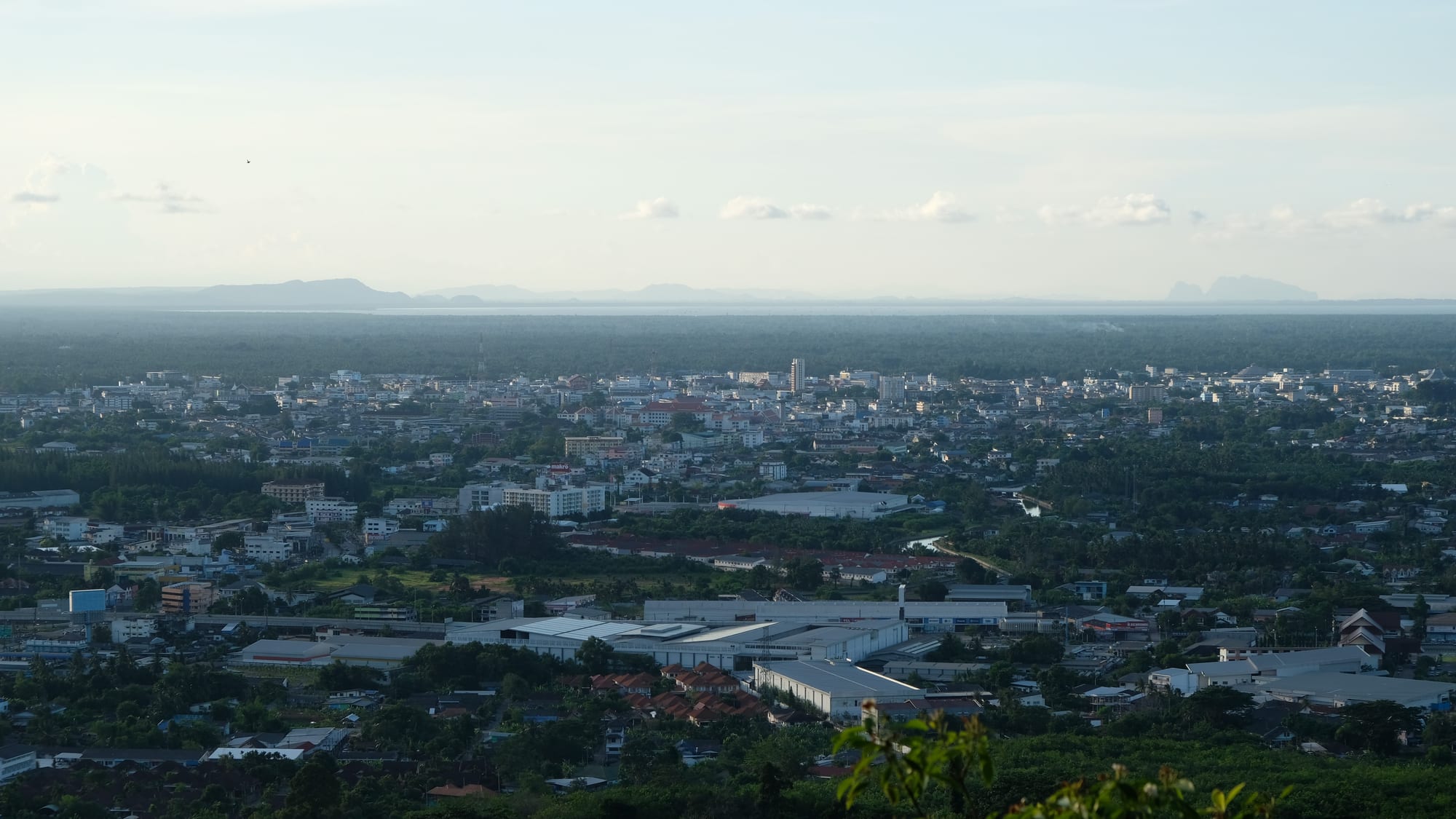
A low-rise city of white and pale buildings spread across a green plain, with distant hills and islands on the hazy horizon

Koh Samui, the Gulf Coast & the Deep South, Thailand

Surat Thani

Surat Thani seen from a hill above the city, on the plain of the Tapi River. (ILikelargeFries / Wikimedia Commons · CC0)

The capital of Thailand's largest southern province, on the Tapi River a few kilometres from the Gulf coast. Known as Ban Don before it was renamed in 1915, it grew as a river port trading coconut, rubber and rambutan, and is now the mainland gateway to Ko Samui and its neighbours and the way in to Khao Sok's rainforest.

Neighbourhoods

  • Ban Don and the riverfront
    • First-time visitors
    • Best for food
    • Historic district

    The old core along the Tapi, named for the settlement that preceded the city. Shophouses, gold shops, Chinese shrines and the night boat pier line the river road, and most of the city's hotels and restaurants sit within a few blocks of it.

    Open in Maps
  • Talat Mai and the market quarter
    • Markets
    • Best for food
    • Local life

    The grid of streets behind the riverfront around the fresh market, busy from before dawn with produce, fish and cooked food. Cheap hotels, coffee shops and the city's day-to-day shopping are all here.

    Open in Maps
  • Ko Lamphu
    • Parks
    • Quiet and residential
    • Walks

    A car-free island in the middle of the Tapi, reached by bridge and used as the city's park — paths under trees, exercise grounds, playgrounds and evening food stalls, with the river on both sides.

    Open in Maps
  • Around the bus terminals and the west of the city
    • Close to public transport
    • Quiet and residential

    The modern spread inland, with the long-distance bus terminals, shopping centres, hospitals and newer housing. It is convenient for onward travel but has little of the older city's character.

    Open in Maps
  • Phunphin
    • Close to public transport
    • Local life

    A separate town west of the city with the province's main railway station on the southern line. Travellers change here for buses and minivans to the city, the piers and the islands.

    Open in Maps

Things to do

In the city

  • Ko Lamphupark

    A low island in the Tapi River about a kilometre long, reached by a bridge near the city pillar shrine and used as a park for picnics, sport and evening food stalls, with a riverside walk looking back at the city.

    Open in Maps
  • Surat Thani City Pillar Shrinelandmark

    The shrine housing the city's foundation pillar, a Chinese-influenced building where residents make offerings for protection and good fortune.

    Open in Maps
  • The riverside Chinese shrineslandmark

    Shrines along and behind the river road, built by the merchant families who ran the port trade, and busy at Chinese festivals.

    Open in Maps
  • Ban Don piertransit hub

    The river pier used by the overnight boats to Ko Samui and Ko Pha-ngan, and by local ferries and cargo, at the heart of the old town.

    Open in Maps

Markets

  • The fresh marketmarket

    The city's main daily market, behind the riverfront, trading fish from the Gulf, oysters, river prawns, fruit and cooked food from early morning.

    Open in Maps
  • The riverfront night marketmarket

    An evening street market near the river road, with grilled seafood, southern curries, noodles and sweets sold to eat on the spot or take away.

    Open in Maps
  • Ko Lamphu evening stallsmarket

    Food and drink stalls that set up by the park island in the cooler part of the day, popular with families and exercisers.

    Open in Maps

Temples and nature near the city

  • Khao Tha Phettrail

    A wooded hill of about 210 metres on the edge of the city, with walking paths and a view over the town and the Tapi plain.

    Open in Maps

Short trips from the city

  • Wat Phra Borommathat Chaiyalandmark

    A stupa at Chaiya of Srivijaya origin, restored over the centuries and among the most important early Buddhist monuments in southern Thailand.

    Open in Maps
  • Suan Mokkhlandmark

    The forest monastery founded in 1932 by the monk Buddhadasa Bhikkhu, known internationally for its meditation retreats and its teaching on Buddhism stripped of ritual.

    Open in Maps
  • Khao Sok National Parkpark

    Rainforest, limestone peaks and the flooded valleys of Cheow Lan Lake, with floating raft houses, caves and some of the oldest forest in the region.

    Open in Maps
  • Chaiya National Museummuseum

    A small museum beside the Chaiya stupa holding Srivijaya-period bronzes and stone sculpture found in the district.

    Open in Maps

Seasonal events

  • Chak Phra festivalOctober, at the end of Buddhist Lent

    Surat Thani's biggest festival, when decorated Buddha images are pulled through the streets and along the Tapi on boats, with longboat racing on the river.

  • Rambutan FairAugust

    A provincial fair in early August marking the fruit harvest in a province that has grown rambutan since the 1920s, with produce displays, decorated boats on the Tapi and contests.

  • SongkranApril

    Thai new year, with temple merit-making, water poured over Buddha images and water throwing in the streets.

  • Loi KrathongNovember

    Candlelit floats set on the Tapi River on the full moon of the twelfth lunar month.

Eat and drink

Long-standing places and food districts in Surat Thani. Hours, ratings and directions come from your maps app, always current.

Surat Thani classics

  • Surat Thani oystersrestaurant

    The province is the largest oyster-farming area in Thailand, growing a big oyster on stakes in the coastal shallows; it is slurped raw from the half shell with lime, chilli and crisp shallots, or fried with egg and flour.

    Open in Maps
  • Southern curry shopsrestaurant

    Rice-and-curry shops serve the southern repertoire — sour yellow kaeng som, dry-fried kua kling and pungent kaeng tai pla — with a plate of raw vegetables.

    Open in Maps

Markets and food streets

  • The riverfront night marketmarket

    Grilled seafood, southern curries, noodle stalls, khanom jeen and sweets in the streets near the river, the easiest introduction to the local kitchen.

    Open in Maps
  • The fresh marketmarket

    The daily market behind the riverfront, where fish, oysters, river prawns and southern fruit arrive early and cooked-food vendors work alongside the produce stalls.

    Open in Maps
  • Riverfront coffee shopsneighborhood

    Old-style kopi shops in the shophouse streets brew strong, sweet coffee poured through a cloth filter, served with toast, custard or rice porridge in the morning.

    Open in Maps

Experience Surat Thani

History

The river mouth of the Tapi has been settled for well over a thousand years. Chaiya, a short way north of the modern city, was a centre of the Srivijaya world, and its stupa and the bronzes found around it place the area among the earliest Buddhist centres in the peninsula. The area later fell under the influence of Nakhon Si Thammarat and then Ayutthaya, while trade continued along the coast and up the river.

The city itself grew as Ban Don, a river port where produce from the interior — coconut, rubber, fruit and timber — was loaded for Bangkok and where Chinese merchants settled and built the shophouses and shrines that still stand along the waterfront. In 1915 King Vajiravudh, Rama VI, gave the town the name Surat Thani, meaning the city of good people, and the province took the same name. The southern railway reached Phunphin to the west and fixed the city's role as a regional hub.

Twentieth-century Surat Thani became the administrative and commercial centre of the largest province in southern Thailand, with an airport, a university and the piers that feed the island trade. Tourism arrived indirectly: as Ko Samui, Ko Pha-ngan and Ko Tao grew from the 1970s onwards, the city became the point where travellers change from train, bus or plane to a boat, and where much of the islands' supplies and workforce still come from. Flooding remains a recurring event along the Tapi, and the river's condition and the growth of the city outwards are continuing local concerns.

Culture & Customs

Surat Thani is southern Thai and Buddhist, with a long-established Chinese-descended merchant community whose shrines, clan associations and festivals are woven into city life; Chinese New Year and the vegetarian festival are both marked along the riverfront. The southern dialect, fast and clipped, is spoken everywhere, and the city keeps the southern arts of nora dance-drama and nang talung shadow puppetry alive at temple fairs, though their heartland lies further south.

The city's own festival is Chak Phra, held at the end of Buddhist Lent in October, when Buddha images are drawn through the streets on decorated carriages and floated down the Tapi on boats, accompanied by longboat racing and by the gift of sweet rice and coconut. It is the largest gathering of the year and draws people from across the province.

Provincial identity is agricultural. Surat Thani is proud of its rambutans, grown here since the 1920s, its oysters, and its coconut plantations, where pig-tailed macaques have traditionally been trained to pick the nuts, a practice that has become internationally controversial and which several producers have moved away from. Visitors are expected to observe ordinary Thai courtesies; this is a city where people are working rather than hosting tourists, and politeness rather than familiarity is the usual register.

Daily Life

About 132,000 people lived in the city municipality at the 2019 count, with many more in the surrounding districts, making it one of the larger cities of southern Thailand. Life concentrates on the river in the old centre and on the newer commercial spread inland, where the bus terminals, shopping centres, hospitals and university campuses sit among housing estates.

The economy rests on agriculture and trade rather than tourism: rubber and oil palm from the plantations inland, coconuts, rambutans and other fruit, oysters and cockles from the estuaries, and fishing from the Gulf. The city processes, finances and ships all of it, and adds the government offices of a large province and the transport business generated by the islands, whose supplies, staff and visitors pass through here.

The day starts early, with the fresh market working before dawn and coffee shops full by seven, and slows in the afternoon heat before the night markets and the riverside fill again. Motorbikes dominate the streets. The recurring local problems are flooding in the late-year monsoon, traffic on the roads out to the piers and the airport, and the pressure of rubber and palm prices on the rural economy that the city serves.

Food

Surat Thani eats southern Thai food with an estuary's supply of shellfish. Oysters, farmed on stakes in the coastal shallows of what is the country's largest oyster-growing area, are the local speciality, served raw with lime, chilli paste, fried shallots and a bundle of leaves to wrap them in, or fried with egg and flour into a crisp pancake. River prawns, blue swimming crab, squid and sea fish arrive at the fresh market each morning and end up grilled over charcoal in the night markets.

The staple cooking is hot and sour. Kaeng som, a fierce yellow curry of fish with vegetables sharpened with tamarind, kua kling, minced meat dry-fried with turmeric and chilli, and kaeng tai pla, made with fermented fish innards, are eaten with rice and a plate of raw vegetables and bitter sato beans. Khanom jeen, fresh rice noodles served with a choice of curries and a basket of herbs, is the classic breakfast, alongside jok rice porridge and coffee poured through a cloth filter in the old shophouse cafés.

Fruit is a point of provincial pride. Rambutans ripen in the middle of the year and are celebrated with their own fair; mangosteen, longkong and durian follow in season, and coconut appears in curries, sweets and drinks. Salted duck eggs from Chaiya, their yolks firm and orange, are the standard souvenir to take home, and Chaiya is also known across Thailand for them.

Planning tools

Budget

Surat Thani is an inexpensive working city rather than a resort, and costs here are a fraction of those on Samui. Hotels near the river and the bus terminals are cheap, market food costs little, and the main expenses for most travellers are onward transport — ferry and bus tickets to the islands or to Khao Sok — rather than anything in the city itself.

Daily Budget Midrange
USD 90–210 (resort on Samui, restaurants, ferries, a dive or national park trip)
Daily Budget Shoestring
USD 20–35 (guesthouse room, market food, local songthaews and shared taxis)

Buy ferry and bus tickets at the terminals or the piers rather than through street agents, and compare the train to Phunphin with the overnight bus from Bangkok.

Best Time to Visit

February to September is the drier half of the year, when island boats run reliably and Khao Sok is easiest to visit. October to December brings the northeast monsoon, with heavy rain and a real risk of flooding along the Tapi. October is also when the Chak Phra festival fills the city, and August brings the rambutan harvest and its fair.

Suggested Number of Days

Most travellers pass through in a day, using the city as a transit point. Three or four days allow time for the province around it — the historic district to the north and the rainforest inland — and a night here is often needed anyway to fit boat and bus connections together.

First Visit
1 day
With Surroundings
3–4 days

Transportation

The city is served by songthaews on fixed routes, motorcycle taxis and metered or negotiated taxis, and long-distance buses and minivans leave from terminals on the edge of town. Ferry company buses connect the city with the piers at Don Sak and Tapi for the islands. Distances within the centre are short, and many visitors walk between the river, the market and their hotel.

Check which terminal an onward bus or minivan leaves from before setting out, as the city has several and they are some way apart.

Airport & Station Connections

Surat Thani International Airport, about 20 kilometres west, has flights from Bangkok and other Thai cities and is a cheaper way into the region than flying to Samui. The railway station is at Phunphin, west of the city, on the southern line from Bangkok, which runs overnight sleepers. Buses run from Bangkok and the southern cities; the fast catamarans use Tapi pier in the city, while the vehicle ferries to Ko Samui and Ko Pha-ngan leave from Don Sak, about 65 kilometres east, reached by connecting coach.

Walkability

The old centre along the river is compact and easy on foot, with the market, the shrines, the pier and most hotels within about a kilometre. Pavements are uneven and often occupied by parked motorbikes and stalls, the heat is strong at midday, and the newer districts inland are spread out and built for traffic.

Safety

Surat Thani is a provincial city with low levels of crime against visitors, and the main risks are traffic and weather. Crossing busy roads and riding motorbikes are the usual causes of injury. Heavy rain in the northeast monsoon can flood parts of the city and the surrounding lowland, and overcharging or unreliable tickets from informal travel agents around the pier and bus areas are a common complaint.

Buy transport tickets from official counters, watch traffic carefully at junctions, and follow local warnings during heavy rain in October to December. Check current official travel advice before travelling.

Climate

Tropical and humid all year, generally between 24 and 35°C, with rain rather than temperature marking the seasons. Sheltered from the southwest monsoon, the province takes its heaviest rain late in the year.

Summer
hot and comparatively dry from February to September, often 30–35°C by day, with afternoon storms
Winter
October to December is the wet season, with prolonged heavy rain, flooding along the Tapi and around 24–31°C

Local Customs

This is a working southern city with few tourists in its everyday life, so ordinary Thai manners matter: shoulders and knees covered at temples and shrines, shoes off indoors, calm voices, and no touching anyone's head. Monks collect alms early in the morning and should not be touched by women. Tipping is not expected, though small change is left at restaurants.

Ask before photographing market traders or people at prayer in the Chinese shrines, and dress modestly when visiting the temples at Chaiya.

Common Payment Methods

The currency is the Thai baht. ATMs are plentiful in the centre and charge a fixed fee per foreign withdrawal. Hotels, supermarkets and larger restaurants take cards, but the markets, songthaews, motorcycle taxis and small kitchens are cash only, and QR-code payment through Thai bank apps is now common among local customers.