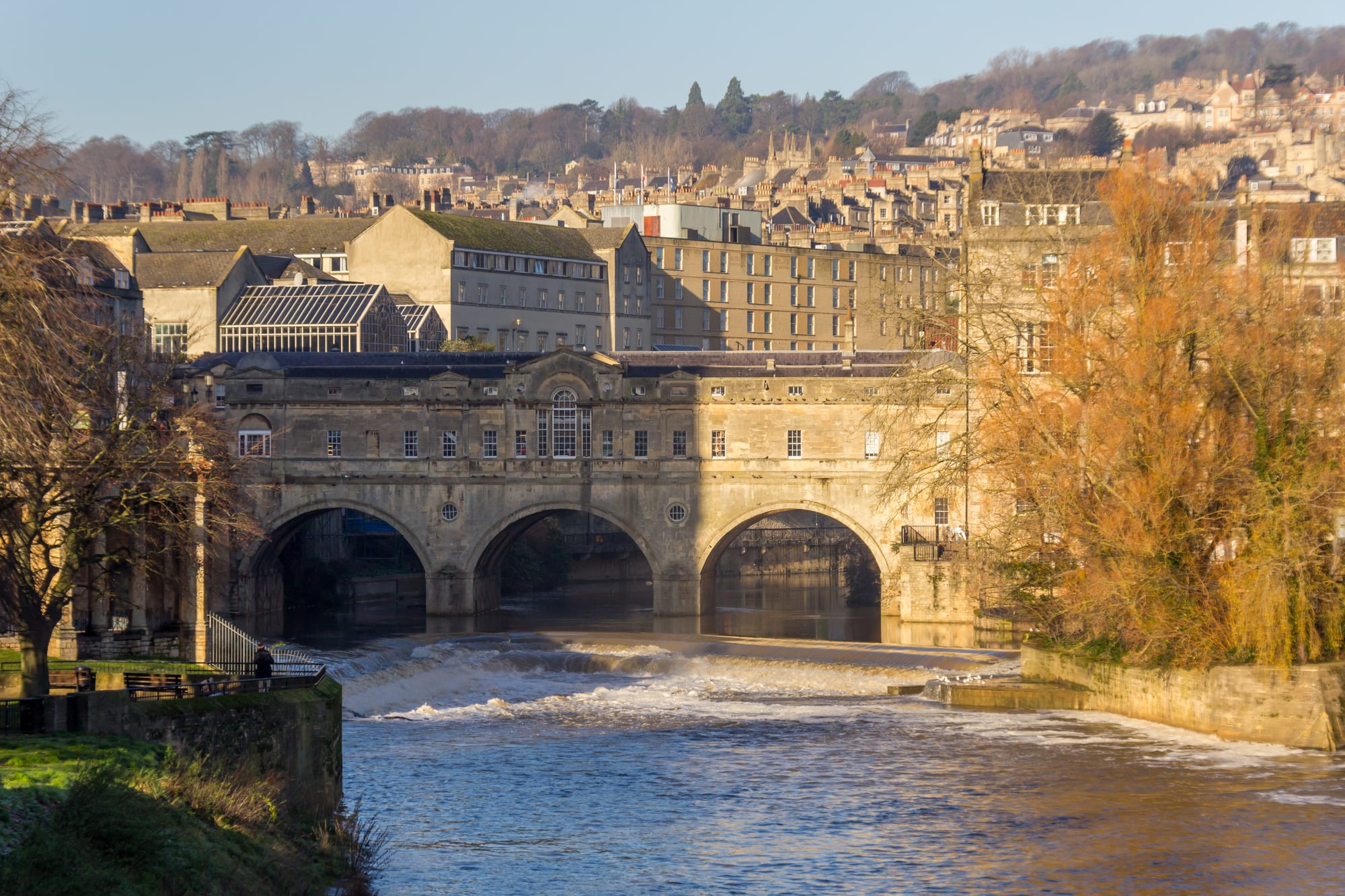
Pulteney Bridge's three stone arches over the River Avon and its curved weir, with Bath's stone terraces rising up the hill behind

South West England, United Kingdom

Bath

Pulteney Bridge and the weir on the River Avon in Bath. (Mike Peel / Wikimedia Commons · CC BY-SA 4.0)

A city in the valley of the River Avon in Somerset, named after the hot springs the Romans enclosed as Aquae Sulis. Rebuilt in honey-coloured Bath stone as the most fashionable spa of Georgian England, it is a World Heritage Site twice over and today a university, rugby and tourist city of about 94,000 people.

Neighbourhoods

  • The city centre and Abbey quarter
    • First-time visitors
    • Close to public transport
    • Historic district

    The compact core around Bath Abbey, the Roman Baths and the Pump Room, with Milsom Street's shops, the SouthGate shopping centre and the railway and bus stations a few minutes' walk to the south. Busy with visitors and buskers by day.

    Open in Maps
  • The Upper Town: the Circus and Royal Crescent
    • Architecture
    • Georgian Bath
    • Quiet and residential

    The grand Georgian quarter laid out by John Wood the Elder and his son on the slope above the centre, with the Circus, the Royal Crescent, the Assembly Rooms and Royal Victoria Park.

    Open in Maps
  • Bathwick and Great Pulteney Street
    • Architecture
    • Parks
    • Quiet and residential

    The planned Georgian district across the river, reached over Pulteney Bridge. Great Pulteney Street, more than 1,000 feet long and 100 feet wide, runs past Laura Place to the Holburne Museum and Sydney Gardens, with the Kennet and Avon Canal beyond.

    Open in Maps
  • Walcot and Kingsmead
    • Independent shops
    • Best for food
    • Nightlife

    The streets just north and west of the Abbey quarter, with shops, bars and restaurants; Kingsmead Square, with its taxi rank, is one of the livelier corners after dark.

    Open in Maps
  • Widcombe and the southern hills
    • Walks and viewpoints
    • Quiet and residential

    South of the river and the station, where residential streets climb towards Prior Park and the hills of the Bath Skyline walks, and the Kennet and Avon Canal meets the Avon.

    Open in Maps

Things to do

Roman and Georgian landmarks

  • Roman Bathslandmark

    The Roman bathing complex and temple built around the hot spring of the goddess Sulis, with the open-air Great Bath and Roman, medieval and Georgian buildings around it.

    Open in Maps
  • Bath Abbeylandmark

    The abbey church founded in the 7th century, where King Edgar was crowned in 973; it was rebuilt on a smaller scale from 1500 and restored as the city's parish church.

    Open in Maps
  • Royal Crescentlandmark

    John Wood the Younger's curved terrace of about 30 houses behind a single façade of Ionic columns, built between 1767 and 1774 above Royal Victoria Park.

    Open in Maps
  • The Circuslandmark

    Three curved terraces forming a circle, designed by John Wood the Elder, who died less than three months after the first stone was laid in 1754; his son completed it.

    Open in Maps
  • Pulteney Bridgelandmark

    Robert Adam's three-arched bridge of around 1770, lined with shops on both sides, modelled on an unused Palladio design for the Rialto Bridge in Venice.

    Open in Maps
  • Bath Assembly Roomslandmark

    The Georgian assembly rooms at the heart of the fashionable city of Beau Nash's day, burnt out in the bombing of 1942 and reopened after restoration in 1963.

    Open in Maps
  • Thermae Bath Spaattraction

    The spa opened in 2006 that lets visitors bathe in the city's naturally heated spring water, including a rooftop pool.

    Open in Maps

Museums

  • Holburne Museummuseum

    An art museum at the end of Great Pulteney Street in Bathwick, at the edge of Sydney Gardens.

    Open in Maps
  • Victoria Art Gallerymuseum

    The city's public art gallery in the centre of Bath.

    Open in Maps
  • Herschel Museum of Astronomymuseum

    The town house where William Herschel discovered Uranus in March 1781 with a telescope built in its workshop, opened as a museum exactly 200 years later.

    Open in Maps
  • Jane Austen Centremuseum

    An exhibition on the novelist, who lived at four addresses in Bath with her family from 1801 to 1806.

    Open in Maps

Parks, gardens and the river

  • Royal Victoria Parkpark

    The large park below the Royal Crescent, which hosts carnivals and seasonal events.

    Open in Maps
  • Sydney Gardenspark

    Gardens at the end of Great Pulteney Street that Jane Austen wrote it would be pleasant to live near.

    Open in Maps
  • Parade Gardenspark

    Riverside gardens in the centre of the city, beside the Avon.

    Open in Maps
  • Kennet and Avon Canaltrail

    The canal completed in 1810 to link the Avon at Bath with the Kennet and the Thames, restored in the late 20th century, with a towpath for walking and cycling.

    Open in Maps
  • Prior Park Landscape Gardenpark

    The Neo-Palladian house John Wood the Elder designed for Ralph Allen on a hill overlooking Bath, with a landscape garden and a Grade I listed bridge under Palladian arches.

    Open in Maps

Sport and stage

  • The Recreation Groundattraction

    The riverside ground of Bath Rugby, with a rugby ground holding about 14,500 people; cricket is also played here in summer.

    Open in Maps
  • Theatre Royalattraction

    The Georgian theatre in the city centre, one of the city's main stages.

    Open in Maps

Short trips from the city

  • Wells Cathedrallandmark

    The cathedral of the small city of Wells, the seat of the Bishop of Bath and Wells, reached by bus from Bath.

    Open in Maps

Seasonal events

  • Bath Literature FestivalMay

    A literature festival, with a counterpart for children, which in 2025 ran side by side with the Bath Music Festival in May.

  • Bath Fringe Festivallate May to early June

    One of the oldest continually running fringe festivals in England, with around 200 events over 17 days.

Eat and drink

Long-standing places and food districts in Bath. Hours, ratings and directions come from your maps app, always current.

Bath classics

  • Sally Lunn'scafe

    A refreshment house and small museum in North Parade Passage, known for the Sally Lunn bun, a large teacake long baked in Bath.

    Open in Maps
  • The Pump Roomrestaurant

    The heart of Georgian Bath beside the Roman Baths, where spa water from a bore-hole sunk in 1983 is drawn for drinking.

    Open in Maps
  • Guildhall Marketmarket

    The daily covered market behind the Guildhall, where a stall sells Bath chaps, the salted and smoked cheek of the pig.

    Open in Maps

Food districts

  • Kingsmead Squareneighborhood

    A small square west of the centre with cafés and restaurants, busy into the evening.

    Open in Maps
  • Pubs and restaurants around the Abbeyneighborhood

    Cafés, tea rooms and restaurants in the streets and passages between the Abbey, the Pump Room and the river.

    Open in Maps

Experience Bath

History

The hot springs of the Avon valley were sacred before the Romans arrived; the Britons dedicated them to the goddess Sulis, whom the Romans equated with Minerva. Around AD 60 the Romans built baths and a temple here and called the town Aquae Sulis, "the waters of Sulis". After Rome, King Alfred laid the town out afresh with an abbey precinct in its south-east quarter, and in 973 King Edgar was crowned in Bath Abbey in a ceremony that formed the basis of later English coronations. By the 15th century the abbey church was dilapidated, and Bishop Oliver King began rebuilding it on a smaller scale in 1500.

The springs revived Bath as a spa under Elizabeth I, and in the Georgian era it became perhaps the most fashionable spa in Britain. Ralph Allen's quarries supplied the honey-coloured Bath stone; John Wood the Elder and his son laid out new quarters of uniform terraces, including the Circus and the Royal Crescent; Robert Adam designed Pulteney Bridge; and Beau Nash presided over the city's social life until his death in 1761. Jane Austen lived here from 1801 to 1806 and never much liked it.

Over three nights in April 1942 Bath was bombed in the Baedeker raids, which burnt out houses in the Royal Crescent, the Circus and the Paragon along with the Assembly Rooms. The city was made a UNESCO World Heritage Site in 1987, and in 2021 it was listed again as one of the Great Spas of Europe. Thermae Bath Spa, the SouthGate shopping centre and riverside developments have followed since 2000.

Culture & Customs

Bath lives off its heritage and celebrates it. More than six million visitors a year come for the Roman Baths, the Abbey and the Georgian streets, and the city honours Jane Austen with the Jane Austen Centre and a walking route despite her low opinion of the place. Its museums include the Victoria Art Gallery, the Holburne Museum and the Herschel Museum of Astronomy, and the Theatre Royal is one of the city's main stages.

The festival calendar is full. In 2025 the Bath Literature Festival and the Bath Music Festival ran side by side in May, and there is a children's literature festival too; the Bath Fringe, one of the oldest in England, fills the end of May and early June with around 200 events; and the city also holds Mozartfest, film, digital and beer festivals, with Bach festivals every two and a half years.

Above all, Bath is a rugby city — in the words of a former head coach, "a Georgian city, a Roman city, but more so than that, it's a rugby city". Bath Rugby, founded in 1865, plays at the Recreation Ground in the centre and is the joint-most successful club in England. In June 2025 it won its first Premiership title in 29 years to complete a treble, and the players paraded on open-top buses across Pulteney Bridge to the Abbey.

Daily Life

About 94,000 people lived in Bath's built-up area at the 2021 census, making it the largest city in Somerset; it is the main town of the Bath and North East Somerset council area, where the Liberal Democrats won a large majority in 2023. Two universities, the University of Bath and Bath Spa University, bring a large student population, and Bath College provides further education.

The biggest employers are the National Health Service, the two universities and the council, alongside tourism, retail and services. The Ministry of Defence was once a major employer too, but between 2010 and 2013 about 2,600 remaining staff moved to Abbey Wood in Bristol. Housing in the Georgian centre is expensive, and newer homes have gone up at Western Riverside on the old Stothert and Pitt engineering works, with offices at Bath Quays.

Everyday life spills well beyond the tourist core, through residential districts such as Oldfield Park, Weston, Combe Down and Twerton. Traffic in the narrow valley is a long-running local complaint, and the debate over how much new building the World Heritage city can absorb has continued since UNESCO reviewed its status in 2009.

Food

Bath has given its name to several foods. Sally Lunn buns, a type of teacake, have long been baked in the city and can be eaten with sweet or savoury toppings; they are often confused with Bath buns, which are smaller, round, very sweet and very rich, and were originally topped with crushed comfits made by dipping caraway seeds in boiling sugar. The Bath Oliver is a hard, dry biscuit invented in the 18th century by Dr William Oliver, physician to the city's Mineral Water Hospital; in February 2025 its maker said the Jacob's Bath Oliver had been discontinued.

Bath chaps, the salted and smoked cheek and jawbone of the pig, also take their name from the city, and are sold from a stall in the daily covered market. At the Pump Room, beside the Roman Baths, visitors can still drink the spa water, drawn since 1983 from a new bore-hole.

Eating out is concentrated in the centre: tea rooms, cafés and restaurants fill the passages around the Abbey and North Parade, and Kingsmead Square, and the pubs serve the usual English pub food alongside local beer. The city also holds a beer festival.

Planning tools

Budget

Bath is one of the most visited cities in England, and rooms are expensive, especially at weekends, in summer and on rugby match days. The Roman Baths and Thermae Bath Spa are the main paid sights. Walking the Georgian streets, the parks, the canal towpath and the Skyline walks costs nothing, and day trips to Bristol are a short train ride.

Daily Budget Midrange
USD 200–360 (B&B or small hotel, restaurant dinners, Roman Baths and spa tickets, a bus or train day trip)
Daily Budget Shoestring
USD 85–140 (hostel or budget room, pub meals and bakery lunches, walking and local buses)

Weekday stays are cheaper than weekends, and much of the city's best architecture is in the open streets rather than behind a ticket desk.

Best Time to Visit

Late spring to early autumn for the parks and walks; May brings the literature and music festivals and the start of the Fringe. Summer is the busiest time. Winter is mild and quieter, a good time for the museums and the spa.

Suggested Number of Days

One or two days covers the centre and the main museums at a steady pace. Three or four allow for the spa, the canal and Skyline walks and day trips into Somerset or to Bristol.

First Visit
1–2 days
With Surroundings
3–4 days

Transportation

The centre is walkable, and most visitors need no transport at all. A network of local buses runs to the outskirts and to Bristol, Wells, Frome and Trowbridge. Traffic in the narrow valley streets is heavy, and multi-storey car parks under SouthGate, at Walcot Street, Manvers Street and Charlotte Street are the usual places to leave a car.

Taxis wait outside the station, by the Abbey and in Kingsmead Square; the canal towpath is a flat route for walking or cycling out of the city.

Airport & Station Connections

Bath Spa station, designed by Isambard Kingdom Brunel and opened in 1840, is on the Great Western Main Line between London Paddington and Bristol Temple Meads. Bristol Airport is about 20 miles away, with bus services to the city. National Express coaches use the bus station next to the railway station, with direct coaches from Heathrow.

Walkability

Very good in the centre, where the Abbey, the Roman Baths, Pulteney Bridge and the shopping streets are minutes apart. The city sits in a steep valley, so walks up to the Circus, the Royal Crescent, Prior Park or the Skyline paths involve real hills.

Safety

The UK is generally safe, with the main risks being pickpocketing and phone theft in crowded parts of London and other cities, occasional late-night antisocial behaviour, and drink-related trouble around nightlife. Bath is a small, busy tourist city where the main concerns are crowded streets around the Abbey in summer and heavy traffic on narrow roads.

Keep phones and bags close in the summer crowds around the Abbey and the Roman Baths, and take care by the fast-flowing river and weir. Check current official travel advice before travelling.

Climate

Mild and temperate, with an annual mean of about 11°C; seasonal changes are less extreme than in much of the country because of the nearby sea.

Summer
mild to warm — July and August are the warmest months, with highs averaging about 22°C
Winter
cool and damp — overnight lows of 2–3°C are common

Local Customs

Bath has defined polite manners since Beau Nash drew up his code of behaviour for its public entertainments in the 18th century, and the city still values a quiet, courteous tone. Queuing is expected, pub rounds are bought in turn, and rugby is followed with great loyalty.

Many Georgian houses are private homes, including most of the Royal Crescent, so keep noise down and respect doorsteps when photographing; dress respectfully in the Abbey during services.

Common Payment Methods

The currency is the pound sterling. Most pubs in the UK now take contactless cards, though a few are still cash only, and cash machines are very widely available.