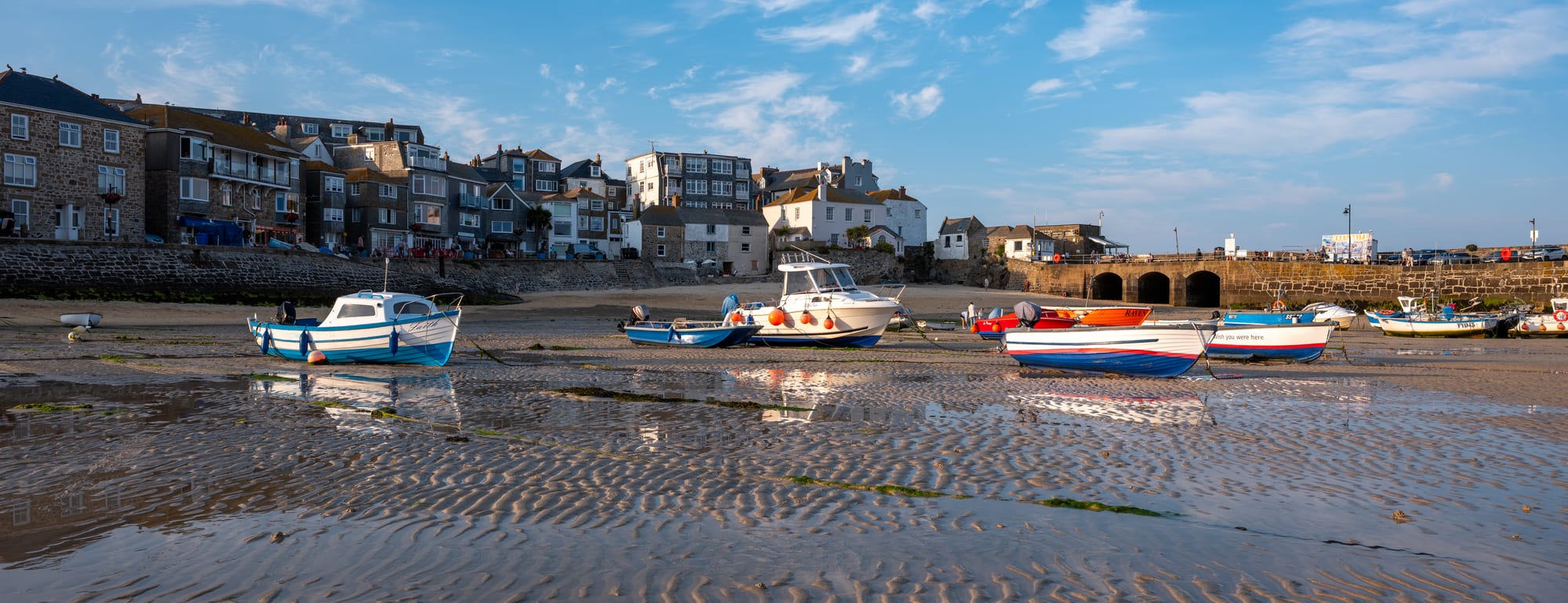
Small boats resting on wet sand in St Ives harbour at low tide, with stone houses along the waterfront and an arched pier

South West England, United Kingdom

St Ives

St Ives harbour at low tide, with the town's waterfront behind. (ArildV / Wikimedia Commons · CC BY-SA 4.0)

A small harbour town on the western shore of St Ives Bay in Cornwall, once one of the most important fishing ports on the north Cornish coast. The railway turned it into a resort in the late 19th century, artists followed, and today its four beaches, Tate St Ives and the Barbara Hepworth garden draw crowds to narrow granite streets.

Neighbourhoods

  • The harbour and the old town
    • First-time visitors
    • Historic district
    • Best for food

    The old fishing quarter around the harbour, sheltered by Smeaton's Pier and the Island, where narrow, uneven lanes of granite cottages, galleries, pubs and cafés crowd behind the Wharf and the parish church of St Ia.

    Open in Maps
  • Porthmeor and the Island
    • Beaches
    • Art
    • Surfing

    The town's Atlantic side, where the surfing beach of Porthmeor faces Tate St Ives, and the grassy headland called the Island, with the old fishermen's chapel of St Nicholas, separates it from the small sandy cove of Porthgwidden.

    Open in Maps
  • Porthminster and the upper town
    • Beaches
    • Close to public transport
    • Quiet and residential

    Newer houses on the rising ground above the bay, with the railway station and the long sands of Porthminster Beach.

    Open in Maps
  • Carbis Bay and Lelant
    • Beaches
    • Quiet and residential

    The villages to the south-east, part of the same parish and stops on the branch line, with Carbis Bay and its beach about a mile south-east of the town.

    Open in Maps

Things to do

Art

  • Tate St Ivesmuseum

    A branch of the Tate Gallery, opened in 1993 beside Porthmeor Beach, in a town known for its artists.

    Open in Maps
  • Barbara Hepworth Museum and Sculpture Gardenmuseum

    The sculptor's studio, home and garden, where she lived and worked from 1949 until her death, run by the Tate since 1980.

    Open in Maps
  • Leach Potterymuseum

    The pottery set up in 1920 by Bernard Leach and Shōji Hamada, still working, with a small museum of work by Leach and his students.

    Open in Maps
  • St Ives Museummuseum

    The town's local history museum, covering mining, fishing, farming and domestic life.

    Open in Maps

The harbour and the old town

  • Smeaton's Pierlandmark

    The harbour pier rebuilt by John Smeaton in 1766–1770, with an octagonal lookout and cupola from his design.

    Open in Maps
  • St Ia's Churchlandmark

    The granite parish church built between 1410 and 1434, dedicated to the Irish holy woman Ia and to St Andrew, patron saint of fishermen.

    Open in Maps
  • The Island and St Nicholas Chapelviewpoint

    The headland between the harbour and Porthmeor, topped by the old fishermen's chapel of St Nicholas, with views over the bay and towards the open sea.

    Open in Maps

Beaches

  • Porthmeor Beachbeach

    The town's surfing beach, on the open Atlantic side below Tate St Ives.

    Open in Maps
  • Porthminster Beachbeach

    Almost half a mile of sand facing St Ives Bay.

    Open in Maps
  • Porthgwidden Beachbeach

    A small sandy cove tucked beside the Island, where the RNLI built a lifeboat house in 1867.

    Open in Maps

Short trips from the town

  • St Ives Bay Linetransit hub

    The branch railway from St Erth, opened in 1877, which runs along the cliff edge above the bays and is promoted as a scenic line.

    Open in Maps
  • Zennorattraction

    A village on the coast to the west, reached by local bus, where the painter Patrick Heron lived and Helen Dunmore set her novel Zennor in Darkness.

    Open in Maps

Seasonal events

  • St Ives Feastthe Sunday and Monday nearest 3 February

    A celebration of the town's founding by St Ia, which keeps one of the two surviving forms of Cornish hurling.

  • St Ives September FestivalSeptember

    A festival held in the town every September, which marked its 30th anniversary in 2008.

  • Knill Ceremony25 July, every five years

    A ceremony laid down in 1797 by the former mayor John Knill, held at his granite monument above the town.

Eat and drink

Long-standing places and food districts in St Ives. Hours, ratings and directions come from your maps app, always current.

St Ives classics

  • Pastiesneighborhood

    The food most associated with Cornwall: beef, potato, swede and onion baked in a crimped shortcrust pastry.

    Open in Maps
  • Saffron bunsneighborhood

    Rich, spiced yeast buns flavoured with saffron and filled with currants and sultanas, also called Cornish tea treat buns.

    Open in Maps

Food districts

  • The Wharfneighborhood

    The harbour front looking over the boats and the bay, where an old fishermen's pub has stood for centuries.

    Open in Maps

Experience St Ives

History

Legend attributes the founding of St Ives to Ia, an Irish holy woman who arrived in the 5th century, and the town's Cornish name, Porthia, means "St Ia's cove". From medieval times fishing made the place: it became one of the most important fishing ports on the north Cornish coast, a pier is first recorded in 1478, and the townspeople built their granite church between 1410 and 1434, although it remained a chapel of the parish of Lelant until much later. St Ives was incorporated as a borough in 1639.

Pilchards were the great catch, and seining was the usual way of fishing for them. In the mid-18th century St Ives was one of the four principal Cornish ports shipping pilchards, and the greatest catch ever taken in a single seine was landed here in 1868. John Smeaton rebuilt the pier in 1766–1770, and a class of fishing boat unique to the town, the jumbo, worked from the harbour in Victorian times.

The railway changed everything. The branch line from St Erth arrived in 1877 and brought Victorian holidaymakers, and in 1884 James Whistler and Walter Sickert came down it to paint. Bernard Leach and Shōji Hamada set up the Leach Pottery in 1920; in 1928 Ben Nicholson and Christopher Wood met the Cornish painter Alfred Wallis, laying the foundation of the St Ives School; and in 1939 Nicholson, Barbara Hepworth and Naum Gabo settled in the town. As the fishing declined, tourism took over, and Tate St Ives opened in 1993.

Culture & Customs

Art defines St Ives' reputation. The town has been home to painters, potters and sculptors for more than a century, and Tate St Ives, the Barbara Hepworth Museum and its sculpture garden, the Leach Pottery and many commercial galleries keep that tradition visible. Bernard Leach, known as the father of British studio pottery, produced work here until 1972, and the abstract painter Patrick Heron lived nearby at Zennor.

The town keeps customs older than its galleries. St Ives Feast, held on the Sunday and Monday nearest 3 February, celebrates the founding by St Ia and is one of the two surviving examples of Cornish hurling. Every five years on 25 July the Knill Ceremony, laid down in 1797 by the former mayor John Knill, takes place at his granite monument overlooking the town; its old Knillian games once included Cornish wrestling. The St Ives September Festival celebrated its 30th anniversary in 2008.

Maritime life remains part of the town's identity: the lifeboat station, the harbour boats and replica jumbos sailed by the St Ives Jumbo Association. St Ives was named best seaside town by The Guardian in 2007 and by the British Travel Awards in 2010 and 2011, and the town and its surroundings have appeared in novels such as Helen Dunmore's Zennor in Darkness.

Daily Life

About 5,400 people lived in the St Ives built-up area at the 2021 census, and about 10,700 in the wider parish, which also includes Carbis Bay, Lelant and the surrounding countryside. The town lost its borough council in 1974 and is now governed as part of Cornwall.

Tourism dominates the economy. The population swells in summer, and much work is seasonal. Commercial fishing is much reduced, but the harbour is still used for recreational boating, fishing trips and boat trips to the seal colonies on the Carrack Rocks. Close to the harbour the old streets are narrow and uneven, while newer houses stand on the rising ground above.

Housing is the town's most argued-over issue. In 2016 residents voted, with 83 per cent in favour, to stop second-home owners buying newly built houses, after average prices had risen to more than £320,000, almost 14 times median annual earnings in Cornwall. By 2019 the Financial Times reported that the policy had not stemmed the number of second homes. Like the rest of Cornwall, the town has seen tourism criticised for its effect on seasonal work and affordable housing.

Food

The pasty is the food most associated with Cornwall and is regarded as its national dish. The traditional Cornish pasty, protected in Europe since 2011, is filled with beef, sliced or diced potato, swede — called turnip in Cornwall — and onion, seasoned with salt and pepper and baked in a folded, crimped shortcrust case. Pasties with many other fillings are made too, and the dish spread around the world with Cornish miners and sailors.

Another Cornish speciality is the saffron bun, sometimes called a tea treat bun: a rich, spiced, yeast-leavened sweet bun flavoured with saffron and full of currants and sultanas, with larger loaves known as saffron cake.

The sea has always fed the town, from the pilchard catches of the past to today's seafood restaurants. On the Wharf along the harbour, one of the oldest inns in Cornwall served as a fishermen's pub for many centuries. The town has even added a spirits school, where visitors can blend their own gin.

Planning tools

Budget

St Ives is one of the most popular resorts in Cornwall, and rooms are scarce and expensive in summer and school holidays. Parking in the town is limited and adds to the cost of a visit by car. The beaches, the harbour, the Island and the coast path cost nothing; Tate St Ives and the Hepworth garden are the main paid sights.

Daily Budget Midrange
USD 200–360 (B&B or small hotel, seafood dinners, Tate and Hepworth tickets, a boat trip or a hire car)
Daily Budget Shoestring
USD 85–140 (hostel or budget room outside peak season, pasties and picnic lunches, buses and the branch line)

Using the park and ride at St Erth and the branch train avoids the town's narrow streets and small car parks in summer.

Best Time to Visit

June to September for the beaches and boat trips, with July and August the busiest; September brings the town's arts festival and fewer crowds. Spring and autumn are quieter and mild. Winter is mild for Britain but windy, and early February has the St Ives Feast.

Suggested Number of Days

Two or three days give time for the galleries, the beaches and the harbour at an unhurried pace. Four or five allow for the coast to the west and other parts of West Cornwall by bus or train.

First Visit
2–3 days
With Surroundings
4–5 days

Transportation

The old town is small and best explored on foot; its streets are narrow and difficult for cars. Go Cornwall buses run to Zennor, Penzance, Truro and other nearby towns, and the branch line links the town with Carbis Bay, Lelant and St Erth. The Island car park on the headland is about a ten-minute walk from the harbour.

Leave the car outside the town where possible; from the harbour, boat trips run to the seal colonies on the Carrack Rocks.

Airport & Station Connections

Trains on the Paddington to Penzance main line connect at St Erth with the St Ives branch line, which runs frequent services into the town; sleeper cabins are available on overnight trains from London. An overnight coach from London Victoria takes about eight hours. The nearest airports are Newquay and Land's End Airport, near St Just.

Walkability

Good, but hilly. The harbour, the beaches, the Tate, the Hepworth garden and the Island are all close together; the old streets near the harbour are narrow and uneven, and the newer parts of the town climb steeply above the bay. The coast path runs out of the town in both directions.

Safety

The UK is generally safe, with the main risks being pickpocketing and phone theft in crowded parts of London and other cities, occasional late-night antisocial behaviour, and drink-related trouble around nightlife. In St Ives the real hazards are the sea and the coast: Atlantic surf and currents on the open beaches, tides in the harbour and the coves, and steep cliff paths.

Swim between the red-and-yellow flags on lifeguarded beaches, check tide times before walking round the coves. Check current official travel advice before travelling.

Climate

Oceanic, with some of the mildest winters in Britain and northern Europe. Cornwall is exposed to the full force of the prevailing Atlantic winds, and the moist air brings more rain than in eastern Britain.

Summer
mild — Cornish summers are not as warm as in other parts of southern England, and nearby Camborne's highest recorded temperature is 30.4°C
Winter
mild and wet — in Cornwall frost and snow are very rare at the coast; nearby Camborne's record low is −9.4°C, set in January 1987

Local Customs

St Ives is a small community with a strong Cornish identity — its Cornish name, Porthia, means "St Ia's cove" — and old customs such as the Feast, hurling and the Knill Ceremony are kept up. Housing and second homes are sensitive subjects. Queuing is expected and pub rounds are bought in turn.

Respect residents' homes in the narrow lanes, keep beaches clean and follow lifeguards' instructions; dress respectfully in St Ia's Church.

Common Payment Methods

The currency is the pound sterling. Most pubs in the UK now take contactless cards, though a few are still cash only, and cash machines are very widely available.