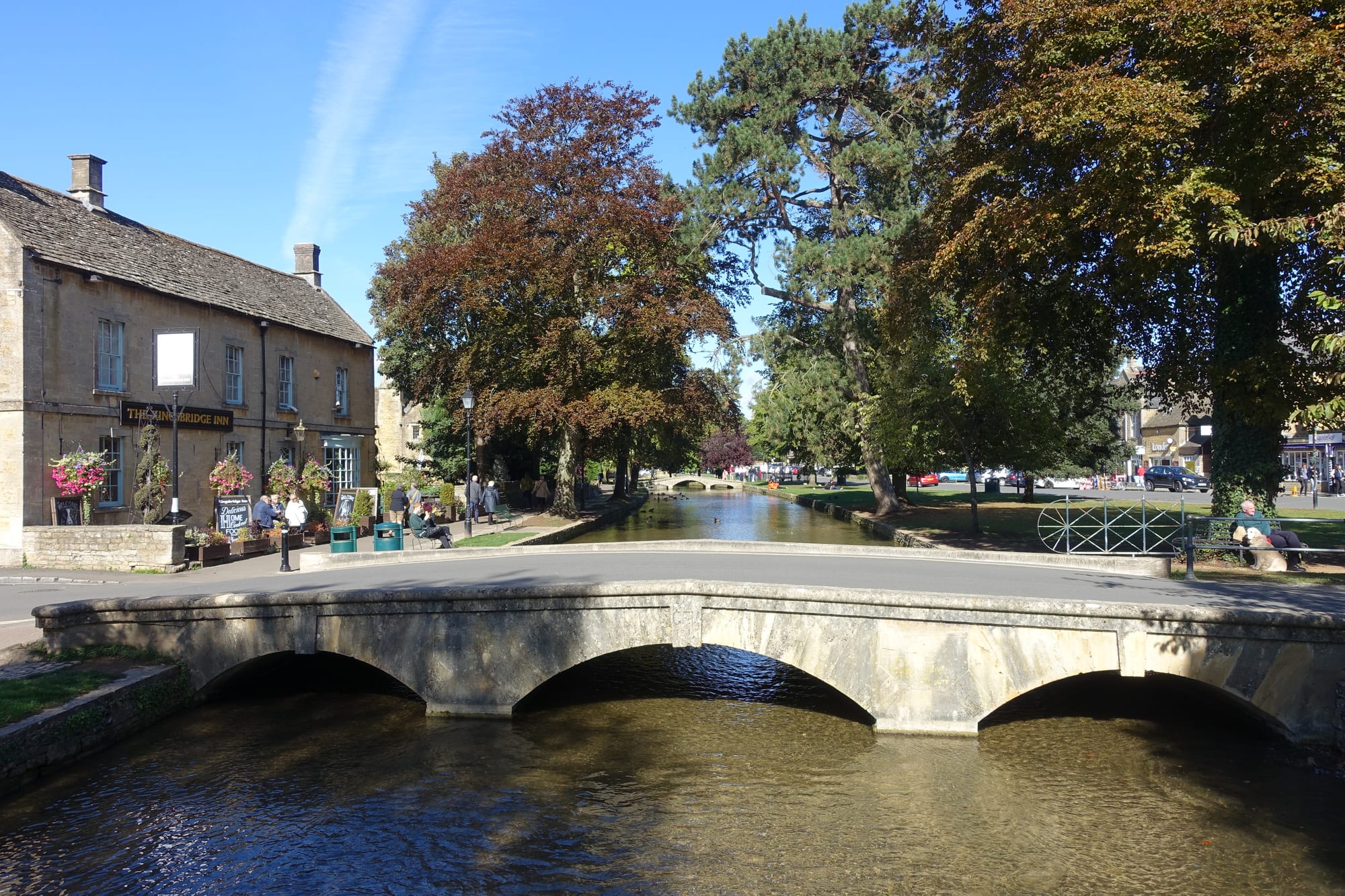
A low three-arched stone bridge over the shallow River Windrush, with a stone building, trees and grassy banks beyond

South West England, United Kingdom

Bourton-on-the-Water

A bridge over the River Windrush in the centre of Bourton-on-the-Water. (Kmtextor / Wikimedia Commons · CC BY-SA 4.0)

A Gloucestershire village on a wide flat vale in the Cotswolds, where the shallow River Windrush runs beside the High Street under five low stone bridges. Settled since prehistoric times and built of yellow Cotswold limestone, it turned to tourism in the 1920s and 1930s and now receives some 300,000 visitors a year, far more than its residents.

Neighbourhoods

  • The village centre and the Windrush
    • First-time visitors
    • Historic district
    • Best for food

    The High Street, flanked by long wide greens with the river running through them and crossed by five low arched bridges built between 1654 and 1953. Most of the shops, tea rooms, pubs and the model village are here, inside a designated conservation area, and it is crowded on summer days.

    Open in Maps
  • Beyond the centre
    • Quiet and residential
    • Families

    Quieter streets of Cotswold-stone houses around the core, with the large car park on the edge of the village linked to the main street by a footpath. Birdland and the Dragonfly Maze are close by, and footpaths lead out across the meadows.

    Open in Maps

Things to do

Village attractions

  • Bourton-on-the-Water model villageattraction

    A 1:9 replica of the village built by local craftsmen in the 1930s and opened in 1937, including a model of the model village itself; it was listed at Grade II in 2013.

    Open in Maps
  • Cotswold Motoring Museummuseum

    A museum of 20th-century motoring founded in 1978, with cars, motorcycles, caravans and toys, and home of Brum, the little car from the children's television series.

    Open in Maps
  • Birdland Park and Gardenspark

    A wildlife park first opened in 1957 and on its present site since 1989, with penguins, parrots and other birds, bird-of-prey displays and penguin feeding.

    Open in Maps
  • Dragonfly Mazeattraction

    A maze designed by the artist and author Kit Williams, between the car park and Birdland.

    Open in Maps

Walks and countryside

  • Salmonsbury Meadowspark

    Meadows protected as a Site of Special Scientific Interest, sharing their name with Salmonsbury Camp, the nearby Iron Age settlement.

    Open in Maps
  • Heart of England Waytrail

    A long-distance walk of around 100 miles through the Midlands from Cannock Chase, which ends in Bourton-on-the-Water.

    Open in Maps
  • Oxfordshire Waytrail

    A long-distance route that starts in the village and runs 68 miles to Henley-on-Thames.

    Open in Maps

Short trips from the village

  • Lower Slaughterneighborhood

    A small neighbouring Cotswold village, about 4 miles south-west of Stow-on-the-Wold.

    Open in Maps
  • Upper Slaughterneighborhood

    A neighbouring village off the Fosse Way, about a mile from Lower Slaughter.

    Open in Maps
  • Stow-on-the-Woldneighborhood

    A market town on top of an 800-foot hill at the junction of main roads through the Cotswolds, including the Roman Fosse Way.

    Open in Maps

Seasonal events

  • Football in the riversummer

    A game of football played with goalposts set up in the River Windrush itself, while crowds line the banks and players try to soak each other.

  • Farmers' marketfourth Sunday of each month

    A monthly market of local producers in the village.

Eat and drink

Long-standing places and food districts in Bourton-on-the-Water. Hours, ratings and directions come from your maps app, always current.

Bourton-on-the-Water classics

  • Tea rooms on the High Streetcafe

    Tea rooms along the High Street and the riverside, part of the village's trade with day visitors.

    Open in Maps
  • Village pubsrestaurant

    A few pubs in Cotswold-stone buildings serve food and drink in the village and nearby hamlets.

    Open in Maps

Markets

  • Bourton-on-the-Water farmers' marketmarket

    The monthly farmers' market, held on the fourth Sunday.

    Open in Maps

Experience Bourton-on-the-Water

History

People have lived around Bourton for a very long time. Neolithic pottery dated to about 4000 BC was found in the Slaughter Bridge gravels, and excavations at nearby Salmonsbury Camp show almost continuous habitation through the Neolithic and Bronze Age and into the Roman period. The Roman Fosse Way runs past the village, and Icknield Street, also called Ryknild Street, branched off it here and ran north to South Yorkshire; Roman pottery and coins found in the village point to a long Roman occupation.

A Saxon timber church stood in the village from about 708, said to be on the site of a Roman temple, and by the 11th century a Norman church had been built and the village had grown along the Windrush much as it is today. The present church of St Lawrence keeps some 14th-century work but is mostly from later centuries, and the five low bridges over the river date from 1654 to 1953. Almost all the houses and shops are of the yellow ashlar limestone characteristic of the Cotswolds, with stone mullions, gables and hoodmoulds over the doors.

A railway reached the village in 1862 and closed to passengers in 1962. Tourism became important only in the 1920s and 1930s, and the model village opened in 1937; the population rose sharply between 1931 and 1951. Scenes from the James Bond film Die Another Day were shot in the village car park in 2002. In 2025 Hartwells, an ironmonger's that had traded for 220 years and was the oldest shop in Gloucestershire, closed its doors.

Culture & Customs

Bourton is known as the "Venice of the Cotswolds" for its low bridges over the Windrush, and its look is protected: the historic core is a conservation area, and 114 buildings in the village are listed. The model village, itself listed in 2013 for the precision of its details and its use of real building materials, is a celebration of that look in miniature, complete with a model of the model village inside it.

Local custom has a playful streak. In summer a game of football is played with goalposts standing in the River Windrush, the teams trying to score as many goals as possible and soak everyone else while crowds watch from the banks. The Cotswold Motoring Museum is home to Brum, the little car from the children's television series, which leaves the museum in the programme's opening title sequence. Oasis recorded the video for "I'm Outta Time" here, with Liam Gallagher walking through the village and the model village.

The village has three churches — Roman Catholic, Baptist and the Church of England church of St Lawrence — and its own non-league football club, Bourton Rovers, who play in the Hellenic League. Walkers are part of the scene too: the Heart of England Way ends here and the Oxfordshire Way begins here.

Daily Life

The village had 3,296 people at the 2011 census and an estimated 3,482 in mid-2016, so about 3,500 live here, while some 300,000 visitors arrive each year and in the peak season visitors often outnumber residents. Much of the local economy is built on that flow: tea rooms, gift shops, pubs and the paying attractions along the High Street and the river.

Life beyond the tourist core is that of a large Cotswold village. Bourton has a primary school and the Cotswold School, a comprehensive opened in 1988, which was found during building work to stand on a Roman cemetery with Iron Age roundhouses. The nearest railway station is at Moreton-in-Marsh, and buses link the village with the surrounding market towns and Cheltenham, so most households rely on cars.

The rhythm of the year is set by the visitor season. Summer days bring coaches, full car parks and crowded greens, while winter evenings are quiet and the village returns to its residents. The farmers' market on the fourth Sunday of each month is a regular fixture for locals and visitors alike.

Food

Gloucestershire's best-known food is its cheese. Gloucester cheese, a traditional semi-hard cheese made in the county since the 16th century, comes in two varieties, Single and Double, both traditionally made from the milk of Gloucester cattle. Both have a natural rind and a hard texture; Single Gloucester is more crumbly, lighter and lower in fat, while Double Gloucester is aged for longer and has a stronger, more savoury flavour.

The cream tea is the day visitor's treat in the tea rooms along the High Street and the river: tea with scones, clotted cream or, less authentically, whipped cream, and jam. Cream teas are sold in tea rooms throughout England, and those in a stone-built village beside the Windrush are part of the experience of a visit.

The village pubs, in old Cotswold-stone buildings, serve food and drink, and more pubs lie in the hamlets around. The monthly farmers' market, held on the fourth Sunday, brings local producers into the village.

Planning tools

Budget

The Cotswold villages are among the pricier parts of the South West all year, and Bourton is no exception for rooms and sit-down meals. Paying attractions are modest in scale, and walking the greens, bridges and footpaths costs nothing beyond parking.

Daily Budget Midrange
USD 180–340 (B&B or small hotel, pub dinners, attraction tickets, a hire car)
Daily Budget Shoestring
USD 80–120 (budget room or a stay in a nearby town, pub meals and picnics, buses)

Staying overnight or arriving early in the day gives time in the village before the coaches arrive.

Best Time to Visit

Late spring and early autumn are pleasant and less crowded. In the peak summer season visitors often outnumber residents, and the greens and bridges are packed on fine weekends. Winter is quiet, with shorter hours at some attractions.

Suggested Number of Days

The village itself fills a day. Two or three days allow time for the neighbouring villages, market towns and long-distance footpaths of the surrounding Cotswolds, which are easier to reach with a car.

First Visit
1 day
With Surroundings
2–3 days

Transportation

The village is small and easy on foot. Local buses link it with Moreton-in-Marsh, Stow-on-the-Wold, Northleach, Cheltenham, Cirencester and Kingham station, though services are infrequent compared with towns. Most visitors arrive by car and use the large car park on the edge of the village. National cycle routes pass through or near it.

Park in the main car park and walk in by the footpath rather than driving through the centre.

Airport & Station Connections

There has been no station since 1962; the nearest is at Moreton-in-Marsh, about 8.5 miles north, on the Cotswold Line between Oxford and Hereford, and buses also connect with Kingham station. By road the village is on the Fosse Way, the A429, north of Cirencester.

Walkability

Entirely walkable: the High Street, the greens, the bridges and the main attractions are within a few minutes of each other on level ground, and footpaths lead straight out into the countryside.

Safety

The UK is generally safe, with the main risks being pickpocketing and phone theft in crowded parts of London and other cities, occasional late-night antisocial behaviour, and drink-related trouble around nightlife. Bourton is a quiet village; the practical issues are crowded pavements and slow traffic on busy summer days.

Keep an eye on small children near the river and on the narrow pavements. Check current official travel advice before travelling.

Climate

Mild and changeable, with rain spread through the year. In nearby Cheltenham a typical year has 139 days with at least 1 mm of rain and around 35 nights of air frost.

Summer
mild to warm; nearby Cheltenham held the British maximum temperature record of 37.1°C from 1990 to 2003
Winter
cool, with frosts; nearby Cheltenham's absolute minimum is −20.1°C, set in December 1981

Local Customs

This is a lived-in village as well as a visitor attraction, with three churches, a school and a non-league football club. The Church of England church of St Lawrence is usually open to visitors during the week. Pubs take orders at the bar.

Keep to the paths and respect private gardens and doorways when photographing the cottages.

Common Payment Methods

The currency is the pound sterling. Shops widely accept debit and credit cards, including foreign ones, and some no longer take cash at all. Scottish and Northern Irish banks issue their own banknotes, with their own designs.