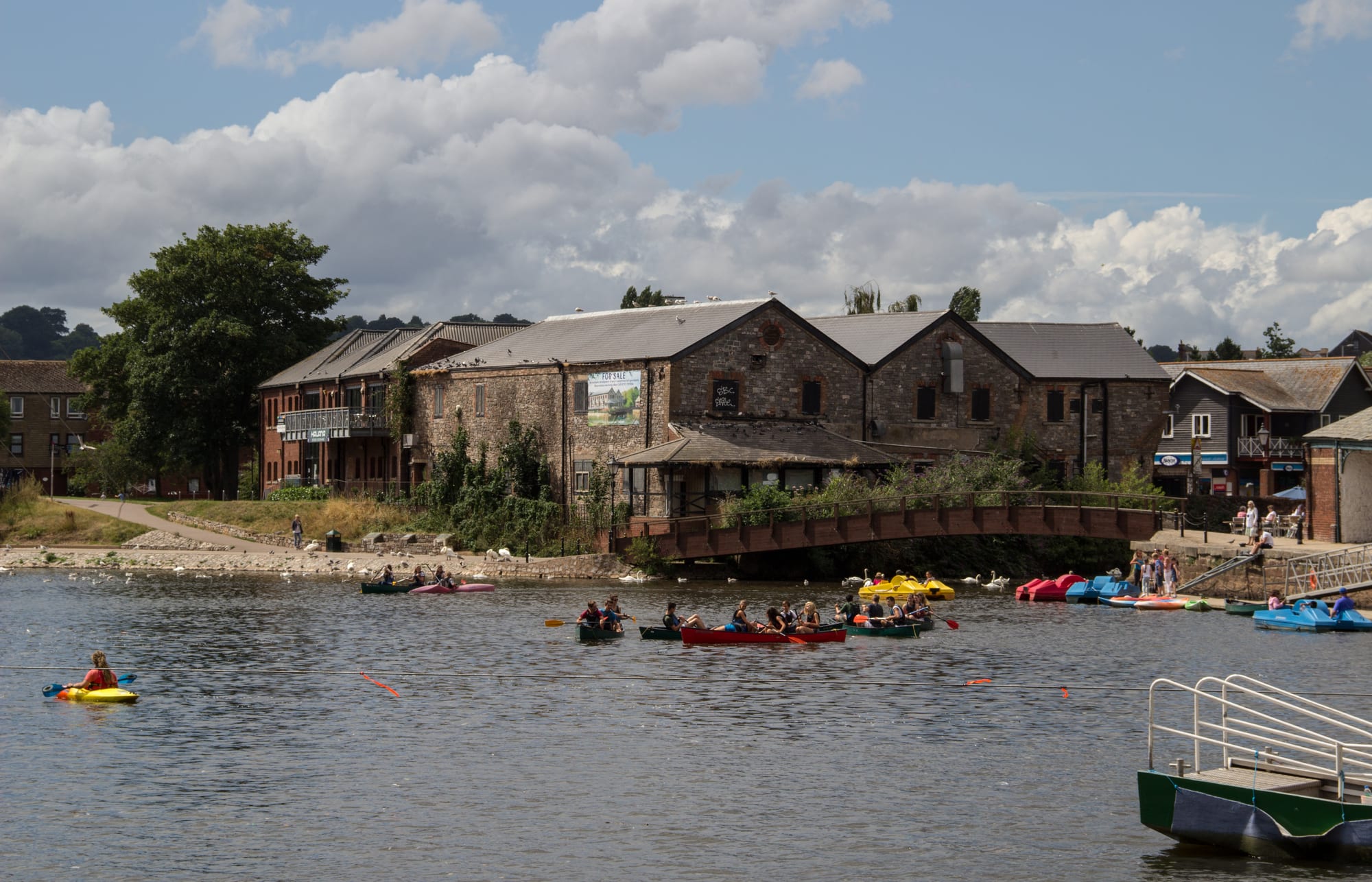
Canoes and kayaks on the River Exe in front of old stone warehouses and a footbridge at Exeter's quayside under summer clouds

South West England, United Kingdom

Exeter

Paddlers on the River Exe beside the old warehouses of Exeter Quay. (Dietmar Rabich / Wikimedia Commons · CC BY-SA 4.0)

Devon's county town and cathedral city on the River Exe, founded beside the Roman fort of Isca, defended by Saxons against the Vikings, and rich in the early modern centuries from the wool trade. Bombed in 1942, it is now a university and service city with a medieval cathedral, Roman walls, underground water passages and a restored quayside.

Neighbourhoods

  • City centre and the Cathedral Close
    • First-time visitors
    • Historic district
    • Shopping

    The old walled city on its ridge above the Exe. The High Street, the Guildhall and the Princesshay and Guildhall shopping centres sit a few steps from the cathedral and its green, ringed by historic buildings such as Mol's Coffee House, with independent shops on Gandy Street and Fore Street.

    Open in Maps
  • Exeter Quay
    • Waterfront
    • Walks and cycling
    • Bars

    The old port beside the river and the head of the ship canal, with the 17th-century Custom House and 19th-century warehouses and fish-market buildings, one of them now a restaurant. Canoes and bikes can be hired, and paths run downriver on both banks.

    Open in Maps
  • Heavitree and Magdalen Road
    • Quiet and residential
    • Local shops

    A former village outside the walls on the old road to London, now an eastern district of the city. Magdalen Road, a few minutes' walk from the centre, has well-regarded butchers, fishmongers and independent shops.

    Open in Maps
  • St Davids and the university
    • Close to the station
    • Students

    The western and northern side of the centre, around Exeter St Davids station, opened in 1844, and the University of Exeter's Streatham campus to the north, home to the Northcott Theatre and the Bill Douglas Cinema Museum.

    Open in Maps
  • Topsham
    • Best for food
    • Historic district
    • Estuary walks

    A historic port town on the east side of the Exe estuary, within the city's district, chartered as a town in 1300. Its 17th- and 18th-century merchants' houses and range of restaurants make it a favourite outing, reached by train or by the riverside cycle path.

    Open in Maps

Things to do

Famous landmarks

  • Exeter Cathedrallandmark

    Completed by about 1400 around two massive Norman towers, with an astronomical clock, an early set of misericords and the longest uninterrupted medieval stone vaulted ceiling in the world.

    Open in Maps
  • Exeter underground passagesattraction

    Tunnels built to carry the medieval city's water supply, the earliest from the 13th century, now a scheduled monument with guided tours through the year.

    Open in Maps
  • Exeter Guildhalllandmark

    The centre of the city's government for at least 600 years, a largely medieval building on the High Street with an elaborate frontage added in the 1590s.

    Open in Maps
  • Rougemont Castlelandmark

    The Norman castle built into the northern corner of the Roman walls from 1068, after Exeter's rebellion against William the Conqueror, on a volcanic outcrop at the highest point inside the walls.

    Open in Maps
  • Exeter city wallslandmark

    Long stretches of the wall first built by the Romans in the late 2nd century and repaired and rebuilt in the Anglo-Saxon, medieval and Civil War periods.

    Open in Maps
  • Mol's Coffee Houselandmark

    A timber-framed, Grade I listed building in the northern corner of the Cathedral Close, overlooking the green and the cathedral's north tower.

    Open in Maps

Museums

  • Royal Albert Memorial Museummuseum

    The city's largest museum and art gallery, with collections of zoology, anthropology, fine art, archaeology and geology.

    Open in Maps
  • Bill Douglas Cinema Museummuseum

    On the university's Streatham campus, one of Britain's largest public collections of books, prints and objects on the history and prehistory of cinema.

    Open in Maps

Parks and the waterfront

  • Northernhay Gardenspark

    Laid out in 1612 as a pleasure walk on the north side of the castle, the oldest public open space in England.

    Open in Maps
  • Exeter Quayattraction

    The riverside port area, used since prehistoric times, with the 17th-century Custom House, the earliest purpose-built one in England.

    Open in Maps
  • Exeter Ship Canaltrail

    Cut in the 1560s and one of the oldest artificial waterways in Britain, the first with pound locks; its towpaths are used for walking and cycling.

    Open in Maps

Stage, sport and nights out

  • Northcott Theatreattraction

    A 460-seat theatre on the university campus, one of relatively few provincial English theatres with its own repertory company.

    Open in Maps
  • Sandy Parkattraction

    Home ground of Exeter Chiefs, who have played in the top division of English rugby union, the Premiership, since 2010.

    Open in Maps
  • St James Parkattraction

    The football ground of Exeter City since the club's formation in 1901, a short walk from the centre.

    Open in Maps

Short trips from the city

  • Topshamneighborhood

    The old estuary port south of the city, with 17th- and 18th-century merchants' houses and a good range of restaurants.

    Open in Maps
  • Powderham Castlelandmark

    A Grade I listed fortified manor house with listed park and gardens, 6 miles south of Exeter near Kenton.

    Open in Maps
  • Exeter Racecourseattraction

    A jumps racecourse on the Haldon Hills, the highest racecourse in the UK, with meetings from November to March.

    Open in Maps

Seasonal events

  • Jump racing at HaldonNovember to March

    Regular National Hunt meetings at the hilltop course outside the city.

  • Double Locks beer festivalMay Day bank holiday

    A busy spring beer festival at the canal-side pub south of the Quay.

Eat and drink

Long-standing places and food districts in Exeter. Hours, ratings and directions come from your maps app, always current.

Exeter classics

  • Double Locksrestaurant

    A pub on the bank of the Exeter Canal, about twenty minutes' walk from the Quay, popular on sunny weekends.

    Open in Maps
  • Cream teascafe

    Devon's cream tea — scones with clotted cream and strawberry jam — is served in tea rooms and cafés around the centre.

    Open in Maps

Food districts and markets

  • Magdalen Roadneighborhood

    A shopping street a few minutes from the centre known for its butchers, fishmongers and independent shops.

    Open in Maps
  • Topshamneighborhood

    The estuary town south of the city, with a good range of restaurants.

    Open in Maps
  • Gandy Street and Cathedral Greenneighborhood

    Narrow streets of independent shops, cafés and restaurants near the cathedral.

    Open in Maps

Experience Exeter

History

Around AD 55 the Romans built a fortress called Isca at a crossing of the Exe, and a civilian town grew beside it as the centre of the Dumnonii. In the late 2nd century a wall enclosing some 92 acres replaced the old defences, and the town seems to have been most prosperous in the early 4th century. After the Roman withdrawal little is known until the Saxons held it as Escanceaster. Danish Vikings captured it briefly in 876 before Alfred the Great drove them out the next summer, and Æthelstan strengthened the walls around 928.

In 1068 Exeter was a centre of resistance to the Normans, home to Gytha, the mother of Harold Godwinson; William the Conqueror's siege ended in negotiation, and he built Rougemont Castle to hold the city. The bishop's seat moved here from Crediton in 1050, and a Norman cathedral begun in 1112 was rebuilt into the present building, complete by about 1400. In 1549 rebels besieged the city and burnt two of its gates before being defeated by Edward VI's army. Wool and cloth then made Exeter rich, and the ship canal, begun around 1566, let ships bypass a weir and reach the Quay.

The railway arrived at St Davids in 1844. In 1942 the Baedeker Blitz destroyed some 40 acres of the city, and post-war rebuilding swept away further landmarks, though some buildings survived, among them the House That Moved. The Exe flooded much of the city in 1960. The University of Exeter received its royal charter in 1955, and between 2005 and 2007 the Princesshay area by the Close was controversially redeveloped. In 2016 a fire destroyed large parts of a historic hotel and neighbouring buildings in the Cathedral Close.

Culture & Customs

The cathedral and its close are the city's heart, and Exeter's identity is that of an old regional capital, the county town of Devon. A small but lively arts scene centres on the Northcott Theatre on the university campus, which keeps its own repertory company, the Barnfield Theatre in the centre, the 500-capacity Corn Exchange and Exeter Phoenix, an arts centre with studios, galleries and a cinema. The Cavern Club has hosted live music since 1991, including Coldplay and Muse.

Sport matters: Exeter Chiefs, founded in 1871 as Exeter Rugby Club, have played in the Premiership since 2010 and moved to Sandy Park in 2006, while Exeter City football club have played at St James Park since 1901. Racing on the Haldon Hills fills the winter calendar.

The city also has a modest place in publishing history: in 1934 Allen Lane was inspired by his experience at Exeter St Davids station to develop paperback books that could be sold affordably at stations, and founded Penguin Books the following year. The university has made Exeter a younger city, with a median age of 35, and nearly half of residents reported no religion in 2021.

Daily Life

Exeter had a population of about 138,000 in 2024, making it the second-largest settlement in Devon after Plymouth, and it grew faster than the South West as a whole between the 2011 and 2021 censuses. It draws more commuters from East Devon than any other district, followed by Teignbridge.

The main employers are the Met Office, the University of Exeter, Devon County Council, the regional NHS trust and South West Water. Shopping is centred on the High Street and the Princesshay and Guildhall centres, and the High Street was ranked among the UK's most appealing in 2024. Yet the city has real strains: pay and employment indicators are low, a 2026 report placed Exeter among the worst performers for improving living standards over the previous decade, and rough sleeping rose sharply between 2024 and 2025.

People live in suburbs such as Heavitree, St Thomas, Pinhoe and Alphington, and in the affluent riverside town of Topsham. Students fill the streets around the Streatham campus in term time, and weekends bring crowds to the Quay, the canal paths and the rugby.

Food

The cream tea is also known as the Devon cream tea, and Exeter's tea rooms serve it. The Devon, or Devonshire, method is to split the scone in two, cover each half with clotted cream and then add strawberry jam on top, and there is evidence that bread with cream and jam was eaten at Tavistock Abbey in Devon as early as the 11th century.

Markets have shaped the city's eating for centuries. Exeter held a weekly market from at least 1213, and by 1281 it was the only town in the South West with three market days a week; buildings at the Quay once served as the fish market. Today Magdalen Road, a few minutes from the centre, is known for its butchers and fishmongers, and Topsham, down the estuary, has a good range of restaurants.

Pubs are central to eating out. The Double Locks, beside the canal about twenty minutes' walk from the Quay, is known for its May Day bank holiday beer festival, and one of the 19th-century warehouses on the Quay holds a restaurant. Gandy Street and the streets around Cathedral Green hold independent cafés and restaurants alongside national chains.

Planning tools

Budget

Exeter is better value than Bath or the Cornish resorts, and its main sights are compact. Rooms are busiest in summer and on big match and event weekends. Walking the walls, the Close, Northernhay Gardens and the Quay costs nothing.

Daily Budget Midrange
USD 180–330 (B&B or mid-range hotel, restaurant dinners, cathedral and passages tours, local trains)
Daily Budget Shoestring
USD 75–110 (hostel or budget room, market and pub food, walking and local trains)

The city's volunteer Redcoat guides run free guided walks from the Cathedral Green and the Quay.

Best Time to Visit

May to September is warmest and best for the Quay, the canal and the estuary paths. The cathedral, museum and passages suit any season, and the racing season on the Haldon Hills runs through winter.

Suggested Number of Days

Two days cover the walled centre and the river. Three to five allow time for the estuary towns, the coast and the moors within reach of the city by train and bus.

First Visit
2 days
With Surroundings
3–5 days

Transportation

The centre is compact and walkable. Local trains are unusually useful: besides the main stations there are suburban stops such as Topsham, St James Park, Polsloe Bridge and Marsh Barton, with lines to Exmouth, Paignton, Barnstaple and Okehampton. Cycle paths run along both sides of the river to the estuary. A previous bike-share scheme closed in 2023.

Use Exeter Central for the city centre and St Davids for main-line trains to London Paddington and the west.

Airport & Station Connections

Exeter St Davids, on the western edge of the centre, is a major interchange with trains to London Paddington, Plymouth and Penzance, including the Night Riviera sleeper; Exeter Central, in the city centre, has services on the line to London Waterloo. Exeter Airport is 4 miles east of the city, and the M5 motorway ends at Exminster, just south of the city.

Walkability

Good: the walled centre, the cathedral, the castle gardens and the High Street sit close together, and it is a short walk to the Quay. The old centre stands on a ridge above the river. The canal and riverside paths make long, flat walks out of town.

Safety

The UK is generally safe, with the main risks being pickpocketing and phone theft in crowded parts of London and other cities, occasional late-night antisocial behaviour, and drink-related trouble around nightlife. Exeter is a calm city for visitors, though it has relatively high levels of rough sleeping for an English city.

Take care on the riverside and canal paths after dark and when the Exe is high. Check current official travel advice before travelling.

Climate

Mild and oceanic, with sunshine above the regional average at around 1,560 hours a year. The highest temperature recorded was 34.0°C, in June 2026, and the lowest −16.5°C, in December 2010.

Summer
mild to warm, with July the hottest month at an average high of 21.8°C
Winter
cool and damp, with January the coldest month at an average high of 9.1°C

Local Customs

A university city with a large student population and a strong sporting identity built around rugby. The cathedral is a working church with daily services. Pub orders are placed at the bar.

Keep quiet in the cathedral during services.

Common Payment Methods

The currency is the pound sterling. Shops widely accept debit and credit cards, including foreign ones, and some no longer take cash at all. Scottish and Northern Irish banks issue their own banknotes, with their own designs.