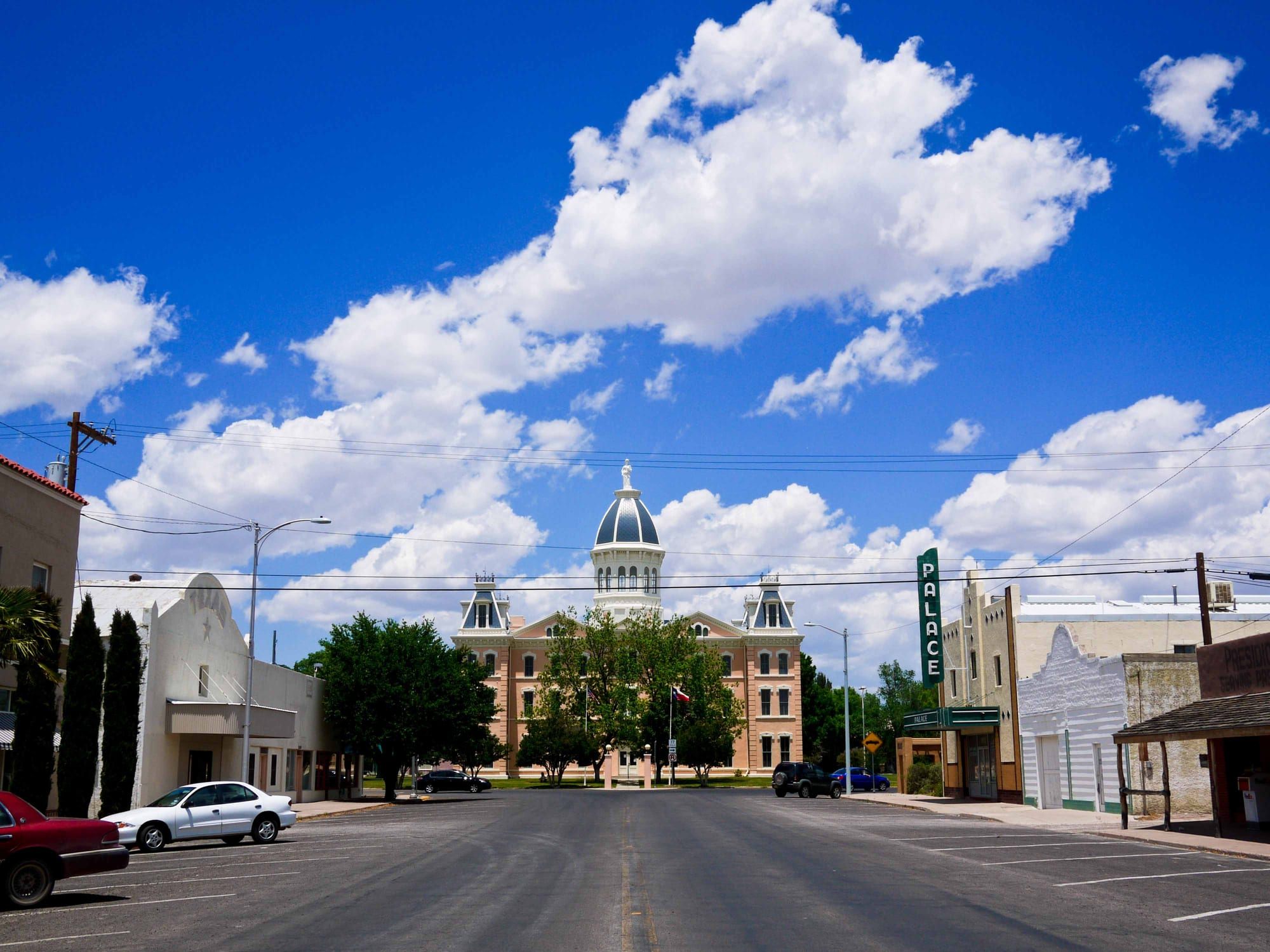
A wide, quiet street of low adobe-style buildings leading to a domed pink-stone courthouse under a deep blue sky with white clouds

Texas, United States

Marfa

A street in downtown Marfa leading to the Presidio County Courthouse. (Paul Joseph from vancouver, bc, canada / Wikimedia Commons · CC BY 2.0)

A small ranching town in the high desert of far West Texas, at about 4,700 feet between the Davis Mountains and Big Bend. Founded as a railway water stop in the 1880s, it struggled after its army post closed, then was remade from the 1970s by the minimalist artist Donald Judd. Today it is a centre of contemporary art, known also for the mysterious Marfa lights.

Neighbourhoods

  • Downtown
    • First-time visitors
    • Galleries
    • Walkable

    A few blocks of low buildings around the domed Presidio County Courthouse and along San Antonio Street, the route of US 90, with galleries, shops, cafés, the Crowley Theater and the art space Ballroom Marfa.

    Open in Maps
  • The south side and Fort D. A. Russell
    • Art
    • History

    On the southern edge of town, the former army post that Donald Judd turned into the Chinati Foundation, its old buildings filled with permanent installations on 340 acres. Building 98, an artist residency, is also on the old fort.

    Open in Maps

Things to do

Art and history in town

  • Chinati Foundationmuseum

    The contemporary art museum founded on the ideas of Donald Judd on the site of Fort D. A. Russell, opened in 1986, with large permanent installations by Judd, Dan Flavin, John Chamberlain and others; most of the collection is seen on guided tours.

    Open in Maps
  • Presidio County Courthouselandmark

    The domed county courthouse at the head of downtown's main street, listed on the National Register of Historic Places in 1977.

    Open in Maps
  • Blackwell School National Historic Sitemuseum

    The adobe schoolhouse where Marfa's Hispanic children were taught in segregated classes from 1909 to 1965, established as a unit of the National Park Service in July 2024.

    Open in Maps
  • Marfa lights viewing areaviewpoint

    A viewing area beside US 90 east of town, from which lights are often seen on the horizon after dark; scientists who studied them from 2000 to 2008 concluded they were distorted car headlights.

    Open in Maps

Short trips from the town

  • Prada Marfaattraction

    A permanent art installation by Elmgreen & Dragset in the form of a Prada shop alone beside US 90 near Valentine, about 36 miles north-west of Marfa, inaugurated in 2005.

    Open in Maps
  • Fort Davis National Historic Sitemuseum

    One of the best remaining examples of a US Army fort in the south-western United States, in the Davis Mountains about 21 miles north of Marfa.

    Open in Maps
  • McDonald Observatoryattraction

    The University of Texas observatory on Mount Locke in the Davis Mountains, which produces the StarDate astronomy programme heard on radio stations across the country.

    Open in Maps
  • Davis Mountains State Parkpark

    A 'sky island' park between 5,000 and 6,000 feet near Fort Davis, cooler and greener than the desert below.

    Open in Maps

Eat and drink

Long-standing places and food districts in Marfa. Hours, ratings and directions come from your maps app, always current.

Eating in Marfa

  • Pizza Foundationrestaurant

    A pizzeria selling big thin-crust slices with a wide range of toppings.

    Open in Maps
  • Downtown cafés and Mexican kitchensneighborhood

    A handful of cafés, Mexican restaurants and bars around Highland Avenue and San Antonio Street — many open only from Wednesday to Saturday.

    Open in Maps

Experience Marfa

History

Marfa was founded in the early 1880s as a water stop on the railway across far West Texas. It was named, at the suggestion of a railway executive's wife, after a character in a Jules Verne novel, although a story that the name came from Dostoevsky's The Brothers Karamazov has long circulated. The town grew as a ranching centre and became the seat of Presidio County, and the Marfa lights were first recorded in 1883.

In 1911 the army set up a post outside town, later named Fort D. A. Russell, for cavalry and air reconnaissance units sent to guard the border after Pancho Villa's raid. During the Second World War the fort grew into a large base, with an airfield for training pilots and a camp for German prisoners of war; Marfa's population had peaked in the 1930s. The fort closed in 1946, and drought and the end of the war left the town struggling. The 1956 film Giant was shot in and around Marfa, and its cast, among them James Dean and Elizabeth Taylor, stayed in the town during filming.

The minimalist artist Donald Judd arrived from New York in the early 1970s, bought ranches and buildings, and with help from the Dia Art Foundation acquired the old fort, where in 1979 he began turning the buildings into spaces for permanent installations. The Chinati Foundation opened in 1986. After Judd's death in 1994 the Chinati Foundation and the Judd Foundation continued his work, and the art drew visitors, film crews and new residents. In July 2024 the Blackwell School, where Hispanic children were taught separately until 1965, became a national historic site.

Culture & Customs

Marfa's fame rests on minimalist art. Judd wanted large bodies of an artist's work installed permanently, as a kind of anti-museum, rather than shown in temporary exhibitions, and Chinati still presents work by Judd, Dan Flavin, John Chamberlain and others in that spirit. Since 2003 Ballroom Marfa has shown art films and installations and hosted concerts, and the Crowley Theater and a local theatre group stage public events. Prada Marfa, a permanent installation by the artists Elmgreen & Dragset in the form of a Prada shop out on US 90, was vandalised on the night it was finished in 2005 and has been repaired rather than left to decay as first planned.

The town also has a long screen history: Giant was filmed here in the 1950s, and parts of There Will Be Blood and No Country for Old Men were shot in and around Marfa in 2006. The Marfa lights are a local institution, celebrated each year with the Marfa Lights Festival.

Beneath the art scene is an older town: about two-thirds of residents are Hispanic, ranching families have deep roots, and the Blackwell School recalls decades of segregated schooling, when, after 1954, pupils were not allowed to speak Spanish.

Daily Life

About 1,800 people lived in Marfa at the 2020 census. It is the seat of Presidio County, and life still revolves partly around the courthouse, the schools and the ranches of the surrounding grassland.

The art economy has changed the town. Galleries, shops and restaurants serve visitors who come for Chinati and the lights, and many open only from Wednesday to Saturday. Of about 1,100 houses counted in 2020, more than a fifth stood vacant. The former army post on the south side has become a cultural district of its own, with Chinati and the Building 98 artist residency, run since 2002 by the International Woman's Foundation.

Marfa Public Radio, a National Public Radio affiliate, is based in the town, and local news comes from a weekly paper, the Big Bend Sentinel. Life moves at a slow pace, the street lights go off late at night, and the nearest airports with commercial flights are more than 180 miles away.

Food

For a town of its size Marfa has a varied, if small, set of places to eat, shaped by the visitors drawn by the art. Mexican cooking reflects the town's Hispanic majority and the ranching country around it.

Pizza Foundation sells big thin-crust slices, and the cafés along Highland Avenue and San Antonio Street serve coffee, breakfast and light meals. Many of the town's galleries and restaurants are within walking distance of one another on the main street, between the courthouse and the post office. Many kitchens keep limited days and hours, so planning meals around the Wednesday to Saturday rhythm matters. Beyond town, Marathon, to the east on US 90, has small cafés of its own.

Planning tools

Budget

Marfa is small and remote, and its few places to stay are pricier than its size suggests, especially on weekends and during events, when rooms sell out. Fuel and a hire car are a large part of the cost, since the nearest major airports are around 180–190 miles away.

Daily Budget Midrange
USD 220–400 (mid-range hotel, restaurant meals with tax and tip, Chinati tour, hire car and fuel)
Daily Budget Shoestring
USD 100–170 (campsite or basic motel, cafés and pizza, own car)

Plan around Wednesday to Saturday, when most shops, restaurants and sights are open, and book rooms early.

Best Time to Visit

Spring and autumn are the most comfortable seasons in the high desert. Summer days are hot but nights cool, and winter brings cold nights. The big day-to-night swing in temperature means layers are useful all year.

Suggested Number of Days

One or two days are enough for the town, a Chinati tour and an evening watching for the lights. Three to five days allow time for the Davis Mountains and the long drive south to Big Bend.

First Visit
1–2 days
With Surroundings
3–5 days

Transportation

A car is essential. US 90 runs through town, leading 74 miles north-west to Van Horn and Interstate 10 and 26 miles east to Alpine; State Highway 17 runs 21 miles north to Fort Davis. A twice-daily bus links Marfa with Alpine, Fort Stockton, Odessa and Midland's airport.

Fill the tank before long drives; distances between towns are large and services few.

Airport & Station Connections

The nearest airports with commercial flights are Midland International Air and Space Port, about 182 miles north-east, and El Paso International Airport, about 189 miles north-west; most visitors hire a car and drive. Amtrak's Sunset Limited passes through Marfa without stopping; the nearest station is in Alpine, 26 miles away. Big Bend National Park lies a long drive to the south-east.

Walkability

The town itself is small and easy to walk, and the Chinati Foundation is at its southern edge. Street lights go off late at night, so a torch is useful. Everything outside town needs a car.

Safety

For most visitors the US is safe, with the main risks being petty theft and car break-ins in tourist areas of some cities, road accidents over long distances, extreme weather, and the hazards of the outdoors. Marfa is a quiet small town; the real risks are long empty roads, summer heat and the distance to the nearest large towns.

For most visitors the US is safe, with the main risks being petty theft and car break-ins in tourist areas of some cities, road accidents over long distances, extreme weather, and the hazards of the outdoors. Carry water, drive carefully after dark, and keep a full tank on desert roads. Check current official travel advice before travelling.

Climate

Semi-arid high desert at about 4,700 feet, with hot summers and cool winters. Because of the altitude and dry air, the difference between day and night temperatures is large in every season.

Summer
hot by day and cool at night; across inland Texas as a whole, summer days typically reach 91–100°F
Winter
cool days and cold nights; for southern Texas as a whole, the usual winter range is a mild 46–68°F

Local Customs

Tipping of roughly 18–22 per cent is expected in restaurants, and Texas sales tax is added at the till. Marfa mixes long-established ranching and Hispanic families — a majority of residents — with artists and newcomers. Dress is casual, and many businesses keep short or irregular hours.

Identification is asked for when buying alcohol (the legal age is 21).

Common Payment Methods

The currency is the US dollar. Cards are widely accepted in town, but ATMs and fuel stations are few in the surrounding desert, so some cash is useful.