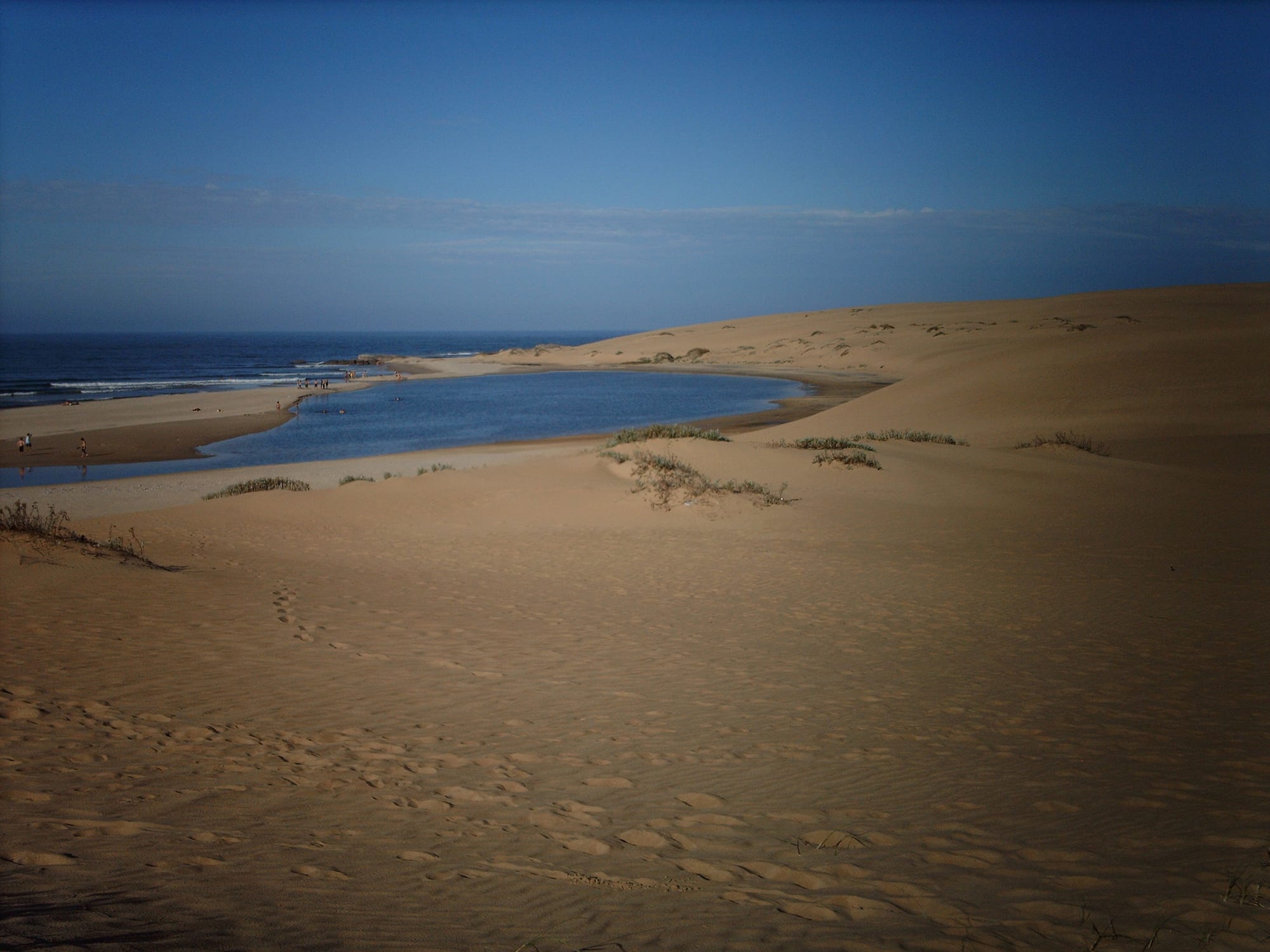
Bare sand dunes sloping down to a shallow lagoon and a beach, with the Atlantic and a few walkers beyond

Punta del Este & the East Coast, Uruguay

Cabo Polonio

Sand dunes and the shore in the protected area of Cabo Polonio, Rocha. (Marcelo uy 1950 / Wikimedia Commons · CC BY-SA 3.0)

A hamlet of scattered cottages on a rocky cape in Uruguay's Rocha department, about 7 km from the nearest highway across shifting dunes, with no road in and no mains electricity or running water. Built by sea-lion hunters and fishing families around an 1881 lighthouse, it lies in a protected area and fills with tens of thousands of visitors each summer.

Neighbourhoods

  • The cape and the lighthouse
    • First-time visitors
    • Wildlife

    The rocky tip of the peninsula, where the lighthouse stands above the granite-grey shore and looks out to the sea lion islands. The oldest houses, built by sea-lion hunters and fishing families, cluster around it, along with the small shops, bars and restaurants.

    Open in Maps
  • The beaches and dune houses
    • Beaches
    • Quiet and residential

    Cottages and cabañas scattered without streets across the sand on either side of the cape, most of them used only in summer, with long beaches running north and south of the point.

    Open in Maps
  • The dunes
    • Walks
    • Nature

    The field of moving sand dunes, some up to 30 metres high, that links the cape with the mainland. The trucks from the highway and the walking track to Barra de Valizas cross them.

    Open in Maps

Things to do

The cape

  • Cabo Polonio Lighthouselandmark

    Completed in 1881 to reduce shipwrecks on the islands and reefs off the cape, and powered from the national grid, it can be climbed for views over the village and the sea lion colony.

    Open in Maps
  • Sea lion colonyattraction

    The rocky Islas de Torres just offshore, with the rocks behind the lighthouse, hold the largest sea lion population in Uruguay and almost half of the country's South American fur seals and sea lions.

    Open in Maps

Beaches and dunes

  • The dunespark

    Mobile dunes of a kind once found all along the Rocha coast and now limited to the Cabo Polonio area, protected as a natural monument since 1966.

    Open in Maps
  • The beachesbeach

    Long open Atlantic beaches on both sides of the cape; the bodies of seals and sea lions from the nearby colony are sometimes washed up on them.

    Open in Maps

Short trips from the cape

  • Barra de Valizasattraction

    The village to the north, outside the protected area, reached on foot through the dunes or along the beach — about 7 km by the shortest route and 12 km along the shore.

    Open in Maps
  • Laguna de Castillospark

    A coastal lagoon inland from the cape, a wildlife refuge and bird sanctuary that forms part of the same Ramsar site as Cabo Polonio.

    Open in Maps
  • Punta del Diabloattraction

    A former fishing village turned surf resort further up the Rocha coast, beside Santa Teresa National Park.

    Open in Maps

Eat and drink

Long-standing places and food districts in Cabo Polonio. Hours, ratings and directions come from your maps app, always current.

Cabo Polonio classics

  • The village's restaurants and barsneighborhood

    A handful of simple restaurants and bars around the cape, most open only in summer, serving fish, seafood and seaweed fritters; the bars give the village a lively summer nightlife.

    Open in Maps

Experience Cabo Polonio

History

People have hunted and fished on this cape for thousands of years. Mounds near the Valizas stream, part of the Cerritos de Indios of eastern Uruguay, hold axes, pottery and mortars about 5,000 years old, and hunter-gatherers came each spring and summer to hunt the sea lions on the islands offshore. Under Spanish rule the hunting continued, and the nearby Cerro de la Buena Vista marked the line between Spanish and Portuguese possessions agreed in the Treaty of Madrid of 1750.

The islands and reefs wrecked hundreds of ships. On 31 January 1753 the Spanish ship Nuestra Señora del Rosario, bound from Cádiz to Buenos Aires, ran aground off the south beach; all 316 men on board survived, and the cape is named after its 25-year-old captain, José Poloní. The lighthouse, completed in 1881, reduced the wrecks without ending them: in 1892 the Brazilian monitor Solimões struck a rock between the islands and 123 men drowned. Around the lighthouse grew the first permanent settlement of sea-lion hunters and fishing families, joined in the 1940s by villagers expelled from Rincón de Valizas.

Protection came in stages: a forest reserve in 1942, a natural monument for the dunes in 1966, a place in UNESCO's Bañados del Este biosphere reserve in 1976, a Ramsar listing in 1984, and inclusion in Uruguay's National System of Protected Areas in 2009, when new construction was banned. Sea-lion hunting in Uruguay ended in 1992.

Culture & Customs

Cabo Polonio is known above all for what it lacks. With no road, no mains power and no running water, it has long been presented as a traditional village set apart from modern tourist towns, and much of its appeal is the glimpse it offers of life before urbanisation. In the late 20th century it became something of an improvised hippie colony, with cottages built on public and private land as visitors sought a rustic, intimate contact with nature.

That outlook remains strong. In a 2013 survey 85 per cent of residents opposed electrifying their homes, and many still treat objects salvaged from old shipwrecks as treasured possessions. Fishing families, artisans and long-staying summer visitors share the cape, and in summer its bars and restaurants give it an active nightlife.

The cape has also entered literature. Caro De Robertis's 2019 novel Cantoras is set there over a period of 36 years, and Pedro Mairal's 2025 novel Los nuevos is largely set here.

Daily Life

The 2023 census counted 128 residents, up from 95 in 2011, though in 2024 about 500 people were estimated to be living on the cape, fewer than 100 of them all year. Houses multiplied from 128 in 1985 to 458 in 2004, when 94 per cent were used only in summer. In January 2015 more than 30,000 tourists visited.

Daily life is shaped by scarcity. Houses take water from rainfall or boreholes, and a few inns and the grocery store run on wind power and generators; only the lighthouse is connected to the national grid. There are no health services, rubbish is collected only in summer, and there is a school and a police station. Tourism is the main source of income: since 2023 favourable exchange rates against the Argentine peso have brought a boom, and many fishing families now build houses and run tourist services, helped by four-wheel-drive trucks that replaced the old horse-drawn carriages.

Current issues follow from that growth. Vehicle traffic is damaging the dunes, summer crowds strain the supply of drinking water and sanitation, and between 2022 and 2024 an outbreak of bird flu killed sea lions along the coast, including here.

Food

Food on the cape is simple and, for most visitors, partly self-catered: rented cabins have basic kitchens, and supplies come from a few small shops. In summer a handful of restaurants and bars open, and a few stay open after the season ends.

The cooking is that of the Rocha coast. Fish caught locally is grilled or fried, with corvina and brótola, a white fish, the most common, and rabas, rings of battered squid, are a standard order. The signature is buñuelos de algas, fritters made with seaweed, sold from stalls and kitchens in Cabo Polonio and Punta del Diablo. The butiá palm that grows in Rocha gives small orange fruit made into jam, sweets and a liqueur.

Otherwise, food follows the Uruguayan pattern. Empanadas are the everyday snack, the parrilla, or grill, turns out beef and chorizo when there is a fire going, and tortas fritas, fried dough, are the traditional treat on a rainy day. Mate, the bitter herbal infusion sipped from a shared gourd, is drunk at all hours, and dulce de leche fills the alfajores sold in the shops.

Planning tools

Budget

Cabo Polonio is not the cheap hideaway it once was. Heavy summer demand has pushed its budget accommodation among the most expensive on the Atlantic coast in high season, and food in the small shops costs more than in the towns, since everything arrives by truck. Low season is far cheaper. The truck ride from the highway and parking there add to the cost.

Daily Budget Midrange
USD 150–300 (rented cabaña or posada, restaurant meals, truck rides)
Daily Budget Shoestring
USD 50–90 (hostel bed or shared cabaña, self-catering, the truck from the highway); much more in January

Arrange a bed before arriving in high season, and bring cash, food supplies and a torch, as there is no mains electricity.

Best Time to Visit

Summer, from December to February, is the main season, with tens of thousands of visitors in January and most restaurants open. March and the spring months are far quieter. Southern right whales pass close to the coast in winter and spring, when the village is almost empty and many places close.

Suggested Number of Days

One night, or two, suits most visitors, since part of the appeal is the evening and the dark night sky. Allow three or four days to add walks to the neighbouring villages and the lagoons along the coast. The truck schedule and the weather can lengthen a stay.

First Visit
1–2 days
With Surroundings
3–4 days

Transportation

No private vehicles are allowed into Cabo Polonio. Visitors leave cars at the paid car park and information centre on Route 10, called the Portal del Cabo, and ride licensed four-wheel-drive trucks across the dunes, a trip of about 20 minutes. Trucks run frequently in high season and on a reduced timetable in winter. It is also possible to walk the 7 km track, half of it soft sand. Inside the village everything is reached on foot.

Tents and pets are not allowed into the protected area.

Airport & Station Connections

Buses of the Rutas del Sol company run along Route 10 from Montevideo, Rocha and Castillos to the Portal del Cabo, where the trucks leave. There is no direct bus from Punta del Este or Piriápolis; travellers from there change at San Carlos. Montevideo's Carrasco International Airport is the nearest international gateway. Barra de Valizas, the next village north, is a walk of about 7 km through the dunes or 12 km along the beach.

Walkability

The village is small and there are no roads, so everything is reached on foot across sand, grass and rock. Walking in loose sand is slow and tiring, and there is no street lighting, so a torch is needed after dark.

Safety

Uruguay is among the safest countries in Latin America, though property crime and, in some Montevideo neighbourhoods, violent crime have risen with drug-trafficking activity. Crime is rare in the village. The real hazards are natural: strong currents on the open beaches, slippery rocks on the cape in high seas, getting lost in the dunes in fog, and the lack of health services in the village.

Keep a respectful distance from the sea lions, carry water and a torch, and do not walk the dunes alone in fog. Check current official travel advice before travelling.

Climate

A humid temperate maritime climate, with an average annual temperature of about 16°C and humidity of around 80 per cent. Summers are mild and winters cool, with January the warmest month and July the coldest.

Summer
December–February, mild to warm; January averages about 21°C
Winter
June–August, cool, damp and windy; July averages about 11°C

Local Customs

Residents value the village's isolation, and in a 2013 survey most opposed bringing mains electricity to their homes. Water is scarce, so it is used sparingly, and rubbish is collected only in summer, so visitors are expected to take theirs out with them. Spanish is spoken in its Rioplatense form, and mate is shared everywhere.

Ask before photographing residents or their houses, keep off the dune vegetation, and keep music down at night.

Common Payment Methods

The currency is the Uruguayan peso (UYU). The village is small and off the grid, and the regional advice is to carry cash there. The small shop accepts foreign money, and US dollars are taken for larger purchases in tourist areas.