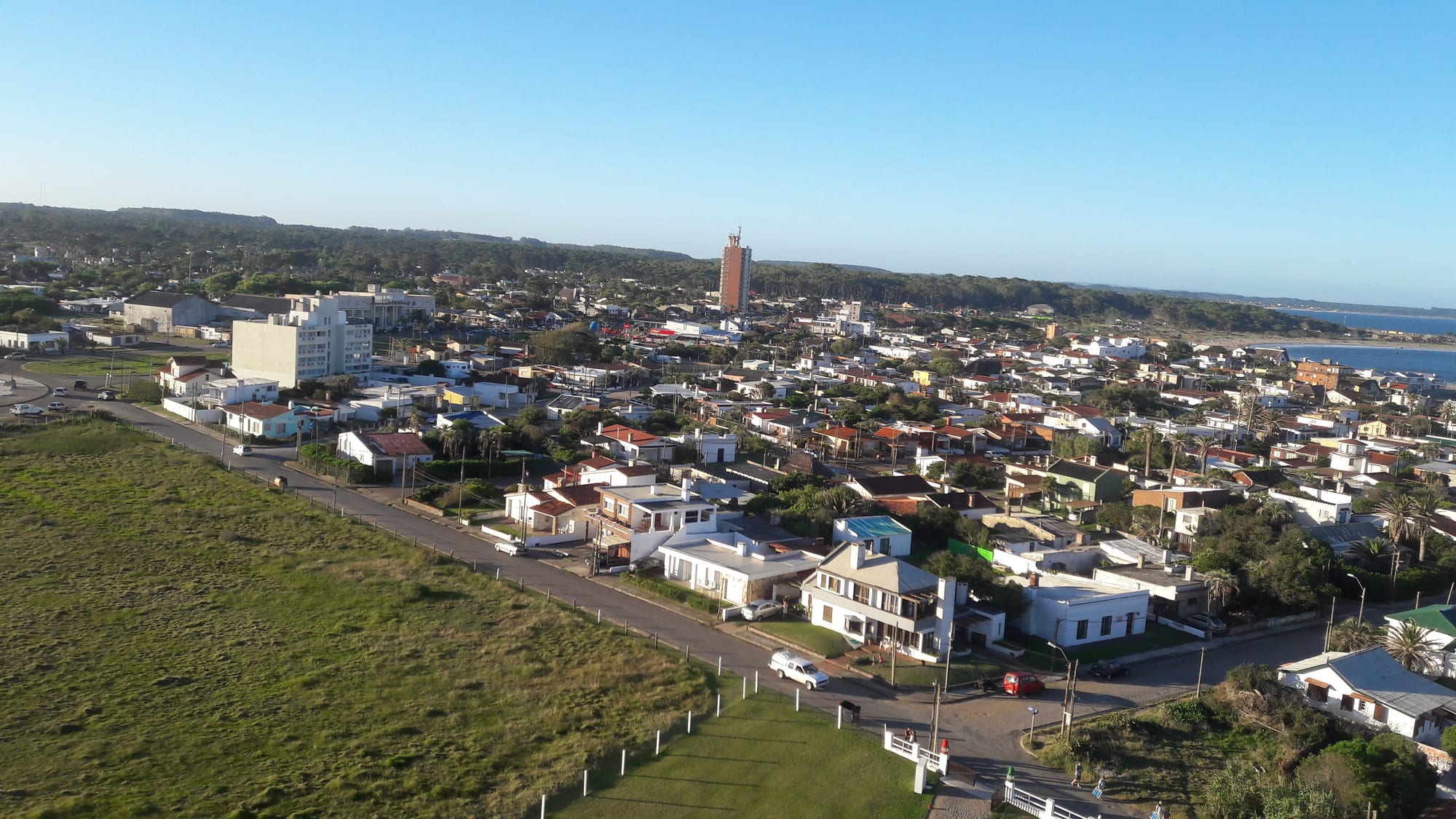
Low houses with red and grey roofs spreading among trees, with a lone tower block and the sea on the right

Punta del Este & the East Coast, Uruguay

La Paloma

La Paloma seen from the Cabo Santa María lighthouse. (Igna / Wikimedia Commons · CC BY-SA 4.0)

A small resort town and fishing port on Cabo Santa María in Uruguay's Rocha department, about 240 km east of Montevideo. Founded in 1874 around the cape's lighthouse and enlarged to architects' plans in the mid-20th century, it has around 20 km of beaches, from sheltered bays to surf breaks, and swells from about 6,000 residents to tens of thousands each summer.

Neighbourhoods

  • The old town and the lighthouse
    • First-time visitors
    • Historic district

    The casco viejo, with the town's oldest houses, around the lighthouse on Cabo Santa María and facing the small Isla La Tuna. The rocky cape, the port and the sheltered bays are all a short walk away.

    Open in Maps
  • The new centre and Avenida Solari
    • Best for food
    • Shopping
    • Close to the bus

    The newer town that surrounds the old one, strung along the main street, Avenida Solari, with shops, restaurants and most of the services. Many of its houses are in an Alpine, French-influenced style and are built to be let.

    Open in Maps
  • La Aguada and Costa Azul
    • Beaches
    • Surf

    Beach districts of holiday houses on the open Atlantic shore, where surf schools work along La Aguada beach and its promenade.

    Open in Maps
  • Anaconda and La Balconada
    • Beaches
    • Quiet and residential

    Two of the town's other beaches, quieter and more residential, with holiday houses behind them; Anaconda is recommended for sunbathing.

    Open in Maps

Things to do

Famous landmarks

  • Cabo Santa María Lighthouselandmark

    A tall masonry tower from the 1870s with a red-and-white striped dome, the town's best-known building, still guiding the fishing boats into the port.

    Open in Maps

Beaches

  • La Aguadabeach

    A surf beach, with surf schools along the beach and promenade renting boards and giving lessons.

    Open in Maps
  • Anacondabeach

    One of the town's beaches, recommended for sunbathing.

    Open in Maps
  • La Balconadabeach

    One of the town's beaches, part of the varied shoreline of rocks, calm water and waves that spreads either side of the cape.

    Open in Maps
  • El Cabitobeach

    One of the smaller beaches of the town's varied shoreline.

    Open in Maps

Short trips from the town

  • Laguna de Rochapark

    A coastal lagoon west of town, protected since 1977 and an Important Bird Area for its coscoroba and black-necked swans, Chilean flamingos and other birds; it can be reached by bicycle.

    Open in Maps
  • La Pedreraattraction

    A small resort village about 8 km north-east along the coast, with a character of its own and a short film festival each summer.

    Open in Maps
  • Rochaattraction

    The capital of the department, an inland city of about 27,000 people.

    Open in Maps

Seasonal events

  • La Pedrera Short Film Festivalsummer

    A festival of short films from several countries held each summer since 2004 in the neighbouring village of La Pedrera.

Eat and drink

Long-standing places and food districts in La Paloma. Hours, ratings and directions come from your maps app, always current.

La Paloma classics

  • Restaurants on Avenida Solarineighborhood

    The main street and the blocks around it hold most of the town's restaurants, cafés and grills, with fish and seafood landed at the port on many menus.

    Open in Maps
  • The fishing portneighborhood

    The working port on the former Isla La Paloma, behind a long breakwater, where the fishing boats that supply the town's kitchens are based.

    Open in Maps

Experience La Paloma

History

The cape was long feared by sailors. One explanation for the town's name is that from a distance the rocks and the foam of the breaking waves on Cabo Santa María looked like the silhouette of a dove — paloma in Spanish. The lighthouse on the cape dates from the 1870s, and La Paloma itself was founded on 1 September 1874. Its natural harbour lay sheltered between the cape and two small islands, La Tuna and La Paloma.

In the 1940s and the decades that followed, the resort was enlarged to plans by the architects Juan Antonio Scasso and Carlos Gómez Gavazzo, which gave the town its newer centre around the old core. La Paloma was raised to the status of village (pueblo) in 1939 and to city in 1982. Nearby, in October 1945, an Air France flying boat made an emergency landing on the Laguna de Rocha after a propeller broke away and cut into its fuselage, killing two passengers; the aircraft was later repaired.

The old harbour was turned into an artificial port, built on the former Isla La Paloma, now joined to the land and protected by a breakwater about a kilometre long. It serves fishing boats and pleasure craft. Proposals to turn it into a deep-water port for bulk cargo and timber have met strong opposition from environmental groups and the tourism sector. Under Uruguay's decentralisation law La Paloma became the seat of its own municipality, with its first mayor elected for 2010–2015.

Culture & Customs

La Paloma is known above all for its calm. Much of its identity comes from the houses built for summer letting — many in an Alpine, French-influenced style — and the tower block in the centre stands out among them.

Surfing is a large part of local life. Surf schools work along La Aguada, and the town's beaches range from calm water to waves. In summer the town fills with visitors from Argentina, Brazil and Chile as well as Uruguayans and Europeans, and the neighbouring village of La Pedrera adds a cultural note with its short film festival, held each summer since 2004.

The wider customs of the Rocha coast hold here: fishing families working from the port, craft stalls selling leather, wool and products of the butiá palm, the department's own carnival, and an outdoor life built around the beach, mate and long evenings. Out of season the town is quiet and residential, with life centred on the port and the shops of Avenida Solari.

Daily Life

The 2023 census counted 5,939 permanent residents. Even the 2011 census, which counted 3,495 people, found 4,633 dwellings, a sign of how much of the housing stands empty for most of the year. In the summer months of January and February the population can reach around 30,000.

Tourism is the main business, from letting houses and running restaurants and shops to building and maintaining holiday homes. The port supports a fishing fleet, and the surrounding countryside of Rocha department adds cattle, rice farming in the wetlands and eucalyptus plantations. La Paloma is also the seat of its own municipality.

The rhythm is seasonal: a crowded few weeks around January, then long quiet months when many houses and businesses close and the town belongs to its residents, surfers and fishermen. Current debates centre on the future of the port, where plans for a deep-water harbour have been repeatedly opposed, and on how far building should spread along the coast.

Food

With a working fishing port, La Paloma eats from the sea. Fish is the town's staple, and corvina and brótola, a white fish, are the common catches on this coast, grilled or fried. Rabas, rings of battered squid, mussels steamed in white wine and fish stews appear on menus, and shrimp are caught in the coastal lagoons in season.

Like the rest of the Rocha coast, the town has buñuelos de algas, fritters made with seaweed, and the butiá palm that grows in the department gives small orange fruit made into jam, sweets and a liqueur.

The Uruguayan staples complete the table. The parrilla, or grill, serves beef, chorizo and morcilla (blood sausage); the chivito is the national steak sandwich, layered with ham, cheese and egg; and pizza is eaten with fainá, a thin flatbread of chickpea flour. Empanadas are the everyday snack, tortas fritas, fried dough, are the treat on rainy days, and dulce de leche fills alfajores and desserts. Mate, the bitter herbal infusion shared from a gourd, is drunk at all hours, and Tannat, Uruguay's dark red wine grape, is the usual choice with a grill.

Planning tools

Budget

La Paloma is one of the more affordable resorts on Uruguay's Atlantic coast, with hostels, campsites, rented houses and small hotels. Prices rise from Christmas through February, peaking in January, and fall sharply the rest of the year, when many places close.

Daily Budget Midrange
USD 130–280 (rented house or small hotel, seafood dinners, a hire car)
Daily Budget Shoestring
USD 50–85 (hostel bed or campsite, fish and empanadas, local buses or a hired bicycle); more in January

Book January stays well ahead, or come in December or March for quieter beaches and lower prices.

Best Time to Visit

The beach season runs from mid-December to early March and peaks in January, when the population swells many times over. February is calmer and March often has settled weather with thin crowds. Southern right whales pass close to the coast in winter and spring, when the town is quiet and much is closed.

Suggested Number of Days

Two or three days suit a beach stay in town. Four or five allow time for the nearby lagoons and neighbouring villages. Out of season, when many places close, a shorter stay is usual.

First Visit
2–3 days
With Surroundings
4–5 days

Transportation

The town is too small to have its own public transport, and most of it can be covered on foot. A bicycle is the easy way to reach La Pedrera or the Laguna de Rocha, and a car helps for the wider coast. Long-distance buses link La Paloma with Rocha, Montevideo and other towns along the coast.

In January allow extra time on Route 10, and book long-distance bus seats ahead in high season.

Airport & Station Connections

La Paloma lies at the junction of Routes 10 and 15, about 240 km from Montevideo and 90 km from Punta del Este. Montevideo's Carrasco International Airport is the main international gateway, and Punta del Este's airport at Laguna del Sauce is nearer. Buses run from Montevideo and Rocha, and coastal services link the town with Punta del Diablo and the resorts further east.

Walkability

The centre, the lighthouse and the nearest beaches are within easy walking distance, and the streets are quiet outside January. The beaches further along the shore and the neighbouring villages are better reached by bicycle or car.

Safety

Uruguay is among the safest countries in Latin America, though property crime and, in some Montevideo neighbourhoods, violent crime have risen with drug-trafficking activity. Violent crime is rare in the town; summer brings some theft from beaches, cars and rented houses. The main hazards are natural — rip currents on the open Atlantic beaches, rocks around the cape in heavy seas, and strong summer sun.

Swim at beaches with lifeguards, choose the sheltered bays when the surf is high, and keep valuables out of sight. Check current official travel advice before travelling.

Climate

A temperate oceanic climate, windier than Montevideo and with cooler sea water than the river beaches. Sea fog can roll in on summer mornings, and storms from the south-east bring heavy surf.

Summer
December–February, warm and breezy; regional figures for this coast are about 24–29°C
Winter
June–August, cool, damp and windy; regional figures about 6–14°C, with storms and many places closed

Local Customs

Spanish is spoken in its Rioplatense form, and in summer visitors from Argentina, Brazil, Chile and Europe add other languages. Mate is shared everywhere, dinner is late in summer, and dress is casual. The town is known for its calm.

Ask before photographing fishermen at work, and keep off the dune vegetation.

Common Payment Methods

The currency is the Uruguayan peso (UYU). Cards are widely accepted and ATMs are common in Uruguay, and US dollars are taken for larger purchases in tourist areas. Some small shops and stalls may prefer cash.