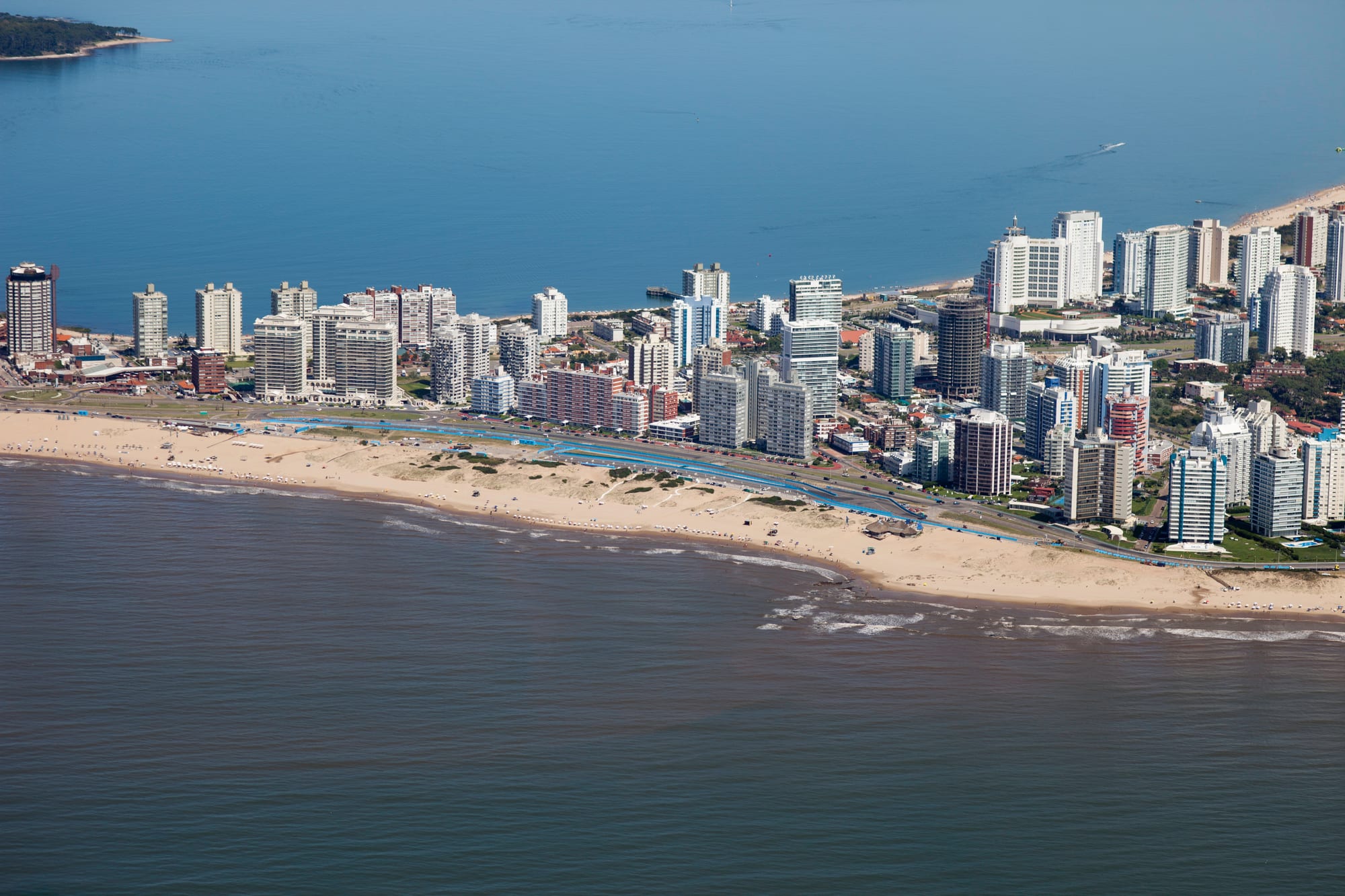
Aerial view of a long sandy beach backed by rows of white high-rise apartment towers, with the sea beyond

Punta del Este & the East Coast, Uruguay

Punta del Este

Playa Brava and the towers of Punta del Este from the air. (Jimmy Baikovicius from Montevideo, Uruguay / Wikimedia Commons · CC BY-SA 2.0)

A resort city on a narrow peninsula in Maldonado Department, where the Río de la Plata meets the Atlantic, about 140 km east of Montevideo. Sand dunes until the late 19th century, it grew into a famous summer resort, with high-rise towers, a yacht harbour and calm and surf beaches on either side; its small year-round population swells many times over in summer.

Neighbourhoods

  • The peninsula and Avenida Gorlero
    • First-time visitors
    • Shopping
    • Nightlife

    The tip of the peninsula, with the port, the lighthouse and older resort houses among newer buildings. Avenida Gorlero, the main street, has shopping arcades, restaurants, cinemas and casinos, and Plaza Artigas on it holds a popular handicraft market. The bus terminal is a block from Avenida Gorlero.

    Open in Maps
  • Playa Mansa side
    • Beaches
    • Families
    • Sunsets

    The sheltered western shore facing the bay, where the beaches have thick golden sand and calm water. High-rise flats line the seafront road, and the sunsets over the water draw evening crowds.

    Open in Maps
  • Playa Brava side
    • Beaches
    • Surfing
    • Landmarks

    The open Atlantic shore to the east, with fine white sand, wind and surf. La Mano, the giant hand sculpture, rises from the sand near its start, and the beach stops — paradas — are used as addresses along the coast road.

    Open in Maps
  • La Barra
    • Nightlife
    • Beaches
    • Watersports

    A resort across the Maldonado Creek, reached by an undulating bridge, popular by day for water sports and fishing and, from late December into mid-January, the centre of the summer night life for a younger crowd.

    Open in Maps

Things to do

Landmarks and the port

  • La Manolandmark

    Mario Irarrázabal's sculpture of five fingers emerging from the sand at Parada 1 on Playa Brava, completed in 1982 and now one of Uruguay's most recognisable landmarks; it is also called Los Dedos.

    Open in Maps
  • Punta del Este Lighthouseviewpoint

    A 25-metre lighthouse of 1860 on the headland of the peninsula.

    Open in Maps
  • The portattraction

    The yacht harbour on the bay side of the peninsula, with a fish market where sea lions gather in the water as fishermen clean their catch, and the boats to Gorriti Island.

    Open in Maps
  • Leonel Viera Bridgelandmark

    The wave-shaped stressed-ribbon bridge over the Maldonado Creek linking Punta del Este with La Barra, a landmark of the coast.

    Open in Maps

Islands and beaches

  • Gorriti Islandbeach

    A 21-hectare island in the bay with two beaches and a natural harbour, reached by a short boat ride from the port.

    Open in Maps
  • Isla de Lobosattraction

    A small island about 8 km south-east of the peninsula, with an 1858 lighthouse and, with Gorriti, a very large colony of South American sea lions and fur seals; a marine national park since 2024.

    Open in Maps
  • Playa Bravabeach

    The windier Atlantic beach on the eastern side of the peninsula, with surf spots and rough water, and whale watching in season.

    Open in Maps
  • Playa Mansabeach

    The long, calm bay beach on the western side, the family beach of the resort.

    Open in Maps

Short trips

  • Casapueblomuseum

    Carlos Páez Vilaró's thirteen-storey whitewashed house and studio on the cliffs of Punta Ballena, 13 km away, built by hand without plans from 1958 over 36 years; it holds a museum, gallery and terraces facing the sunset.

    Open in Maps
  • Lussich Arboretumpark

    A 192-hectare arboretum near Punta Ballena, begun by Antonio Lussich after he bought the dunes in 1896 and planted trees from around the world.

    Open in Maps
  • Fundación Pablo Atchugarrymuseum

    An arts foundation created in 2007 by the sculptor Pablo Atchugarry, with his workshop, exhibition rooms, an open-air stage and a 30-hectare sculpture park.

    Open in Maps

Seasonal events

  • Summer seasonlate December to February

    The resort's high season, when the population multiplies, the beaches and La Barra fill, and exhibitions, concerts and film festivals are held.

  • Whale watchingwinter and spring

    Southern right whales pass close to the coast and can be seen from the points and from Playa Brava.

Eat and drink

Long-standing places and food districts in Punta del Este. Hours, ratings and directions come from your maps app, always current.

Punta del Este classics

  • Chivitorestaurant

    Uruguay's national sandwich of sliced steak, ham, mozzarella, tomato, olives and often egg and bacon, which is reported to have been invented in a Punta del Este bar in 1946.

    Open in Maps
  • The port and fish marketmarket

    Fresh fish sold at the harbour, and restaurants nearby serving the catch, with sea lions waiting in the water below.

    Open in Maps

Food districts

  • Avenida Gorleroneighborhood

    The main street, lined with restaurants, cafés and bars, and the handicraft market on Plaza Artigas.

    Open in Maps
  • La Barraneighborhood

    The resort across the bridge, with restaurants and bars that stay open late in summer.

    Open in Maps

Experience Punta del Este

History

Spaniards were the first Europeans to reach this point of the coast, early in the 16th century, but settlement came only in the late 18th century, around Maldonado. In August 1827, during the Cisplatine War, Juan Antonio Lavalleja led a three-day operation that failed to dislodge a small Brazilian garrison from the peninsula. At the end of the 19th century the area was kilometres of sand and dunes. In 1896 Antonio Lussich bought about 1,800 hectares of empty land and began planting trees from around the world, the first of them tamarisks, pines, eucalyptus and acacias chosen to resist the wind and sand.

Punta del Este was declared a village in 1907 and grew as a summer retreat for families from Montevideo and Buenos Aires. It became a city in 1957 and briefly entered world history: the Alliance for Progress charter was signed here in 1961, an inter-American conference in 1962 suspended Cuba from the Organization of American States, and in 1967 a summit of the Americas brought President Lyndon Johnson.

In the 1970s threats by the Tupamaros guerrillas and a shift towards cheaper hotels drove away many Argentine visitors. The 1980s brought a building boom of apartment towers, spas and hotels, and in 1986 the Uruguay Round of trade negotiations, which led to the World Trade Organization, was launched here. The resort hosted the Whitbread round-the-world yacht race from 1985 to 1994 and Formula E races in 2014, 2015 and 2018, and property development remains one of the engines of its economy.

Culture & Customs

Punta del Este has been called the Hamptons, the Monaco and the St Tropez of South America, and in January it lives up to the comparisons: Argentine and Brazilian visitors, art exhibitions, polo, beach clubs and dinners that start near midnight. Many well-known people have owned summer houses here. The rest of the year it is a quiet seaside town.

Art is part of the resort's identity. Mario Irarrázabal's La Mano, the hand emerging from the sand of Playa Brava, has been a symbol of the city since 1982. At Punta Ballena the painter Carlos Páez Vilaró built Casapueblo, his whitewashed house and studio, by hand from 1958, and watching the sunset from its terraces has become a ritual, marked by the museum's daily Ceremonia del Sol. The sculptor Pablo Atchugarry's foundation holds summer exhibitions and concerts in its sculpture park.

The coast has two characters: the calm Mansa beaches facing the bay, and the surf of the Brava beaches facing the Atlantic. Across the Maldonado Creek, La Barra is where younger summer visitors go out at night. Religious life includes Catholic parishes and chapels and several synagogues.

Daily Life

About 18,200 people live in Punta del Este year-round, a number that multiplies in summer. The resort is joined to the city of Maldonado, the department capital, and Maldonado department is among the fastest-growing in Uruguay. Argentines, Brazilians and Europeans have increasingly chosen to live here permanently.

The economy runs on tourism and building. Many of the towers along the beaches are second homes, many owned by Argentines, and their construction, maintenance and cleaning employ much of the area's workforce. In winter the streets empty and many hotels and restaurants close, and workers fall back on other jobs or short contracts.

The rhythm is seasonal above all: a frantic six to eight weeks from Christmas, then a long quiet stretch. Current issues include the cost of housing for local workers, coastal erosion and debate over high-rise building along the shore. Every beach on the peninsula has public access, so residents and visitors share the same sand all year.

Food

Seafood matters more here than in most of Uruguay. Menus feature corvina and brótola, white fish served grilled or fried, rabas (battered squid rings) and mussels, and at the port fishermen sell the morning catch while sea lions wait in the water below for scraps.

The chivito, Uruguay's national sandwich, is reported to have been invented in Punta del Este in 1946, at a bar called El Mejillón, when a customer from northern Argentina, where chivito means barbecued kid, ordered a chivito sandwich. Today it comes with steak, ham, mozzarella, tomato, olives and mayonnaise, often with bacon and egg, and chips on the side. Asado is the other local favourite.

Summer brings restaurants of every kind, from parrillas to sushi and paella, along Avenida Gorlero, at the port and in La Barra. Inland, around Pueblo Garzón, vineyards and olive groves now produce wine and olive oil, and Tannat, Uruguay's flagship red grape, is the usual partner for grilled meat.

Planning tools

Budget

Prices swing more here than anywhere in Uruguay. In late December and January Punta del Este is among the most expensive places in South America, with room rates and restaurant bills to match; from March to November it is far cheaper, though much closes. Taxis are expensive by Uruguayan standards, and a hire car is the easiest way to reach La Barra and the coast beyond.

Daily Budget Midrange
USD 150–350 (hotel, seafood dinners, a hire car); high season can exceed this
Daily Budget Shoestring
USD 50–85 (hostel bed, chivitos and empanadas, local buses); much more in January

Book January stays months ahead, or come in December or March for the same beaches at a fraction of the price.

Best Time to Visit

The beach season runs from mid-December to early March and peaks in the first weeks of January. February is calmer and March often has fine weather with thin crowds. In winter and spring, southern right whales pass close to the coast, while many hotels and restaurants close.

Suggested Number of Days

Two or three days covers the peninsula and its beaches. Allow four to six to include the coast to the west and east and the countryside inland. Beach holidays in summer often run to a week or more.

First Visit
2–3 days
With Surroundings
4–6 days

Transportation

The peninsula is small enough to walk, and local buses run to Maldonado and along the coast. Beyond that, buses are not very frequent and taxis usually have to be called by phone and are dear, so a hire car is the practical way to reach La Barra, Punta Ballena and the resorts further east, especially outside summer.

Allow extra time on the coast roads and the approaches to the peninsula in January.

Airport & Station Connections

Capitán de Corbeta Carlos A. Curbelo International Airport, also called Laguna del Sauce, is 14 km north-west of Maldonado, with regional flights, mostly from Buenos Aires and busiest in summer; buses and taxis link it with the resort. Most international flights land at Carrasco in Montevideo, around 115 km away. Frequent buses from Montevideo's Tres Cruces terminal take about two hours.

Walkability

The peninsula is flat and compact: the port, the lighthouse, Avenida Gorlero and both beaches are within easy walking distance, and the coast road makes a pleasant promenade. The high-rise strip along Playa Mansa and Playa Brava stretches for kilometres, so places further out need a bus, bicycle or car.

Safety

Uruguay is among the safest countries in Latin America, though property crime and, in some Montevideo neighbourhoods, violent crime have risen with drug-trafficking activity. Punta del Este is very safe; summer brings some theft from cars, beach bags and rented houses. The main hazard is the sea: Playa Brava has strong rip currents, and lifeguards are on duty mainly in high season.

Swim at beaches with a lifeguard flag system, keep valuables out of sight in cars and rentals, and use strong sun protection. Check current official travel advice before travelling.

Climate

Oceanic and mild, close to humid subtropical, with rain spread evenly through the year. Summer here is December to February; winter is June to August. The Atlantic side is windier and its water cooler than the bay, and sea fog sometimes rolls in on summer mornings.

Summer
pleasant and breezy — February, the warmest month, averages about 22°C
Winter
cool and windy — July averages about 11.5°C, with rain and storms

Local Customs

The resort is informal by day and dressier at night, when dinners start late, often near midnight in January, and clubs open later still. Many summer visitors are Argentine or Brazilian. Mate is everywhere, and a kiss on the cheek is the usual greeting among acquaintances.

Leave around 10 per cent in restaurants when service is good. Do not feed or approach the sea lions at the port.

Common Payment Methods

The currency is the Uruguayan peso. Cards are widely accepted and ATMs are common; US dollars are taken for larger purchases, including many rentals and hotels. Carry some cash for buses, beach kiosks and the handicraft market.