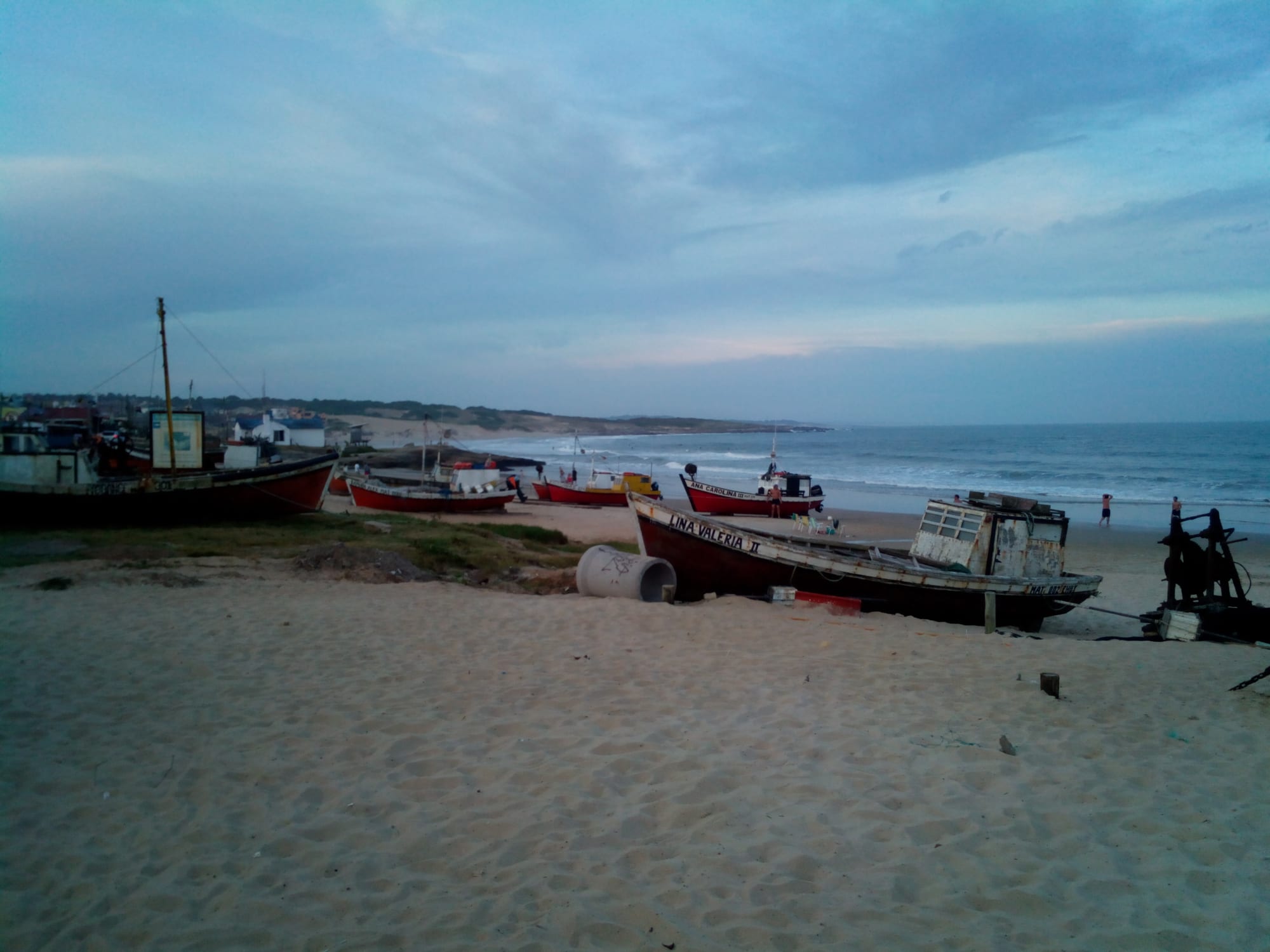
Red and white wooden fishing boats pulled up on a sandy beach at dusk, with low houses and surf beyond

Punta del Este & the East Coast, Uruguay

Punta del Diablo

Fishing boats on the Playa de los Pescadores at Punta del Diablo, Rocha. (Mariana Zorrilla / Wikimedia Commons · CC BY-SA 3.0)

A village on a rocky point of Uruguay's Atlantic coast in Rocha department, about 43 km south of the Brazilian border at Chuy. Founded by shark fishermen from Valizas in the 1940s, it has grown into a surf and beach resort of sandy lanes and low cabins, with Santa Teresa National Park just to the north and a summer population many times its own.

Neighbourhoods

  • The point and the fishermen's beach
    • First-time visitors
    • Best for food
    • Nightlife

    The heart of the village, on a gentle rise above the sea around a square of brightly painted houses, shops, restaurants and bars along sandy lanes. Below it the fishing boats are pulled up on the Playa de los Pescadores, where fish is sold on the beach and an artisans' market sets up.

    Open in Maps
  • La Viuda and the south
    • Beaches
    • Surf

    South of the point, the long Playa de la Viuda draws surfers, and the dunes at its southern end are used for sandboarding. Holiday houses and cabins spread back from the beach towards the main road.

    Open in Maps
  • Rivero and Playa Grande
    • Beaches
    • Surf
    • Close to the national park

    North of the point, Playa de Rivero is lined with open-air bars in high season and is popular with surfers; beyond it the long Playa Grande runs up to the edge of Santa Teresa National Park.

    Open in Maps

Things to do

Beaches

  • Playa de los Pescadoresbeach

    The fishermen's beach below the village, the most family-friendly, where the small fishing boats come in and offer the day's catch.

    Open in Maps
  • Playa de la Viudabeach

    The surf beach south of the point, with dunes at its southern end used for sandboarding.

    Open in Maps
  • Playa de Riverobeach

    A surf beach north of the point, lined with open-air bars in the summer season.

    Open in Maps
  • Playa Grandebeach

    The furthest beach to the north, which separates the village from Santa Teresa National Park.

    Open in Maps

Markets

  • Artisans' marketmarket

    A craft market on the fishermen's beach, with stands selling hot empanadas, carrying on a tradition begun by fishermen's wives who made crafts from shells, stones and wood.

    Open in Maps

Short trips from the village

  • Santa Teresa National Parkpark

    A forested coastal park just north of the village, run by the Uruguayan army, with beaches, a nature reserve, a large camping area and a greenhouse of plants.

    Open in Maps
  • Fortaleza de Santa Teresalandmark

    A hilltop fortress begun by the Portuguese in 1762 on the disputed frontier with Spain, restored in 1928 and now a museum, inside the national park.

    Open in Maps
  • Laguna Negrapark

    A large shallow lagoon behind the national park, known for boating and birdwatching among its swamps.

    Open in Maps
  • Chuyattraction

    The border town about 43 km to the north, divided from the Brazilian town of Chuí by an avenue, where shoppers cross freely between the two countries.

    Open in Maps

Eat and drink

Long-standing places and food districts in Punta del Diablo. Hours, ratings and directions come from your maps app, always current.

Punta del Diablo classics

  • Fish stands on the fishermen's beachmarket

    Fishermen sell fish and seafood directly from stands along the beach, beside simple kitchens serving fried fish, squid and empanadas.

    Open in Maps
  • Restaurants around the village squareneighborhood

    Restaurants, bars and cafés along the sandy lanes near the point, many open only in summer, though a growing number, including some fine-dining places, stay open out of season.

    Open in Maps

Experience Punta del Diablo

History

The point lies on the coast south of the fortress of Santa Teresa, begun by the Portuguese in 1762. In 1935 a family named Rocha moved here because one of their children suffered from asthma and had been advised to live by the sea. From about 1942 fishermen from Valizas began to come for the season, drawn by shark fishing: oil was extracted from the livers and exported. By the mid-20th century the settlement was known as the hill of the fishermen of Punta del Diablo.

In 1949 an inn, the Hostería del Pescador, was built between Route 9 and the point, with a track to the road; beyond it travel continued by cart until an access road to the point was made in 1968. The fishermen's wives began making crafts from shells, starfish, stones, wood and clay, the start of the artisan tradition that still runs alongside the fishing.

Tourism followed. In 2008 Lonely Planet ranked the village among the places to visit, and its popularity grew steadily as the single farming family that had owned the land sold plots to investors, including foreign buyers. Strict building rules have kept out high-rise towers and large resorts, and in 2011 the long-announced plan for a deep-water port on the Rocha coast became an issue for the area.

Culture & Customs

Punta del Diablo's identity rests on two groups: the families who still fish from the beach, and the artisans who began with the fishermen's wives and their shell and wood crafts. The boats on the Playa de los Pescadores and the craft stalls beside them remain the centre of village life, and buying fish directly from the people who caught it is part of a visit.

Surfers, campers and summer renters have added a bohemian layer, and the village is known for its eclectic architecture of wooden cabins and colourful houses on sandy lanes. In summer live music is a staple, with folk singers in restaurants and a club scene that peaks around full moons, and the crowd is regional: mostly Argentinians, Brazilians and Uruguayans.

Winter is a different place. With the visitors gone, the beaches empty and the surf is at its best. Many locals get around by motorbike, quad bike or on horseback.

Daily Life

The 2023 census counted about 2,000 permanent residents, more than double the 823 of 2011, many of them fishermen and artisans. In high season the population swells to around 25,000, mostly Argentine, Brazilian and European holidaymakers renting houses and cabins or staying in hostels and small hotels.

The economy rests on tourism and fishing, and many residents are fishermen or artisans; the artisanal fleet still works from the beach and sells its catch there. Most hotels and hostels open only in the high season, but a growing number of places, including some restaurants, now stay open all year as visitors arrive out of season.

Services are basic. Some buses stop at the turn-off on Route 9, about 5 km away, cash machines may be scarce, and there is a bank in Chuy, about 43 km north. The rhythm is set by the seasons: a few crowded weeks from Christmas to February and in Easter week, then quiet months of surfers and residents.

Food

Fish is the point of Punta del Diablo's kitchen. The day's catch is sold straight from stands on the fishermen's beach, and the simple kitchens and restaurants nearby serve it fried or grilled. Corvina and brótola, a white fish, are the common catches on this coast, and a picada — a mixed plate of fried fish, squid and other seafood to share — is a standard order, along with rabas, rings of battered squid.

The village's own speciality, shared with Cabo Polonio, is buñuelos de algas, fritters made with seaweed, sold from stalls and kitchens. Empanadas, filled pastries, are the everyday snack and are sold hot at the craft market on the beach. Paella appears on some menus, and shrimp from the coastal lagoons are eaten in season.

The rest follows Uruguayan habits: beef and chorizo from the parrilla, or grill; chivitos, the steak sandwich layered with ham, cheese and egg; and dulce de leche in alfajores and desserts. The butiá palm of Rocha gives small orange fruit made into jam, sweets and a liqueur, and mate, the bitter herbal infusion shared from a gourd, is drunk at all hours.

Planning tools

Budget

Punta del Diablo is cheaper than Punta del Este or José Ignacio, with hostels, cabins and campsites as well as small hotels and rented houses. Prices rise steeply from Christmas to February and in Easter week, when the village fills and bus seats can sell out days ahead. Out of season many places close, but those that stay open are much cheaper.

Daily Budget Midrange
USD 130–280 (rented cabin or small hotel, seafood dinners, a hire car)
Daily Budget Shoestring
USD 50–85 (hostel bed or campsite, fish from the beach stands and empanadas, local buses); more in January

Book January stays and bus seats well ahead, and bring cash, as cash machines in the village may be scarce.

Best Time to Visit

The high season runs from December to February and again in Easter week, when the village is busy and has its summer nightlife and live music. The surf is best in autumn and winter, when the beaches are almost deserted and the village is quiet. Whales can sometimes be seen from the shore.

Suggested Number of Days

Two or three days suit a beach and surf stay in the village. Four or five allow time for the national park, the lagoons and the border towns to the north. Out of season, when much is closed, a shorter stay is usual.

First Visit
2–3 days
With Surroundings
4–5 days

Transportation

The village can be crossed on foot in about an hour, and many locals get around on motorbikes, quad bikes or horses. Some long-distance buses enter the village; others stop at the turn-off on Route 9, about 5 km away, where taxis wait for arrivals. A car makes the national park and the lagoons easier to reach; hire cars are found in Montevideo, Rocha and Maldonado.

Horses are not allowed on the beaches in the peak months; rides can be arranged in the national park.

Airport & Station Connections

Punta del Diablo is about 298 km from Montevideo, roughly three and a half hours by bus, and 172 km from Punta del Este. Regular buses link it with Montevideo, Rocha and Chuy, and coastal services run to La Paloma, La Pedrera and Punta del Este. Montevideo's Carrasco International Airport is the nearest international gateway. Chuy, on the Brazilian border, is about 43 km north.

Walkability

The village is compact and walkable on sandy, unpaved lanes, and the beaches are close to the centre. The open coast can be walked for very long distances in either direction, including north along Playa Grande into the national park.

Safety

Uruguay is among the safest countries in Latin America, though property crime and, in some Montevideo neighbourhoods, violent crime have risen with drug-trafficking activity. Violent crime is rare in the village; summer brings some theft from beaches and rented houses. The main hazards are natural — rip currents on the surf beaches, rocks around the point in big seas, and strong summer sun.

Swim where lifeguards are posted, keep valuables out of sight in rentals and on the beach, and carry a torch on the unlit lanes at night. Check current official travel advice before travelling.

Climate

A temperate climate with four seasons, tempered by the Atlantic. Summers are warm and breezy; winters are cool, damp and windy, with storms that bring heavy surf.

Summer
December–February, warm; temperatures average about 21–27°C
Winter
June–August, cool; temperatures average about 10–16°C

Local Customs

Life follows the fishing and the seasons. Spanish is spoken in its Rioplatense form, and Brazilian visitors mean Portuguese is often heard in summer. Mate is shared everywhere, dinner is late, and summer nights run on into the small hours at the bars and clubs. Dress is casual throughout.

Ask before photographing fishermen at work, and keep off the dune vegetation.

Common Payment Methods

The currency is the Uruguayan peso (UYU). Cash machines in the village may be scarce and may not accept every foreign card, and many accommodation owners prefer payment in US dollars, so cash should be brought. Cards are widely accepted in Uruguay, and there is a bank in Chuy.