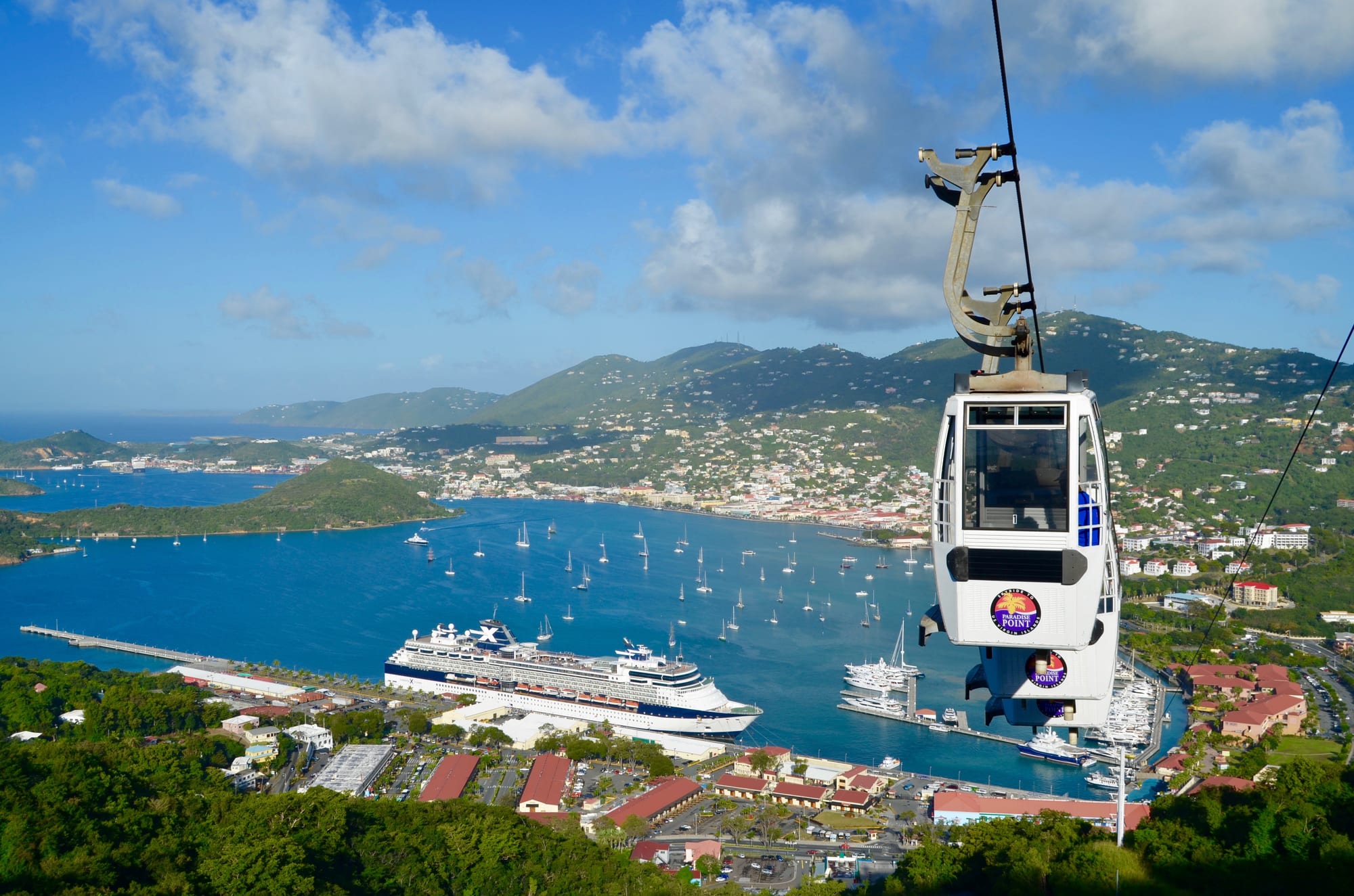
A gondola above Charlotte Amalie's blue harbour, with a cruise ship, moored yachts and the town spread across green hills

United States Virgin Islands

Charlotte Amalie

Charlotte Amalie and its harbour seen from Paradise Point, east of Havensight. (Matt H. Wade / Wikimedia Commons · CC BY-SA 2.0)

The capital and largest town of the US Virgin Islands, on the south shore of St Thomas at the head of a deep harbour. Founded in the 1660s, it grew rich as a free port and slave-trading centre; today its Danish warehouses, step streets and hilltop towers sit above one of the Caribbean's busiest cruise ports and a long strip of duty-free shops.

Neighbourhoods

  • Downtown and the historic quarters
    • First-time visitors
    • Historic district
    • Shopping

    The Danish-era core between the waterfront and Government Hill, divided into the King's, Queen's and Crown Prince's quarters. Fort Christian, Emancipation Garden and the government buildings stand at the east end; to the west, alleys of old stone warehouses between the waterfront and Main Street are now shops, and the step streets climb the hills.

    Open in Maps
  • Frenchtown
    • Best for food
    • Nightlife
    • Local life

    A fishing community just south-west of downtown, settled by families from Saint-Barthélemy in the late 19th and early 20th centuries, with French-named streets and French-Caribbean traditions. Its waterfront restaurants and bars are where many people head for dinner, close to the seaplane base and the ferry terminal.

    Open in Maps
  • Havensight
    • Cruise passengers
    • Shopping
    • Boat trips

    The cruise district on the east side of the harbour, about a mile and a half from downtown, built around the deep-water dock. Havensight Mall, the first shopping centre in the territory, the aerial tramway up to Paradise Point and the departure points for boat, diving and snorkelling trips are all here.

    Open in Maps

Things to do

Famous landmarks

  • Fort Christianlandmark

    The red-walled fort built by the Danes between 1672 and 1680 on the harbour, the seat of defence and government throughout Danish rule, a National Historic Landmark that holds the St Thomas Museum.

    Open in Maps
  • Emancipation Gardenpark

    The park beside the fort that commemorates the freeing of the enslaved on 3 July 1848, with a bronze bust of a freed man blowing a conch shell, a replica of the Liberty Bell and a gazebo used for concerts.

    Open in Maps
  • St. Thomas Synagoguelandmark

    A synagogue built in 1833 for a congregation founded by Sephardic Jews in 1796 — the second-oldest synagogue in the United States — built of rubblestone bound with a mortar of lime, sand and molasses, behind a Greek Revival front.

    Open in Maps
  • Blackbeard's Castlelandmark

    A stone watchtower raised by the Danes in 1679 on the highest point of Government Hill to watch the harbour approaches, a National Historic Landmark; it is no longer open to the public.

    Open in Maps
  • 99 Stepslandmark

    Store Taarne Gade, the best known of the 45 Danish-era step streets that link the waterfront with the hillsides above.

    Open in Maps
  • Saints Peter and Paul Cathedrallandmark

    The historic Catholic cathedral of the town, mother church of the Diocese of Saint Thomas.

    Open in Maps

Markets and views

  • Market Squaremarket

    Officially Rothschild Francis Square, once one of the busiest slave markets in the Caribbean and now a produce market under a cast-iron roof, busiest early on Saturday mornings.

    Open in Maps
  • Skyride to Paradise Pointviewpoint

    An aerial tramway from Havensight up Flag Hill to Paradise Point, which looks down over the harbour, the town and Hassel Island.

    Open in Maps
  • Drake's Seatviewpoint

    A roadside lookout on the north side of the island, with a bench named for Francis Drake, who in local lore watched for ships from the spot.

    Open in Maps

Beaches and short trips

  • Magens Baybeach

    A sheltered white-sand beach nearly three-quarters of a mile long at the head of a deep bay on the north shore, run as a public park with lifeguards and rentals, and one of the island's most popular places for locals and visitors alike.

    Open in Maps
  • Water Islandattraction

    A small residential island in the harbour, about ten minutes by ferry from Crown Bay, with Honeymoon Beach, plantation ruins and a partly built Second World War fort; it stayed Danish until 1944.

    Open in Maps
  • Hassel Islandattraction

    The island that shelters the harbour, a former peninsula cut off by the Danish government in 1860, now largely undeveloped.

    Open in Maps
  • Coral World Ocean Parkattraction

    A marine park beside Coki Beach on the island's East End.

    Open in Maps

Seasonal events

  • St Thomas CarnivalApril, sometimes running into early May

    The island's carnival, with parades, a Carnival Village opened by the governor and the Carnival Queen and open for about a week, and food and craft stalls with steel pan music in Emancipation Garden.

  • Emancipation Day3 July

    The anniversary of the 1848 freeing of the enslaved, marked at Emancipation Garden, where official ceremonies are held.

Eat and drink

Long-standing places and food districts in Charlotte Amalie. Hours, ratings and directions come from your maps app, always current.

Charlotte Amalie classics

  • Market Squaremarket

    The old market square at the west end of Main Street, where local growers sell fruit, vegetables and herbs, above all on Saturday mornings.

    Open in Maps
  • Gladys' Caferestaurant

    A café in Royal Dane Mall, one of the narrow alleys between Main Street and the waterfront.

    Open in Maps
  • Mountain Topcafe

    A stop on the heights of St Thomas known as the birthplace of the banana daiquiri.

    Open in Maps

Food districts

  • Frenchtownneighborhood

    The waterside fishing quarter just west of downtown, where several of the town's better-known restaurants and bars stand.

    Open in Maps

Experience Charlotte Amalie

History

The town began in the 1660s as Taphus — Danish for "tap house" — a harbour settlement known for its beer halls. The Danish West India Company chartered it in 1671, the Danes began building Fort Christian in 1672, and enslaved Africans were brought to work the island's plantations; by 1680 they outnumbered the European settlers. In 1691 the town was renamed after Charlotte Amalie, the wife of King Christian V. Pirates, Blackbeard among them, had long used the sheltered harbour.

When Denmark made St Croix the capital in 1754, Charlotte Amalie turned from plantation agriculture to trade. King Frederick V declared it a free port in 1764, and it became the busiest harbour in the Caribbean and one of its largest slave markets, with importing houses from across Europe and the Americas. Alexander Hamilton wrote that "gold moved through the streets in wheel-barrows", and at one point it was the second city of the Danish realm after Copenhagen. Fires in 1804, 1805 and 1806 destroyed more than two thousand buildings, and most of the colonial buildings standing today date from the 1830s.

Steamships made the port a coaling station, but trade declined after 1848, when abolition brought a deep recession. The Civil War briefly made it a base for blockade runners, and the capital returned here in 1871. The United States bought the islands in 1917 for 25 million dollars; the Navy ruled until 1931, and the town was officially called St Thomas from 1921 to 1936. When American tourists were barred from Cuba in 1960, some began coming here instead, and in the 1980s and 1990s many old buildings were restored. Hurricanes Irma and Maria struck in September 2017, damaging buildings including the synagogue.

Culture & Customs

The town's culture mixes Afro-Caribbean traditions with American habits and a strong Danish inheritance — street names, hillside step streets, and words of Danish origin in everyday Creole speech. Quelbe, also called scratch or fungi music, is the traditional music of the islands, and steel pan bands play at public events.

Carnival is the year's great celebration. Held in April and sometimes running into early May, it brings parades, a Carnival Village opened by the governor and the Carnival Queen, and stalls of food and crafts in Emancipation Garden. Emancipation Day on 3 July recalls the end of slavery in 1848, and the garden that commemorates it is the setting for official ceremonies.

The town's communities reflect centuries of trade. Frenchtown keeps the French-Caribbean traditions, cooking and religious practices of families who came from Saint-Barthélemy. Sephardic Jews settled as merchants in the 18th century, and their congregation still worships in the synagogue of 1833. The town is also the seat of the Catholic Diocese of Saint Thomas and of the Frederick Lutheran congregation, founded in 1666, whose present church was completed in 1793. Charlotte Amalie claims the Caribbean's largest collection of colonial buildings, many of them Danish adaptations of Georgian architecture from the 1830s.

Daily Life

The town itself had 8,194 people at the 2020 census, the most densely populated town in the territory, with more living in the neighbouring districts of Charlotte Amalie West and East that make up "the City". It has no local government of its own and is run directly by the territorial government, whose legislature, courts and Government House are all here.

The economy rests on tourism and shopping. About 1.5 million cruise passengers land each year; up to eleven ships can be in the harbour on a single day, though about five is usual. More than 400 shops line Main Street, many of them selling jewellery, and others cluster at the Havensight and Crown Bay docks. Rum, bay rum, jams and handicrafts are made locally, and the harbour has docks and shipyards. The University of the Virgin Islands has its main St Thomas campus just west of town.

The rhythm of the day follows the ships: the streets fill when passengers come ashore and empty in the evening, when locals head to Frenchtown or home to the hillside houses that have spread above the harbour since the 1960s. Steep terrain leaves little flat land, which limits the town's growth.

Food

Virgin Islands cooking centres on fungi, pronounced "foon-gee" — a stiff cornmeal dish usually served with boiled fish or saltfish. Callaloo, sometimes spelled kallaloo, is a soup of callaloo leaves. For snacks there is paté, a turnover of fried dough filled with beef, chicken, conch or saltfish, and johnnycake, a fried dough originally known as "journey cake".

Seafood and local produce come from the open-air markets, and Market Square at the west end of Main Street still sells fruit, vegetables and herbs, above all early on Saturdays. Danish words survive at the table too: "frikadeller", meatballs, is still in use. Popular cold drinks include maubi, brewed from tree bark, sorrel, soursop, sea moss and passion fruit juice.

Frenchtown's waterfront restaurants are where many people go for an evening meal, and small cafés hide in the downtown alleys. Rum is made on the islands and sold duty free along Main Street, and the banana daiquiri is said to have been born at Mountain Top, high on the island.

Planning tools

Budget

Charlotte Amalie is priced like the United States and higher than most of the mainland for food and rooms. Waterfront and hillside hotels are the main cost; market produce, local cafés and the shared open-air taxis keep costs down. Day trips by ferry to the other islands and boat excursions add noticeably to the bill.

Daily Budget Midrange
USD 220–420 (hotel, sit-down dinners in Frenchtown, taxis, a ferry or boat trip)
Daily Budget Shoestring
USD 90–150 (guesthouse room, local cafés and market food, shared safari taxis)

Duty-free shopping is the main draw for cruise passengers, but Emancipation Garden, the step streets and the market square cost nothing to see.

Best Time to Visit

December to April is the drier, busier season across the islands, with the highest prices around the winter holidays. May to November is hotter and wetter and overlaps the Atlantic hurricane season, which peaks from August to October. Carnival fills the town in April. The town is most crowded on days when several cruise ships are in port.

Suggested Number of Days

The historic centre can be seen in a day or two. Allow three to five days to include the beaches and viewpoints around St Thomas and ferry trips to the other islands. Staying on days without large cruise calls makes the town quieter.

First Visit
1–2 days
With Surroundings
3–5 days

Transportation

Taxis and the shared open-air 'safaris' — benches mounted on the back of pickup trucks — are the usual way around; some follow the VITRAN bus routes at the bus fare, and VITRAN buses also serve the town. On busy cruise days many safari drivers leave their fixed routes to carry passengers from the ships. Traffic drives on the left, although almost all cars are left-hand drive. A hire car is useful for the north-shore beaches and viewpoints.

Confirm with a safari driver that the truck is running a fixed 'dollar ride' route, and its direction, before getting on.

Airport & Station Connections

Cyril E. King Airport, the busiest in the territory, is about two miles west of the town centre, with flights from the US mainland and a short hop of about half an hour from San Juan, Puerto Rico. Cruise ships dock at Havensight and Crown Bay. Ferries from the Edward William Blyden terminal near Frenchtown run to Christiansted on St Croix and to the British Virgin Islands, and ferries from Red Hook at the island's eastern end cross to St John; a seaplane links the harbour with Christiansted.

Walkability

Downtown is compact and walkable, from Fort Christian along Main Street to Market Square, but it is steep: the step streets climb sharply, and the heat makes even short walks tiring at midday. Havensight is about a mile and a half from downtown along the busy waterfront road; beaches and viewpoints elsewhere on the island need a taxi or car.

Safety

The USVI have a higher violent-crime rate than most US states, concentrated in parts of Charlotte Amalie and away from the tourist areas and largely tied to the drug trade; robberies and car break-ins affect visitors occasionally.

Avoid unfamiliar parts of Charlotte Amalie at night and take a taxi after dinner, leave nothing in parked cars, and watch the forecast in hurricane season. Check current official travel advice before travelling.

Climate

Tropical, warm and breezy all year. Average highs run from about 84 to 88°F and lows from about 73 to 77°F. The drier season across the islands is December to April; May to November is wetter and overlaps the hurricane season, which runs from June to November.

Summer
hotter and wetter from May to November, overlapping the hurricane season, with the town's average monthly highs ranging across the year from about 84 to 88°F
Winter
the drier season, from December to April, still warm and breezy, with the town's average monthly lows ranging across the year from about 73 to 77°F

Local Customs

Daily speech is Virgin Islands Creole English, which keeps Danish words such as 'skål' for a toast, and many streets still carry Danish names ending in 'gade'. The town is the seat of government, and official ceremonies are held in Emancipation Garden. Market Square was once a slave market, and the history of slavery and emancipation is treated with seriousness.

Ask before photographing vendors or residents, and dress more fully than beachwear when walking around town or visiting churches and the synagogue.

Common Payment Methods

The currency is the US dollar. Cards are accepted in shops, hotels and most restaurants; small bills are useful for safari taxis, market stalls and food vans. ATMs are found downtown and in the cruise districts. Goods in the shops are sold duty free.